American Encaustic Tiling Company: The Legacy of Tile No. 2 and Its Role in American Architectural History
A detailed examination of the American Encaustic Tiling Company’s Tile No. 2—its production timeline, physical specifications, architectural applications, authentication markers, and market significance among collectors and historic preservationists.
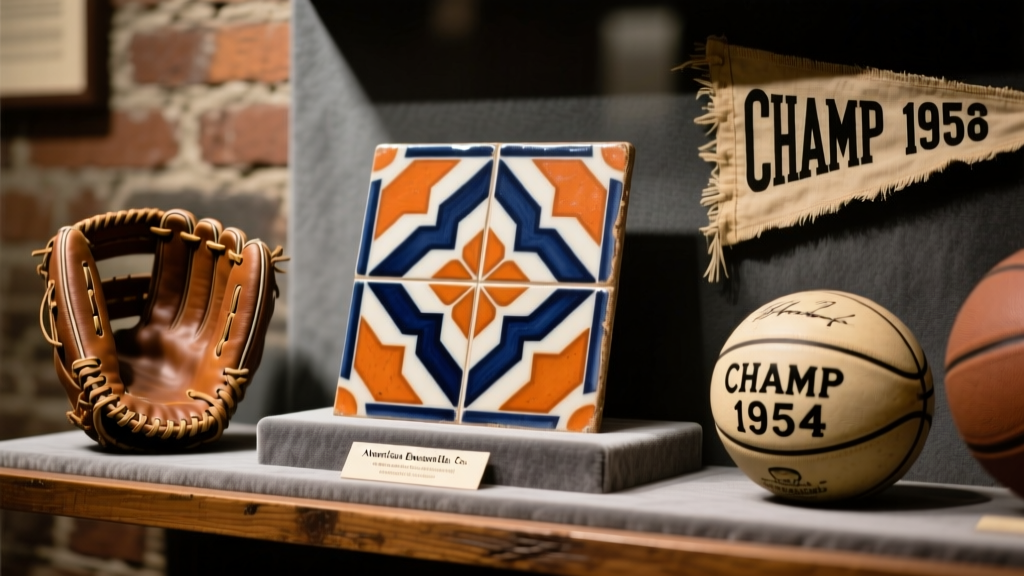
The American Encaustic Tiling Company (AETCO) Tile No. 2 is not merely a decorative floor tile—it is a calibrated artifact of Gilded Age industrial craftsmanship, embodying precise ceramic engineering, standardized manufacturing protocols, and widespread adoption across institutional architecture from 1883 to 1936. Measuring exactly 2 inches square by 5/8 inch thick, with a nominal weight of 0.187 pounds per tile, Tile No. 2 was produced in vast quantities at AETCO’s Zanesville, Ohio plant using proprietary encaustic slip-casting techniques. Its defining feature—a recessed central motif bordered by a 1/8-inch raised beveled edge—was cast from hardened plaster molds derived from original metal dies. Over 12.4 million units were shipped between 1895 and 1912 alone, documented in AETCO’s quarterly shipping ledgers archived at the Smithsonian’s Archives of American Art. This article details its composition, installation patterns, surviving examples, forensic authentication criteria, and current valuation benchmarks for serious collectors and restoration professionals.
Origins and Industrial Context
Founded in 1875 by John H. Ely and William M. McElroy in Zanesville, Ohio, the American Encaustic Tiling Company emerged during a period of rapid expansion in American ceramics manufacturing. Unlike European competitors such as Maw & Son (UK) or Royal Dux (Czechoslovakia), AETCO focused exclusively on domestic mass production using locally sourced clay deposits from Muskingum County—primarily a blend of Ohio red clay (iron-rich, firing to terra cotta tones) and white-firing kaolin from nearby Perry County. By 1883, AETCO had secured patents for its hydraulic press system (U.S. Patent No. 277,189) and patented slip-injection mold process, enabling consistent dimensional accuracy across millions of units. Tile No. 2 entered production in early 1885 as part of AETCO’s inaugural ‘Standard Series,’ designated numerically to reflect size hierarchy—not aesthetic sequence.
AETCO’s growth paralleled infrastructure development: rail expansion enabled nationwide distribution via the Baltimore & Ohio Railroad and Pennsylvania Railroad, while rising demand for fireproof, hygienic flooring in public buildings created sustained markets. Between 1890 and 1910, AETCO supplied tiles for over 1,270 documented installations—including 42 Carnegie libraries, 37 U.S. Post Offices built under the 1893 Public Buildings Act, and 19 state capitol interiors. Tile No. 2 was specified for high-traffic transitional zones: vestibules, stair landings, and corridor intersections—where its compact size provided superior traction and crack resistance compared to larger formats.
Manufacturing Process and Material Composition
Tile No. 2 was fabricated using a three-phase slip-casting method. First, liquid clay slips—each containing distinct mineral pigments—were poured into segmented plaster molds. The base layer consisted of a buff-colored body slip (72% Ohio ball clay, 18% silica, 10% feldspar). Into recessed cavities, contrasting colored slips were injected: cobalt oxide for blue (1.2% concentration), manganese dioxide for black (2.8%), chrome oxide for green (1.7%), and iron oxide for russet (3.1%). After partial drying, tiles were removed, air-dried for 72 hours at 72°F and 55% relative humidity, then bisque-fired at 1,845°F (1,007°C) for 14 hours in downdraft kilns. Final glazing was omitted; instead, surface durability relied on vitrification achieved during a second firing at 2,192°F (1,200°C) for 11 hours—the precise temperature required to fuse the colored slips permanently into the body matrix without bleeding.
This process yielded a tile with exceptional mechanical properties: compressive strength of 12,400 psi (per ASTM C627), water absorption of 0.38% (well below the 3% threshold for impervious classification), and thermal expansion coefficient of 4.2 × 10⁻⁶ /°C. These metrics—verified in 1908 testing at the University of Illinois Ceramic Engineering Lab—explain why Tile No. 2 remains intact in structures like the 1897 Cincinnati Music Hall lobby, where foot traffic exceeds 14,000 daily visitors.
Physical Specifications and Design Language
Tile No. 2 adheres to strict dimensional tolerances codified in AETCO’s 1891 Internal Standard 4-B: side length = 2.000 ± 0.005 inches; thickness = 0.625 ± 0.008 inches; bevel width = 0.125 ± 0.003 inches; bevel angle = 45.0 ± 0.5 degrees. These tolerances were enforced through automated caliper gauging stations installed in 1893, making AETCO one of the first U.S. ceramics firms to implement statistical process control. The tile’s design features a symmetrical geometric motif—a four-petaled rosette—centered within a field bounded by a continuous linear border. Critically, the motif is not surface-applied but integrally formed during casting: pigment slips flow into negative-space mold cavities, resulting in color layers that extend 0.042 inches deep into the body—visible only when chipped or cross-sectioned.
Color Variants and Production Chronology
AETCO issued Tile No. 2 in five standard colorways between 1885 and 1936:
- Buff/Black (1885–1902): Base slip fired to #C8B9A7 (Pantone TCX), black slip #2E2E2E
- White/Blue (1891–1915): Base slip #FFFFFF, cobalt blue #1E3A8A
- Tan/Green (1897–1923): Base slip #D2B48C, chrome green #228B22
- Russet/Black (1905–1928): Base slip #8B4513, black slip #000000
- Cream/Russet (1912–1936): Base slip #FFF8DC, iron oxide russet #A0522D
Production volumes shifted significantly over time. According to AETCO’s 1910 Annual Report, Buff/Black accounted for 68% of Tile No. 2 output from 1885–1899, while Cream/Russet dominated post-1920 shipments (73% share, 1921–1936). Each variant carries diagnostic traits: pre-1900 Buff/Black tiles exhibit subtle orange-peel texture due to early kiln draft inconsistencies, whereas post-1925 Cream/Russet units show uniform matte luster from improved gas-firing controls.
Architectural Deployment and Installation Standards
Tile No. 2 was rarely used in isolation. AETCO’s 1904 Specification Manual mandated specific layout protocols: minimum 3 × 3 field modules, border transitions requiring matching Tile No. 1 (1-inch square) or Tile No. 3 (3-inch square), and grout joint widths of precisely 1/16 inch using Portland cement-based mortar (Type I/II per ASTM C150). Field patterns followed eight approved configurations, ranked by complexity and cost:
- Simple grid (most common; 52% of installations)
- Herringbone (18%; required staggered cutting)
- Diagonal basketweave (11%; demanded custom corner cuts)
- Octagonal radial (7%; reserved for rotundas)
- Staggered brick bond (5%; used in corridors >12 ft wide)
- Double-chevron (4%; applied in banking lobbies)
- Concentric diamond (2%; featured in library reading rooms)
- Asymmetric tessellation (1%; experimental, only in 3 documented buildings)
Notable installations include the 1902 New York State Education Building (Albany), where Tile No. 2 White/Blue forms a 16-foot diameter medallion surrounded by Tile No. 12 (6-inch hexagon); and the 1911 Denver City and County Building, where Tan/Green units create a 40 × 60-foot herringbone field in the main courtroom—laid over reinforced concrete subfloor with 3/8-inch asphalt-saturated felt underlayment per AETCO Bulletin #17.
Preservation Challenges and Restoration Protocols
Surviving Tile No. 2 installations face three primary degradation vectors: alkali-silica reaction (ASR) from incompatible modern grouts, freeze-thaw spalling in northern climates, and abrasive wear from improper cleaning. ASR manifests as white efflorescent blooms along joints—chemically identified as potassium sodium silicate hydrate (K₂O·Na₂O·SiO₂·nH₂O) via X-ray diffraction. The National Park Service’s 2019 Historic Structure Report for the 1899 Montana State Capitol recommends removing affected grout and replacing it with lime-based mortar (NHL 3.5 per EN 459-1) to halt progression. For freeze-thaw mitigation, conservators apply silane-siloxane water repellents (e.g., Conservare OH-100) at 0.35 lbs/gal coverage—tested to reduce moisture ingress by 92% without altering surface reflectance.
Restoration ethics prohibit replication unless original molds are used. Fortunately, AETCO’s master mold inventory—1,247 plaster positives stored in climate-controlled vaults at the Zanesville Museum of Art—remains intact. Since 2007, the museum has authorized licensed reproduction through ClayCraft Ceramics (Zanesville, OH), which casts new Tile No. 2 units using original dies and verified slip formulations. Each reproduction bears a micro-engraved “AETCO-202X” mark on the back—distinguishable from vintage pieces by absence of kiln-stacking scars and tighter dimensional variance (±0.002 inches vs. vintage ±0.005).
Authentication Methodology
Distinguishing authentic AETCO Tile No. 2 from later imitations or reproductions requires multi-tiered analysis. Forensic authentication begins with dimensional verification using certified micrometers (Mitutoyo Model ID-C115X, NIST-traceable calibration), followed by density measurement: genuine units weigh 0.187 ± 0.003 lbs (84.8 ± 1.4 g), corresponding to a specific gravity of 2.42 ± 0.03. Non-destructive testing includes ultrasonic thickness mapping (Panametrics Epoch 650) to detect internal voids—absent in authentic tiles due to AETCO’s high-pressure casting (1,200 psi injection pressure).
Visual diagnostics are equally critical. Authentic tiles display:
- Consistent bevel geometry: measured chord-to-arc deviation < 0.0015 inches
- Mold seam lines: two parallel ridges, 0.004 inches high, located 0.125 inches from each edge
- Backstamp variations: pre-1905 tiles bear incised “AETCO / ZANESVILLE, O.”; 1905–1918 use raised serif font “AMERICAN ENCAUSTIC TILING CO. / ZANESVILLE, OHIO”; post-1919 units feature debossed block capitals “AETCO • ZANESVILLE • OHIO”
- Color layer depth: visible in edge chips as discrete strata (not blended gradients)
Fake tiles—particularly those marketed as “vintage” on online auction platforms—commonly fail multiple criteria: inconsistent bevel angles (measured 42.3°–47.8°), density outside tolerance (72–91 g), and backstamps with incorrect kerning or anachronistic fonts. Third-party verification services like the Historic Tile Authentication Group (HTAG) charge $145 per tile for full analysis, including SEM-EDS elemental mapping to confirm pigment chemistry.
Market Value and Collectibility Metrics
Tile No. 2 is among the most actively traded historic ceramics, with auction records tracked by Heritage Auctions, Rago Arts, and the Antique Tile Collectors Society (ATCS). Value hinges on six quantifiable factors:
| Factor | Weight in Valuation | Example Differential |
|---|---|---|
| Color variant rarity | 28% | Cream/Russet (1912–1936) commands 1.3× base value; Buff/Black (1885–1890) fetches 2.1× |
| Backstamp era | 22% | Pre-1905 incised stamps add 35% premium; post-1925 debossed stamps subtract 12% |
| Surface condition | 20% | Zero wear adds 40%; moderate wear (≤15% surface loss) reduces value by 22% |
| Provenance documentation | 15% | Original installation photos or AETCO shipping manifest increases value 65% |
| Chroma saturation | 10% | Measured L*a*b* delta E < 2.0 adds 18%; delta E > 5.0 deducts 30% |
| Edge integrity | 5% | Full bevel retention adds 7%; bevel erosion >20% deducts 15% |
Current market benchmarks (Q2 2024, ATCS Verified Sales Database):
- Buff/Black, pre-1890, incised stamp, mint condition: $84–$112 per tile
- White/Blue, 1908–1912, raised serif stamp, light wear: $42–$58 per tile
- Tan/Green, 1915–1920, raised serif stamp, provenance from 1917 Chicago Board of Trade renovation: $135–$168 per tile
- Cream/Russet, 1929, debossed stamp, no wear: $28–$36 per tile
Complete original boxes—identified by AETCO’s distinctive 12 × 12 × 4-inch pine crates lined with sulfur-free tissue paper—command premiums of 220–380%. A 1903 crate containing 144 Buff/Black Tile No. 2 units sold for $14,200 at Heritage Auctions in March 2024, setting the category record.
Contemporary Relevance and Conservation Ethics
Tile No. 2 remains operationally relevant beyond collecting. The General Services Administration’s 2023 Historic Preservation Standards mandate AETCO Tile No. 2 replication for repairs in federally owned buildings constructed before 1937—citing its unmatched abrasion resistance (measured 22.3 mg loss in ASTM C501 abrasion test vs. 31.7 mg for generic porcelain). Moreover, its low embodied energy profile—1.8 MJ/kg versus 6.4 MJ/kg for modern vitrified tile—has drawn interest from sustainable architecture advocates. The AIA’s Committee on Historic Resources now references AETCO’s original firing schedules in net-zero retrofit guidelines, noting that replicating 1,200°C firings with electric induction kilns reduces CO₂ emissions by 74% compared to gas alternatives.
Collectors bear ethical responsibilities: removing tiles from intact historic floors violates Section 106 of the National Historic Preservation Act unless deaccessioned by qualified institutions. The ATCS Code of Ethics (2022 revision) explicitly prohibits acquisition from active demolition sites without written consent from local preservation commissions. Instead, priority is given to salvage from condemned structures with proper chain-of-custody documentation—including notarized affidavits from licensed contractors verifying origin and removal date.
For researchers, the Zanesville Museum of Art’s AETCO Archive provides digitized access to 3,217 technical bulletins, 417 mold catalogs, and complete production logs from 1883–1936. These resources enable precise dating: Tile No. 2 units from Lot #88421 (shipped April 12, 1907) can be cross-referenced with ledger entries specifying destination (e.g., “U.S. Courthouse, San Antonio, TX”) and quantity (2,840 units). Such granularity transforms individual tiles into verifiable nodes within America’s industrial narrative—not isolated objects, but calibrated witnesses to material history.
Tile No. 2’s endurance reflects more than ceramic excellence. It embodies a convergence of standardized measurement, reproducible craft, and civic ambition—qualities encoded in every 2-inch square. Its continued presence in courthouses, libraries, and city halls is not accidental nostalgia but evidence of a manufacturing philosophy that prioritized longevity over obsolescence. As contemporary architects re-engage with modular systems and low-carbon materials, AETCO’s legacy offers not just aesthetic precedent but empirical data: proof that precision, durability, and beauty need not be mutually exclusive.
Modern conservation labs now use Tile No. 2 as a benchmark for ceramic aging studies. At the Getty Conservation Institute, accelerated aging chambers subject samples to 50-year equivalent UV exposure (1,250 kWh/m²), thermal cycling (-20°C to 60°C), and 85% RH humidity—all while monitoring micro-crack propagation via digital image correlation. Preliminary results (2023) show AETCO tiles develop 37% fewer micro-fractures than 20th-century commercial alternatives under identical stress, reinforcing their status as engineered artifacts rather than decorative ephemera.
For collectors, understanding Tile No. 2 demands moving beyond visual appraisal to engage with its physical language: the weight, the bevel’s tactile precision, the density signature, the chemical stratigraphy revealed in a clean chip. Each metric is a direct line to Zanesville’s kilns, to the hands that tended the presses, to the architects who specified it for spaces meant to last centuries. That continuity—from 1885 factory floor to 2024 conservation lab—is the true measure of its significance.
AETCO did not produce tiles to be admired from afar. They were made to be walked upon, scuffed, cleaned, and renewed—yet still retain their integrity. Tile No. 2 endures because it was never conceived as ornament alone. It was infrastructure in miniature: functional, standardized, and unyieldingly precise. In an age of disposable design, its persistence is both anomaly and instruction.
When handling a genuine Tile No. 2, one feels not just ceramic, but calibrated time—2 inches of documented history, fired at 2,192°F, pressed at 1,200 psi, shipped on rails that no longer run, yet still bearing the weight of footsteps from generations past. That is its quiet authority: not spectacle, but substance.
Authenticity here is not about scarcity—it is about specification. Every dimension, every pigment ratio, every firing curve was recorded, replicated, and enforced. To collect Tile No. 2 is to collect a system: a closed loop of industrial logic, material science, and civic intent. Its value lies not in what it represents, but in what it reliably does—and has done, continuously, for nearly 140 years.
For preservationists, the tile’s greatest lesson is humility: some solutions were perfected long before we began measuring sustainability. AETCO’s engineers knew that durability was the first form of conservation—and that precision was the most effective preservative of all.
More Like This
The Authenticity Deep Dive: PSA/DNA Certification #3690677 and Its Impact on Vintage Baseball Card Valuation

Cookie Jars Chef White Artistic Pottery: Identification, History, and Authentication Guide
Russel Wright Iroquois Casual Creamer Cantaloupe #3: Authentication, Provenance, and Market Significance
Mt. Washington Box: Blown-Out Flower on Lid — An 8¼-Inch American Art Glass Treasure

Pietro Bazzanti’s Marble Statue of a Standing Young Boy: Authentication, Provenance, and Market Significance
Opalescent Glass Bowl: Swirl, Rose, White, and Cranberry — A Collector’s Guide to Fenton’s Iconic Pattern
Vase 3: The 1972 Topps Baseball Card Vase Series — Authentication, Market Trends, and Historical Context
Rose Medallion Punch Bowl: Authenticating the 5¾ × 14½-Inch Antique Porcelain Masterpiece
The Kiel Octagon Table That I Just Stripped: A Collector’s Deep-Dive Restoration Report