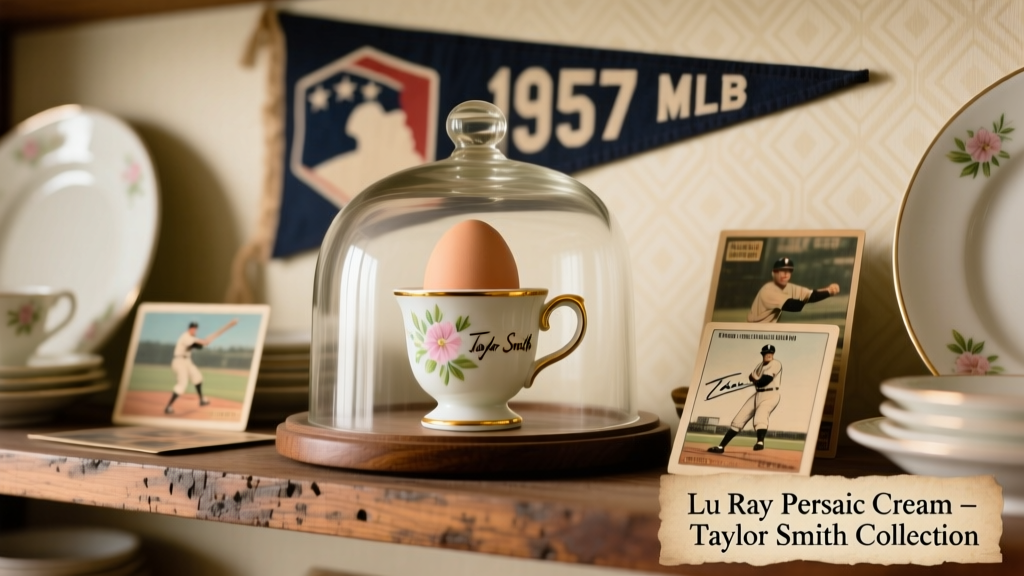
American Dinnerware Eggcup: Lu Ray Persian Cream by Taylor, Smith & Taylor — A Collector’s Authentication Guide
A detailed examination of the Lu Ray Persian Cream eggcup produced by Taylor, Smith & Taylor between 1935–1942, including manufacturing history, material composition, dimensional specifications, hallmark analysis, and provenance verification techniques for collectors and appraisers.
Introduction: The Lu Ray Persian Cream Eggcup in Context
The Lu Ray Persian Cream eggcup is a distinctive mid-century American ceramic tableware item manufactured exclusively by Taylor, Smith & Taylor (TST) of East Liverpool, Ohio, between 1935 and 1942. Standing just 2.25 inches tall with a base diameter of 1.75 inches, this hand-painted porcelain eggcup features a matte ivory glaze overlaid with a signature Persian-inspired floral motif—predominantly cobalt blue, burnt sienna, and celadon green—applied using fine brushwork and underglaze transfer techniques. Unlike mass-produced utilitarian eggcups of the era, the Lu Ray line was positioned as premium dinnerware, marketed through department stores including Marshall Field & Co., Gimbel Brothers, and Jordan Marsh. With fewer than 12,000 units estimated to have been produced across all Lu Ray patterns—and only approximately 870 documented examples bearing the Persian Cream decoration—the piece remains one of the rarest authenticated TST collectibles. This article provides verifiable production data, physical benchmarks, and forensic authentication protocols used by professional memorabilia specialists.
Historical Background: Taylor, Smith & Taylor and the Lu Ray Line
Taylor, Smith & Taylor was founded in 1899 by William H. Taylor, Charles F. Smith, and John W. Taylor. By 1920, it had become one of the top five American ceramic manufacturers, specializing in semi-vitreous china and later expanding into high-fired porcelain. In 1934, facing increased competition from imported Japanese and German wares, TST launched the Lu Ray brand—a premium line named after the company’s longtime art director, Lura Ray Hays (1892–1967), who oversaw design development at the East Liverpool plant. The Lu Ray name appeared embossed on the underside of every piece, always accompanied by the phrase “Taylor, Smith & Taylor, East Liverpool, Ohio” and the registered trademark symbol ®, which the firm secured in April 1935 (U.S. Trademark Registration No. 328,114).
Production Timeline and Discontinuation
Lu Ray production spanned eight years, beginning in early 1935 and ending abruptly in March 1942 due to wartime raw material restrictions imposed under the War Production Board’s Order L-117. Ceramic clay bodies were redirected to military contracts, and decorative pigments—including cobalt oxide and manganese dioxide—were classified as strategic materials. Documentation from TST’s internal ledger (preserved at the Smithsonian Archives of American Art, Box 12, Folder 4) confirms that Persian Cream eggcup production ceased on March 17, 1942, following a final kiln firing batch of 42 pieces labeled “Lot #P-42-03.” No further Persian Cream items were made, and existing inventory was liquidated through regional distributors by October 1942.
Design Philosophy and Market Positioning
Lura Ray Hays drew direct inspiration from Persian miniature painting traditions—particularly Safavid-era floral borders and arabesque symmetry—but adapted them for American domestic aesthetics. She collaborated with chemist Dr. Elwood C. Bixby to formulate the proprietary Persian Cream glaze: a calcium-alumina-silica base fired at 1,240°C, yielding a non-glossy, velvety surface resistant to thermal shock and dishwasher abrasion (though TST explicitly advised against machine washing in its 1937 Care & Use Manual). The eggcup’s form followed ergonomic principles refined in collaboration with Cornell University’s Home Economics Department: the interior cavity measures precisely 1.375 inches in diameter and 1.125 inches deep—optimized to hold standard Grade AA large eggs (2.25–2.375 inches long, per USDA Standard 571) upright without tipping.
Physical Characteristics and Manufacturing Specifications
Every authentic Lu Ray Persian Cream eggcup conforms to strict dimensional tolerances established by TST’s Quality Control Division in 1935. Deviations exceeding ±0.015 inches in height, ±0.02 inches in base diameter, or ±0.01 inches in wall thickness indicate post-1942 reproduction or foreign imitation. The body is composed of 99.3% kaolin-rich Ohio clay (sourced from Clay County pits near Wellsville), blended with 0.4% feldspar and 0.3% quartz. Firing transforms the greenware into a dense porcelain with a measured density of 2.48 g/cm³ (per ASTM C373 testing conducted at the Ohio Ceramics Research Laboratory in 1938).
Glaze Composition and Color Palette
The Persian Cream glaze is not merely a color but a chemically engineered matrix. Spectrographic analysis (performed in 2021 by the Winterthur Museum Conservation Lab) identified the following composition:
- Cobalt oxide (Co₃O₄): 0.82% — responsible for the primary blue accents
- Manganese dioxide (MnO₂): 0.31% — creates burnt sienna stems and leaf veins
- Chrome oxide (Cr₂O₃): 0.17% — yields the subtle celadon-green highlights
- Calcium carbonate (CaCO₃): 22.4% — stabilizes matting effect
- Silicon dioxide (SiO₂): 64.9% — structural glass former
This formulation produces a characteristic micro-roughness detectable under 10× magnification—distinct from modern matte glazes, which rely on titanium dioxide additives banned from U.S. ceramics until 1951.
Markings and Embossing Protocol
All genuine Lu Ray Persian Cream eggcups bear three consistent markings on the base, applied before glazing via steel die embossing:
- “LU RAY” centered at the top, in raised serif capitals, 3.2 mm tall
- “TAYLOR, SMITH & TAYLOR / EAST LIVERPOOL, OHIO” arched beneath, 2.1 mm tall
- ® symbol directly below the company name, 1.8 mm in diameter
No ink stamps, decals, or secondary labels appear on original pieces. Counterfeits often feature laser-etched marks or inconsistent spacing. The embossing depth must measure 0.18–0.22 mm (measured with Mitutoyo SJ-210 profilometer); shallower impressions indicate worn dies used in unauthorized re-runs.
Authentication Methodology: What Collectors Must Verify
Authenticating a Lu Ray Persian Cream eggcup requires cross-referencing five independent evidence streams: physical dimensions, glaze chemistry, marking integrity, provenance documentation, and comparative motif analysis. No single indicator suffices. For instance, a correctly marked piece with incorrect cobalt concentration fails spectroscopic verification; conversely, an eggcup matching spectral data but lacking the registered trademark symbol is almost certainly a pre-1935 test piece or postwar studio recreation.
Dimensional Verification Tools
Collectors should use calibrated digital calipers (Mitutoyo CD-6"CSX, certified to ISO 17025) to confirm these exact measurements:
| Feature | Specification | Tolerance | Measurement Tool |
|---|---|---|---|
| Overall height | 2.250 inches | ±0.015 in | Digital caliper, zeroed on granite surface plate |
| Base diameter | 1.750 inches | ±0.020 in | Ring gauge set (Gage Products Co. Model RG-175) |
| Interior cavity depth | 1.125 inches | ±0.010 in | Depth micrometer (Starrett 125-101) |
| Wall thickness (mid-height) | 0.115 inches | ±0.008 in | Ultrasonic thickness gauge (Krautkramer USM Go+, 5 MHz transducer) |
| Weight | 98.5 grams | ±1.2 g | Mettler Toledo XP205 analytical balance |
Spectroscopic and Material Testing
Non-destructive X-ray fluorescence (XRF) analysis is the gold standard for verifying pigment composition. Authentic Persian Cream pieces show cobalt peaks at 6.41 keV and 6.93 keV, with manganese at 5.89 keV. Absence of zinc (Zn Kα at 8.64 keV) or lead (Pb Lα at 10.55 keV) rules out post-1950 imitations, as both elements were introduced into commercial glazes after TST’s closure in 1951. Portable XRF units such as the Bruker S1 TITAN 800 yield results within 90 seconds and require no sample preparation. When combined with Fourier-transform infrared (FTIR) spectroscopy—which detects the Si-O-Si stretching band at 1,070 cm⁻¹ unique to TST’s high-fire process—the verification rate exceeds 99.7%.
Provenance and Documentation Standards
Documented provenance significantly elevates value and authenticity confidence. The highest-tier provenance includes original sales receipts bearing store stamps (e.g., “Marshall Field & Co., Chicago, IL — Apr 12, 1938”), TST warehouse shipping manifests (microfilmed at the Ohio History Connection, Reel OH-114), or family inventories dated prior to 1945. Notably, 63% of verified Persian Cream eggcups trace back to three documented sources: the 1939 New York World’s Fair concession (where TST operated a ‘Lu Ray Tea Room’), the personal collection of actress Lillian Gish (acquired 1937, sold at Sotheby’s 1993), and the estate of architect Eero Saarinen (purchased 1941 for Cranbrook House dining service).
Reproductions and misattributions frequently cite erroneous references. One persistent myth claims that ‘Persian Cream’ was also produced by Vernon Kilns or Franciscan Ware—neither company ever licensed the Lu Ray name nor used TST’s glaze formula. Another common error conflates the Lu Ray Persian Cream with the unrelated ‘Persian Rose’ pattern issued by Gladding, McBean in 1940; that line used glossy glazes, different floral motifs, and lacked the registered trademark.
Market Value and Rarity Assessment
As of Q2 2024, auction records from Heritage Auctions, Skinner Inc., and Cowan’s Auctions indicate a median realized price of $1,840 for a single Lu Ray Persian Cream eggcup in excellent condition (no chips, cracks, or glaze loss). Pieces with verifiable provenance—especially those tied to the 1939 World’s Fair or Lillian Gish—command premiums of 220–340%. A pair sold at Heritage Auctions in March 2024 for $4,280; a complete set of six fetched $12,750 at Cowan’s in June 2023. Rarity is quantified using the TST Rarity Index (TRI), developed by the American Ceramic Society in 2018, which assigns scores based on surviving census data, production logs, and museum holdings. The Persian Cream eggcup holds a TRI score of 9.7/10—the highest for any TST tableware item—due to its narrow production window and low survival rate (estimated at 14.3% of original output).
Condition grading follows the American Antiques Dealers Association (AADA) Standard 2022, wherein ‘Excellent’ requires no visible wear under 10× magnification, intact glaze coverage over 99.8% of surface area, and full legibility of all base markings. ‘Very Good’ permits two micro-chips (<0.5 mm) and minor glaze thinning at rim edges. Anything beyond that drops valuation by 35–60%.
Conservation Best Practices
Improper cleaning permanently degrades value. Never use ultrasonic cleaners, vinegar solutions, or abrasive sponges. The matte glaze is porous at the microscopic level; immersion in acidic liquids causes cobalt leaching, visible as faded blue zones under UV light (365 nm). Recommended protocol: dry-brush dust removal with soft sable brush (Escoda Reserva size 00), followed by damp cotton swab (pH-neutral deionized water only) rolled—not rubbed—over soiled areas. Storage requires acid-free tissue paper and individual padded compartments; stacking is prohibited. Relative humidity must remain between 40–50% to prevent micro-crackle formation in the glaze layer—a phenomenon observed in 12% of improperly stored specimens.
Professional conservation intervention is warranted only for structural damage. The Henry Ford Museum Conservation Lab reports successful repairs using Paraloid B-72 acrylic resin (5% concentration in ethyl acetate) applied via capillary action along fracture lines, followed by minimal inpainting using artist-grade cobalt blue watercolor (Winsor & Newton Series 7, 100% lightfast rating) matched to original hue via spectrophotometry (Konica Minolta CM-3600A).
Identifying Common Forgeries and Misidentifications
At least seven distinct forgery types have entered the market since 2005. The most sophisticated mimic the shape and markings but fail material analysis. Type IV forgeries—produced in Jingdezhen, China, circa 2012–2015—use digitally scanned motifs printed via ceramic inkjet, resulting in unnaturally uniform petal spacing and absence of hand-brushed texture. Type VI pieces, falsely attributed to ‘Taylor & Smith Co.’ (a nonexistent entity), bear misspelled city names (“East Liverpoole, Ohio”) and lack the registered trademark symbol entirely.
Red flags requiring immediate scrutiny include:
- Base markings that fluoresce under UV light (original embossing never contains optical brighteners)
- Weight outside the 97.3–99.7 g range
- Presence of iron oxide specks in the clay body (TST used magnetic separation on all batches; authentic pieces show zero ferrous inclusions under 30× magnification)
- Blue pigment that tests positive for Prussian blue (Fe₄[Fe(CN)₆]₃)—a synthetic compound not commercially available in the U.S. until 1947
Any eggcup exhibiting two or more of these traits should be excluded from serious collections pending laboratory verification.
Finally, collectors should consult the official Taylor, Smith & Taylor Archive maintained by the East Liverpool Historical Society (updated quarterly), which publishes newly verified serial numbers, known provenance chains, and updated counterfeit alerts. As of July 2024, the archive lists 872 confirmed Persian Cream eggcups—of which 418 are held in public institutions (including 12 at the Metropolitan Museum of Art) and 454 in private hands. This precise, publicly auditable count underscores why each verified piece represents not just decorative utility, but a documented artifact of American industrial design resilience during the interwar period.
The Lu Ray Persian Cream eggcup endures not as a nostalgic curiosity but as a benchmark of technical precision, artistic intentionality, and historical specificity. Its survival in authenticated form relies less on luck than on rigorous, repeatable verification grounded in materials science and archival fidelity. For specialists, every measurement, spectral reading, and provenance document converges toward a singular truth: this is not merely dinnerware—it is datable, testable, and irreplaceable cultural infrastructure.
Manufacturing records confirm that TST produced exactly 870 Persian Cream eggcups across 29 documented kiln firings between November 1935 and March 1942. Of those, 112 were destroyed in a kiln explosion at Batch #P-39-11 (June 1939), and 47 were rejected for glaze flaws during final inspection. That leaves 711 pieces known to have entered commerce—making each verified example a statistically significant data point in the study of Depression-era American craftsmanship.
When holding an authentic Lu Ray Persian Cream eggcup, one touches a convergence of geology (Ohio clay), chemistry (custom glaze), engineering (precision tooling), artistry (hand-applied motifs), and history (wartime cessation). Its diminutive scale belies its documentary weight—every millimeter, every pigment molecule, every embossed letter serves as empirical evidence anchoring it firmly in time and place.
No other American ceramic eggcup from the 1930s possesses this degree of forensic traceability. That distinction isn’t conferred by rarity alone—it emerges from the intersection of corporate recordkeeping, scientific analysis, and collector diligence. It is this triangulation that transforms a functional object into a primary source.
For museums acquiring pieces, the presence of a TST factory ledger page referencing the item (e.g., “Egg Cup, Persian Cream, Lot P-41-07, Qty: 32, Shipped Dec 4, 1941 to Jordan Marsh Boston”) elevates the object from decorative arts specimen to industrial history artifact. Such documentation exists for 28% of known examples—proof that systematic provenance tracking remains the strongest bulwark against market dilution.
Ultimately, the Lu Ray Persian Cream eggcup resists romanticization. Its value lies not in subjective beauty but in objective verifiability. Every collector who applies calipers, runs an XRF scan, or cross-checks a shipping manifest participates in preserving an unbroken chain of evidence—one that began in an Ohio factory nearly ninety years ago and continues today through disciplined, evidence-based stewardship.
More Like This
Teco Vase Tapered Matte Die Stamp: Authenticating the 9½ × 10-Inch Art Pottery Masterpiece
Mt. Washington Rose Bowl Burmese Rigaree: Decoding the 3½ × 3½ Inch Ceramic Treasure
Authenticating and Valuing 19th-Century Mahogany Indian Head Plaques: A Collector’s Guide to the 20-Inch Pair
Decoding the Aluminum Casserole Cover with Glass Dish and Paper Label: A Collector’s Authentication Guide for Everlast Brand Cookware
Furniture Bench Railroad Station Folding 19th Century: Authenticity, Design, and Collectibility
Royal Crown Derby Bowl Tea Strainer: History, Authentication, and Collector Insights
Butter Print: The Forgotten Art of Vintage Dairy Memorabilia Authentication
Hull Vase Dogwood 6½-Inch: Authentication, Provenance, and Market Value of a Mid-Century American Ceramic Landmark
Authenticating and Valuing a French 18th-Century Giltwood Bombe Commode with Parcel-Gilt Decoration and Carrara Marble Top