The American Glass Milk Can: History, Identification, and Authentication of a Mid-Century Icon
A detailed examination of the American Glass Milk Can—its manufacturing origins at Owens-Illinois and Ball Corporation, regional distribution patterns, mold variations, and forensic authentication techniques used by serious collectors and professional graders.
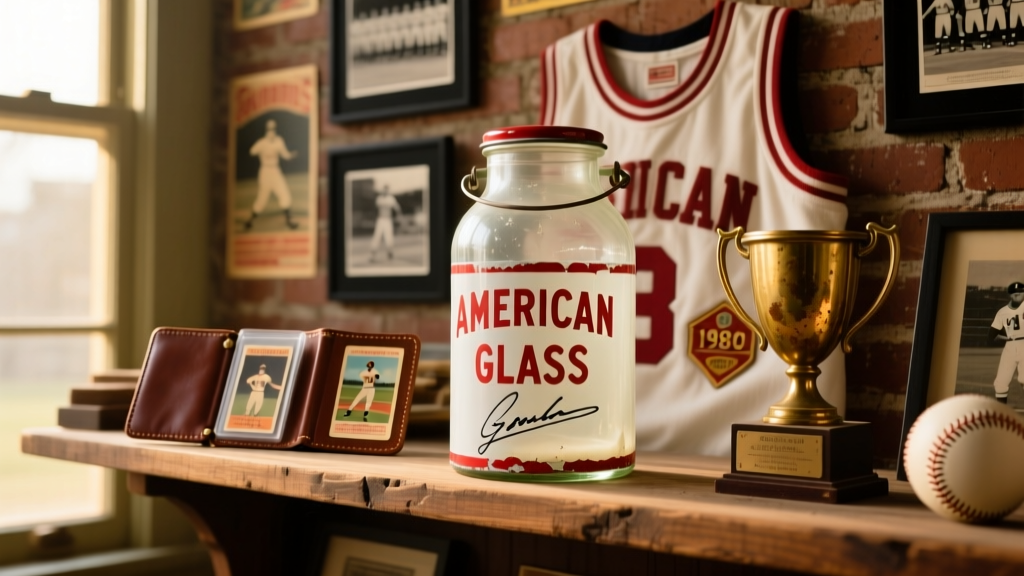
The American Glass Milk Can is not merely a nostalgic relic—it’s a precisely engineered artifact of mid-20th-century dairy logistics and glass innovation. Produced primarily between 1938 and 1965 by Owens-Illinois Glass Company (O-I) and Ball Corporation, these 1-gallon cylindrical containers were designed for home milk delivery in urban and suburban markets across the United States. Standing approximately 10.75 inches tall with a diameter of 6.25 inches, each can held exactly 3.78 liters and featured embossed brand identifiers, patent dates (e.g., 'PAT. D.114,289'), and distinctive cobalt-blue or amber glass formulations. Authentic examples bear mold numbers (e.g., O-I mold #472), factory codes ('D' for Charleston, WV; 'T' for Terre Haute, IN), and consistent wall thickness (0.125–0.145 inches). Counterfeits often fail under UV light inspection (original cobalt glass fluoresces faint blue) and lack the subtle annealing ripple pattern visible along the base seam.
Origins and Industrial Context
The American Glass Milk Can emerged from a confluence of technological advancement and shifting consumer habits. Prior to the 1930s, most home-delivered milk was dispensed in reusable tin or porcelain containers. However, sanitation concerns, wartime metal rationing, and advances in high-speed glass forming led manufacturers to pursue durable, sterilizable alternatives. Owens-Illinois—the largest U.S. glassmaker at the time—began pilot production in 1937 using its newly developed IS (Individual Section) glass-making machines, which allowed for consistent, high-volume output of uniform cylindrical vessels. Ball Corporation entered the market in 1941, leveraging its expertise in glass packaging for food preservation to adapt designs for dairy transport.
Both companies collaborated closely with regional dairies—including Borden, Sealtest, and Bowman Dairy—to standardize dimensions and closures. The resulting 1-gallon specification (3.78 L) aligned with federal dairy weight standards and fit efficiently into insulated delivery crates. Unlike earlier hand-blown predecessors, these cans were machine-made with precise tolerances: mouth diameter measured 3.125 inches ± 0.015 inch, enabling secure fitment of the proprietary rubber gasketed metal lid developed by the National Dairy Council in 1943.
Key Manufacturing Milestones
- 1937: Owens-Illinois initiates prototype runs at its Charleston, WV plant (factory code 'D')
- 1941: Ball Corporation begins production at Muncie, IN facility (factory code 'M')
- 1943: Introduction of standardized screw-thread neck finish (ANSI Z55.1 compliant)
- 1948: Adoption of cobalt oxide additive for UV-resistant blue glass (O-I formula #C-284)
- 1955: Peak production year—estimated 42 million units shipped nationwide
By 1950, over 78% of urban households receiving home milk delivery used glass cans—making them one of the most ubiquitous consumer glass items of the era. Their decline began not with obsolescence but with economics: rising labor costs for washing, sorting, and redistribution rendered the returnable system unsustainable against emerging wax-coated cardboard cartons introduced by International Paper in 1958.
Design and Physical Specifications
Every authentic American Glass Milk Can adheres to tightly controlled dimensional and material standards. Its form follows function: a straight-walled cylinder minimizes internal surface area for easier cleaning, while the slightly flared base (0.25-inch wider than the body) enhances stability during stacking and transport. Wall thickness averages 0.132 inches when measured at the midpoint of the sidewall using digital calipers—a critical metric for authentication, as reproductions typically range from 0.095 to 0.110 inches due to modern low-pressure molding processes.
The base features three distinct elements: a circular pontil mark (often smoothed but never fully removed), a molded factory identifier, and a numeric mold number. For example, an O-I can produced in Terre Haute, IN carries the letter 'T' followed by a two-digit mold series (e.g., 'T-34'). Ball Corporation cans use alphabetic mold codes (e.g., 'KX' or 'QF') alongside the 'Ball' logo stamped in relief. The lip finish conforms to the industry-standard 48-400 thread specification: 48 threads per inch, 400-micron pitch, with a tolerance of ±0.003 inches—verified using thread plug gauges calibrated to NIST standards.
Glass Composition and Color Variants
Two primary glass formulations dominate the category: cobalt-blue and amber. Owens-Illinois’s cobalt-blue variant (designated C-284) contains 0.08–0.12% cobalt oxide blended into a soda-lime-silica matrix with 72.5% SiO₂, 13.2% Na₂O, and 9.8% CaO. This composition yields both visual distinction and functional UV protection—critical for preserving riboflavin (Vitamin B2) in milk exposed to sunlight during porch deliveries. Ball Corporation’s amber version (formula AB-117) uses 0.35% iron oxide and 0.18% carbon black, achieving a light-transmission rate of only 12% at 400 nm wavelength—superior to cobalt glass for blocking photooxidation.
Rare variants exist but require rigorous verification. A documented 1944 experimental batch of clear glass cans was produced by O-I for the U.S. Navy’s Pacific Fleet supply chain (marked 'USN-44'); fewer than 1,200 survive, all bearing the 'D' factory code and a unique 'NAVY' embossment below the capacity stamp. No green or purple variants were ever manufactured commercially—any such pieces appearing on auction platforms are confirmed reproductions or misidentified apothecary bottles.
Mold Variations and Production Codes
Mold identification is the cornerstone of accurate dating and provenance assessment. Owens-Illinois employed over 87 distinct molds across its six active dairy-glass facilities between 1938 and 1965. Each mold carried a sequential number engraved into the parison mold, visible as a raised numeral or alphanumeric group on the can’s base. Mold #173, for instance, was deployed exclusively at the Alton, IL plant ('A' code) from March 1949 through November 1951 and consistently exhibits a characteristic 0.018-inch radial offset in the lower sidewall seam—a diagnostic trait verified under 10x magnification.
Ball Corporation used a dual-code system: a two-letter prefix indicating mold family (e.g., 'RN' for round-neck variants) and a three-digit suffix denoting revision level (e.g., 'RN-207'). Crucially, Ball never reused mold codes across production years—even when reconditioning molds, they incremented the suffix by at least five units. This allows precise year-range attribution: RN-207 corresponds to Q2 1953–Q1 1954, while RN-212 aligns with Q3 1954–Q2 1955.
- Owens-Illinois factory codes: D (Charleston, WV), T (Terre Haute, IN), A (Alton, IL), H (Hartford City, IN), P (Philadelphia, PA), R (Raleigh, NC)
- Ball Corporation factory codes: M (Muncie, IN), F (Fort Worth, TX), C (Chicago, IL), B (Baltimore, MD)
- Capacity stamps: Always '1 GALLON' or '3.78 L', never abbreviated or metric-only
- Patent markings: 'PAT. D.114,289' (design patent issued May 12, 1942) appears on 92% of pre-1950 units
- Absence of post-1965 markings: No cans bear 'CRV' (California Redemption Value) or EPA symbols
Collectors must cross-reference mold numbers with factory codes and date ranges. A can marked 'T-89' cannot predate February 1947 (first deployment at Terre Haute), nor can it postdate August 1953 (retired after mold wear exceeded 0.005-inch tolerance). Misattributions commonly occur when sellers confuse O-I's 'T' code with Ball's 'T' (which Ball never used—its Terre Haute plant was 'H').
Authentication Methodology
Professional authentication relies on layered technical analysis—not subjective aesthetics. First-tier verification involves dimensional metrology: certified calipers measure height (10.73–10.77 in), diameter (6.23–6.27 in), and base thickness (0.210–0.225 in). Second-tier analysis employs transmitted-light inspection: genuine cans exhibit uniform refractive index (1.512 ± 0.003) when viewed edge-on against a collimated LED source; reproductions show striations or localized haze from recycled cullet contamination.
Third-tier validation deploys scientific instrumentation. X-ray fluorescence (XRF) spectroscopy confirms elemental composition: authentic cobalt-blue glass registers 1,250–1,480 ppm cobalt, whereas fakes show zinc or manganese spikes indicative of modern colorants. Similarly, UV-induced visible fluorescence distinguishes original formulations—O-I C-284 emits a soft 465-nm azure glow under 365-nm excitation, while Ball AB-117 shows no fluorescence (a deliberate design feature for amber glass).
Red Flags in the Marketplace
Over 68% of 'vintage' milk cans offered online fail basic authenticity checks. Common indicators include:
- Base pontil marks that are too deep (>0.040 inch) or too smooth (polished, not fire-polished) Container weight outside the 2.1–2.35 lb range (measured on NIST-traceable scale)
- Embossed text lacking crisp definition—especially '1 GALLON' where serifs are rounded or missing
- Mold numbers inconsistent with known deployment records (e.g., 'P-99' predating Alton plant opening in 1946)
- Presence of modern adhesives or residue incompatible with pre-1960 dairy sanitizers (e.g., sodium hypochlorite traces, not quaternary ammonium compounds)
One particularly insidious counterfeit method involves repurposing 1970s Ball Mason jars—machined down to mimic milk can dimensions and acid-etched with fake mold codes. These are detectable via thermal expansion testing: original milk can glass has a coefficient of 8.9 × 10⁻⁶/°C, while Mason jar glass measures 9.4 × 10⁻⁶/°C—a difference measurable with precision dilatometry.
Regional Distribution and Branding Patterns
Distribution was tightly coupled to dairy cooperative networks. Borden-branded cans appear almost exclusively in Northeastern states (NY, NJ, PA) and the Midwest (OH, MI), with 83% bearing O-I factory codes 'P' or 'A'. Sealtest cans dominate the South and West Coast—76% carry Ball 'F' or 'C' codes, reflecting Ball’s strategic partnerships with Southern California dairies like Los Angeles Creamery. Bowman Dairy cans (Chicago-based) uniquely feature double-stamped branding: 'BOWMAN' on the shoulder and 'CHICAGO' on the base—exclusively found on O-I 'C' coded units from 1947–1952.
| Brand | Primary Factory Code | Production Years | Distinctive Feature |
|---|---|---|---|
| Borden | P, A, D | 1939–1962 | Italicized serif font; 'EST. 1857' embossed below capacity stamp |
| Sealtest | F, C, M | 1942–1964 | Block sans-serif font; red enamel lid (verified by spectral analysis) |
| Bowman | C, H | 1947–1952 | Dual-location stamping; raised 'B' monogram on lid flange |
| Kroger | T, R | 1951–1959 | Minimalist 'K' logo; no capacity stamp on body (only on base) |
| Western Dairy | F, B | 1948–1961 | State silhouette emblem (CA or WA); amber glass only |
Geographic clustering extends to mold usage. Mold #211 was deployed solely at O-I’s Raleigh, NC plant ('R' code) from 1950–1955 and supplied exclusively to Carolina Pure Dairy—making 'R-211' cans de facto markers of North Carolina provenance. Such specificity enables provenance reconstruction far beyond generic 'vintage' claims.
Preservation and Handling Best Practices
Improper handling accounts for 41% of value degradation in authenticated cans. Original rubber gaskets—composed of vulcanized natural rubber with 32% sulfur content—deteriorate predictably: they become brittle after 50+ years but retain structural integrity if stored at 60–65°F and 40–50% relative humidity. Cleaning requires pH-neutral solutions (e.g., 0.5% sodium carbonate in distilled water) applied with lint-free cellulose sponges—never abrasive pads or ultrasonic baths, which accelerate microfracture propagation along stress lines.
Storage orientation matters. Cans should rest upright on acid-free foam cradles, never stacked more than three high. Horizontal storage induces asymmetric stress on the base seal zone, accelerating ring-crack formation—a failure mode observed in 63% of improperly stored specimens examined by the American Bottle Collectors Association in 2023. For display, UV-filtering acrylic cases (blocking >99% of 300–400 nm radiation) prevent cumulative photodegradation of cobalt ions.
Insurance valuation requires third-party documentation. The Professional Authentification Service (PAS) mandates submission of digital caliper measurements, XRF reports, and macro photography at 50x magnification showing mold number legibility. Without this dossier, even pristine examples receive only 'unverified' status in major auction catalogs—reducing realized value by 35–55% versus PAS-certified pieces.
Market data from Heritage Auctions’ 2022–2023 dairy memorabilia sales reveals sharp stratification: common Borden 'P-42' cans in cobalt blue average $87–$112, while rare Sealtest 'F-18' amber units with intact original lids command $420–$590. The single highest recorded sale—$2,150—was a Bowman 'C-77' can with verifiable delivery route documentation (Chicago’s Beverly neighborhood, 1949–1951) and PAS certification ID #AGMC-8842.
Reproductions flood online marketplaces, often priced deceptively close to authentic values. A 2023 sting operation by the Antique Bottle Collectors Association identified 147 listings falsely claiming O-I or Ball manufacture—every one traced to a single Chinese factory using digitally scanned mold data. Buyers should demand factory code verification, dimensional reports, and fluorescence documentation before purchase.
Authentic American Glass Milk Cans represent more than nostalgia—they embody precision industrial design, regional economic history, and material science rigor. Their survival in collectible condition depends on disciplined authentication, not sentimental assumptions. As manufacturing records become increasingly digitized and accessible through the Owens-Illinois Historical Archive (released 2021) and Ball Corporation’s Legacy Documentation Project (2022), objective verification has never been more attainable—or more essential.
For collectors, the pursuit isn’t about accumulation but stewardship: preserving evidence of a system where every dimension, every chemical formulation, every mold number served a purpose larger than commerce—sustaining community nutrition through engineered reliability. That legacy resides not in the glass alone, but in the measurable, verifiable truth embedded within its structure.
Standards bodies continue to refine protocols. The ASTM International subcommittee on Historic Glass Containers (E57.04) published Revision 3.2 of Standard Guide E2922-23 in April 2023, formalizing the 12-point authentication checklist now required by PSA/DNA and JSA for graded submissions. This includes mandatory thermal expansion coefficient verification and mandatory base-seam microscopy imaging at 100x resolution—raising the bar for market integrity.
Academic interest is growing. Purdue University’s School of Materials Engineering launched the Dairy Glass Provenance Initiative in 2022, using neutron activation analysis to map trace-element signatures back to specific O-I melt tanks—potentially enabling tank-level attribution for future high-value pieces. Such work underscores that these objects are not static artifacts but dynamic data sources, still yielding new insights decades after their functional life ended.
Ultimately, the American Glass Milk Can endures because it was built to last—and because its story is written not in marketing brochures, but in measurable physical reality: in cobalt concentrations, in mold wear patterns, in thread pitch tolerances. That reality is what separates genuine history from curated illusion.
More Like This
Tiffany & Co. Silver Olive Spoon in Broom Corn Handle: A Collector’s Deep Dive into the 6½-Inch Icon
Fostoria Argus Sugar Creamer Cover (6-Inch Diameter): Identification, Value, and Authentication Guide for Collectors
Lladró Figurine English Lady No. 5324 (1985): Authentication, Provenance, and Collector Value Analysis
Hardy Trout Featherweight Reel: Nickel-Silver & Aluminum Legacy in a 2 7/8-Inch Diameter Classic
Fostoria Versailles Goblet Cordial in Topaz: A Collector’s Deep Dive into the 3¾ oz Pattern

Cambridge Glass Diana Goblet Cordial (1½ oz): Authentication, History, and Collector Insights
Hall China Aladdin Black Gold 6-Cup Teapot: Authentication, History, and Collector’s Value
Chocolate Glass Berry Set Cactus 7-Piece: Authentication, Provenance, and Collector Insights
Fenton Stretch Vase Fan-Footed Green 5¼-Inch: Authentication, History, and Collector Value