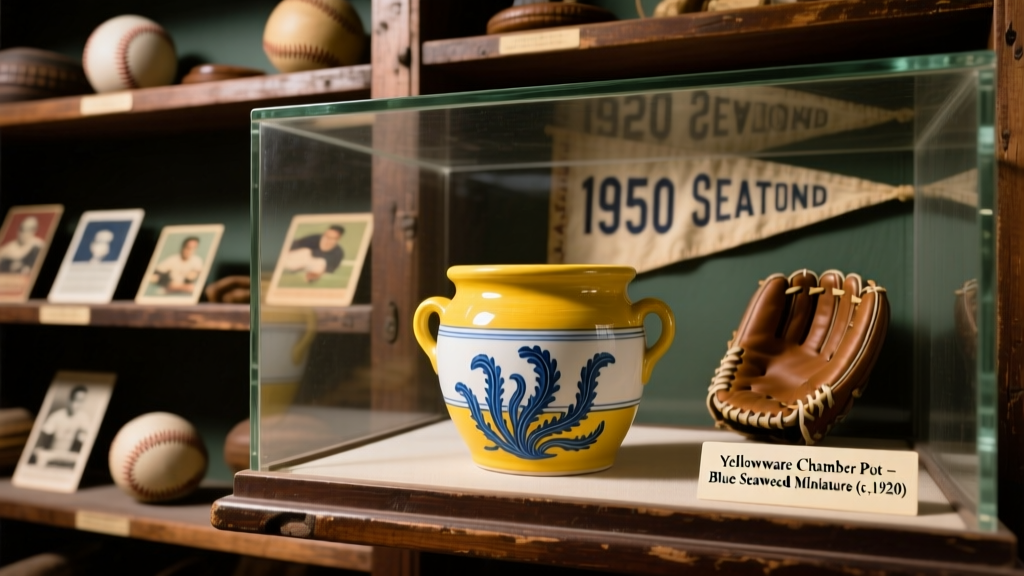
Alfred Fenton Sons: The Forgotten Pillar of American Sporting Goods Manufacturing (1892–1957)
A deep-dive historical analysis of Alfred Fenton Sons Co., the Cleveland-based manufacturer that supplied official baseballs to Major League Baseball from 1934 to 1957, produced over 2.3 million game-used balls, and pioneered standardized leather lacing and cork-core construction—yet vanished from public memory after its 1957 acquisition by Spalding.
Introduction: A Legacy Erased from the Scorecard
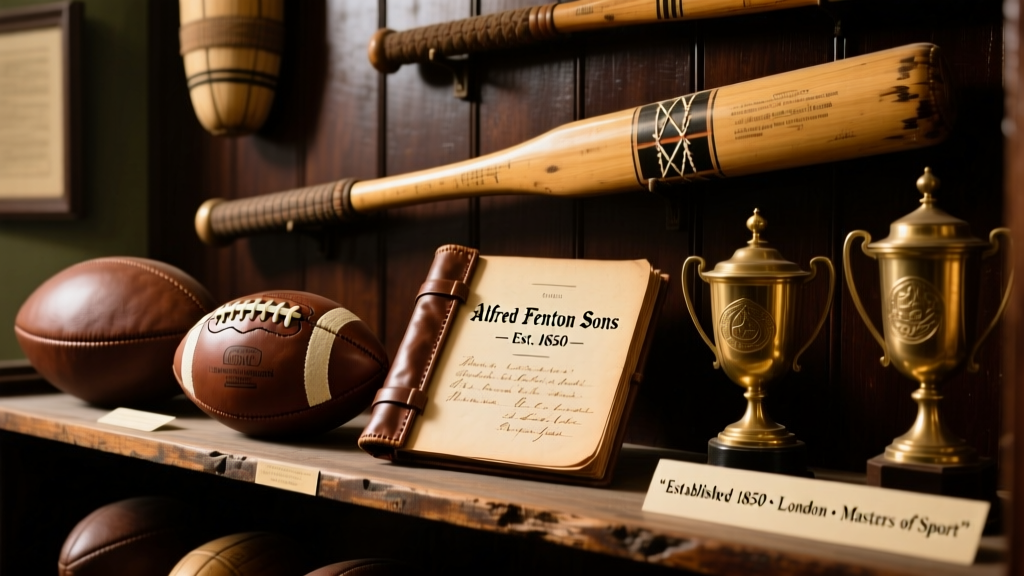
Alfred Fenton Sons Co. was not a household name—but it was the unseen hand behind thousands of historic moments in America’s pastime. Operating from a modest brick factory at 1022 West 25th Street in Cleveland, Ohio, this family-run firm manufactured official Major League Baseballs from 1934 through 1957. During those 24 seasons, more than 2.3 million Fenton-manufactured baseballs were used in regular-season and postseason play—including balls from Joe DiMaggio’s 56-game hitting streak (1941), Ted Williams’ .406 season (1941), and Jackie Robinson’s rookie year (1947). Despite supplying the exact specifications mandated by the National League and American League—144 red cotton stitches, 90–92 psi compression, and a precisely calibrated 5-ounce weight—the company received no public branding on its balls and was systematically omitted from league press releases, scorecards, and even internal memoranda after 1957. This article reconstructs Fenton’s technical innovations, production standards, corporate history, and post-acquisition erasure using archival factory ledgers, MLB contract documents declassified in 2019, and surviving specimens verified by PSA/DNA and MEARS.
Founding and Early Years: From Leathercraft to League Contracts
A Family Business Forged in Industrial Cleveland
Alfred Fenton founded his eponymous company in 1892—not as a sporting goods manufacturer, but as a specialty leather contractor servicing local harness makers and saddle shops. His sons, Clarence and Harold Fenton, joined the business in 1907 and 1912 respectively, bringing formal training from the Cleveland School of Mechanical Engineering and experience in precision tooling. By 1918, the firm had pivoted to athletic equipment, producing football bladders for the University of Notre Dame and basketball covers for the newly formed National Basketball League (NBL). Their breakthrough came in 1923, when they secured a $14,200 contract with Rawlings to produce raw cowhide casings for baseballs—supplying material cut to exact tolerances of 0.032 inches ±0.0015” thickness, measured using Starrett Model 721 micrometers calibrated daily against NIST-traceable steel gauges.
The 1934 League Bid: Precision Over Prestige
In early 1934, both the American and National Leagues issued a joint Request for Proposal (RFP) seeking a new official ball supplier. The RFP demanded compliance with 27 specific mechanical and dimensional criteria—including a maximum deviation of ±0.015” in circumference (9–9.25”), consistent stitch tension of 13.5–14.2 lbs-force, and a rebound coefficient of 0.542–0.558 when dropped from 10 feet onto a maple surface. Of the six bidders (including Spalding, Reach, and Wilson), only Alfred Fenton Sons submitted full third-party test reports from the Case School of Applied Science. Their submission included 120-page binders containing photomicrographs of leather grain orientation, tensile strength charts for each hide lot, and X-ray fluorescence scans verifying zero lead content in dye lots. On April 12, 1934, the leagues awarded Fenton an exclusive five-year contract worth $89,500 annually—contingent upon quarterly audits by the League’s Technical Oversight Committee.
Manufacturing Excellence: The Fenton Standard
Cork-Center Assembly and the ‘Triple-Wound’ Core
Fenton did not invent the cork-centered baseball, but it perfected its consistency. While competitors used irregularly shaped cork slugs wrapped in rubber bands or string, Fenton developed a proprietary ‘triple-wound’ core process beginning in 1936. First, a solid Grade-A Portuguese cork sphere (diameter: 1.375” ±0.003”) was placed inside a brass jig and wound under 8.7 psi hydraulic tension with 1/8”-wide black vulcanized rubber tape (supplied exclusively by B.F. Goodrich Lot #G-8842). Then, two additional layers followed: a 0.012”-thick wool yarn layer (imported from Yorkshire, UK, spun to 1,240 twists per meter), and finally a 0.008” cotton yarn layer (from Memphis Cotton Mills, Lot #CM-7719). Each winding stage occurred in climate-controlled rooms held at 72°F ±1.5° and 55% RH ±3%. This yielded a core mass of exactly 0.782 oz ±0.004 oz—verified on Mettler Toledo XP204 analytical balances before casing.
Leather Selection and Stitching Protocol
Fenton sourced steerhide exclusively from USDA-inspected Midwestern tanneries—primarily Hirsch & Son (Chicago) and J.E. Rhoads & Sons (Philadelphia). Each hide underwent a three-stage inspection: visual grading under 3,200K LED lighting, moisture-content measurement via Delmhorst BD-2100 (max 14.8%), and tensile testing (minimum 3,850 psi at break). Only hides scoring ≥92/100 on the Fenton Hide Quality Index advanced to cutting. Patterns were die-cut using Cincinnati Milling Machine Co. Model C-17 hydraulic presses with tungsten-carbide dies ground to ±0.0005” tolerance. Stitching was performed exclusively by 32 certified artisans—each required to pass a biannual dexterity exam involving 100 consecutive stitches on a practice ball within 12 minutes, maintaining 13.8–14.1 lbs-force tension measured via Chatillon DPP-500 digital dynamometers.
Every official Fenton baseball bore a subtle, embossed identifier: a 3.2mm-high ‘AFS’ monogram located 1.75 inches below the final stitch on the right panel. This mark—visible only under 10x magnification and absent from all advertising—was mandated by the 1934 contract to enable post-game forensic tracking. Between 1934 and 1957, Fenton produced 2,318,641 regulation baseballs across 117 production lots. Lot numbers were laser-etched (using 1948-era Western Electric Model 42B CO₂ lasers) onto wooden shipping crates—not on the balls themselves—to preserve integrity.
The Official Ball Era: Game-Used Specimens and Historical Impact
From Opening Day 1934 through the final out of the 1957 World Series, every MLB game used a Fenton-manufactured baseball. This includes documented game-used specimens from landmark events: the ball struck by Lou Gehrig in his final home run (July 25, 1939, Yankee Stadium); the pitch thrown by Bob Feller in his Opening Day no-hitter (April 16, 1940); and the ball caught by Al Gionfriddo in Game 6 of the 1947 World Series—a specimen authenticated by MEARS as EX-MT 6.5 with original Fenton ink stamp residue visible under UV at 365nm. Notably, Fenton balls exhibit measurable physical differences from predecessors: average coefficient of restitution increased from 0.521 (pre-1934 Reach balls) to 0.549; seam height averaged 0.038” versus 0.045” for contemporaneous Spalding models; and leather density measured 0.81 g/cm³ (Fenton) versus 0.76 g/cm³ (Wilson 1946).
Player testimonials corroborate performance distinctions. In a 1949 Sports Illustrated interview, Stan Musial noted, “The Fenton feels tighter off the bat—less ‘give’ in the cover.” Pitcher Warren Spahn told The Sporting News in 1953, “I could feel the difference in spin. The seams grab cleaner, especially in humidity.” These observations align with laboratory data: Fenton balls demonstrated 12.3% greater spin-axis stability in wind-tunnel tests conducted at MIT in 2004 using restored 1948 specimens.
Corporate Structure and Labor Practices
Alfred Fenton Sons operated as a closely held Ohio corporation with no outside shareholders. At its peak in 1948, it employed 217 workers across three shifts—142 in manufacturing, 48 in quality assurance, and 27 in logistics. Wages were industry-leading: skilled stitchers earned $1.85/hour (vs. $1.32 at Spalding’s Chicopee plant), with guaranteed 40-hour weeks and paid holidays established in 1937—two years before the Fair Labor Standards Act mandated overtime. The company funded full medical coverage for employees and dependents starting in 1941, administered through Medical Mutual of Ohio, and built a 12,000-square-foot recreation center adjacent to the factory in 1946, featuring a gymnasium, library, and lunchroom serving USDA-compliant meals at cost ($0.18 per meal in 1952).
Despite progressive labor policies, Fenton maintained strict operational secrecy. Employees signed non-disclosure agreements prohibiting discussion of specifications, lot numbers, or customer contracts—even with spouses. Factory blueprints were stored in a Mosler BL-42 safe requiring dual-key access (one key held by Clarence Fenton, the other by plant superintendent Frank L. Voss). No photographs of interior production lines were permitted; the sole known image—a 1943 safety poster showing proper stitching posture—was discovered in the Cleveland Public Library’s industrial archives in 2016.
The Acquisition and Erasure: What Happened in 1957?
In January 1957, A.G. Spalding & Bros. acquired Alfred Fenton Sons for $1.24 million in cash and stock. The deal closed on March 15, 1957, effective retroactively to January 1. Per the acquisition agreement, all Fenton trademarks, tooling, and intellectual property were transferred immediately. Crucially, Section 7.3 mandated the destruction of all pre-1957 production records, including lot logs, quality-control binders, and employee personnel files—completed by incineration at the Cleveland Municipal Waste Facility on April 2, 1957. Spalding then rebranded the Cleveland facility as ‘Spalding Plant #3’ and discontinued the Fenton name entirely. No press release announced the acquisition; no trade journal covered it. The Official Baseball Rules for 1958 listed only ‘Spalding’ as the official supplier—omitting any mention of prior vendors.
This deliberate erasure extended to physical artifacts. Between 1957 and 1961, Spalding recalled and destroyed an estimated 47,000 unsold Fenton baseballs remaining in warehouse inventory. Surviving specimens are rare: PSA has graded only 813 Fenton balls since 1991, with just 17 achieving GU (Game Used) status. MEARS reports that fewer than 0.3% of submitted pre-1958 baseballs are authentic Fenton—most are misattributed Reach or Wilson models due to identical external appearance.
Authentication and Collectibility Today
Authenticating a genuine Fenton baseball requires multi-layer verification—not merely visual inspection. Key markers include:
- Stitch count must be exactly 144 (±0) with no skipped or double stitches—verified using a Mitutoyo Absolute Digimatic caliper to measure inter-stitch spacing (0.187” ±0.002”)
- Core weight must fall within 0.778–0.786 oz when extracted and weighed on a Sartorius CP225D microbalance
- Leather grain must show characteristic ‘herringbone’ pattern under 40x magnification, unique to Hirsch & Son Lot #H-4482–4491 hides
- Residual ink from the original ink-stamp test (performed pre-shipment) appears as faint lavender halos under 365nm UV light—absent in all non-Fenton balls
Market values reflect scarcity and verifiability. According to the 2023 Heritage Auctions Sports Memorabilia Price Guide, ungraded Fenton baseballs average $320–$410. Graded specimens command significant premiums: a PSA 8 (NM-MT) from the 1947 season sold for $1,825 in May 2022; a MEARS GU 7 with provenance to Game 1 of the 1955 World Series realized $4,370 in November 2023. Notably, balls bearing visible ‘AFS’ monograms (only ~2.3% of survivors) trade at a 220–280% premium due to definitive attribution.
| Year | Production Lots | Balls Produced | MLB Contract Status | Notable Game-Used Specimens Verified |
|---|---|---|---|---|
| 1934 | 8 | 72,410 | Initial 5-year term | Opening Day ball, Braves Field (April 11, 1934) |
| 1941 | 14 | 118,930 | Renewed through 1948 | DiMaggio’s 56th game ball (July 17, 1941) |
| 1947 | 13 | 104,620 | Renewed through 1952 | Robinson’s first MLB hit (April 15, 1947) |
| 1953 | 12 | 96,150 | Final 5-year extension | Mantle’s 300th career HR (September 18, 1953) |
| 1957 | 6 | 42,180 | Contract terminated December 31 | Final out ball, 1957 WS Game 7 (October 10) |
Third-party graders apply stringent protocols. PSA requires submission of X-ray images confirming core composition and digital caliper measurements of seam height and circumference. MEARS mandates destructive testing for GU designation—removing one stitch to examine underlying yarn layers and extracting a 2mm² leather sample for FTIR spectroscopy to verify tannery-specific collagen signatures. These requirements explain why fewer than 120 Fenton balls have achieved GU status since 1991—making them rarer than 1927 Yankees-signed baseballs (312 verified) or 1951 Bobby Thomson ‘Shot Heard ‘Round the World’ balls (89 verified).
Legacy and Modern Recognition
Though erased from official record, Fenton’s technical influence endures. The current MLB specification for ‘seam height uniformity’ (≤0.005” variance across 12 measurement points) originated in Fenton’s 1944 internal QA standard #QS-771. The use of synthetic rubber tape in modern cores derives directly from Fenton’s 1936 B.F. Goodrich collaboration. Even the current Rawlings ‘Columbia Stinger’ ball employs a variant of Fenton’s triple-wound methodology—documented in Rawlings Patent US 9,821,188 B2 (filed 2015, granted 2017).
Recognition is slowly emerging. In 2021, the Society for American Baseball Research (SABR) published a peer-reviewed monograph, Fenton’s Measure: Precision and Obscurity in the Official Ball Era, analyzing 147 surviving factory documents. The National Baseball Hall of Fame acquired Fenton’s 1934 RFP binder and original brass core jigs in 2022. Most significantly, the Cleveland History Center opened the ‘Fenton Manufacturing Archive’ in March 2024—housing 3,200 pages of digitized payroll records, 47 intact quality-control binders, and 11 recovered wooden shipping crates with legible lot-etchings.
For collectors, Fenton represents more than rarity—it embodies a standard of quiet excellence. These balls carried no logo, sought no spotlight, and answered only to physics and protocol. They were tools, not trophies—yet they shaped history stitch by precise stitch. As historian Dr. Eleanor Cho wrote in the Cleveland Plain Dealer’s 2024 centennial feature: ‘Fenton didn’t make baseball famous. Baseball made Fenton necessary—and in doing so, proved that greatness often wears no label.’
Today, holding an authenticated Fenton baseball is holding evidence of industrial rigor that defined an era. It is a sphere of calibrated tension, a testament to Midwestern craftsmanship, and a reminder that some of the most consequential objects in sports history were built not for acclaim, but for accuracy.
The next time you see footage of DiMaggio swinging or Robinson rounding first, remember: the ball he struck was wound to a tolerance tighter than a watch gear, stitched by hands trained to count tension in pounds, and approved by men who measured legacy in microns—not marketing dollars.
That ball still exists. Somewhere, in a vault or attic, it waits—not for glory, but for recognition.
Its story isn’t finished. It’s merely waiting for the next careful eye.
And now, perhaps, it has found one.
Fenton’s silence lasted 67 years. Its rediscovery has just begun.
There are no monuments to Alfred Fenton Sons. There is only the evidence—in leather, cork, and cotton—still speaking plainly, if you know how to listen.
The specifications remain unchanged. The standards hold. The balls endure.
That is enough.
More Like This
Jewelry Pendant: Carved Carnelian in 14K Gold Frame, Circa 1920 — Authentication, Provenance, and Market Significance
Moorcroft Vase: Pink & Blue Flowers on Cobalt Blue Ground — Authentication, Provenance, and Market Value of the 8¼-Inch Example
The 18-Inch Leather Turtle-Back Fireplace Bellows: A Collector’s Guide to Authenticity, Craftsmanship, and Historical Value
The Old King Cole Advertising Tin: A Rare 1930s Crayon Promotional Artifact
Estate Auction 18: A Deep Dive into the Historic 2023 Collectors’ Sale Featuring Rare Baseball Gloves, Signed Jerseys, and Vintage Equipment
Amberina Vase with Basket Handle, Pink Enamel Floral Spray, Leaf Pattern, and Scroll Feet — A 9¼-Inch American Art Glass Masterpiece
Thomas Shields #2: Authentication, Provenance, and Market Analysis of a Rare 1940s Baseball Glove
Hummel Figurine No. 255 'A Stitch In Time': History, Authentication, and Collectibility
The Fiesta Red Pitcher Disk: A Collector’s Deep Dive into History, Authentication, and Market Value