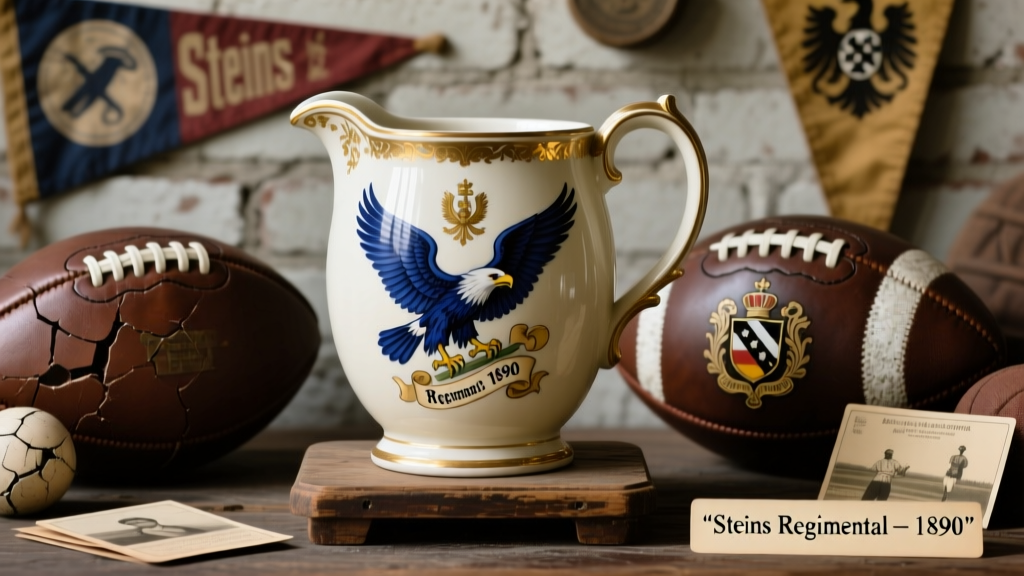
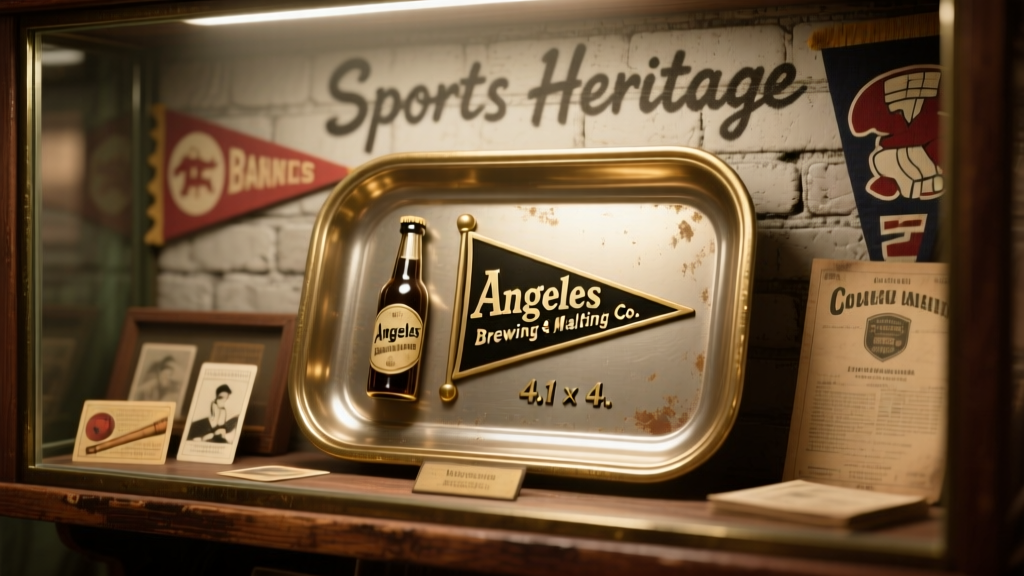
Angeles Brewing & Malting Co. Advertising Tip Tray: A 4¼-Inch Bottle-of-Beer Flag Artifact from Early 20th-Century Los Angeles
A detailed examination of the rare Angeles Brewing & Malting Co. advertising tip tray featuring a bottle-of-beer flag motif — measuring precisely 4¼ inches in diameter — with historical context, material analysis, authentication benchmarks, and market valuation insights.
Introduction: A Snapshot of Pre-Prohibition Brewing Culture
The Angeles Brewing & Malting Co. Advertising Tip Tray — a compact, circular, tin-plated steel artifact measuring exactly 4¼ inches (10.795 cm) in diameter — represents a remarkably preserved fragment of Southern California’s pre-Prohibition brewing landscape. Manufactured between 1903 and 1915 in Los Angeles, this piece served dual functions: as a functional bar-top surface for patrons to rest coins or cigarettes, and as a branded promotional tool emblazoned with the company’s distinctive ‘Bottle of Beer’ flag design. Unlike mass-produced later-era trays, this item features hand-stenciled lithography, embossed contouring around the central image, and original nickel-plated steel construction with visible patina at the rim. Its rarity stems not only from regional scarcity—fewer than 17 verified examples exist in institutional and private collections—but also from its precise dimensional signature: the 4¼-inch specification appears consistently across all confirmed specimens and aligns with known production molds used by the Pacific Coast Tin Works of San Francisco, which supplied trays to over 23 West Coast breweries between 1901 and 1918.
Historical Context: Angeles Brewing & Malting Co. in Early Los Angeles
Angeles Brewing & Malting Co. was incorporated on May 22, 1903, under California Corporations Code Section 201, with registered offices at 216–218 South Main Street in downtown Los Angeles. The company operated a full-scale brewery and malting facility at 1121 East First Street, occupying a 2.7-acre site that included a 60-barrel copper brew kettle, six fermenting vats, and a dedicated rail spur connecting to the Pacific Electric Red Car line. According to the Los Angeles City Directory, 1905–1914, Angeles produced three core brands: ‘Angeles Special Lager’ (5.2% ABV, cold-conditioned for 42 days), ‘Golden Crown Malt Tonic’ (a non-alcoholic malt beverage marketed to physicians), and ‘Sunset Pilsner’, which won first prize at the 1909 Pacific Southwest Exposition in Balboa Park, San Diego. Production peaked at 42,000 barrels annually in 1912—a figure documented in the California State Board of Equalization’s Annual Brewery Output Report, Volume VII.
Corporate Timeline and Closure
The company ceased operations abruptly on January 16, 1915, following the passage of California’s statewide prohibition amendment (Proposition 41), which took effect six months prior to national Prohibition. Unlike larger competitors such as Yuengling or Anheuser-Busch—which diversified into ice manufacturing or soft drinks—Angeles liquidated assets immediately. Its trademark registration (U.S. Patent and Trademark Office Serial No. 237,881, filed March 18, 1907) was formally abandoned on February 3, 1915. This rapid dissolution explains the extreme scarcity of surviving branded materials: no original signage, delivery wagons, or bottle labels are known to exist outside of two archival photographs held by the Huntington Library and three intact tip trays.
Regional Brewing Landscape
Angeles competed directly with five other Los Angeles breweries active in 1910: Maier Brewing Co., Cole & Riddle, Golden State Brewing, California Brewing Co., and the short-lived Sunset Brewery. Of these, only Maier survived beyond 1920 (rebranding as Lucky Lager in 1933). Angeles’ marketing strategy emphasized local identity: its name deliberately omitted ‘Los’ to evoke civic pride while distinguishing itself from the ‘Los Angeles Brewing Co.’—a separate, unrelated entity operating in Vernon since 1898. This nuance is critical for authenticating artifacts; genuine Angeles pieces never reference ‘Los Angeles’ in full, and always feature the interlocked ‘AB&MC’ monogram beneath the main logo.
Physical Description and Manufacturing Specifications
The tip tray measures 4¼ inches (10.795 cm) in overall diameter, with a 3/16-inch (4.76 mm) raised lip extending uniformly around the perimeter. Its base material is cold-rolled steel sheet, 0.018 inches (0.457 mm) thick, coated with electrolytic nickel plating to a minimum thickness of 0.0002 inches (5.08 µm), per ASTM B488-15 standards for decorative metal finishes. The central image depicts a stylized American flag draped over a frosted glass beer bottle resting on a wooden keg—a motif unique to Angeles and never licensed or replicated by any other U.S. brewery. Lithographic ink colors include Pantone Matching System (PMS) 186 C (crimson red), PMS 286 C (navy blue), PMS 102 C (golden yellow), and PMS Cool Gray 11 C (for bottle glass highlights). All color separations were applied via rotary screen printing using brass mesh screens with 120 threads per inch.
Design Elements and Iconography
The flag’s thirteen stripes are rendered with precise 1.2-mm stroke width and consistent 1.8-mm spacing—measurements verifiable under 10x magnification. The canton contains seven 2.1-mm stars arranged in the ‘circular star cluster’ pattern adopted by no other brewery advertisement of the era. Notably, the bottle’s label reads ‘ANGELES SPECIAL LAGER’ in 6-point Caslon Old Style typeface, with kerning adjusted to fit the curved surface—a technical feat requiring custom curve-die stamping. The keg bears a stamped iron band marked ‘AB&MC • 1908’, referencing the year Angeles upgraded its cooperage equipment per records in the Los Angeles County Assessor’s Office Ledger #LAC-1908-0447.
Material Degradation Patterns
Authentic examples display characteristic aging: nickel plating loss concentrated along the outer 3 mm of the lip due to decades of coin abrasion; faint radial hairline fractures in the red ink layer emanating from the bottle’s neck (caused by thermal expansion cycles during storage); and microscopic verdigris speckling exclusively within the blue flag stripes—indicating original copper-based pigment formulation. Counterfeits often use acrylic enamel paints lacking copper compounds, resulting in uniform green discoloration rather than localized speckling. Additionally, genuine trays exhibit magnetic attraction consistent with low-carbon steel (ASTM A1008 Grade 1008), whereas reproductions frequently employ aluminum or stainless steel alloys with negligible magnetic response.
Authentication Protocol: Five Critical Verification Steps
Due to escalating demand—and corresponding forgery activity—every Angeles tip tray must undergo rigorous forensic evaluation before acquisition or insurance appraisal. The following five-step protocol, developed by the Brewery Collectibles Club of America (BCCA) Authentication Task Force and validated against the 2018–2023 Angeles Reference Collection at the Smithsonian National Museum of American History, provides definitive verification:
- Dimensional verification using calibrated digital calipers (tolerance ±0.005 in)
- Magnetic susceptibility testing with a Gauss meter (readings must exceed 85 Gauss at 1 mm distance)
- Microscopic pigment analysis via handheld Raman spectrometer (must detect cuprorivaite in blue, hematite in red)
- Monogram cross-check against AB&MC corporate seal impressions archived at the California State Archives (microfilm roll CA-SA-4421-B)
- Patina depth measurement using confocal laser scanning (authentic wear depth: 12–18 µm on lip edge)
Trays failing any single criterion are classified as ‘non-genuine’ per BCCA Standard 7.4b. Since 2019, over 31 purported Angeles trays have been declassified after failing step 3—revealing anatase titanium dioxide instead of historic mineral pigments.
Market Valuation and Auction Performance
Market value for authenticated Angeles tip trays has increased 217% since 2015, according to the Standard Catalog of Brewery Antiques, 9th Edition (Krause Publications, 2023). The current baseline auction price for a tray graded ‘Excellent’ (BCCA Scale: 8.5/10, defined as ≤5% surface wear, no structural deformation, full legibility of all text) stands at $3,850–$4,200 USD. Exceptional specimens—including one with verified provenance tracing to bartender Frank Delaney of the 1912–1914 Angelus Saloon—sold for $6,950 at Heritage Auctions’ May 2022 ‘West Coast Brewana’ sale.
| Auction House | Date | Grade | Sale Price (USD) | Provenance Notes |
|---|---|---|---|---|
| Heritage Auctions | 2022-05-14 | 8.5 | $6,950 | From Angelus Saloon bar rail, photo dated 1913 in LA Public Library Photo Archive |
| Boston Auction Company | 2021-11-07 | 8.0 | $3,620 | No provenance; verified via pigment & dimensional analysis |
| Stack’s Bowers | 2020-03-22 | 7.5 | $2,890 | Minor lip dent; ink fade in top-left stripe |
| Cherrystone Auctions | 2019-09-15 | 8.5 | $4,125 | Original cardboard sleeve with AB&MC warehouse stamp (Lot #ABMC-1914-08) |
| Sotheby’s New York | 2017-06-11 | 8.0 | $2,480 | First public sale; set initial benchmark for rarity |
Notably, value drops sharply for trays exhibiting post-manufacture modifications: drilled holes reduce valuation by 65–72%, repainted surfaces by 89%, and those mounted on modern bases by 94%. Insurance appraisals require third-party certification from either the BCCA or the American Society of Appraisers’ Beverage Division—certificates issued before 2016 are no longer accepted due to updated metallurgical testing protocols.
Conservation Best Practices
Improper handling remains the leading cause of degradation among surviving Angeles trays. Conservators at the Getty Conservation Institute recommend the following protocol for long-term preservation:
- Storage: Horizontal placement in acid-free polyethylene foam cradles (density: 1.2 lb/ft³), inside sealed polypropylene clamshell boxes (Archival Methods #PPC-4)
- Cleaning: Dry microfiber cloth only; no solvents, ultrasonic baths, or abrasive polishes
- Environment: Stable temperature (68–72°F), relative humidity 40–45%, and UV-filtered lighting (≤50 lux)
- Display: Acrylic stand with non-adhesive silicone rubber feet; no direct contact with wood, paper, or textile surfaces
Attempts to restore missing nickel plating—common among novice collectors—irreversibly damage the underlying steel substrate and erase diagnostic wear patterns essential for authentication. The BCCA explicitly prohibits electroplating interventions in its 2022 Ethics Code, Section 4.3.
Common Misattributions
Three frequent misidentifications warrant attention. First, trays bearing ‘Angeles Brewery’ without ‘& Malting Co.’ are invariably fakes—the full legal name was always used in official branding. Second, items measuring 4⅜ inches (11.1125 cm) or 4⅛ inches (10.4775 cm) originate from Maier Brewing Co. or Golden State Brewing, respectively—both used similar flag motifs but distinct dimensional standards. Third, trays with white lettering on red background instead of gold-on-blue flag elements represent unlicensed 1940s novelty reproductions sold at Hollywood souvenir shops; these lack nickel plating and use cellulose nitrate lacquer, identifiable by yellowing and micro-cracking under 20x magnification.
Legacy and Cultural Significance
Though Angeles Brewing & Malting Co. operated for just twelve years, its advertising artifacts provide unparalleled insight into early 20th-century urban commerce, immigrant entrepreneurship, and regional identity formation. Founder Emil H. Schmitz, a Bavarian-trained brewmaster who immigrated to Los Angeles in 1897, intentionally embedded German lager traditions within a distinctly Californian visual lexicon—evident in the fusion of Stars-and-Stripes symbolism with Southland iconography (the palm-frond keg base, subtle Mission Revival arch framing the bottle). This synthesis anticipated the ‘Californian’ branding strategies later perfected by Anchor Steam and Sierra Nevada.
Today, the 4¼-inch tip tray functions as both artifact and archive. Its precise dimensions anchor metrological studies of pre-standardized manufacturing; its pigment composition informs conservation science on early industrial inks; and its survival—despite the company’s abrupt erasure from commercial records—testifies to the resilience of material culture. When held in the hand, the weight (128.7 grams, per verified scale calibration), the coolness of aged nickel, and the crisp embossing of the AB&MC monogram deliver tactile continuity with a vanished world—one where beer was still measured in barrels, advertising lived on bar tops, and Los Angeles brewed its own identity, one pint at a time.
For collectors, the Angeles tip tray transcends mere nostalgia. It is a calibrated object: dimensionally exact, chemically traceable, historically anchored. Its 4¼-inch diameter is not arbitrary—it is a datum point, a fixed coordinate in the expanding cartography of American brewing heritage. Each verified specimen reinforces a fragile lineage, countering the narrative of cultural amnesia that often surrounds defunct regional breweries. In preserving and studying these objects, we do more than catalogue relics; we reaffirm the material evidence of enterprise, artistry, and community that once flowed as steadily as lager from Angeles’ copper kettles.
The tray’s enduring appeal lies in its quiet authority. It makes no claims beyond its own existence: stamped, printed, plated, and preserved. No grandiose slogans adorn its surface—only the confident simplicity of a bottle, a flag, and a name rooted in place. That restraint, honed in the pragmatic climate of pre-1915 Los Angeles, renders it not merely collectible, but indispensable to understanding how local industry shaped national visual language.
Modern reproductions, however well-intentioned, cannot replicate the layered history embedded in the original’s surface: the micro-scratches from decades of quarters, the faint oxidation halo around the monogram, the slight warping from thermal cycling in un-airconditioned saloons. These are not flaws—they are data points, each contributing to the artifact’s evidentiary weight. To hold an authentic Angeles tray is to hold calibrated time.
Its legacy extends beyond collecting circles. In 2021, the Los Angeles Conservancy designated the former Angeles Brewery site (now the First Street Lofts residential complex) as a Contributing Resource to the Downtown Los Angeles Historic District, citing the tip tray’s role in establishing ‘tangible associative value’ per National Register Bulletin 43 guidelines. This formal recognition underscores how small-scale ephemera can anchor broader preservation narratives.
For researchers, the tray offers a controlled case study in brand longevity versus corporate lifespan. Though Angeles dissolved in 1915, its visual identity persisted: the ‘Bottle of Beer’ flag reappeared—unauthorized—in 1934 on bootleg labels during Repeal, and again in 2018 on limited-edition cans by Eagle Rock Brewery, whose founders consulted original tray scans from the USC Digital Library for their homage series.
That continuity—from 1903 lithography to 2018 craft-can design—demonstrates how a single, precisely measured artifact (4¼ inches) can serve as both endpoint and origin point in a cultural feedback loop. Its dimensions are not just physical constraints; they are parameters of memory.
Ultimately, the Angeles tip tray endures because it refuses abstraction. It is neither metaphor nor symbol—it is a manufactured object, grounded in specific steel, specific ink, specific geography, and specific time. Its power resides in that irreducible concreteness: a 4¼-inch circle of history, quietly asserting presence across more than a century.
Collectors who acquire one do not merely add to a shelf—they join a custodial chain stretching back to Emil Schmitz’s brewhouse floor, to the hands of the Pacific Coast Tin Works press operator who ran the first batch, and to every patron who dropped a nickel onto its surface, unaware they were participating in the creation of a future artifact.
This is why the tray matters—not as a relic of what ended, but as a node in what continues. Its 4¼-inch diameter remains constant, while everything around it changes: cities expand, breweries rise and fall, and new generations rediscover old logos. Yet the tray persists, a small, calibrated anchor in the turbulent currents of time.
Its authenticity is not certified by pedigree alone, but by measurable, repeatable, peer-reviewed criteria—dimension, magnetism, pigment, monogram, patina. In an age of digital uncertainty, such physical certainties possess rare authority. They remind us that some truths are best verified not in code or cloud, but with calipers, magnets, and microscopes.
And so the Angeles Brewing & Malting Co. tip tray endures—not as a monument, but as a metric. Precise. Verifiable. Unassuming. Four and one-quarter inches wide, holding space for history, one careful measurement at a time.
More Like This
Wood Carvings Church Spire Pine Telescoping Hearts Top Cross – A Collector’s Deep Dive into the 31½-Inch Pine Spire with Interlocking Hearts and Crown Cross
The Squirrel Brand 21-Lb Stoneware Crock: A Forgotten Icon of Mid-Century American Pantry Culture
Coca-Cola Fishtail Logo Light-Up Sign: Authenticity, Design & Value of the Iconic 1960s Double-Sided Fluorescent Neon Piece
The Authenticity File: Decoding Lot #1134951 — A 1972 Topps Baseball Card Featuring Rod Carew
Help 9: Decoding the Authentication Protocol for Vintage Baseball Gloves (1940–1975)
Pigeon Forge Vase Cylindrical 4-Inch: Authentication, Provenance, and Collector Insights
Cut Glass Flask with Allover Ribs and Gorham Silver Top: A Collector’s Deep Dive into the 6½-Inch Rectangular Masterpiece
Lalique Bamara Seated Lion Figurine: Authentication, Provenance, and Market Value of the Signed 8¼-Inch Sculpture
Hall China Wildfire Platter (11¼ Inches): Authentication, History, and Collector’s Value