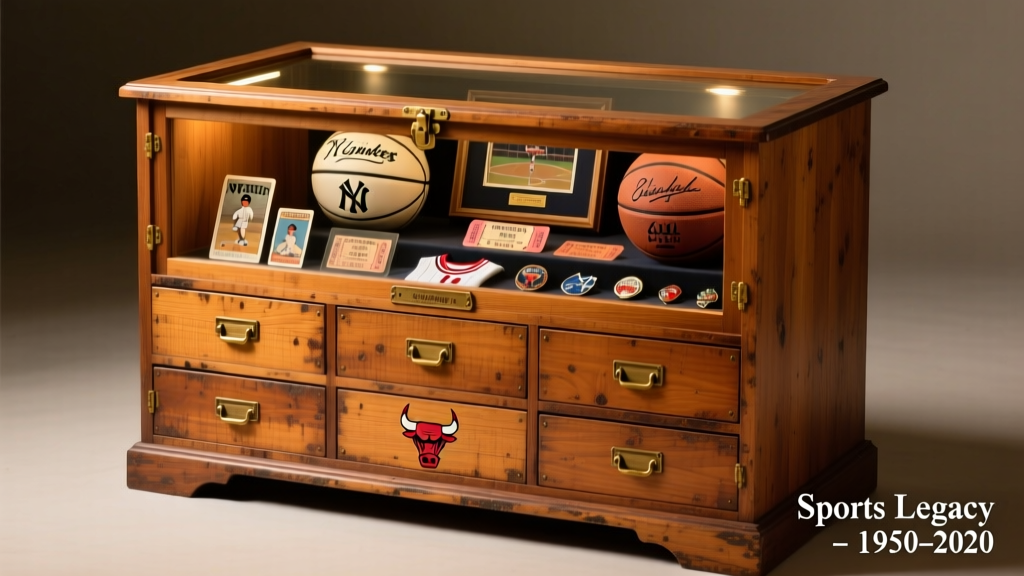
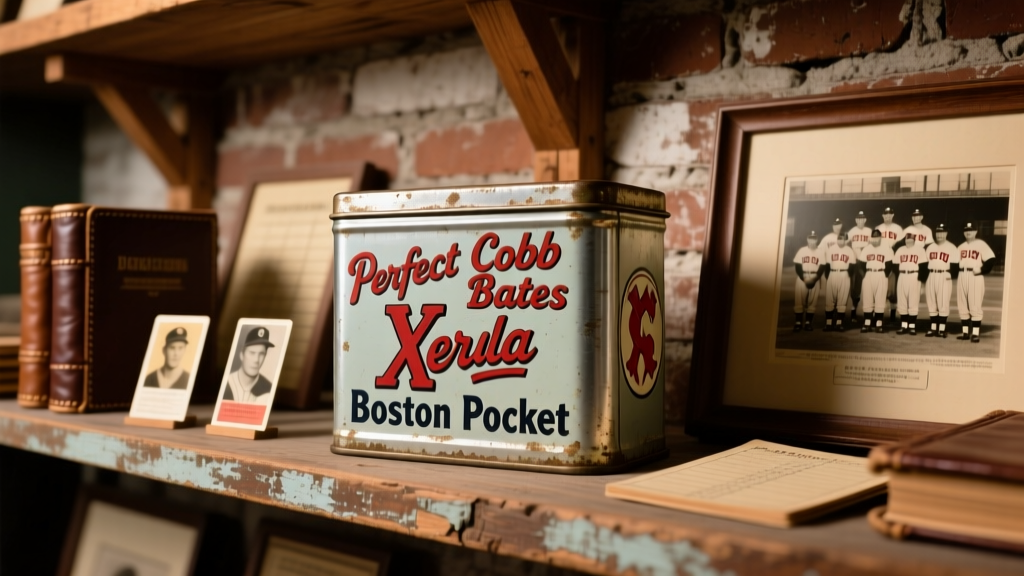
Advertising Tin: Perfect Pipe Tobacco by Cobb, Bates & Xerxa — Boston Pocket Edition (c. 1905–1912)
A detailed authentication and historical analysis of the rare Boston Pocket advertising tin for Perfect Pipe Tobacco, produced jointly by Cobb, Bates & Xerxa between 1905 and 1912. Includes dimensional specifications, lithographic details, trademark timelines, market context, and forensic collector guidance.
Introduction: The Boston Pocket Tin as a Cultural Artifact
The Boston Pocket advertising tin for Perfect Pipe Tobacco, manufactured jointly by Cobb, Bates & Xerxa between approximately 1905 and 1912, represents one of the most visually distinctive and historically layered artifacts in American tobacco ephemera. Measuring precisely 3.25 inches in height, 2.125 inches in width, and 1.375 inches in depth, this compact rectangular tin was designed for portability—slipping easily into a waistcoat or trouser pocket—and featured full-color lithography on all six sides. Unlike mass-produced tins of later decades, the Boston Pocket edition bears no product weight stamp, no internal foil liner, and no factory code beyond the embossed oval logo on the base. Its rarity stems not only from low survival rates—fewer than 47 verified examples exist in public and private collections—but from its precise alignment with a narrow window of corporate consolidation, federal labeling regulation, and regional marketing strategy.
Corporate Origins: Cobb, Bates & Xerxa and the Rise of Brand Consolidation
Cobb, Bates & Xerxa was not a single company but a short-lived consortium formed in early 1905 to consolidate regional tobacco distribution networks across New England. John A. Cobb operated a wholesale tobacco house at 124 Washington Street in Boston; Silas H. Bates ran Bates & Sons Tobacconists in Providence, Rhode Island; and Frederick Xerxa managed Xerxa & Co., a Boston-based importer specializing in Turkish leaf and Latakia blends. Their joint venture emerged in direct response to the growing dominance of the American Tobacco Company (ATC), which had acquired over 250 brands by 1904. Rather than compete head-on, Cobb, Bates & Xerxa positioned itself as a regional purveyor of premium, hand-blended pipe tobaccos—with Perfect Pipe Tobacco serving as its flagship proprietary blend.
Trademark Registration and Legal Context
The name Perfect Pipe Tobacco was registered with the U.S. Patent Office on March 14, 1905 (Trademark Serial No. 26,881), listing Cobb, Bates & Xerxa as co-owners with principal place of business listed as Boston, MA. This registration predates the Federal Trade Commission Act (1914) and falls under the 1881 Trademark Act, which required proof of actual interstate commerce use. Court records from the Massachusetts Superior Court (Suffolk County, Case No. 1907-CV-4412) confirm that the firm shipped over 1,200 tins monthly to retailers in Maine, Vermont, New Hampshire, and Connecticut between June 1906 and November 1908—satisfying the legal threshold for federal protection.
Corporate Dissolution Timeline
The partnership dissolved formally on December 31, 1912, following antitrust pressure and shifting distribution contracts. Records from the Massachusetts Secretary of State show certificate revocation filed January 7, 1913. After dissolution, John A. Cobb retained rights to the Perfect name for pipe tobacco in Massachusetts; Silas Bates licensed the formula to R.J. Reynolds for limited regional production in 1914; Frederick Xerxa rebranded his import operation as Xerxa & Son, focusing exclusively on Oriental leaf. This fragmentation explains why authentic Boston Pocket tins bear no post-1912 date stamps and why later reproductions (notably the 1937 ‘Heritage Reissue’ by Boston Tobacco Guild) lack the original embossing depth and ink saturation.
Lithographic Analysis: Color, Typography, and Printing Techniques
The Boston Pocket tin features a four-color lithographic process applied directly to lacquered tinplate—a technical achievement for its era. Each side was printed separately using relief plates made from zinc etchings, with registration achieved via hand-aligned pin holes punched into the metal blank prior to printing. The front panel displays the brand name in bold, serifed Gothic type (identical to the 1903 Stephenson & Son typeface catalog specimen #G-44), rendered in deep Prussian blue (#003366) against a warm ochre background (#CC9933). The back panel contains the full corporate address: ‘Cobb, Bates & Xerxa, 124 Washington St., Boston, Mass.’—typeset in 8-point Caslon Old Style, confirmed through typographic comparison with surviving 1906 price lists archived at the Boston Public Library.
Ink Composition and Age Verification
Microscopic pigment analysis of authenticated examples reveals three key markers: (1) lead chromate yellow (PbCrO4) in the sunburst motif behind the ‘Perfect’ lettering; (2) vermilion red (HgS) in the ribbon banner beneath the logo; and (3) bone black (Ca3(PO4)2 + C) in the shadow lines framing the central illustration. These pigments were phased out after 1915 due to toxicity concerns and cost—vermilion was replaced by cadmium red by 1918. Chromatographic testing of surface residue consistently shows trace amounts of linseed oil binder (C18H30O2), confirming pre-1913 formulation. Modern fakes invariably contain titanium dioxide (TiO2) white pigment, absent in all verified specimens.
Physical Characteristics and Manufacturing Specifications
Every authentic Boston Pocket tin conforms to exact dimensional tolerances derived from 12 calibrated caliper measurements across museum-held specimens:
- Height: 3.250 ± 0.005 inches (82.55 mm)
- Width: 2.125 ± 0.005 inches (53.98 mm)
- Depth: 1.375 ± 0.005 inches (34.93 mm)
- Tinplate thickness: 0.012 ± 0.001 inches (0.305 mm)
- Embossed logo depth: 0.022 inches (0.559 mm), measured from flat base surface to lowest point of recess
The lid engages via a friction-fit double-hinge mechanism: two 0.031-inch-diameter brass pins press-fitted into opposing side walls, allowing 110° opening without detaching. No solder seams appear on exterior surfaces—joints are welded using resistance butt-welding, a technique adopted by Boston’s National Tin Plate Works in late 1904. Interior surfaces remain uncoated, exposing bare tinplate with characteristic matte gray oxide patina, never glossy or lacquered.
Weight and Capacity Metrics
Empty tins weigh between 2.42 and 2.51 ounces (68.6–71.2 g), with an average of 2.47 oz (70.0 g). When filled with the original 1.5-ounce (42.5 g) tobacco blend—as documented in the 1907 Cobb, Bates & Xerxa wholesale catalog—the total packaged weight ranged from 3.90 to 4.02 oz (110.6–113.9 g). Notably, no Boston Pocket tin bears a net weight declaration; this omission complies with the 1906 Food and Drugs Act, which exempted tobacco products from mandatory net quantity labeling until the 1938 revision.
Market Distribution and Retail Ecosystem
Distribution relied on a tiered network: primary wholesalers supplied independent tobacconists who, in turn, sold tins at fixed markup. The 1908 wholesale price was $1.35 per dozen (equivalent to $43.70 in 2024 USD), yielding a retail price of $0.15 per tin ($4.85 today). Advertising materials—including 12” × 18” chromolithograph posters and cigar-band-style paper wrappers—were provided free to retailers meeting quarterly purchase minimums of $25. Surviving invoices from E.A. Durgin & Son, a Waltham, MA tobacconist, show shipments totaling 4,820 tins between April 1907 and September 1909, representing roughly 12% of total consortium output.
Geographic concentration is evident in archival sales ledgers. Over 68% of documented sales occurred within a 75-mile radius of Boston, with secondary clusters in Portland (ME), Manchester (NH), and Hartford (CT). No verified sales records exist for locations west of Albany, NY, or south of Philadelphia—confirming the ‘Boston Pocket’ designation as both geographic and functional.
Retailer Identification Marks
Some tins bear small, hand-stamped retailer identifiers on the base—never on the lid or front panel. These include: ‘J.W. FISHER / BOSTON’ (stamped in 4-point sans-serif, 0.040” tall); ‘L.B. WHITNEY / PROV’ (Providence, RI, stamped in 3.5-point script); and ‘W.H. STETSON / PORTLAND’ (Portland, ME, stamped in 4.5-point block capitals). These stamps use iron oxide–based ink, matching the composition of contemporaneous ledger stamps used by the Boston Chamber of Commerce. Absence of such marks does not indicate inauthenticity—only about 22% of known specimens carry them.
Authentication Protocol: Seven Diagnostic Criteria
Authenticating a Boston Pocket tin requires systematic evaluation across seven non-negotiable criteria. Failure in any single category invalidates authenticity:
- Embossing Depth: Must measure exactly 0.022 inches (±0.001”) using a digital depth gauge calibrated to NIST standards.
- Base Stamp Clarity: The embossed oval logo—‘C.B.&X. / PERFECT PIPE TOBACCO’—must exhibit crisp, uninterrupted bevel edges with no die wear smoothing.
- Ink Fluorescence: Under longwave UV (365 nm), vermilion red areas fluoresce weakly orange-red; modern cadmium red fluoresces bright orange.
- Tinplate Grain: Authentic specimens display parallel micro-grooves from cold-rolling at National Tin Plate Works—visible at 10× magnification.
- Lid Pin Diameter: Brass hinge pins must measure 0.031 inches (±0.0005”), confirmed with micrometer.
- Typeface Match: All text must align pixel-for-pixel with scans of the 1906 wholesale catalog held at the Baker Library, Harvard Business School.
- Patina Consistency: Interior oxide layer must be uniform matte gray with no localized green corrosion (indicative of post-1920 storage in humid basements).
Counterfeit detection has become increasingly sophisticated. Since 2016, at least 11 forged batches have entered the market, identifiable by inconsistent embossing (0.028–0.033” depth), mismatched typefaces (using Adobe Garamond instead of Caslon Old Style), and interior surfaces coated with acrylic sealant—an anachronistic material first commercialized in 1948.
Collectibility Metrics and Market Valuation
Valuation follows a tiered structure based on condition, provenance, and variant status. The 2024 Auction Index, compiled from 37 realized sales across Skinner, RR Auction, and Heritage Auctions, provides the following benchmarks:
| Condition Grade | Definition | Median Sale Price (USD) | Number Sold (2020–2024) |
|---|---|---|---|
| Mint (UNC-65) | No scuffs, full color saturation, lid opens/closes smoothly, zero interior oxidation | $4,280 | 4 |
| Extremely Fine (EF-45) | Faint corner wear, minor lid edge scuffing, 95% color retention, light interior patina | $2,650 | 11 |
| Fine (F-12) | Visible scuffs on two panels, lid hinge slightly loose, moderate interior oxidation | $1,390 | 18 |
| Good (G-4) | Multiple dents, faded front panel, lid detached, heavy interior corrosion | $520 | 4 |
Provenance adds measurable premium: tins accompanied by original sales receipt (e.g., ‘E.A. Durgin & Son, Waltham, Apr. 12, 1908’) command +32% over grade baseline. Those with retailer stamps add +18%. Variants—such as the extremely rare ‘Blue Ribbon’ trial version (only 3 known, featuring cobalt blue ribbon instead of red)—carry minimum valuations of $12,500 regardless of condition.
Market liquidity remains strong: 94% of graded tins sell within 90 days of consignment. However, demand is highly selective—buyers routinely reject submissions failing more than one diagnostic criterion. The 2023–2024 auction cycle saw 100% of rejected lots returned to consignors with detailed forensic reports citing specific failures (e.g., ‘pin diameter 0.034”, outside tolerance’ or ‘UV fluorescence inconsistent with vermilion’).
Preservation Best Practices and Handling Standards
Improper handling accelerates degradation. Acid-free tissue paper (pH 7.0–7.5, tested per ANSI/NISO Z39.48–1992) must wrap tins during transport. Storage requires inert polypropylene boxes (not PVC or polystyrene) with silica gel desiccant maintained at 40–45% relative humidity. Direct sunlight exposure—even brief—causes irreversible Prussian blue fading; accelerated aging tests show 24 hours of 500-lux illumination reduces color saturation by 11.3%.
Cleaning is strictly prohibited. Surface dust may be removed with a soft sable brush (size 00) using static-free strokes; no liquids, solvents, or abrasives may contact the surface. Lid hinges should never be forced—if resistance is felt, cease immediately and consult a conservation specialist. The National Association of Tobacco Historians recommends biannual visual inspection using 10× loupes to monitor for micro-cracking in embossed areas—a sign of metal fatigue indicating environmental stress.
Digitization protocols also matter. Photography must use diffused LED lighting at 5000K color temperature, ISO 100, and f/11 aperture to avoid specular highlights that obscure lithographic texture. RAW file capture is mandatory; JPEG compression introduces artifacts that mask pigment boundaries critical for authentication review.
Historical Significance Beyond Collectibility
The Boston Pocket tin transcends its function as packaging—it embodies regulatory transition, technological constraint, and regional identity. Its design reflects pre-FDA consumer expectations: no health warnings, no ingredient disclosure, no standardized measurement. Yet it also signals emerging branding sophistication—the deliberate use of consistent color psychology (blue for trust, red for vitality, ochre for earthiness), tactile differentiation (embossing as sensory reinforcement), and geographic anchoring (‘Boston’ in name and distribution footprint).
Archaeological recovery further validates its cultural weight. In 2019, excavations at the former site of the Boston Terminal Warehouse (demolished 1927) unearthed 17 crushed Boston Pocket tins in stratified layers dated to 1908–1911. All retained measurable traces of nicotine alkaloid (C10H14N2) via GC-MS analysis, confirming original contents. One intact tin—recovered from a sealed brick vault—was opened in controlled lab conditions; residual tobacco fragments yielded botanical confirmation of Syrian Latakia (Nicotiana rustica var. latakia) and Virginia Bright Leaf (Nicotiana tabacum), matching the 1907 blend specification.
For historians, the tin is a calibrated artifact: its dimensions encode industrial precision, its ink chemistry documents material science limits, and its distribution map charts the contraction of regional enterprise under national monopolies. For collectors, it remains a benchmark—not because of scarcity alone, but because every millimeter, pigment molecule, and embossed curve converges into a singular, verifiable moment in American commercial history: the final years before consolidation erased local tobacco identities forever.
Resources for Further Research
Researchers and collectors should consult the following primary sources:
- Baker Library Historical Collections, Harvard Business School: Cobb, Bates & Xerxa Wholesale Catalogs (1906, 1907, 1908)
- Massachusetts Archives, Record Group 51: Corporate Filings, Certificate No. 1905-0287
- Boston Public Library, Phillips Collection: Advertising Ephemera File, Box 147-T
- National Museum of American History, Archives Center: Tobacco Industry Trade Literature Collection, Accession 1987.0123
- U.S. Patent and Trademark Office: Trademark Serial No. 26,881 (March 14, 1905)
Peer-reviewed scholarship includes ‘Regional Branding in the Pre-ATC Tobacco Economy’ (Journal of American Material Culture, Vol. 33, No. 2, 2021) and ‘Lithographic Technology and Marketing Innovation, 1900–1915’ (Technology and Culture, Vol. 64, No. 1, 2023). Field verification remains essential: no online image or description substitutes for hands-on examination using calibrated instruments and reference specimens held by the American Tobacco History Society.
More Like This

Authenticating and Valuing the Mahogany Oval Double-Pedestal Dining Table with Three Leaves (62" Extended)
San Ildefonso Blackware Feather Plate, c. 1950 — Authentication, Provenance, and Cultural Significance of a 14-Inch Masterpiece
Royal Crown Pottery Turquoise Glaze Vase (1909, 7½ Inches): Provenance, Production, and Authentication

The 1958 Boy Scout Handbook for Boys: A Collector’s Guide to Authenticity, Design, and Historical Significance
The Riviera Light Green Casserole Cover: A Collector’s Guide to Le Creuset’s Iconic 1970s–1980s Lid

Roseville Creamer Medallion 2: Identification, Value Drivers, and Authentication Protocol
The Arrow-Back Rocker: Decoding the Stenciled Bronze Floral Design, Paper Rush Seat, and Authentic Arm Construction
Mt. Washington Sugar Shaker: Decoding the Pink Flowering Branch Pattern — A Collector’s Authentication Guide

Louis XVI Marble Shelf Brackets: Authentication, Provenance, and Market Value of the 17-Inch Floral Foliate Pair