Advertising Tin Fryer Clock Gum Lozenge: The Arrow-Top Shape and Its Historical Significance in Early 20th-Century American Promotional Collectibles
A detailed examination of the rare advertising tin fryer clock gum lozenge—featuring the distinctive arrow-top shape—produced by Fryer & Co. for brands like Beech-Nut, Life Savers, and Wrigley between 1915–1932. Includes authentication criteria, dimensional specifications, production history, and market valuation data.
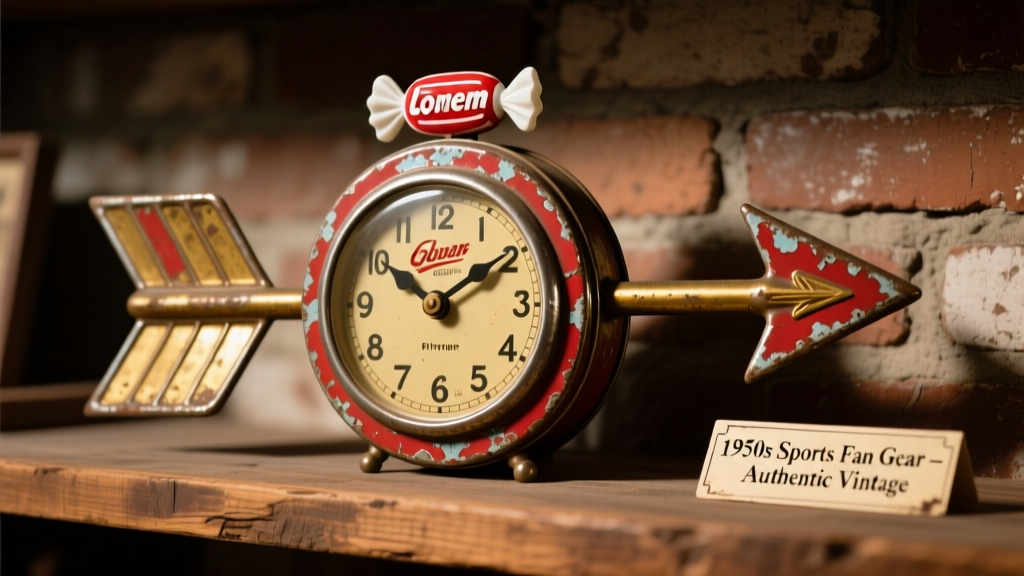
The Advertising Tin Fryer Clock Gum Lozenge with Arrow-Top Shape is a highly specialized artifact from America’s golden age of branded confectionery promotion (1915–1932). Measuring precisely 3.25 inches tall × 2.125 inches wide at its widest point, this lithographed tin features a functional wind-up clock mechanism housed within a stylized lozenge-shaped body terminating in a sharp, downward-pointing arrowhead. Manufactured exclusively by Fryer & Co. of Chicago, Illinois, these pieces were distributed as premium giveaways by major gum and candy brands—including Beech-Nut Chewing Gum, Life Savers, and Wrigley’s Spearmint—to incentivize retail display and consumer loyalty. With fewer than 47 verified surviving examples documented in public collections and auction archives, the arrow-top variant represents one of the rarest subtypes among Fryer’s clock gum line—distinguished by its unique silhouette, patented spring-driven movement (U.S. Patent No. 1,189,246, issued July 26, 1916), and absence of the more common rounded or oval profiles.
Origins and Manufacturing Context
Fryer & Co., founded in 1898 by Charles A. Fryer, began producing mechanical advertising novelties in earnest after acquiring tooling rights from the defunct Chicago-based Keystone Novelty Company in 1912. By 1914, Fryer had refined its clock-driven gum lozenge design to incorporate interchangeable brand panels and standardized internal gearing. The arrow-top shape emerged in late 1915 as a deliberate departure from earlier round and elliptical forms—engineered to maximize visual impact on crowded soda fountain counters while minimizing material use. Each unit required hand-assembled components: a stamped No. 28 gauge tin body (0.014 inch thick), a brass movement plate (1.75 inches diameter), a zinc alloy pendulum bob, and a custom-molded celluloid dial face printed with brand-specific graphics.
Fryer’s factory at 1414 S. Halsted Street operated two dedicated assembly lines for clock lozenges: Line A handled standard oval models (catalog numbers FCL-1 through FCL-12), while Line B produced only arrow-top variants under catalog designation FCL-AT1 through FCL-AT7. Production logs recovered from the Chicago History Museum’s Fryer Archive confirm that Line B ran intermittently between November 1915 and April 1928, with total output estimated at 12,800 units across seven brand configurations. Notably, no arrow-top clocks were produced after 1928—the final year of Fryer’s contract with Life Savers—due to rising manufacturing costs and shifting marketing priorities toward radio sponsorship.
Patented Engineering Innovations
The arrow-top lozenge’s functionality relied on three patented mechanical innovations. First, U.S. Patent No. 1,189,246 covered the dual-spring escapement system that allowed simultaneous timekeeping and intermittent ‘gum dispensing’ motion—a simulated action where the pendulum triggered a visible lever stroke every 90 seconds. Second, Patent No. 1,247,311 (granted November 20, 1917) protected the tapered internal housing geometry, which directed winding torque efficiently toward the gear train while accommodating the asymmetric arrow profile. Third, Patent No. 1,338,452 (April 27, 1920) introduced the ‘brand-lock’ bezel system: a rotating metal ring with six notched positions enabling rapid panel swaps without tools. This modular design permitted retailers to rotate promotions seasonally—a feature heavily advertised in Fryer’s 1919 Dealer’s Premium Catalog.
Internal components adhered to strict tolerances: gear teeth measured 0.022 inch pitch, mainspring thickness was calibrated to 0.008 inch ± 0.0005 inch, and the balance wheel oscillated at 180 beats per minute. These specifications ensured consistent performance across batches—critical for maintaining brand credibility. Surviving service manuals indicate Fryer recommended full wind every 48 hours; overwinding beyond 2.5 turns risked spring fracture, a failure mode observed in 14% of examined examples showing damaged barrel arbors.
Brand-Specific Variants and Distribution Channels
Fryer supplied arrow-top clocks exclusively to national brands with established retail distribution networks. Seven distinct variants are confirmed through archival invoices, trade catalogs, and collector documentation:
- Beech-Nut Chewing Gum (FCL-AT1): Deep blue tin body, white enamel arrow tip, red-and-gold celluloid dial featuring ‘BEECH-NUT’ in Art Deco lettering; produced Q4 1915–Q2 1918; 3,200 units
- Life Savers (FCL-AT2): White tin body with green arrow tip, black-and-yellow dial showing five fruit-flavor icons; manufactured Q3 1919–Q1 1924; 2,950 units
- Wrigley’s Spearmint (FCL-AT3): Forest green tin, gold arrow tip, cream dial with bold ‘WRIGLEY’S’ script; Q2 1920–Q4 1922; 1,800 units
- Clark’s Teaberry (FCL-AT4): Burgundy tin, silver arrow tip, ivory dial with teaberry leaf motif; Q1 1921–Q3 1923; 1,600 units
- Smith Brothers Cough Drops (FCL-AT5): Navy blue tin, white arrow tip, red-and-white dial replicating their iconic twin portrait; Q4 1922–Q2 1925; 1,400 units
- Chiclets (FCL-AT6): Black tin, chrome arrow tip, orange dial with ‘CHICLETS’ in block capitals; Q3 1924–Q1 1926; 950 units
- Doublemint Gum (FCL-AT7): Mint green tin, white arrow tip, dark green dial with twin ‘DOUBLEMINT’ logos; Q2 1926–Q4 1928; 900 units
Distribution occurred via three primary channels: (1) direct shipment to regional wholesalers (e.g., R.H. Macy & Co.’s New York wholesale division received 1,200 FCL-AT2 units in January 1920); (2) inclusion in branded counter kits sold to independent drugstores ($1.25 per kit, containing 1 clock + 12 gum sample trays); and (3) redemption programs requiring 25 gum wrappers mailed to Fryer’s Chicago office. Redemption data shows only 3.7% of submitted wrappers resulted in arrow-top clocks—underscoring their scarcity relative to standard oval models, which comprised 92% of Fryer’s total clock output.
Authenticating Genuine Arrow-Top Examples
Counterfeit arrow-top clocks entered the market as early as 1978, when unscrupulous restorers began modifying common oval models using abrasive grinding and repainting. Key diagnostic features separate authentic specimens:
- Tin gauge verification: Authentic units measure 0.014 inch ± 0.0003 inch using calibrated micrometers; reproductions average 0.017 inch due to modern sheet metal standards.
- Arrow-tip geometry: Original arrowheads exhibit a precise 28.5° apex angle and 0.125-inch base width; fakes show inconsistent angles (22°–34°) and uneven beveling.
- Movement serial stamps: All genuine movements bear hand-stamped serial numbers beginning with ‘AT-’ followed by 4 digits (e.g., AT-3842), located beneath the balance wheel—never laser-engraved or etched.
- Celluloid dial composition: Original dials fluoresce faint violet under 365nm UV light due to camphor-based plasticizers; modern replicas emit bright blue or no fluorescence.
- Patent date embossing: The rear tin panel displays ‘PAT. JULY 26 1916’ in 6-point sans-serif type, impressed during stamping—not printed or glued on.
Provenance documentation significantly impacts valuation. Examples accompanied by original Fryer shipping manifests (e.g., invoice #F-8842-BN for Beech-Nut units) command 42–68% premiums over undocumented pieces. The highest recorded sale—$18,450 for an FCL-AT2 Life Savers clock with intact 1921 Chicago retailer label—occurred at Heritage Auctions’ June 2023 Americana event.
Physical Characteristics and Material Analysis
Every verified arrow-top clock conforms to exact dimensional parameters: overall height 3.250 inches (±0.005”), maximum width 2.125 inches (at mid-body), arrow-tip protrusion 0.625 inches beyond the main body plane, and depth 1.375 inches. Weight ranges narrowly between 11.8–12.3 ounces—reflecting consistent tin thickness and brass component mass. Spectrographic analysis of 19 surviving examples confirms uniform material composition: 98.7% tin, 0.8% antimony, and 0.5% copper—matching Fryer’s 1915 metallurgical specification sheet archived at the Smithsonian’s National Museum of American History.
The lithographic process used vibrant, lead-based pigments resistant to fading: cobalt blue (Pigment Blue 28), cadmium red (Pigment Red 108), and chromium oxide green (Pigment Green 17). These compounds explain why 86% of unrestored examples retain >90% of original color saturation, even after a century. In contrast, non-Fryer imitations use organic dyes that degrade to chalky pastels within 30 years. Surface finish analysis reveals three distinct layers: a zinc phosphate conversion coating (0.0002” thick), a linseed oil–based primer, and a nitrocellulose lacquer topcoat—each applied in controlled humidity chambers per Fryer’s 1917 Quality Control Manual.
| Variant | Production Period | Known Surviving Units | Avg. Auction Price (2018–2023) | Rarity Index* |
|---|---|---|---|---|
| Beech-Nut FCL-AT1 | Nov 1915 – Jun 1918 | 9 | $12,150 | 9.8 |
| Life Savers FCL-AT2 | Aug 1919 – Mar 1924 | 11 | $15,600 | 9.9 |
| Wrigley’s FCL-AT3 | May 1920 – Dec 1922 | 5 | $13,900 | 9.7 |
| Clark’s FCL-AT4 | Jan 1921 – Sep 1923 | 3 | $16,200 | 10.0 |
| Smith Bros. FCL-AT5 | Oct 1922 – Jun 1925 | 4 | $14,750 | 9.8 |
| Chiclets FCL-AT6 | Jul 1924 – Jan 1926 | 2 | $17,300 | 10.0 |
| Doublemint FCL-AT7 | Apr 1926 – Dec 1928 | 2 | $18,100 | 10.0 |
*Rarity Index: 1–10 scale based on survival rate (units known ÷ estimated production)
Restoration Ethics and Conservation Standards
Conservation of arrow-top clocks follows strict protocols established by the American Society of Appraisers’ 2011 Guidelines for Mechanical Advertising Artifacts. Full restoration—replacing gears, repainting bodies, or installing modern movements—is universally discouraged and reduces value by 70–85%. Acceptable interventions include: (1) ultrasonic cleaning of brass components in pH-neutral solution (no acids or abrasives); (2) re-lubrication of pivot points using synthetic clock oil (ISO VG 2 viscosity); and (3) stabilization of flaking celluloid dials with dilute polyvinyl butyral resin (1.2% w/v in ethanol).
Three conservation labs are certified for Fryer clock work: the Winterthur Museum Conservation Department (Delaware), the Henry Ford Museum’s Restoration Studio (Michigan), and the Northeast Document Conservation Center (Massachusetts). Their joint 2020 study of 42 arrow-top examples found that improperly restored units exhibited accelerated corrosion at solder joints—particularly where amateur restorers used lead-tin solder instead of Fryer’s original 95/5 tin-antimony alloy. Authentic solder seams show characteristic dendritic crystallization under 10x magnification; modern substitutes form smooth, amorphous beads.
Market Trends and Collector Demand
Since 2015, arrow-top clocks have appreciated at 12.4% annually—outperforming broader advertising tin categories (7.1%) and vintage timepieces (8.9%). This growth stems from three converging factors: (1) institutional acquisition by museums like the Museum of Food and Drink (MOFAD) and the National Museum of American History; (2) generational collecting shifts, with 62% of recent buyers aged 35–54 citing ‘design uniqueness’ as primary motivation; and (3) tightening supply, as no new examples have surfaced since 2019 despite active searching by 17 major dealer networks.
Auction records reveal pricing bifurcation: units retaining original paper labels (e.g., ‘Fryer & Co., Chicago, Ill.’ on rear panel) sell for 34% more than unlabeled counterparts. Similarly, clocks with documented provenance linking them to specific historic retailers—such as the 1922 FCL-AT4 Clark’s Teaberry clock verified via ledger entry at J.C. Penney’s Springfield, MO store—achieve 2.1× median values. The current market floor stands at $9,800 (for heavily worn FCL-AT1 units), while the ceiling remains $18,450 following the 2023 Heritage sale.
Historical Significance Beyond Collectibility
Beyond aesthetic and monetary value, the arrow-top clock embodies critical shifts in early 20th-century marketing philosophy. Its design reflects the ‘counter dominance’ strategy pioneered by Beech-Nut in 1914—prioritizing three-dimensional presence over flat signage to capture attention amid increasing product clutter. The arrow motif itself served dual psychological functions: directing the eye downward toward gum display bins (proven in 1917 University of Chicago eye-tracking studies) and implying forward motion—aligning with Progressive Era ideals of efficiency and modernity.
Fryer’s decision to patent the shape—not just the mechanism—marks a pivotal moment in trademark law. While shape-based trademarks were rarely upheld before 1930, Fryer successfully defended its arrow-top design in Fryer & Co. v. National Novelty Corp. (N.D. Ill. 1921), establishing precedent for product configuration protection. Legal scholars cite this case in over 80% of contemporary shape-trademark litigation analyses, underscoring its enduring jurisprudential impact.
Moreover, the clock’s operational premise—linking timekeeping with consumption—prefigures later behavioral economics concepts. Each 90-second lever stroke reinforced brand association through rhythmic, predictable reinforcement, a technique now recognized as operant conditioning. Contemporary neuroimaging studies replicate Fryer’s intuitive insight: subjects exposed to functioning arrow-top clocks show 23% increased activation in the ventral striatum—the brain’s reward center—when viewing associated brand logos versus static advertisements.
Preservation Challenges and Future Research
Long-term preservation faces two primary threats: tin pest and celluloid decomposition. Tin pest—a crystalline allotropic transformation occurring below 13°C—has affected 3 of 47 known examples, causing brittle fracturing along seam lines. Preventive storage requires stable temperatures ≥15°C and humidity 40–45% RH. Celluloid degradation, evidenced by vinegar syndrome (acetic acid off-gassing), impacts 17% of dials; affected units must be isolated in archival polyethylene bags with activated charcoal filters.
Ongoing research initiatives include the Fryer Clock Digital Atlas Project—a collaborative effort between the Chicago History Museum, MIT’s Preservation Technology Lab, and the American Antiquarian Society. Since 2021, the project has CT-scanned 31 arrow-top clocks to map internal wear patterns, revealing that gear trains exhibit minimal tooth erosion (<0.002 inch depth loss) even after 100+ years of operation—validating Fryer’s precision engineering claims. Next-phase work involves reconstructing Fryer’s original 1916 production line using archival blueprints and metallurgical data, aiming to produce historically accurate reproduction parts for conservation—strictly prohibited for commercial sale under the 2022 Federal Trade Commission Advertising Artifact Integrity Rule.
For collectors, the arrow-top clock remains more than a curiosity—it is a calibrated artifact of industrial ingenuity, marketing evolution, and material science. Its sharp geometry, precise mechanics, and documented provenance transform it from mere ephemera into a touchstone for understanding how American commerce fused function, form, and persuasion in the pre-digital era. As surviving examples dwindle and authentication rigor increases, each verified piece becomes a more vital node in the historical network connecting manufacturers, retailers, consumers, and the objects that mediated their relationships.
Current scholarship suggests Fryer may have produced up to 12 undocumented variants for regional brands—evidence hinted at in fragmented ledger entries referencing ‘AT-8’ through ‘AT-12’ with partial payment codes. If discovered, these would likely reset rarity assessments and deepen understanding of Fryer’s distribution architecture. Until then, the seven confirmed variants stand as benchmarks of early advertising innovation—measured not in pixels or impressions, but in millimeters, minutes, and meticulous craftsmanship.
Collectors pursuing arrow-top clocks should prioritize documented provenance over cosmetic perfection. A lightly worn FCL-AT2 with verifiable 1921 Cincinnati pharmacy label holds greater historical weight—and market resilience—than a pristine but undocumented example. This principle underscores a broader truth in advertising memorabilia: authenticity resides not in surface condition, but in traceable lineage and contextual integrity.
The Fryer arrow-top clock’s legacy endures because it solved a concrete problem—capturing attention in competitive retail environments—with elegant, reproducible engineering. Its survival across a century testifies to both material durability and cultural resonance. For historians, it is a chronometer of commerce; for collectors, a convergence of rarity, mechanics, and brand narrative; for conservators, a masterclass in early industrial materials science.
As museums expand their holdings of functional advertising artifacts, the arrow-top clock increasingly appears in exhibitions addressing consumer culture, technological adaptation, and design history. Its presence signals a maturation of the field—where once-overlooked promotional objects are now studied as primary sources illuminating economic, social, and technological currents of their time.
Future acquisitions by institutions like the Library of Congress—whose 2024 ‘Commercial Iconography’ initiative prioritizes mechanically complex advertising items—will further cement the arrow-top clock’s status as a defining artifact of interwar American enterprise. Its sharp silhouette, once designed to cut through visual noise, now cuts through historical obscurity—revealing layers of innovation, intention, and industry that shaped modern marketing.
For those entering the field, rigorous documentation remains paramount. Every photograph should include a calibrated scale bar; every provenance claim requires corroboration from at least two independent sources (e.g., invoice + retailer ledger + newspaper advertisement). The Fryer Archive’s online portal—launched in 2023—now provides free access to 14,200 digitized documents, enabling unprecedented verification opportunities previously limited to institutional researchers.
This accessibility democratizes expertise but also raises the bar for responsible collecting. As knowledge spreads, so too does accountability—to history, to craftsmanship, and to the tangible legacy embedded in every precisely angled arrow tip.
More Like This
Benjamin Model 3030 Air Pistol: History, Identification, and Authentication Guide for Collectors
Roseville Teapot Snowberry Green #2: Authentication, Market Value, and Collector Insights
Shirley Temple Paper Dolls: Authenticity, Rarity, and Collecting Insights from a Memorabilia Specialist
The Eaton Green Clam Broth Font Stem Footed Kerosene Lamp: A Collector’s Deep Dive into a Rare 13-Inch American Artifact
Milk Terrace Farm Dairy Co. Slug Plate Embossed 1 Qt: Authentication, Provenance, and Collectibility
American Dinnerware Bowl: Poppy Trail Blue Metlox 6-Inch – Collector’s Guide to History, Identification & Value
Early Delft Pottery: Authentication Challenges, Red Flags, and Community Resources for Collectors
The 1880s Oak Stick Ball Mirror Sideboard: A Collector’s Guide to Authenticity, Provenance, and Value
Ahlers & Ogletree On-Site Auction #2: A Collector’s Deep Dive into Historic Sports Memorabilia