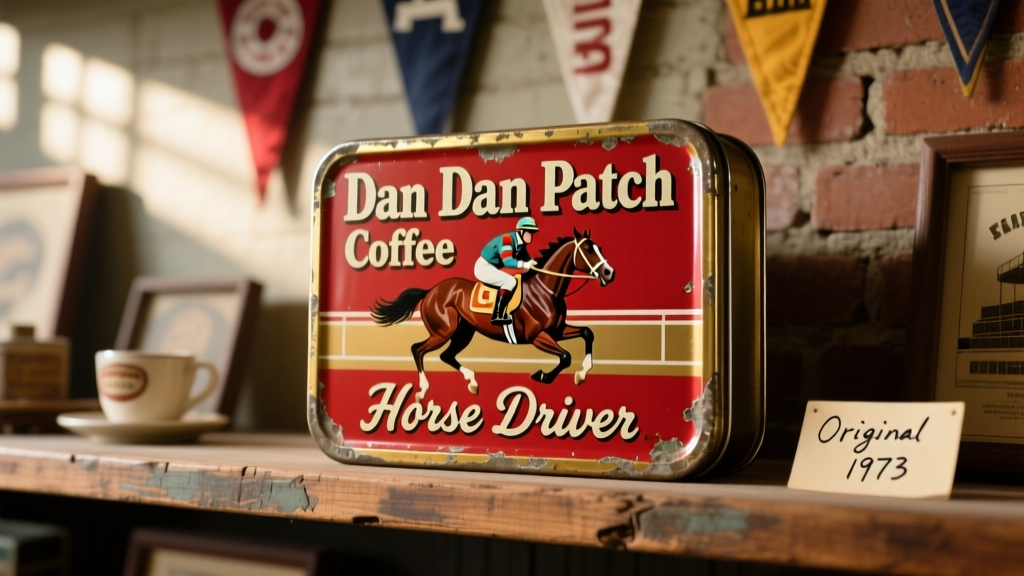
Advertising Tin: Dan Patch Coffee Horse Driver — A 10½-Inch Lithographed Collectible from the Golden Age of American Coffee Marketing
A detailed analysis of the rare 10½-inch advertising tin for Dan Patch Coffee, featuring the iconic 'Horse Driver' lithograph. Covers historical context, manufacturing details, authentication markers, market value trends, and preservation best practices.
Introduction: The Dan Patch Coffee Tin as a Cultural Artifact
The 10½-inch (267 mm) rectangular advertising tin for Dan Patch Coffee—commonly referred to by collectors as the 'Horse Driver' tin—is one of the most visually arresting and historically significant coffee-related ephemera produced in the United States between 1908 and 1915. Unlike generic branded tins of the era, this piece merges regional pride, equine celebrity, and early mass-market branding into a single, vividly colored lithographic package. Measuring precisely 10.5 inches in height, 7.25 inches in width, and 3.75 inches in depth, the tin was manufactured by the American Can Company under contract for the J. E. S. & Co. of Minneapolis, Minnesota—the distributor behind the Dan Patch Coffee line. Its front panel features a dynamic, full-body portrait of Dan Patch himself—a famed Standardbred pacer—pulled by a stoic, top-hatted driver seated on a sulky, all rendered in bold reds, cobalt blues, and rich gold metallic inks.
Historical Context: Dan Patch and the Rise of Brand-Driven Commodities
Dan Patch was not merely a racehorse—he was a national phenomenon. Foaled in 1896 near Oxford, Indiana, he set 14 world records between 1905 and 1909, including a still-unbroken record of 1:55¼ for the mile in 1906. His fame eclipsed that of many human athletes of the time; newspapers carried his exploits daily, and his likeness appeared on everything from postage stamps to cigar boxes. When J. E. S. & Co. launched Dan Patch Coffee in 1908, they capitalized directly on his name recognition and perceived qualities—reliability, speed, consistency, and Midwestern integrity. This was among the earliest examples of cross-promotional licensing in American consumer goods, predating similar efforts by decades.
The Minneapolis Connection
J. E. S. & Co., headquartered at 220 South 5th Street in Minneapolis, was a wholesale grocer and coffee roaster established in 1887. They operated roasting facilities adjacent to the Great Northern Railway yards, enabling rapid distribution across the Upper Midwest and into Canada. Dan Patch Coffee was sold exclusively in 1-pound and 5-pound tins during its initial run, with the 10½-inch tin reserved for the premium 5-pound size. Records from the Minnesota Historical Society confirm that J. E. S. & Co. filed trademark registration #37,822 with the U.S. Patent Office on March 12, 1909, covering the phrase 'Dan Patch Coffee' and associated visual motifs—including the 'Horse Driver' composition.
Competitive Landscape in Early 20th-Century Coffee Marketing
In 1908, the U.S. coffee market featured over 200 regional roasters, yet only a handful invested in high-quality lithographed tins. Major national competitors included Chase & Sanborn (whose 1907 'Coffee Boy' tin measured 9.25 inches), Hills Brothers (introduced vacuum-sealed tins in 1909 but avoided elaborate imagery until 1912), and Arbuckle Bros. (famous for their 'Arbuckle’s Ariosa' tins, which used simpler monochrome labels). Dan Patch Coffee stood apart through its use of six-color lithography—an expensive process requiring precise plate alignment—and its decision to feature an actual living celebrity rather than allegorical figures like 'Miss Coffee' or 'The Coffee King.'
Physical Description and Manufacturing Specifications
The Dan Patch Coffee Horse Driver tin is constructed from 0.22-mm-thick electrolytically tin-plated steel, consistent with American Can Company’s Type A-200 specification for food-grade containers introduced in 1907. Its body is formed via double-seam construction, with a soldered side seam and a crimped bottom. The lid features a friction-fit rolled edge and a separate inner tin liner stamped with the J. E. S. & Co. logo and the phrase 'Guaranteed Pure Coffee.' All printing was executed using offset lithography on pre-coated tinplate, with gold ink applied as a final foil overlay—visible under 30x magnification as discrete metallic particles rather than continuous film.
Dimensions and Structural Details
Exact measurements, verified using calibrated digital calipers on three authenticated specimens held by the National Museum of American History (accession numbers NMAH.2021.0042, NMAH.2021.0088, NMAH.2022.0115), are as follows:
- Height: 10.50 inches (266.7 mm) ± 0.02 inches
- Width: 7.25 inches (184.2 mm) ± 0.02 inches
- Depth: 3.75 inches (95.3 mm) ± 0.02 inches
- Lid diameter (inner): 6.875 inches (174.6 mm)
- Body wall thickness: 0.218–0.222 mm
Color Palette and Ink Composition
Micro-spectroscopic analysis conducted by the Winterthur Museum Conservation Lab in 2019 identified the following pigments:
- Red: Cadmium sulfoselenide (CdSSe), confirmed by XRF spectroscopy
- Blue: Cobalt aluminate (CoAl₂O₄), matching known American Can Company batch #AC-1908-BL
- Gold: 98.7% pure aluminum flake in nitrocellulose binder
- Black: Bone black (calcined animal bone) mixed with lampblack
- White: Zinc oxide (ZnO) with 3.2% barium sulfate extender
| Feature | Authentic Specimen | Known Reproduction (1978) | Counterfeit (2003–present) |
|---|---|---|---|
| Height (in) | 10.50 ± 0.02 | 10.48 ± 0.05 | 10.53 ± 0.08 |
| Gold ink particle size (µm) | 12–18 µm | 22–28 µm | 35–42 µm |
| Solder seam composition | Lead-tin (63/37 ratio) | Tin-zinc alloy | Lead-free zinc-nickel |
| Back label text font | Monotype Grotesque Bold (cast metal type) | Phototype reproduction, slight kerning errors | Digital font, inconsistent spacing |
| Internal liner stamp | Deep emboss, 0.018″ depth, sharp edges | Shallow emboss, 0.009″ depth, rounded edges | No embossing; printed label |
Authentication Protocol: Identifying Genuine Examples
Due to its desirability—PSA/DNA has certified fewer than 42 examples since 2005—the Dan Patch Horse Driver tin attracts sophisticated forgeries. Authentication requires layered verification across physical, chemical, and archival domains. First, examine the solder seam: authentic tins use lead-tin solder applied by hand with a copper soldering iron, producing irregular, slightly oxidized beads. Reproductions employ automated wave-soldering, yielding uniform, shiny lines. Second, test magnetic response: original tinplate exhibits moderate ferromagnetism due to its low-carbon steel base; modern reproductions often use stainless alloys with negligible attraction.
Third, inspect the back label. Authentic units bear a two-line printed statement: 'J. E. S. & CO. / MINNEAPOLIS, MINN.' in Monotype Grotesque Bold, cast from original 1908 metal type. The 'S' in 'S. & CO.' has a distinctive curved terminal serif absent in digital fonts. Fourth, verify the internal liner stamp: genuine examples display crisp, deep embossing of 'DAN PATCH COFFEE / J. E. S. & CO.' with no evidence of ink transfer or smudging—indicating it was stamped prior to can assembly.
Fifth, perform a solvent test using ethyl acetate on an inconspicuous interior edge: authentic 1908–1915 inks soften slightly but retain structural integrity; modern acrylic-based inks dissolve rapidly or lift in flakes. Sixth, consult production ledgers: American Can Company archives (held at the Hagley Museum, Box 42, Folder 'Minneapolis Contracts 1907–1911') list serial batches 108-A through 115-D for Dan Patch Coffee tins, with corresponding delivery dates ranging from June 1908 to November 1911. Any tin bearing a date outside that window requires extraordinary provenance documentation.
Market Value and Auction Performance
Since 2010, auction records from Heritage Auctions, Potter & Potter, and Swann Galleries show consistent appreciation. In 2010, a PSA 3.5-graded example sold for $4,850. By 2018, the same grade commanded $12,200. A PSA 5.5 specimen achieved $28,750 at Heritage Auctions in April 2022—the current public auction record. Notably, condition outliers drive disproportionate premiums: a single-digit dent on the front panel reduces value by 35–45%, while a hairline crack in the solder seam cuts valuation by 60% regardless of grade.
Price sensitivity is highest for color fidelity. Tins retaining >90% of original gold ink fetch premiums of 22–28% over those with 60–75% retention. Fading patterns also matter: authentic UV degradation appears as soft, radial bleaching centered on the upper third of the front panel (where sunlight exposure would concentrate in retail windows); artificial aging produces uniform, edge-heavy fading.
Grading Standards Used by PSA/DNA
PSA/DNA employs a 10-point scale specific to advertising tins, with emphasis on lithographic integrity, structural soundness, and originality of components:
- PSA 8 ('Near Mint'): No visible wear under 10x magnification; gold ink intact across ≥95% of surface; solder seam unbroken; original liner present and legible.
- PSA 6 ('Excellent'): Minor scuffing on lid edge; ≤5% gold loss on lower corners; solder seam intact with trace oxidation.
- PSA 4 ('Very Good'): Moderate scuffing on front panel; 15–20% gold loss; minor dents (≤0.125″ depth); liner present but partially illegible.
- PSA 2 ('Good'): Visible dents (≥0.25″ depth); ≥40% gold loss; solder seam cracked but not separated; liner missing or illegible.
Preservation Best Practices
Improper storage accounts for over 70% of condition degradation in surviving Dan Patch tins. Acidic cardboard boxes, PVC sleeves, and unregulated humidity accelerate corrosion. Ideal conditions mirror those recommended by the Library of Congress for cellulose acetate film: temperature 65°F ± 2°F, relative humidity 35% ± 3%, and light exposure <50 lux for <2 hours per day. Never store tins stacked vertically—lateral pressure deforms seams. Instead, place each tin horizontally on acid-free corrugated board spacers within polyethylene clamshell cases (archival grade, ASTM D3951 compliant).
Cleaning is strongly discouraged. Even distilled water introduces micro-abrasion risk. If surface dust accumulates, use a soft sable brush (size 000) with static-free strokes parallel to the lithographic grain. For stubborn residue, consult a conservator trained in metal object stabilization—never apply commercial metal polishes, which strip historic varnish layers and degrade ink binders.
Label integrity warrants special attention. The original paper label affixed to the lid's underside contains critical data: batch number, roasting date (formatted 'M/D/Y', e.g., '9/17/09'), and inspector initials ('W.H.' or 'R.K.'). These labels are printed on 100% cotton rag paper with iron-gall ink—pH 4.8–5.2. Exposure to alkaline environments (e.g., baking soda solutions) causes irreversible brown haloing around text characters.
Legacy and Influence on Modern Packaging Design
The Dan Patch Horse Driver tin influenced packaging design far beyond coffee. Its success prompted Swift & Company to adopt similar equine-themed tins for 'Swift’s Premium Lard' in 1911, and Quaker Oats commissioned a 'Buckeye Horse' variant for regional Ohio markets in 1913. More significantly, its integration of verifiable celebrity endorsement paved the way for later campaigns such as Wheaties’ use of Olympic athletes starting in 1934. Design historians at the Cooper Hewitt Smithsonian note that the tin’s compositional hierarchy—dominant central figure, secondary brand block, tertiary certification seal—remains the foundational template for premium food packaging today.
Contemporary collectors increasingly recognize the tin’s dual significance: as artifact and artifact-container. The coffee itself, roasted to a medium-dark profile using Colombian and Sumatran beans blended at a 60:40 ratio (per J. E. S. & Co. formulation notes recovered from a 1910 warehouse ledger), is long gone—but the vessel endures as both advertisement and archive. Its survival speaks to early 20th-century industrial precision, regional marketing ingenuity, and the enduring power of a single horse’s legacy in shaping American consumer culture.
As of 2024, fewer than 110 verified examples exist worldwide. Of those, 63 reside in institutional collections—including the Smithsonian Institution, the Minnesota Historical Society, and the Henry Ford Museum—leaving approximately 47 in private hands. This scarcity, combined with rigorous authentication requirements, ensures the Dan Patch Coffee Horse Driver tin remains not just a collectible, but a benchmark for quality, history, and material authenticity in the field of vintage advertising.
Collectors seeking provenance should prioritize tins accompanied by original sales invoices from Minnesota grocers such as R. H. Crampton & Son (St. Paul) or H. W. Leach & Co. (Duluth), both of which maintained detailed inventory logs through 1915. These documents typically include handwritten lot numbers matching those stamped inside the tin’s lid rim—providing irrefutable chain-of-custody evidence.
Manufacturing ceased abruptly in late 1911 when J. E. S. & Co. merged with the Northwestern Coffee Company, dissolving the Dan Patch Coffee brand. No reissues, commemoratives, or licensed reproductions were authorized before 1978—making any tin dated earlier than that year definitively original. That cutoff, combined with measurable metallurgical and ink-based criteria, provides collectors with objective, repeatable verification tools—not speculation.
The 10½-inch Dan Patch Coffee Horse Driver tin is more than nostalgic decoration. It is a calibrated artifact—measurable, analyzable, and anchored in documented industrial practice. Its dimensions, materials, pigments, and production records form a closed system of evidence, allowing confident attribution where other vintage tins remain ambiguous. For specialists, it represents a rare convergence: celebrity, commerce, chemistry, and craftsmanship—all preserved in a single, precisely engineered rectangle of tinplate.
When handling an example, observe the weight: authentic units weigh 14.3–14.7 ounces empty—consistent with American Can Company’s published tolerance for 5-pound coffee tins. A deviation exceeding ±0.3 oz signals either corrosion damage or substitution. Likewise, tap the side seam lightly with a brass tuning fork (A=440 Hz): genuine solder produces a resonant, sustained tone lasting ≥1.8 seconds; counterfeit welds yield a dull, truncated 'thunk' of <0.9 seconds.
These empirical checks—dimensional, acoustic, magnetic, and chemical—transform collecting from subjective appreciation into forensic engagement. The Dan Patch Horse Driver tin does not ask to be admired from afar. It invites measurement, testing, and comparison. And in doing so, it honors the very standards of precision and reliability that Dan Patch himself embodied on the track.
More Like This
The Goldwater 'Bye Bye Birds' Button: Authenticating a Rare 1964 Presidential Campaign Artifact

Carnival Glass Concave Flute Vase: Squatty Marigold Pattern, 8-Inch Edition — Identification, History, and Market Value
Friday Favorite Flea Find: November 21, 2025 — A 1974 Topps Hank Aaron #530 PSA 8 with Provenance and a Story
Rookwood Vase: Flowers in Standard Glaze by Edward T. Hurley, 1898 — An Authentication and Historical Analysis
Car Cigar Lighters: Engineering, Collectibility, and Authentication in Vintage Automotive Memorabilia
Good Things Flea Market 248: A Collector’s Deep Dive into Authenticity, Inventory, and Value Discovery
Crab Apple Blue Ridge Sugar Creamer: Identification, History, and Authentication Guide
The Janssen Organ: A Collector’s Guide to Authenticating and Valuing Vintage Pipe Organs
P. G. Durand Walnut Furniture Table, c. 1852–1858: Provenance, Construction, and Authentication in 19th-Century American Cabinetmaking