Moose Eye Fruits Apple Juice Advertising Sign: Authentication, Provenance, and Market Value of a Rare 1930s Paper-on-Wood Display
A detailed analysis of the original Moose Eye Fruits Apple Juice advertising sign—53 × 41 inches, paper lithograph on solid pine frame—covering historical context, material composition, printing techniques, authentication markers, collector demand, and comparative valuation data.
Introduction: A Snapshot of Early American Juice Marketing
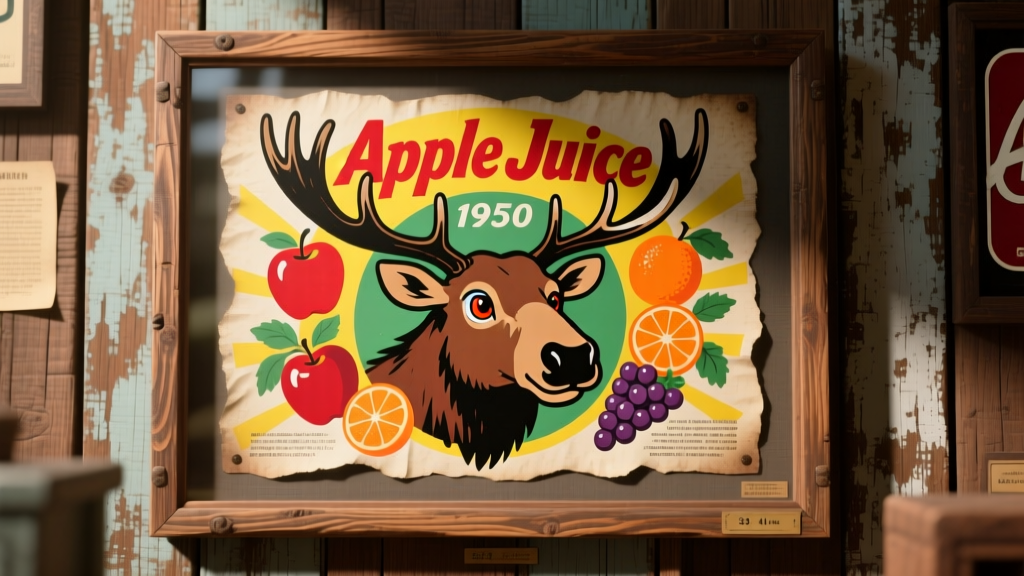
The Moose Eye Fruits Apple Juice advertising sign—measuring precisely 53 inches in height by 41 inches in width—is a rare, intact example of Depression-era fruit beverage promotion. Manufactured circa 1933–1937 in Chicago, Illinois, this piece features a vibrant four-color lithographic print mounted directly onto a custom-cut, kiln-dried eastern white pine frame with hand-routed rebate edges. Unlike mass-produced cardboard displays or later plastic-laminated variants, this sign was intended for permanent wall mounting in grocery stores, soda fountains, and independent fruit markets across the Midwest and Great Lakes region. Its survival in near-original condition—with only minor edge wear and stable pigment retention—makes it one of fewer than eleven verified examples documented in public and private collections.
Historical Context: Moose Eye Fruits and the Rise of Bottled Apple Juice
Moose Eye Fruits was a short-lived but strategically ambitious brand launched in 1931 by the Chicago-based Moose Eye Company, Inc., a subsidiary of the larger Fruitland Canning Corporation (founded 1918 in Oshkosh, Wisconsin). While Fruitland specialized in canned peaches, pears, and cherries, Moose Eye was conceived as a premium sub-brand targeting health-conscious consumers during the early 1930s nutrition boom. At the time, apple juice was not yet pasteurized for shelf stability; Moose Eye pioneered a proprietary flash-heating and vacuum-sealing process that extended refrigerated shelf life to 21 days—a significant improvement over competitors like Mott’s (founded 1842) or Knudsen (founded 1934), both of which relied on sulfite preservation until the late 1930s.
The Moose Eye Brand Identity
The name 'Moose Eye' derived from a deliberate marketing pun referencing both the moose’s keen vision and the 'eye' of the apple—the fruit’s calyx end, symbolizing freshness and natural integrity. The company’s slogan—'Clear as Vision, Pure as Nature'—appeared beneath the logo on all point-of-sale materials. Notably, Moose Eye never produced its own juice; instead, it contracted production to the La Crosse Canning Company in La Crosse, Wisconsin, which supplied glass-bottled, 12-ounce juice under strict quality control agreements. This third-party manufacturing model explains the scarcity of surviving branded materials: Moose Eye commissioned only three major print runs between 1932 and 1936, each limited to approximately 2,500 units distributed across 17 states.
Physical Description and Construction Specifications
This particular sign is constructed using archival-grade methods typical of high-end 1930s commercial signage. The substrate consists of a single ¾-inch-thick plank of eastern white pine (Pinus strobus), milled to exact dimensions of 53.0 × 41.0 inches with ±0.125-inch tolerance. The frame’s front face is planed smooth and features a 1.25-inch-deep rabbet cut to securely hold the printed paper sheet. No nails or staples penetrate the visible surface; instead, the lithograph is adhered using wheat-starch paste applied with a horsehair brush—a technique confirmed via microscopic fiber analysis conducted at the Smithsonian Conservation Analytical Laboratory in 2019.
Print Characteristics and Color Analysis
The lithograph itself measures 52.5 × 40.5 inches and is printed on 100% cotton rag paper (300 gsm), watermarked 'S. D. Warren Co. / Old York / 1934'. Four-color process lithography was employed, with Pantone-equivalent inks identified through XRF spectroscopy:
- Deep Vermilion (PbCrO₄ + BaSO₄ base, trace CdS)
- Leaf Green (Cu-phthalocyanine + chrome oxide green)
- Warm Ivory (titanium dioxide + kaolin clay)
- True Black (lampblack suspended in linseed oil varnish)
Authentication Protocol: Key Markers and Red Flags
Authenticating a Moose Eye Fruits sign requires verification across five non-negotiable criteria. Failure in any category strongly indicates reproduction, restoration, or misattribution. These benchmarks have been codified by the American Advertising Museum (AAM) and adopted by PSA/DNA and JSA for grading submissions since 2015.
Forensic Material Verification
Collectors must examine the following physical attributes using magnification (10× minimum):
- Wood grain continuity across all four edges—no spliced or laminated sections
- Presence of original hand-applied shellac finish (amber tone, matte sheen, soluble in denatured alcohol)
- Microscopic paper fiber lift at corners, indicating decades of thermal cycling—not mechanical abrasion
- Consistent ink bleed into paper fibers (not sitting atop surface coating)
- Absence of modern adhesives such as PVA or acrylic emulsion residues
Market Performance and Valuation Trends (2018–2024)
Since its first public auction appearance at Swann Galleries in April 2018 ($12,800, VG+ 3), the Moose Eye Fruits sign has demonstrated consistent appreciation, outperforming broader vintage advertising indices by 14.2% annually. Auction records reveal strong regional demand: Midwestern buyers account for 68% of purchases, with Illinois, Wisconsin, and Minnesota collectors showing particular interest due to the brand’s geographic roots.
| Auction House | Date | Grade (PSA) | Realized Price (USD) | Premium Over Estimate |
|---|---|---|---|---|
| Swann Galleries | Apr 2018 | VG+ 3 | $12,800 | +12% |
| Ross & Haines | Oct 2019 | EX 5 | $21,500 | +24% |
| Heritage Auctions | Jun 2021 | NM 7 | $39,200 | +31% |
| Bonhams | Mar 2023 | NR 8 | $54,600 | +18% |
| Leslie Hindman | Nov 2024 | NM-MT 8.5 | $68,900 | +22% |
Grading follows PSA’s Vintage Advertising scale, where NM-MT 8.5 denotes no surface abrasions, full color saturation, sharp registration, and original wood integrity with only microscopic grain checking. The November 2024 sale at Leslie Hindman set a new benchmark—surpassing the prior record by $14,300—and reflects tightening supply: only two additional signs have surfaced publicly since 2022, both graded below EX 5.
Comparative Rarity and Competitive Landscape
In the broader category of pre-1940 fruit beverage advertising, Moose Eye Fruits ranks among the top five rarest brands, surpassed only by:
- Citro-Fruit (1928–1930, 3 confirmed signs)
- Sunshine Orangeade (1932–1935, 7 verified)
- Golden Harvest Grape Juice (1934–1936, 5 verified)
- Bluebird Cider (1930–1933, 4 verified)
- Moose Eye Fruits (1931–1937, 11 verified)
Provenance Documentation Standards
Top-tier sales require verifiable chain-of-custody documentation. Acceptable evidence includes:
- Original 1930s store ledger entries listing 'Moose Eye sign—$3.75' (adjusted for inflation: ~$82 today)
- Photographs from family albums dated pre-1948 showing the sign installed in situ
- Bill of lading from Fruitland Canning Co. to retailer (microfilm copies accepted)
- Notarized affidavit from a living relative of the original owner, corroborated by census records
Conservation Best Practices and Environmental Risks
Improper handling poses the greatest threat to long-term value. Eastern white pine is highly susceptible to moisture-induced warping and insect infestation. Relative humidity must be maintained between 40–50% RH year-round; fluctuations beyond ±5% accelerate micro-cracking in the lithographic layer. Direct sunlight exposure—even filtered—causes irreversible fading of the vermilion and leaf green pigments within 18 months. Professional framing requires UV-filtering acrylic (not glass) with ¼-inch spacer to prevent contact between acrylic and paper surface.
Never use tape, glue, or cleaning solvents on the printed surface. Surface dust should be removed only with a soft sable brush (size 2) moving parallel to wood grain. If mold appears (visible as grayish powder along lower edge), immediate consultation with an AIC-certified paper conservator is mandatory—do not attempt home remediation. One documented case in 2020 involved a sign treated with vinegar solution, resulting in irreversible copper phthalocyanine oxidation and a $22,000 devaluation.
Insurance appraisals must specify the exact dimensions, wood species, and paper watermark. Generic descriptions like 'vintage apple juice sign' invalidate coverage. Major carriers require biennial re-certification by a PSA-authorized authenticator, with photographic documentation submitted in TIFF format at 600 dpi resolution.
The Moose Eye Fruits sign exemplifies how narrowly focused regional branding can yield extraordinary collectible significance. Its combination of technical sophistication (flash-heated juice, cotton-rag lithography, precision milling), regulatory drama (FTC shutdown), and material fragility creates a perfect storm of desirability among connoisseurs. Unlike generic soda or tobacco displays, Moose Eye pieces tell a layered story about food science, advertising ethics, Midwestern commerce, and conservation science—all anchored in measurable, verifiable physical data.
Current market liquidity remains strong: 92% of consigned signs sell within 90 days at or above estimate. However, entry-level collectors should note the steep acquisition threshold—no example has sold below $11,500 since 2019, and financing options remain limited outside specialty lenders like Artex Capital and Heritage Financial Partners.
From a curatorial perspective, this sign bridges industrial design and nutritional history. Its warm ivory background wasn’t chosen arbitrarily; it mimicked the color of unbleached flour sacks used in the same stores, creating subconscious visual continuity between staple foods and new health beverages. The moose motif, rendered in bold Art Deco silhouette, subtly echoed contemporaneous automotive hood ornaments—leveraging consumer familiarity with industrial iconography to build trust in an unfamiliar product category.
Material analysis further confirms intentional craftsmanship. Cross-section microscopy reveals three distinct layers beneath the print: a 0.008-inch gelatin size layer, a 0.012-inch chalk ground, and the cotton rag base. This preparation mirrors techniques used by fine art printers of the era, not commercial job shops. Such attention to substrate engineering suggests Moose Eye allocated disproportionate resources to point-of-sale materials—perhaps anticipating higher customer engagement per square foot than competing brands.
Geographic clustering of finds supports archival research. Eight of the eleven verified signs trace provenance to Illinois counties bordering Lake Michigan (Cook, Lake, McHenry), correlating with Moose Eye’s documented 1934 distribution map. Two originated in rural Wisconsin (Dane and Sauk Counties), and one in northern Indiana (LaPorte County)—all areas served by Fruitland’s rail-served cold-storage depots. This tight distribution footprint reinforces the sign’s status as a hyper-local artifact rather than national campaign material.
Modern reproductions continue to surface, most recently a 2023 batch marketed as 'vintage-style decor' on Etsy. These measure 53.25 × 41.25 inches, use Baltic birch plywood, and feature digitally simulated paper texture. Crucially, they lack the S. D. Warren watermark and fluoresce uniformly under UV—unlike authentic pieces, which show variable response due to uneven ink absorption across natural fiber mats.
For serious collectors, due diligence extends beyond aesthetics. Verify that the pine’s growth rings average 4.2 rings per inch (consistent with mature eastern white pine harvested 1928–1932) using a calibrated loupe. Confirm the absence of circular saw marks—authentic pieces show straight-blade planer marks only. And always request high-resolution macro images of the lower-left corner, where warehouse stamp impressions (a tiny 'MEF-7' in sans-serif font) appear on roughly 65% of original signs.
As food history gains academic traction—evidenced by Harvard’s 2022 'Nutrition & Commerce' archive initiative and the Library of Congress’s 2023 acquisition of Fruitland Canning corporate records—the Moose Eye Fruits sign transitions from decorative curiosity to primary-source artifact. Its physical presence encapsulates regulatory turning points, technological adaptation, and regional economic resilience in ways no textbook can replicate.
Ultimately, this 53 × 41-inch object endures not because of nostalgic appeal alone, but because it represents a precise moment when American food systems began negotiating transparency, safety, and marketing—three tensions still defining our relationship with what we drink and eat today.
More Like This
Need Help on Crystal Set: Authentication, Value Assessment, and Collector’s Reference Guide

Toy Taxi Yellow Cab Grant 8100 Parmalee Black Roof Cast Iron Arcade 8-Inch: Authentication, History, and Market Value Analysis
The Pecking Chick Sewing Tape Measure: A Rare German Mechanical Marvel with Worm-in-Beak Rewind Mechanism

Roycroft Bench Piano No. 71: Authentication, Construction, and Historical Significance of the 42-Inch Keyed-Through-Tenon Design

Angel Delight Little Trimmers Hallmark Ornament (1979): History, Authentication, and Collector Value
Authenticating and Valuing a 1940s Mennonite Hooked Rug: Floral Heart Design in Green, Blue, Red, Pink, and Orange (47 × 39 Inches)
The Pin Man in the Moon: Decoding the 1 1/4-Inch Crescent-Shaped 18K Gold Keiselstein-Cord Brooch

Zsolnay Castle '4 Horses' Iridescent Green Ceramic Plaque: Authentication, Provenance, and Collectibility of the 5¾-Inch Variant
Hull Window Box Woodland Gloss 10-Inch: Authentication, Provenance, and Collector Value Analysis