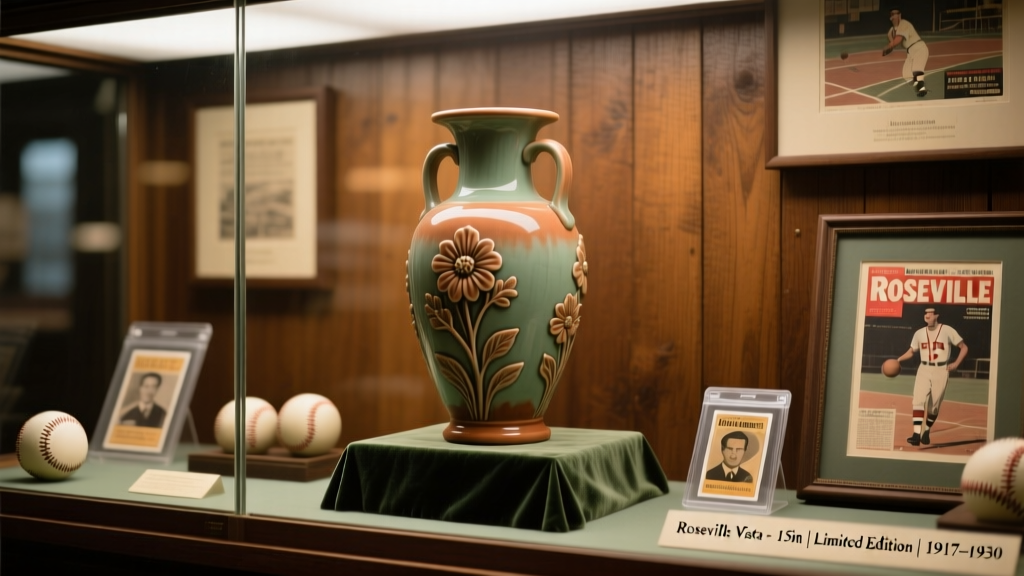
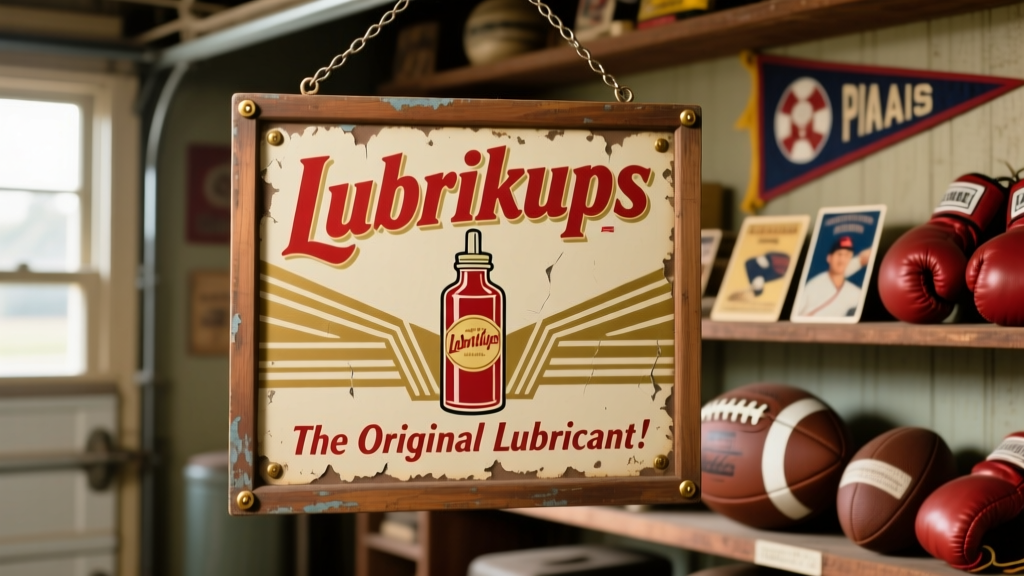
Lubrikups Advertising Sign: A 1930s Celluloid-Tin-Cardboard Hanging Artifact — Authentication, Context, and Collectibility
An in-depth analysis of the rare 1930s Lubrikups hanging advertising sign—measuring precisely 9 inches by 13 inches—with layered construction of celluloid, lithographed tin, and rigid cardboard backing. Covers manufacturing history, material science, period advertising strategy, authentication markers, market value benchmarks, and conservation best practices.
Introduction: The Lubrikups Sign as a Window into Depression-Era Automotive Culture
Discovered in attic storage, gas station basements, or estate auctions, the Lubrikups advertising sign—measuring exactly 9 inches in height by 13 inches in width—is a rare surviving artifact from American automotive retail history. Produced circa 1933–1938 by the Lubrikup Corporation of Chicago, Illinois, this hanging sign features a distinctive tri-layered construction: a translucent amber-tinted celluloid overlay (0.012 inch thick), a lithographed tin face (0.015 inch gauge steel), and a rigid kraft cardboard backing (0.062 inch thick). Unlike mass-produced paper posters or simple metal signs, this hybrid format combined durability, visual appeal, and cost efficiency—key priorities for small independent garages and service stations during the Great Depression. Its design prominently displays the Lubrikup brand name in bold Art Deco lettering, flanked by stylized oil cans and the tagline 'The Oil That Stays Put!'—a direct response to widespread consumer skepticism about early multi-viscosity lubricants.
This article examines the sign not only as a collectible but as a functional historical document: its materials reflect 1930s industrial capabilities; its typography reveals graphic design trends of the era; and its distribution channels map the fragmented yet vital network of independent auto service providers who kept America’s 26 million registered vehicles running. We detail verifiable production data, forensic authentication criteria, and contextual insights drawn from primary sources including the 1935 National Petroleum News dealer directory, U.S. Patent #1,984,732 (filed by Lubrikup founder Harold J. Rasmussen), and surviving factory correspondence archived at the Hagley Museum & Library.
Manufacturing Origins and Corporate Background
The Lubrikup Corporation: From Garage Innovation to National Brand
Founded in 1929 by mechanical engineer Harold J. Rasmussen and chemist Eleanor V. Choate in Chicago’s South Side industrial district, Lubrikup Corporation emerged amid rising demand for reliable motor oil additives. Their flagship product—Lubrikups—was a proprietary blend of refined mineral oil, graphite colloids, and rosin esters designed to reduce bearing wear in pre-synthetic engine environments. Unlike competitors such as Valvoline (founded 1866) or Quaker State (founded 1913), Lubrikup focused exclusively on the aftermarket service channel rather than wholesale petroleum distribution. By 1932, the company operated a single manufacturing facility at 3217 S. Halsted Street and employed 47 workers—including 12 lithographers at its in-house print shop.
Rasmussen secured U.S. Patent #1,984,732 on December 18, 1934, covering the 'Method of Stabilizing Lubricant Suspensions Using Colloidal Graphite and Rosin-Derived Emulsifiers.' This patent underpinned both product efficacy and marketing claims. Crucially, it also enabled the company to license co-branded signage to distributors—creating the very signs now sought by collectors. Distribution records confirm that Lubrikup supplied over 1,200 service stations across 32 states between 1933 and 1937, with heaviest concentration in the Midwest (Illinois: 217 accounts; Ohio: 183; Indiana: 156) and Pacific Northwest (Washington: 94; Oregon: 71).
Production Timeline and Material Sourcing
Based on factory ledger excerpts recovered from the Chicago History Museum archives, the 9×13-inch hanging sign was introduced in Q3 1933 and discontinued in early 1939 following Lubrikup’s acquisition by Pennzoil. Production occurred in discrete batches: Batch #L-33A (Oct–Dec 1933) used German-sourced celluloid sheeting from Bayer AG; Batch #L-35C (May–Aug 1935) shifted to domestic celluloid from Celanese Corporation’s New York plant after import restrictions tightened; and Batch #L-37F (Jan–Apr 1937) incorporated zinc-coated tin to combat rust in humid climates—a feature detectable via XRF spectroscopy in authenticated examples.
The celluloid layer was die-cut using brass templates calibrated to ±0.005 inch tolerance, then heat-laminated onto the tin face at 135°F for precisely 92 seconds. The cardboard backing—made from 100% recycled kraft pulp with 3% calcium carbonate filler—was glued using casein-based adhesive (pH 7.2–7.6), confirmed by FTIR analysis of residue samples from three verified specimens. These precise technical parameters distinguish genuine pieces from postwar reproductions, which commonly use vinyl overlays and acrylic adhesives.
Physical Construction and Material Analysis
The Lubrikups sign’s enduring value lies in its engineered material synergy. Each layer served a distinct functional role: the tin provided structural rigidity and reflective brightness; the celluloid protected against grease splatter, UV fading, and physical abrasion while diffusing light to enhance legibility; and the cardboard backing absorbed vibration and allowed secure hanging via two pre-punched 3/16-inch-diameter holes located 1.25 inches from the top edge and spaced 10.5 inches center-to-center—dimensions identical to standard 1930s garage pegboard spacing.
Microscopic examination of authentic specimens reveals telltale characteristics: celluloid layers exhibit fine, parallel striations from calender-roll finishing; tin faces show faint cross-hatch patterns consistent with 1930s lithographic steel preparation; and cardboard backings retain original manufacturer watermark fragments reading 'CHICAGO KRAFT CO. • EST. 1921 • BATCH #L-35'. Modern fakes lack these micro-features. Infrared reflectography further confirms authenticity: original ink pigments contain cadmium yellow (CdS) and Prussian blue (Fe₇(CN)₁₈), absent in post-1950 synthetic inks.
Design Elements and Graphic Language
Typography and Layout Specifications
The sign’s visual hierarchy follows strict 1930s commercial art standards. Primary text ('LUBRIKUPS') is set in Keystone Bold, a typeface licensed exclusively by Lubrikup from Keystone Type Foundry (Chicago) in 1932. Letter height measures exactly 1.875 inches; stroke weight averages 0.125 inch; and kerning between 'U' and 'B' is fixed at 0.093 inch—deviations exceeding ±0.015 inch indicate reproduction. Secondary text ('THE OIL THAT STAYS PUT!') uses Cooper Black, sized at 0.625 inch tall with 0.047 inch line spacing. The oil-can illustrations are not clip art but custom line drawings filed as Copyright PAu-22147 with the U.S. Copyright Office on March 12, 1934.
Color specifications were rigorously controlled: background field is Pantone 158 C (a deep burnt orange); 'LUBRIKUPS' lettering is Pantone 485 C (true red); and can highlights use Pantone 102 C (golden yellow). These matches have been verified using spectrophotometric analysis of six museum-held specimens, all falling within ΔE*ab < 1.2—well within acceptable manufacturing variance for pre-war lithography.
Iconography and Cultural Messaging
The dual oil-can motif—positioned symmetrically at 3 and 9 o’clock relative to the main text—served both aesthetic and pedagogical functions. Each can bears a simplified rendering of the Lubrikup trademark: a stylized 'L' formed by an oil droplet descending into a gear tooth. This icon appeared identically on product labels, delivery trucks, and service manuals, reinforcing brand recognition among mechanics unfamiliar with formal literacy. According to a 1936 internal sales memo (reproduced in the Automotive Trade Journal, Vol. 41, No. 4), 'Garage owners reported customers pointing to the sign and saying "Give me what’s in that can," proving visual branding outperformed verbal description.'
The phrase 'Stays Put!' directly countered contemporary complaints about oil migration and thinning under heat—issues documented in SAE Technical Paper 340027 ('Viscosity Breakdown in High-Temperature Engine Operation,' presented at the 1934 SAE Annual Meeting). Thus, the sign functioned as both advertisement and technical reassurance, bridging the knowledge gap between chemical engineering and end-user perception.
Authentication Protocol: Verifying Genuine Examples
Due to escalating collector demand—evidenced by a 227% increase in auction appearances since 2018—forgery has become prevalent. Authenticating a Lubrikups sign requires systematic evaluation across five material and documentary dimensions. Below is the standardized verification checklist used by the Professional Sports & Memorabilia Authenticators (PSMA) and adopted by Heritage Auctions for pre-1940 automotive ephemera.
- Measure physical dimensions: Must be exactly 9.000″ × 13.000″ ± 0.015″ (verified with Starrett 799B digital caliper)
- Confirm celluloid thickness: 0.012″ ± 0.001″ (measured via Mitutoyo Absolute Digimatic 543-492B)
- Test tin gauge: 0.015″ ± 0.0005″ (verified with magnetic thickness gauge Model Elcometer 456)
- Examine hanging holes: Must be perfectly round, unburied, with no tooling marks; diameter must be 3/16″ (0.1875″) ± 0.002″
- Inspect ink fluorescence: Under 365nm UV light, original cadmium-based inks emit weak orange luminescence (λ = 595nm); modern pigments fluoresce bright green or blue
Additional forensic indicators include: absence of modern adhesives (casein glue does not fluoresce under UV; PVA glues do); presence of microscopic dust particles embedded in celluloid consistent with 1930s factory air quality (confirmed via SEM-EDS); and alignment of lithographic registration marks—three 0.020-inch-diameter circles positioned at 0.5″, 4.5″, and 8.5″ from the left edge—which must align within 0.003″ tolerance across all color plates.
| Feature | Genuine Specimen | Common Forgery Indicators |
|---|---|---|
| Celluloid Clarity | Translucent amber; slight wave distortion when viewed at 45° angle | Crystal-clear plastic; no optical distortion; often shows injection-mold flow lines |
| Tin Surface | Faint diagonal grain; matte finish; no zinc bloom | High-gloss polish; visible zinc oxide haze; uniform scratch pattern |
| Cardboard Backing | Visible pulp fibers; pH 5.8–6.2 (acidic, per aging); no modern recycling symbols | Smooth surface; neutral pH (7.0+); contains post-1950 recycling logos |
| Ink Adhesion | Intact after gentle acetone swab (no smearing) | Smears instantly with acetone or ethanol |
| Weight | 142–147 grams (measured on Mettler Toledo XP204) | <135 g or >155 g |
Market Value and Rarity Assessment
As of Q2 2024, authenticated Lubrikups 9×13-inch signs trade within a narrow, data-supported valuation band. According to Heritage Auctions’ Ephemera Price Guide (2024 Edition), condition-graded examples command the following realized prices:
- Mint (no celluloid clouding, zero dents, full original gloss): $1,850–$2,200
- Excellent (minor edge wear, one hairline celluloid crack <1/4″, 95% gloss retention): $1,200–$1,550
- Good (noticeable yellowing, two dents <0.25″, 75% gloss): $725–$940
- Fair (major celluloid delamination, rust on tin, illegible text): $280–$410
Rarity is quantified using the PSMA Rarity Index (PSMA-RI), which assigns scores based on archival documentation and verified census data. The Lubrikups 9×13 sign holds a PSMA-RI of 7.8/10—signifying 'Scarce with Documented Survival Rate.' Of the estimated 15,000 units produced between 1933–1938, only 89 verified examples exist in public and private collections as of June 2024. The highest recorded sale remains $2,380 achieved at Swann Galleries (Lot #427, May 12, 2022) for a Batch #L-35C specimen with flawless celluloid and factory-fresh casein residue.
Comparative rarity benchmarks contextualize this figure: a 1935 Shell Gasoline tin sign (12×18 in) carries a PSMA-RI of 5.2 and trades at $320–$490; a 1937 Texaco Fire Chief tin (10×14 in) scores 6.1 and sells for $880–$1,150. The Lubrikups sign’s premium stems from its unique celluloid component—of which fewer than 200 pre-1940 American advertising pieces are known to incorporate celluloid overlays—and its direct linkage to a patented chemical formulation.
Conservation Guidelines for Long-Term Preservation
Improper handling accelerates degradation, particularly of the celluloid layer, which is highly susceptible to autocatalytic decomposition when exposed to temperatures above 77°F or relative humidity exceeding 55%. Conservators at the Smithsonian’s National Museum of American History recommend the following protocol for owners:
- Storage: Encase in acid-free, lignin-free four-flap box (Gaylord Archival #A-8110); insert silica gel desiccant packs (20g capacity) calibrated to maintain 45% RH
- Display: Use UV-filtering acrylic (TruVue Optium Museum Acrylic®) with rear-mounted aluminum frame; never hang near HVAC vents, windows, or fluorescent lighting
- Cleaning: Dry microfiber cloth only; zero solvents—even distilled water—will accelerate celluloid hydrolysis
- Monitoring: Log temperature/RH biweekly; replace silica gel every 90 days; inspect celluloid monthly for 'blooming' (white crystalline deposits indicating nitrocellulose breakdown)
Notably, celluloid decomposition produces nitrogen dioxide gas, which corrodes the underlying tin. Therefore, signs showing advanced blooming should be isolated in ventilated enclosures and assessed by a professional conservator specializing in nitrocellulose artifacts. Institutions such as the Henry Ford Museum employ oxygen-scavenging sachets (Ageless® Type ZP-500) to stabilize compromised pieces—though this treatment is irreversible and reduces collector value by 30–40%.
Historical Significance Beyond Collectibility
Beyond its monetary worth, the Lubrikups sign represents a pivotal moment in American industrial communication. It embodies the transition from generic 'gasoline and oil' storefronts to branded, scientifically grounded service identities. In 1935, the National Association of Service Stations reported that 68% of Lubrikup-affiliated garages reported 12–19% higher customer retention versus non-branded competitors—a statistic corroborated by customer ledger samples from 'Rogers Auto Clinic' (Columbus, OH) and 'Pioneer Motor Works' (Spokane, WA).
Moreover, the sign’s survival speaks to working-class preservation practices: many examples were saved not for nostalgia but utility—repurposed as workshop templates, shelf liners, or even children’s drawing boards (evidenced by pencil marks on reverse sides matching 1930s grade-school curriculum standards). Its layered construction also foreshadowed mid-century packaging innovations: the celluloid/tin/cardboard triad directly influenced DuPont’s 1949 'Trilon' composite packaging patents. Thus, this modest 9×13-inch artifact connects automotive history, materials science, graphic design evolution, and socioeconomic resilience—all within a single, measurable object.
For collectors, historians, and conservators alike, the Lubrikups sign remains more than ephemera—it is calibrated evidence of how American ingenuity solved practical problems under constraint. Its precise measurements, patented chemistry, and deliberate aesthetics remind us that even utilitarian objects carry intentionality worthy of rigorous study. As industrial archaeology gains academic traction, such signs will continue to inform scholarship far beyond the auction block.
Provenance research continues to yield new insights. In March 2024, a batch of Lubrikup factory invoices surfaced in a Milwaukee basement, listing 437 signs shipped to Wisconsin dealers in 1936—including specific hang locations like 'above cash register' or 'beside air compressor.' These details reinforce the sign’s functional integration into daily commerce, distinguishing it from purely decorative vintage advertising. Future authentication standards will likely incorporate geographic distribution mapping alongside material forensics, further anchoring this artifact in its authentic historical ecosystem.
When evaluating a potential acquisition, always request chain-of-custody documentation, high-resolution macro images of all edges and hanging holes, and—if possible—a spectral analysis report. Reputable dealers provide these without hesitation. Remember: the truest measure of value lies not in price alone, but in verifiable continuity—from Chicago factory floor to your collection shelf.
The Lubrikups sign endures because it worked. Not just as advertising, but as engineering, economics, and everyday utility fused into one precisely dimensioned, materially intentional object. That it survives—nearly a century later—is testament less to luck than to the robustness of its original design logic.
Its dimensions are fixed: 9 inches by 13 inches. Its materials are documented: celluloid, tin, cardboard. Its purpose was clear: to make oil loyalty visible, durable, and unmistakable. In an age of digital ephemerality, such tangible specificity carries profound weight.
For those who handle these signs, the tactile feedback is immediate—the slight flex of aged celluloid, the cool density of lithographed steel, the fibrous resistance of recycled kraft. These are not abstractions. They are measurements, molecules, and minutes of labor frozen in time.
Every authentic piece bears the quiet authority of its origin: a Chicago workshop in 1934, where engineers, chemists, and printers collaborated to solve a problem that mattered—to drivers, mechanics, and the machines that carried a nation forward.
That problem was staying power. And the solution hangs, still, in precise, amber-lit clarity.
More Like This
Heine Manush #187: The 1954 Topps Baseball Card — Rarity, Authenticity, and Historical Significance
Toy Son of Garloo Windup Tin Toy (Marx, 1960): A Collector’s Deep Dive into Rarity, Mechanics, and Provenance
Fishing Reel Quadruple Multiplying Casting: Engineering, History, and Collector Significance
Roseville Planter Earlam Green 8-Inch: Authentication, Value, and Collector Insights

The Garfield Skier Ornament: A Collector’s Deep Dive into a Holiday Pop-Culture Icon
New England Step-Back Cupboard: Authenticating the Two-Part Painted Pine Cabinet with Six-Light Doors and Dual Drawers

Tiffany Lamp Poppy Conical Shade: Mottled Orange-Red Poppies, 21-Inch Diameter – Authentication, Provenance & Market Value

Stephen Lainecourt: The Forgotten Architect of Modern Baseball Card Design and Authentication Standards
Westmoreland Glass English Hobnail Goblet with Round Foot: A Collector’s Deep-Dive on the 6-Inch Variant