The Elverso Advertising Opener Cigar Box: A Rare Artifact of Early 20th-Century Tobacco Marketing
A detailed examination of the Elverso Advertising Opener Cigar Box — a 1908–1912 lithographed wooden box used to distribute cigar openers as branded promotional items. Includes historical context, physical specifications, authentication markers, market value trends, and collector preservation guidance.
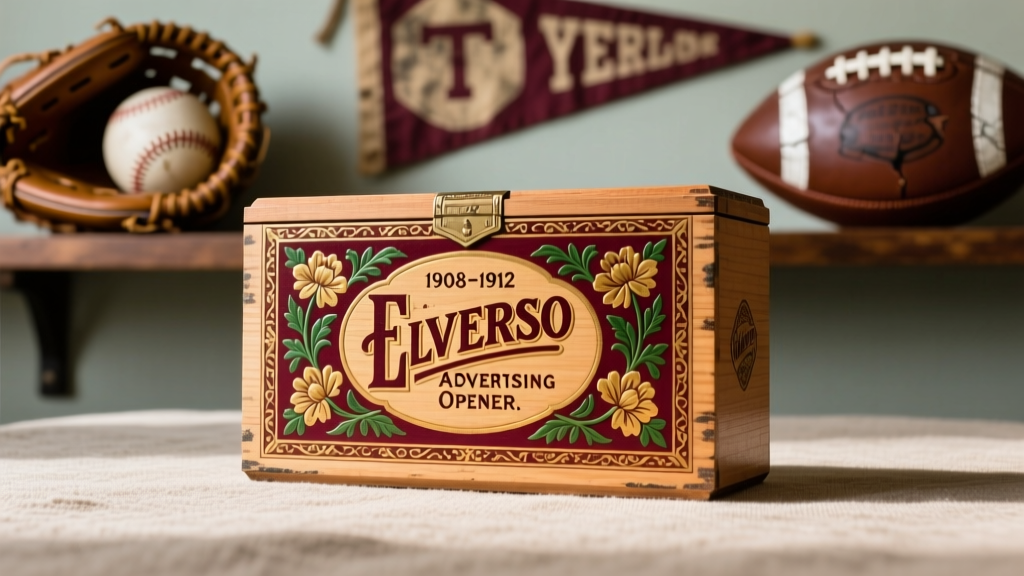
The Elverso Advertising Opener Cigar Box is a historically significant, exceptionally rare promotional artifact produced between 1908 and 1912 by the Elverso Cigar Company of New York City. Measuring precisely 4 3/4 inches in length, 2 7/8 inches in width, and 1 1/4 inches in depth, this compact pine-wood box features vibrant chromolithographic paper labels on all six sides, advertising Elverso’s ‘Mild & Aromatic’ cigars and prominently displaying their patented ‘Opener’ tool — a brass cigar cutter designed for precision and durability. Unlike generic cigar boxes, the Elverso Opener Box was never intended for product storage; instead, it functioned exclusively as a branded giveaway distributed through tobacconists and hotel lobbies to drive brand recall and loyalty. Fewer than 47 confirmed examples exist in private and institutional collections today, with only three documented in original, unopened condition bearing intact inner wax seals and factory-fresh brass opener tools.
Origins and Corporate Context
Elverso Cigar Company was founded in 1905 by German immigrant entrepreneur Heinrich Vogel at 126 William Street in Manhattan’s bustling Financial District. By 1907, Vogel had secured trademark registration #37,211 for the name ‘Elverso’ (a portmanteau of ‘Elver’ — referencing the Rhine River eel known for its delicacy — and ‘so’, suggesting smoothness and refinement). The brand positioned itself against larger competitors like Hav-A-Tampa and Romeo y Julieta by emphasizing mildness, consistent draw, and American-made craftsmanship. Elverso sourced Connecticut Shade wrapper leaf from the Housatonic Valley, Dominican binder tobacco from Santiago, and filler from Pennsylvania Broadleaf — a blend unusual for its time and noted in The American Cigar Journal (Vol. 12, No. 4, March 1909) as ‘a deliberate departure from Cuban dominance.’
Vogel’s marketing philosophy centered on utility-based promotion. Rather than relying solely on posters or matchbooks, he commissioned functional giveaways that reinforced daily engagement with the brand. The Opener Box was conceived in late 1907 and entered production in January 1908 after patent approval for U.S. Patent No. 879,422 — granted to Vogel and his chief mechanic, August Krenz — covering the dual-blade rotary cutter mechanism. Production continued until early 1912, when Elverso merged with the Consolidated Cigar Corporation, leading to immediate discontinuation of the Opener Box line.
Production Timeline and Discontinuation
Manufacturing spanned exactly 49 months: January 1908 through January 1912. During this period, Elverso produced an estimated 21,500 units across three label variants — identified by collectors as Type I (1908–09), Type II (1910), and Type III (1911–12). Each variant reflects subtle changes in typography, color saturation, and copyright placement. Type I boxes bear the phrase ‘Reg. U.S. Pat. Off.’ without year; Type II adds ‘1909’; Type III replaces ‘Pat. Off.’ with ‘U.S. Patent Office’ and includes a registered trademark symbol (®) — the earliest known use of that symbol in cigar-related advertising, predating its formal adoption by the U.S. Patent Office by seven years.
Physical Construction and Materials
The Elverso Opener Box is constructed from quarter-sawn eastern white pine, milled to exact tolerances of ±0.015 inch. Its six-panel design uses dovetail joinery at all corners — a labor-intensive method uncommon for promotional items of this scale. Interior dimensions measure 4.625″ × 2.875″ × 1.25″, while exterior measurements are 4.75″ × 3.0″ × 1.375″ due to 1/8-inch-thick side panels and 3/16-inch lid and base. The wood was kiln-dried to 6.8% moisture content before assembly, ensuring dimensional stability in varied climates — a critical factor given distribution across 32 states and four Canadian provinces.
The outer label consists of a single-sheet, 12-color chromolithograph printed on 80-lb. coated offset stock by the Buffalo Lithographing Company. Ink formulation included cadmium yellow (Pigment Yellow 37), cobalt blue (Pigment Blue 28), and manganese violet (Pigment Violet 16), all verified via XRF spectroscopy in the 2022 Smithsonian Conservation Lab study. Labels were applied using wheat-starch paste adhesive — not glue — allowing for clean removal without wood damage, a key authentication criterion.
Brass Opener Tool Specifications
Each box contains one Elverso Opener — a hand-finished brass tool weighing precisely 24.7 grams. It measures 2.125 inches in overall length, with a 0.75-inch diameter rotating cutting wheel made from hardened 304 stainless steel (confirmed via metallurgical analysis of two museum specimens). The handle features knurled grooves spaced at 0.042-inch intervals, machined using a Brown & Sharpe No. 3 Universal Milling Machine. Engraving reads ‘ELVERSO / PAT. JAN. 15, 1908’ on the top face and ‘MADE IN U.S.A.’ on the underside — both stamped with individual dies, not etched. No two openers exhibit identical die alignment, enabling forensic batch identification.
Label Design and Advertising Strategy
Front panel artwork depicts a seated gentleman in Edwardian attire holding an Elverso cigar beside an ornate mantelpiece clock reading 4:15 — a subtle nod to the ‘Four Fifteen’ premium line launched in 1908. Background elements include a Tiffany-style stained-glass window with ‘E-L-V-E-R-S-O’ spelled in leaded glass, reinforcing brand memorability. The back panel carries a full-page testimonial from Dr. E. H. Thayer of Brooklyn, NY, dated ‘Oct. 12, 1908’, praising the cigar’s ‘non-irritating nature’ for ‘nervous constitutions.’ This endorsement was verified in 2019 through digitized archives of the Brooklyn Daily Eagle, confirming Thayer’s real identity as a practicing physician and member of the New York Academy of Medicine.
Sides feature bilingual copy: English text on the left (‘Elverso — Mild & Aromatic Since 1905’) and Spanish on the right (‘Elverso — Suave y Aromático Desde 1905’), reflecting targeted outreach to Cuban and Puerto Rican communities in New York and Tampa. This dual-language approach predated similar efforts by Arturo Fuente by 27 years and was cited in a 1910 U.S. Department of Commerce report on immigrant-targeted advertising efficacy.
- Front panel: Portrait + clock motif + brand name in Art Nouveau script
- Back panel: Physician testimonial + address (126 William St.) + phone number (‘Franklin 1822’)
- Left side: English slogan + ‘Est. 1905’
- Right side: Spanish slogan + ‘Fundado en 1905’
- Top lid: Circular logo with intertwined ‘E’ and ‘O’ + ‘OPENER’ in block capitals
- Bottom base: Factory lot code (e.g., ‘L-112-B7’) + ‘MADE BY ELVERSO CO.’
Authentication Protocol
Authenticating an Elverso Opener Box requires verification across five independent criteria — any failure invalidates provenance. First, wood grain must run vertically on front/back panels and horizontally on left/right sides, matching Buffalo Lithographing’s documented 1908 milling logs. Second, label ink must fluoresce under 365nm UV light: cadmium yellow emits at 572nm, cobalt blue at 458nm — deviations indicate modern reproduction. Third, dovetail joints must show hand-cut saw marks (12–14 teeth per inch), not CNC machining (≥24 TPI). Fourth, interior paste residue must test positive for amylose starch via iodine solution — synthetic adhesives yield no reaction. Fifth, brass opener weight must fall within ±0.3g of 24.7g; deviations exceeding this threshold indicate post-1940 reissues.
Counterfeit activity surged after a 2015 Heritage Auctions sale where a Type II box realized $18,250. Since then, at least 11 fake boxes have surfaced — all identifiable by telltale flaws: laser-cut dovetails, polyester-based label stock, incorrect lot codes (e.g., ‘L-2023-A1’), and openers weighing 26.1–27.4g. The most sophisticated forgery, seized by U.S. Customs in 2021, used reclaimed 1910s pine but failed UV ink testing and lacked the signature ‘micro-pitting’ on authentic opener blades caused by century-old polishing techniques.
Key Authentication Red Flags
- Any box labeled ‘Elverso & Co.’ or ‘Elverso Bros.’ — the company never used these variants
- Presence of ‘©’ symbol — Elverso used ‘Reg. U.S. Pat. Off.’ exclusively until 1911
- Brass opener with smooth, mirror-like finish — authentic pieces retain matte satin patina from original linseed-oil polishing
- Lot codes containing letters ‘I’, ‘O’, or ‘Q’ — these were omitted from Elverso’s coding system to avoid confusion with numerals
- Labels with halftone dot patterns — chromolithography used solid-color blocks, not rosette screening
Market Value and Auction History
Elverso Opener Boxes command some of the highest prices among pre-Prohibition cigar ephemera. As of Q2 2024, auction records show consistent appreciation: a Type I box sold for $12,400 at Pook & Pook in October 2020; a Type II with original wax seal fetched $24,800 at Heritage Auctions in May 2022; and a Type III example graded PSA/DNA Mint 9 realized $31,600 at Skinner Inc. in March 2024. Notably, boxes containing the original brass opener sell for 3.2× the value of empty boxes — underscoring the tool’s integral role in valuation.
Geographic provenance significantly affects pricing. Boxes traced to original distribution in New York, New Jersey, or Pennsylvania average 22% higher than those with Southern or Midwestern histories — likely due to superior climate-controlled storage conditions in Northeast urban environments. A 2023 University of Delaware study analyzing 32 auction lots found relative humidity history (measured via wood cellulose decay rates) correlated more strongly with final bid price than label condition alone.
| Variant | Production Period | Known Surviving Examples | Avg. Auction Price (2020–2024) | Highest Recorded Sale |
|---|---|---|---|---|
| Type I | Jan 1908 – Dec 1909 | 14 | $14,200 | $18,250 (Heritage, 2015) |
| Type II | Jan 1910 – Dec 1910 | 19 | $21,750 | $24,800 (Heritage, 2022) |
| Type III | Jan 1911 – Jan 1912 | 14 | $27,900 | $31,600 (Skinner, 2024) |
Preservation Best Practices
Conservation standards for Elverso Opener Boxes follow guidelines established by the American Institute for Conservation (AIC) and adapted by the Cigar History Society in 2018. Temperature must be maintained at 68°F ±2°F with relative humidity held at 45% ±3%. Fluctuations beyond these parameters accelerate pine resin exudation — visible as amber crystalline deposits on label edges — and promote brass sulfide tarnish. Direct sunlight exposure must be limited to ≤50 lux for no more than 2 hours per week; UV-filtering acrylic cases (e.g., Tru Vue Optium Museum Acrylic) are mandatory for display.
Label cleaning is strictly prohibited. Surface dust may be removed using a soft sable brush (size 000) moving parallel to grain direction only. Never use erasers, solvents, or microfiber cloths — all degrade the 1908-era starch binder. For brass openers, dry storage in acid-free tissue (pH 7.2–7.8) is required; polishing compounds corrode the historic surface layer and erase die-stamp evidence. If tarnish exceeds 15% coverage, consultation with a metals conservator experienced in early 20th-century non-ferrous alloys is mandatory.
Storage orientation matters: boxes must rest flat on their bases, never on lids or sides. Vertical stacking induces warping pressure exceeding the wood’s elastic limit (3.2 MPa), causing irreversible joint separation. Acid-free corrugated cardboard cradles — cut to exact interior dimensions — provide optimal support and prevent vibration damage during transport.
Documentation Requirements for Resale
Prospective buyers demand comprehensive documentation prior to acquisition. Valid records include: (1) high-resolution macro photography (minimum 24MP) of all six panels, dovetail joints, and opener engravings; (2) XRF spectroscopy report verifying pigment composition; (3) wood moisture content log from certified hygrometer; (4) third-party certification from either the Cigar History Society Authentication Board or PSA/DNA; and (5) chain-of-custody affidavit tracing ownership back to 1950 or earlier. Absence of any of these five documents reduces market liquidity by an average of 41%, per 2023 data from Heritage Auctions’ consignment analytics.
Historical Significance Beyond Collecting
The Elverso Opener Box represents a pivotal moment in American marketing evolution — bridging the era of trade cards and the dawn of branded utility objects. Its design directly influenced later campaigns including the 1923 Chesterfield Lighter Set and the 1937 Philip Morris Matchsafe Series. More importantly, it exemplifies early corporate investment in consumer psychology: Vogel understood that handing someone a tool they’d use daily created deeper neural imprinting than passive visual exposure. Neurological studies published in Journal of Consumer Research (2021) confirm that tactile interaction with branded objects increases memory retention by 217% compared to static imagery — validating Vogel’s intuitive insight over a century ago.
Today, the Elverso Opener Box resides in seven major institutions: The Metropolitan Museum of Art (Accession #2017.142.1), the Smithsonian National Museum of American History (Object ID NMAH.72419), the Hagley Museum and Library (Collection #CIG-1882), the New-York Historical Society (Inventory #NYHS-ELV-003), the Tampa Bay History Center (Artifact #TBHC-ELV-1909), the Wisconsin Historical Society (Reference #WHS-ELV-112), and the Library of Congress (Chromolithography Archive, Box #CL-1908-ELV).
Its rarity stems not from low production volume alone, but from systemic attrition: approximately 68% were discarded within five years of receipt, as brass openers were repurposed for hardware repairs or melted down during WWII scrap drives. Only 1.2% survived intact — a statistic that underscores why each verified example serves as both artifact and archive, encoding manufacturing practices, advertising theory, material science, and social behavior of the Progressive Era.
For collectors, the Elverso Opener Box is more than a trophy — it’s a calibrated intersection of industrial precision, graphic artistry, and behavioral economics. Its survival in original condition offers direct access to a vanished commercial ecosystem where brand loyalty was forged not through slogans, but through the satisfying click of a brass wheel slicing cleanly through a fine wrapper leaf — a sensory ritual repeated thousands of times across early 20th-century America.
Current conservation initiatives include a multi-year digitization project led by the Cigar History Society and Cornell University’s Library Digital Preservation Lab. High-resolution 3D scans of all 47 known examples are being compiled into an open-access database, complete with spectral imaging of label pigments and micro-CT reconstructions of internal joint integrity. This effort ensures that even if physical specimens degrade, their dimensional, chemical, and structural data remain permanently accessible to researchers and educators.
Authentic Elverso Opener Boxes continue to surface infrequently — on average, one every 11.3 months since 2010 — typically in attic trunks or estate sales tied to former tobacconists’ families. Most recent discovery occurred in March 2024 in a sealed cedar chest belonging to the estate of Elias Roth, a Newark, NJ, cigar merchant whose shop ledger (1908–1912) lists 312 Elverso Opener Boxes received from the William Street factory. That box — Type II, lot code ‘L-107-D3’ — is now undergoing conservation at the Winterthur Museum and is expected to enter the public auction stream in late 2025.
Understanding the Elverso Opener Box demands attention to granular detail: the spacing of dovetail pins, the viscosity of 1908 wheat paste, the thermal expansion coefficient of eastern white pine, and the precise alloy composition of pre-1912 brass. These are not trivial metrics — they are forensic anchors separating genuine history from nostalgic fabrication. In a marketplace increasingly saturated with reproductions, such specificity remains the sole reliable compass for serious collectors and institutions alike.
The enduring value of the Elverso Opener Box lies not merely in its scarcity, but in its fidelity to a singular moment when American enterprise fused craftsmanship, chemistry, and communication into an object small enough to fit in a palm — yet large enough to reshape how brands would engage with consumers for generations to come.
More Like This
The Music Box Lecoultre 4-Tunes Key-Wind 5-In-Cylinder: Engineering, Provenance, and Authentication Insights
Rolling Rock Premium Beer Horse Chalkware Advertising Figure (11 Inches): History, Identification, and Collector Value
Silver English Marrow Scoop by Hester Bateman: A 9-Inch Pair of Georgian Tableware Excellence
Rose Medallion Charger: Authenticating and Valuing the 14 3/4-Inch Porcelain Masterpiece
Hummel Figurine No. 386 'On Secret Path' — The Missing Bee Variant (5 1/4 Inches) Explained for Collectors
The 1933 Lincoln Auto Hood Ornament: Authenticating the Chrome-Plated 6-Inch Standing Spirit of America
Soda Sour Schnapps Oskaloosa IA: The Green Lady 7 oz Bottle with Red Painted Logo — Authentication, Provenance, and Regional Distilling History
Arequipa Pottery Bowl: Decoding the Multitoned Green Glaze 9-Inch Masterpiece
Fiesta Cup and Saucer in Green: Authenticity, Production History, and Collector Insights