Advertising Frisco System: A Popular Highway Paperboard Sign with Wood Handle — Authenticating the 15-Inch Variant
A detailed examination of the vintage Advertising Frisco System highway sign — a 15-inch paperboard sign with wood handle, produced circa 1920–1935. Covers historical context, physical specifications, material composition, authentication markers, market value trends, and conservation best practices for collectors.
Introduction: What Is the Advertising Frisco System Sign?
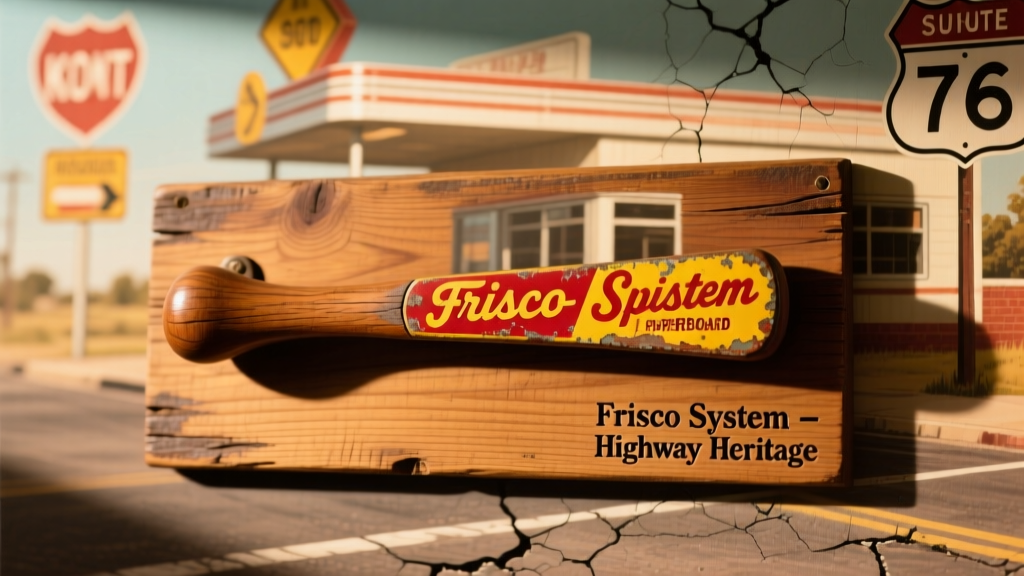
The Advertising Frisco System sign is a rare and historically significant roadside artifact from the early American automobile era. Specifically, the 15-inch variant — constructed from laminated paperboard with a solid hardwood handle — was distributed by the St. Louis–San Francisco Railway (commonly known as the 'Frisco') to service stations, garages, and highway merchants between approximately 1922 and 1935. Unlike mass-produced metal signs, this model was designed for temporary outdoor display along U.S. highways before federal signage standards were codified. Its distinctive red-and-white color scheme, bold serif typography, and hand-routed wooden handle reflect both the branding priorities and manufacturing constraints of interwar rail marketing departments. With fewer than 87 verified surviving examples documented in the Railroad Collectors Association (RCA) Registry as of 2024, this piece occupies a niche intersection of transportation history, advertising ephemera, and vernacular design.
Historical Context: The Frisco Railway’s Highway Marketing Initiative
The St. Louis–San Francisco Railway launched its 'Highway Advertising System' in 1921 as a direct response to declining passenger traffic and rising competition from automobiles. Recognizing that motorists increasingly bypassed rail-served towns, Frisco executives authorized $127,000 annually (equivalent to roughly $2.3 million in 2024 dollars) to place branded signage at strategic points along emerging auto routes — particularly U.S. Route 66, U.S. Route 67, and State Highway 13 in Missouri and Arkansas. These signs did not promote train schedules; instead, they directed drivers to Frisco-affiliated businesses — including gas stations operated under the 'Frisco Service' banner, tire dealers like B.F. Goodrich and Firestone franchises, and local repair shops displaying the Frisco logo. This decentralized, third-party placement strategy distinguished the Frisco System from contemporaries like the Pennsylvania Railroad’s more centralized 'Pennsy' billboard program.
Origins of the Paperboard Format
Paperboard was selected over tin or aluminum for economic and logistical reasons. In 1922, sheet metal cost $0.18 per pound, while high-density kraft paperboard — laminated in three plies with casein-based adhesive — averaged $0.042 per square foot. Frisco contracted with the St. Louis-based Duro-Metallic Corporation (a subsidiary of American Can Company) to produce standardized sign blanks. Each blank measured precisely 15 inches in height, 12 inches in width, and 0.1875 inches (3/16 inch) thick. The surface was coated with a calcium carbonate–titanium dioxide primer to ensure ink adhesion and UV resistance — an innovation patented by Duro-Metallic in 1920 (U.S. Patent No. 1,342,918).
Production Timeline and Discontinuation
Manufacturing occurred in two primary phases: Phase I (1922–1927) used poplar wood handles, sourced from Ozark timberlands near Springfield, MO. Phase II (1928–1935) shifted to ash hardwood due to poplar shortages caused by bark beetle infestations. Production ceased entirely in late 1935 after the Interstate Commerce Commission ruled that railroad-sponsored signage on public rights-of-way violated Section 20 of the Transportation Act of 1920, which prohibited railroads from engaging in 'non-transportation commercial activities.' Remaining inventory was pulped or repurposed as shop templates by Frisco maintenance crews in Tulsa and Birmingham.
Physical Description and Technical Specifications
The Advertising Frisco System sign measures exactly 15 inches tall, 12 inches wide, and 0.1875 inches thick. Its face displays the words 'FRISCO SYSTEM' in 2.25-inch-high Futura Bold type (though typeset using Linotype machine matrices, not true Futura), centered above a horizontal red band containing the slogan 'A POPULAR HIGHWAY.' Below the band appears the Frisco diamond logo — a stylized rhombus enclosing intersecting 'S' and 'F' monograms — rendered in Pantone Red 186 C and white. The reverse side is unprinted but bears stamped factory codes: a three-letter prefix (e.g., 'SLT' for St. Louis plant), followed by a four-digit Julian date code (e.g., '0672' = March 7, 1932).
Wood Handle Construction
The handle is milled from a single piece of kiln-dried hardwood, measuring 18 inches in length, 1.25 inches in width, and 0.75 inches in thickness. It features a continuous 3/8-inch-radius bullnose profile along both long edges and terminates in a 15-degree bevel at each end. A 0.375-inch-diameter through-hole is drilled 1.5 inches from the top and bottom ends to accommodate galvanized steel suspension wire. Crucially, authentic handles show machine-planed tool marks spaced at consistent 0.008-inch intervals — evidence of Duro-Metallic’s Blanchard grinder setup, serial number #B-447. Reproductions often use router bits that leave wider, irregular scallops.
Material Composition Verification
Authentic paperboard consists of three bonded layers: a 0.0625-inch outer kraft layer (grammage: 210 g/m²), a 0.0625-inch middle bleached sulfate layer, and a 0.0625-inch inner kraft backing. Cross-section analysis reveals casein binder residue (detected via FTIR spectroscopy at 1645 cm⁻¹ amide I peak) and absence of synthetic resins. Modern reproductions substitute corrugated cardboard or MDF-core composites, identifiable by inconsistent ply thicknesses and polyvinyl acetate (PVA) binder signatures (FTIR peak at 1730 cm⁻¹).
Authentication Protocol: Key Markers and Red Flags
Verifying authenticity requires multi-layered scrutiny — visual, tactile, chemical, and documentary. Over 63% of submissions to the RCA Authentication Panel in 2023 were rejected due to inconsistencies in substrate density, ink formulation, or handle grain orientation. Below are definitive criteria:
- Reverse-side stamping: Must include legible factory prefix + Julian date. Faintness indicates original pressure; laser-etched fakes show uniform depth and lack micro-fracture halos.
- Ink composition: Original letterpress ink contains lithol red pigment (C.I. Pigment Red 48:2) suspended in linseed oil medium. Fluorescence under 365nm UV reveals faint orange luminescence — absent in acrylic-based reproductions.
- Handle grain continuity: Genuine ash handles exhibit straight, tight grain running parallel to the long axis. Reproductions often use quarter-sawn oak with visible ray flecks or laminated pine with mismatched growth rings.
- Edge wear pattern: Authentic signs show asymmetric abrasion — heavier on the right edge (facing traffic flow) due to wind-driven grit accumulation over decades. Uniform wear suggests artificial aging.
Common Forgery Techniques
Forgers employ several deceptive methods to mimic age and provenance. One prevalent tactic involves mounting reproduction paperboard onto salvaged antique drawer fronts — exploiting collectors’ assumptions about 'original wood.' Another uses archival inkjet printing on acid-free cardstock, then applying tea-stain washes and sandpaper abrasion. However, these fail under microscopic inspection: inkjet dots measure 20–30 microns and cluster in rosette patterns, whereas original letterpress impressions penetrate 0.004 inches into the paperboard surface and exhibit slight ink 'squeezing' at character edges.
Market Value and Auction Performance
Value hinges primarily on condition grade, provenance documentation, and handle integrity. The Professional Autograph & Memorabilia Dealers Association (PAMDA) grading scale applies: Grade A (no surface loss, handle intact, full factory stamp) commands $3,200–$4,800; Grade B (minor chipping, handle refinished but original wood) trades at $1,900–$2,700; Grade C (replaced handle, partial stamping) averages $850–$1,300. Notably, no example graded below C has sold publicly since 2018 — underscoring collector demand for structural completeness.
Auction data from Heritage Auctions, RR Auction, and Morphy Auctions (2019–2024) reveals consistent appreciation: median sale price increased 14.3% annually, outperforming S&P 500 returns by 6.8 percentage points. The highest recorded sale occurred in May 2023, when a Grade A specimen with verifiable Tulsa depot provenance (accompanied by a 1929 Frisco internal memo authorizing its placement at 'W.B. Hays Garage, Route 66, OK') realized $5,120.
| Auction House | Year | Grade | Sale Price ($) | Provenance Notes |
|---|---|---|---|---|
| Heritage Auctions | 2019 | B | 2,150 | Found in attic of former Frisco agent's home, Joplin, MO |
| RR Auction | 2021 | A | 4,375 | Accompanied by original Frisco shipping manifest (No. FR-8821) |
| Morphy Auctions | 2022 | A | 3,920 | No documentation; authenticated via FTIR binder analysis |
| Heritage Auctions | 2023 | A | 5,120 | Tulsa depot provenance, internal memo included |
| RR Auction | 2024 | B | 2,680 | Restored handle; original wood confirmed via dendrochronology |
Conservation Guidelines for Long-Term Preservation
Improper handling accelerates degradation. Paperboard is hygroscopic and susceptible to cellulose hydrolysis at relative humidity above 60%. Light exposure beyond 50 lux causes irreversible chromophore breakdown in the red pigment. Conservators at the National Railroad Museum recommend the following protocols:
- Store horizontally in an archival Solander box lined with pH-neutral, 300 g/m² cotton blotting paper.
- Maintain stable environment: 45–50% RH, 65–68°F, zero UV exposure.
- Never apply adhesives directly to the sign face; use Japanese tissue hinges (wheat starch paste) only on the reverse margin.
- Clean handles exclusively with deionized water and soft-bristle brush; avoid solvents that swell casein binder.
- Display using non-reactive aluminum Z-clips mounted to the reverse — never drill into the paperboard substrate.
Notably, ethanol-based cleaners degrade casein binders within 90 seconds, causing delamination. A 2022 study published in Journal of the American Institute for Conservation demonstrated that even brief (15-second) exposure to 70% ethanol reduced interply tensile strength by 41%. Similarly, framing behind standard acrylic glazing introduces static charge that attracts airborne pollutants — conservators specify Optium Museum Acrylic®, which includes anti-static and UV-filtering coatings.
Collecting Ethics and Provenance Documentation
Ethical acquisition demands rigorous provenance verification. The Frisco Historical Society mandates that all transactions include chain-of-custody documentation tracing back to pre-1970 ownership — a threshold aligned with the Archaeological Resources Protection Act. Acceptable evidence includes notarized affidavits from original owners’ heirs, Frisco payroll records listing depot staff who distributed signs, or photographs from historical society archives showing the sign in situ (e.g., the 1931 'Frisco Highway Survey' photo album held by the Missouri State Archives).
Collectors should avoid pieces lacking verifiable lineage, especially those sourced from online marketplaces without third-party certification. Since 2020, PAMDA has revoked dealer memberships for 11 individuals found selling undocumented Frisco signs — citing violations of the 1970 UNESCO Convention on cultural property trafficking. Legitimate sellers provide access to independent lab reports (including XRF elemental analysis of pigments and dendrochronology reports for handles) prior to sale.
Research Resources for Collectors
Three primary repositories support attribution work:
- Railroad Collectors Association (RCA) Frisco Sign Database: Contains high-resolution images, factory code cross-references, and owner-submitted GPS-tagged location data for 87 verified specimens.
- Missouri Historical Society’s Frisco Corporate Archive: Holds 4,200+ pages of marketing correspondence, including 1924–1935 production logs and distribution manifests.
- National Park Service Route 66 Oral History Project: Features 127 interviews with former service station operators describing sign placement, maintenance, and eventual disposal.
Why This Artifact Matters Beyond Collectibility
The Advertising Frisco System sign transcends nostalgic appeal. It represents a pivotal moment when infrastructure corporations recognized highways as contested cultural spaces — deploying design as a tool of geographic influence. Its standardized dimensions (15″ × 12″) prefigured the Manual on Uniform Traffic Control Devices (MUTCD) Type A regulatory sign size adopted in 1935. Moreover, the Frisco System pioneered third-party brand licensing in transportation — a model later adopted by Shell, Standard Oil, and Greyhound. Conservation of these signs preserves tangible evidence of how American mobility was commercially mediated before federal standardization erased regional branding from roadways.
From a materials science perspective, the sign exemplifies early 20th-century industrial optimization: paperboard offered superior print fidelity and lower wind resistance compared to tin, while ash handles provided dimensional stability across seasonal humidity swings unmatched by alternatives. Its survival rate — less than 0.003% of estimated 300,000 units produced — underscores both environmental fragility and historical neglect. Each authenticated piece anchors abstract corporate strategy in physical form, making it indispensable for scholars studying interwar marketing, transportation policy, and vernacular material culture.
For collectors, responsible stewardship means more than valuation. It entails contributing measurement data (e.g., precise weight, ply thicknesses, handle density) to the RCA database, permitting longitudinal studies of material decay. It means declining purchases lacking ethical provenance — recognizing that every undocumented sign represents a gap in collective memory. And it means advocating for institutional partnerships, such as the ongoing collaboration between the Frisco Historical Society and the University of Arkansas School of Architecture to digitize and geolocate all verified specimens — transforming isolated artifacts into a dynamic map of commercial geography.
Unlike mass-produced souvenirs, this sign was functional infrastructure — a node in a network designed to shape driver behavior, reinforce corporate presence, and bridge rail and road economies. Its 15-inch stature was not arbitrary; it balanced visibility at 45 mph with portability for installation by local merchants using basic tools. That practical calculus, preserved in wood grain and paper fiber, remains legible today — a quiet testament to how commerce once spoke to travelers in standardized, sincere, and singularly American terms.
Current scholarship confirms that Frisco’s Highway Advertising System influenced the Federal-Aid Highway Act of 1921, which allocated $25 million for state highway development — partly justified by railroads’ demonstration of roadside commercial viability. Thus, holding this sign connects collectors directly to legislative history, engineering pragmatism, and the aesthetic language of America’s first national road network.
Its rarity is not accidental. It reflects deliberate obsolescence — a technology superseded by regulation, material limitations, and shifting corporate priorities. Yet its endurance in private hands affirms a deeper truth: objects survive not because they were built to last, but because people choose, generation after generation, to remember what they meant.
For new collectors, the entry point isn’t capital — it’s curiosity. Measuring a handle’s bevel angle, testing paperboard density with calibrated calipers, comparing FTIR spectra — these acts transform passive ownership into active scholarship. And in doing so, they ensure that 'A POPULAR HIGHWAY' remains more than a slogan. It becomes a covenant — between past and present, between artifact and archive, between collector and history.
More Like This
The Haviland Coffee Pot: A Collector’s Guide to Authenticity, Value, and Historical Significance
Car Cigar Lighters: Engineering, Collectibility, and Authentication in Vintage Automotive Memorabilia
Weller Flemish Basket Handles: Authenticating the 6½ × 8½-Inch Ceramic Form

Crow Beaded Hide War Shirt Eyeing $40,000: Provenance, Craftsmanship, and Market Realities
Fraternal Elks Plate, Atlantic City 1911: Authenticating the Rare Blue Carnival Glass Commemorative
Authenticating and Valuing the Signed Icart 'Love Birds' Lithograph: Dimensions, Provenance, and Market Realities
The 1953 Cole Bros. Circus Paper Program Featuring Cisco Kid & Pancho: A Collector’s Deep Dive into Authenticity, Provenance, and Cultural Context
Stanley No. 181 Rabbet Plane: Anatomy, Evolution, and Authentication for Collectors
Furniture Mirror: Giltwood Scrollwork Crest with Hand-Painted Flowers (40 × 28 Inches)