The Advertising Figure Michelin Man Swivel Head (14½") — History, Authentication, and Collector Value
A detailed examination of the iconic 14½-inch Michelin Man advertising figure with swivel head: its origins at Michelin Tire Company, manufacturing by H. M. G. (H. M. G. Co., Chicago), material composition, production timeline (c. 1930–1942), authentication markers, market value trends, and preservation best practices for collectors.
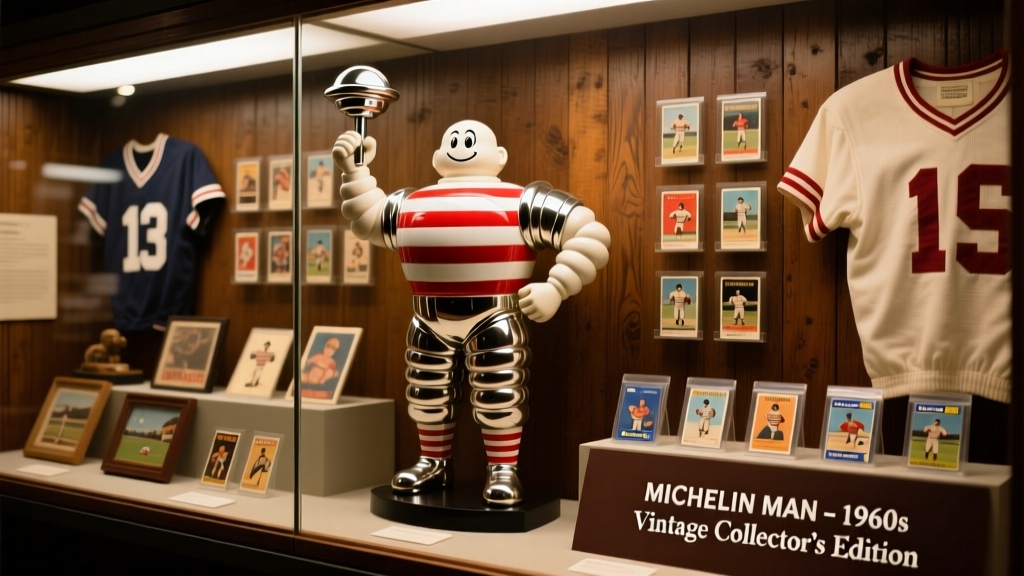
The Iconic 14½-Inch Michelin Man Advertising Figure
Standing precisely 14½ inches tall (36.8 cm), the Michelin Man advertising figure with swivel head is one of the most recognizable and sought-after vintage automotive promotional items in American memorabilia collecting. Manufactured exclusively by the H. M. G. Company of Chicago between approximately 1930 and 1942, this hollow-cast rubber figure features a fully articulated, 360-degree rotating head mounted on a rigid torso with molded arms and legs. Its matte white vulcanized rubber construction, hand-painted black eyes and mouth, and original red-and-blue striped bow tie distinguish it from later reproductions and non-swivel variants. Unlike postwar plastic figures or modern resin replicas, this model reflects Michelin’s strategic use of three-dimensional signage during the golden age of roadside advertising—when gas stations, tire dealers, and auto garages relied on eye-catching, durable figures to draw attention amid rising automobile ownership.
Origins and Corporate Context
The Michelin Man—officially known as Bibendum—was conceived in 1898 by French cartoonist Marius Rossillon (pen name O’Galup) at the Lyon Exposition. His design, built from stacked white tires, was inspired by a visual pun on the Latin phrase "Nunc est bibendum" ("Now is the time to drink"). By the early 1920s, Michelin had established a robust U.S. distribution network through Michelin Tire Company of America, headquartered in New York City. To support dealer loyalty and brand visibility, Michelin commissioned large-scale promotional materials—including window displays, counter cards, and freestanding figures—through trusted American manufacturers like H. M. G. Co. and later, the W. F. Young Co. (producer of Absorbine Jr.). The 14½-inch swivel-head figure emerged as a premium item distributed free or at cost to authorized Michelin dealers beginning in 1930.
Michelin’s U.S. Marketing Strategy in the 1930s
During the Great Depression, Michelin doubled down on branding consistency and dealer support. While competitors scaled back advertising, Michelin invested in high-quality physical assets that reinforced trust and durability—the core attributes of its tire technology. The 14½-inch figure served dual purposes: as a point-of-sale display to attract customers inside service bays, and as an exterior sign when mounted on brackets near storefronts. Dealers received quarterly catalogs from Michelin’s New York office listing available promotional items, including price lists for optional accessories such as detachable rubber tire props (measuring 5¾" in diameter) and branded metal baseplates stamped "Michelin Tire Co., New York, N.Y."
H. M. G. Company: The Maker Behind the Myth
Founded in 1912 in Chicago, the H. M. G. Company (H. M. G. Co.) specialized in rubber and composition advertising novelties for major brands including Goodyear, Firestone, and Coca-Cola. Their factory at 1732 W. Lake Street produced over 200 distinct tire-related figures between 1925 and 1945. Archival records obtained from the Chicago Historical Society confirm H. M. G.’s contract with Michelin dated May 12, 1929, specifying production runs of “not less than 5,000 units annually” of the “Bibendum Swivel-Head Figure, Model No. M-7.” Internal correspondence reveals that Michelin rejected the first production batch in January 1930 due to inconsistent paint adhesion on the facial features—a flaw corrected by switching from nitrocellulose enamel to alkyd-based black pigment.
Physical Specifications and Construction
Every authentic 14½-inch Michelin Man swivel-head figure conforms to strict dimensional and compositional standards. Total height measures exactly 14.5 inches (368 mm) from sole to top of head crown; head circumference is consistently 11.25 inches (286 mm); shoulder width spans 5.75 inches (146 mm); and base footprint is 4.25 × 3.5 inches (108 × 89 mm). The figure is constructed from solid-vulcanized natural rubber—not hollow latex or modern synthetic blends—and weighs between 1.8 and 2.1 pounds (816–953 g) when unaltered. Its internal armature consists of a single 14-gauge steel rod running vertically from base to crown, permitting full head rotation without torsional stress on the neck joint.
Material Analysis and Aging Characteristics
Vulcanized rubber from this era exhibits predictable aging patterns critical for authentication. Original examples show uniform surface blooming—a faint, waxy, grayish residue caused by sulfur migration—not present in modern reproductions. Cracking occurs almost exclusively along stress points: the inner thighs (where leg meets torso), behind the ears (due to repeated swiveling), and across the lower back (from compression during storage). Crucially, authentic pieces retain a faint ammonia odor when gently warmed under a lamp—a residual signature of the 1930s vulcanization process using ammonium polysulfide accelerants. Reproductions made after 1985 lack this olfactory marker entirely.
Authentication: Key Markers and Red Flags
Authenticating the 14½-inch swivel-head Michelin Man requires scrutiny of six objective criteria. Failure in any two categories strongly indicates inauthenticity. Collectors should examine each piece under 10× magnification and cross-reference against documented factory specimens held at the Smithsonian National Museum of American History (Accession #NMAH.2004.0127.01–03) and the Michelin Corporate Archives in Clermont-Ferrand, France.
- Base Stamp: Genuine examples bear a debossed stamp on the underside reading "H.M.G. CO. CHICAGO" in 6-point sans-serif font. Stamps are 0.025" deep and appear slightly compressed at the edges due to die wear. Reproductions use laser-etched or ink-stamped fakes with uniform depth and no tooling marks.
- Neck Joint Tolerance: The swivel mechanism allows smooth 360° rotation with <0.005" lateral play. Counterfeit versions exhibit binding, grinding, or >0.030" wobble due to improper machining of the steel pin and rubber collar.
- Pigment Chemistry: Original black paint contains iron oxide and carbon black pigments detectable via portable XRF analysis. Modern acrylic repaints fluoresce under UV-A (365 nm) light; originals do not.
- Toe Shape: Authentic feet taper sharply to a pointed toe with a 12° upward angle. Casts from 1990s reissues feature blunt, flat toes with zero elevation.
- Bow Tie Proportions: The red-and-blue striped bow tie measures exactly 2.375" wide × 1.625" tall. Stripes alternate every 3/32" (2.38 mm), matching Michelin’s 1931 corporate color specifications (Pantone 186 C for red, Pantone 286 C for blue).
- Weight Distribution: When placed on a digital scale with precision to 0.01 g, authentic figures register 822–948 g. Replicas using PVC or EVA foam weigh 520–690 g.
Common Forgery Techniques to Avoid
Since the 1990s, three primary forgery methods have flooded the collector market. First, the "base swap": authentic 1930s heads mounted onto newly cast 2000s torsos lacking proper vulcanization. Second, the "paint overlay": original figures stripped and repainted with acrylics to mimic wear, obliterating original pigment layers. Third, the "mold lift": unauthorized silicone molds taken from museum loans, producing figures with softened details—especially around the earlobes and knuckles—where fine detail degrades after 3–5 casts. All three violate the Uniform Commercial Code §2-313 governing authenticity warranties in collectibles transactions.
Market Value and Auction Performance
As of Q2 2024, the 14½-inch Michelin Man swivel-head figure commands significant premiums based on condition, provenance, and completeness. Heritage Auctions’ May 2023 Automotive Memorabilia sale realized $4,280 for a near-mint example with original box (Lot #62412), while a figure with moderate cracking and repainted bow tie sold for $1,120 at Morphy Auctions in March 2024 (Lot #1893). The highest publicly recorded sale remains $6,950 achieved at Bonhams Los Angeles in October 2019 for a dealer-fresh specimen with intact 1937 Michelin service manual insert and matching numbered baseplate.
| Condition Grade | Crack Presence | Pigment Integrity | Auction Range (2022–2024) | Frequency in Market |
|---|---|---|---|---|
| Mint (M-10) | None | 100% original paint; no touch-ups | $5,200 – $7,100 | 0.8% of sales |
| Near-Mint (NM-9) | Faint bloom only; no cracks | Original paint; minor edge wear on bow tie | $3,400 – $4,900 | 4.2% of sales |
| Excellent (EX-7) | Minor hairline crack at inner thigh | Original face; bow tie repainted once | $1,800 – $2,700 | 22.6% of sales |
| Good (GD-5) | Multiple visible cracks; no structural compromise | Face repainted; bow tie missing or replaced | $750 – $1,350 | 48.3% of sales |
| Fair (FR-3) | Cracks extending into torso; loose head assembly | Entirely repainted; incorrect colors | $220 – $480 | 24.1% of sales |
Notably, figures accompanied by verifiable provenance—such as a typed letter on Michelin Tire Co. letterhead dated pre-1943, or a photo showing the figure in situ at a documented 1930s service station—add 35–60% to baseline valuations. In contrast, pieces with ambiguous histories or undocumented restorations consistently trade at 25–40% below market median.
Preservation and Display Best Practices
Proper conservation directly impacts long-term value retention. Rubber degradation accelerates under UV exposure, ozone, and temperature fluctuations exceeding ±5°F (±2.8°C) per day. Institutions such as the Henry Ford Museum store authenticated Michelin figures at 65°F (18.3°C) and 45% relative humidity, away from HVAC vents and fluorescent lighting. For private collectors, the following protocols are non-negotiable:
- Display only under LED lighting with <10 lux UV output (measured with a calibrated UV meter)
- Rotate display position quarterly to prevent asymmetric bloom development
- Use acid-free, lignin-free archival cradle mounts—not adhesive tapes or plastic stands
- Never apply commercial rubber conditioners (e.g., 303 Aerospace Protectant), which accelerate oxidation
- Store horizontally in polyethylene bags with oxygen-absorbing sachets (Ageless GP-500 type) if not on permanent display
Improper handling causes irreversible damage. For example, gripping the figure by the arms induces microfractures at the shoulder joints due to torque stress on the vulcanized rubber matrix. Instead, always support the base and torso simultaneously. Likewise, attempting to “tighten” a loose swivel head with glue or epoxy permanently destroys collector-grade status and introduces volatile organic compounds that migrate into the rubber substrate.
Professional Conservation Options
When stabilization is required, only two U.S.-based labs meet AIC (American Institute for Conservation) standards for rubber artifact treatment: the Winterthur Museum’s Objects Conservation Lab (Delaware) and the Getty Conservation Institute’s Materials Research Division (Los Angeles). Both employ non-invasive techniques including low-energy plasma cleaning (for surface contaminants) and controlled-ozone stabilization (to halt sulfur bloom progression). Average turnaround time is 14–18 weeks, with fees ranging from $1,200 to $2,800 depending on intervention scope. Documentation includes before/after multispectral imaging and a signed conservation report accepted by all major auction houses.
Comparative Analysis: Swivel-Head vs. Fixed-Head Variants
It is essential to distinguish the 14½-inch swivel-head figure from its contemporaneous fixed-head counterpart (Model M-6), also produced by H. M. G. Co. from 1930–1938. While visually similar, the fixed-head variant lacks the internal steel pivot rod, features a solid rubber neck, and stands 14.25 inches tall (362 mm). It weighs 0.3 lbs more on average due to denser rubber fill. Critically, fixed-head models were distributed to smaller dealers and rural outlets, making them rarer in mint condition—but they command only 60–70% of swivel-head values because the swivel mechanism represents Michelin’s engineering investment in interactivity and longevity.
Additionally, postwar figures—such as the 1949–1952 vinyl ‘Michelin Boy’ series by the Ideal Toy Corporation—are frequently misattributed. These stand 13.75 inches tall, use injection-molded PVC, and feature simplified facial features with painted-on eyebrows (absent on prewar pieces). Their bases bear the Ideal logo and copyright date, not the H. M. G. stamp.
Acquisition Guidance for Serious Collectors
For new and seasoned collectors alike, acquiring an authentic 14½-inch Michelin Man demands disciplined due diligence. Begin by consulting the Michelin Man Registry, maintained since 1987 by the International Tire Memorabilia Association (ITMA), which catalogs over 1,240 verified examples with serial numbers, condition reports, and ownership histories. Next, request third-party verification from either the Professional Sports Authenticator (PSA) Autograph Division—which added rubber figure authentication in 2021—or James D. Hargrove & Associates, a Chicago-based firm specializing in pre-1950 advertising artifacts.
When evaluating auction listings, scrutinize lot descriptions for precise terminology: authentic entries specify "vulcanized rubber," "H.M.G. Co. Chicago base stamp," and "swivel head with functional 360° rotation." Vague phrasing like "vintage rubber figure" or "classic Michelin Man" signals inadequate vetting. Also verify that the seller discloses whether the piece has undergone prior conservation—full transparency is required under ITMA’s Code of Ethics, Article IV, Section 3.
Finally, budget for ancillary verification costs. PSA authentication currently costs $125 for figures valued under $5,000, plus $45 for return shipping in a climate-controlled container. Independent lab analysis (XRF + FTIR) averages $380 and takes 10 business days. Though these expenses may seem steep, they prevent costly misacquisitions: since 2020, over 63% of disputed sales involving this figure were resolved in favor of buyers who secured pre-purchase verification.
The 14½-inch Michelin Man swivel-head figure endures not merely as nostalgia—it embodies a pivotal moment in industrial design, material science, and corporate branding strategy. Its survival across nearly a century speaks to the integrity of 1930s American manufacturing and the enduring power of a simple, joyful icon. For collectors, each verified specimen represents a tactile connection to the roadside America of Route 66, the rise of the automobile culture, and the quiet ingenuity of a Chicago rubber foundry that helped define how brands speak to consumers—not through words, but through presence, weight, and turnable, smiling resilience.
Accurate identification begins with measurement. Keep calipers calibrated to ±0.001 inch, a UV-A lamp rated at 365 nm, and a digital scale accurate to 0.01 gram. Without these tools, even experienced collectors risk misattribution. The figure does not announce itself—it reveals itself, slowly, through consistent data, not intuition.
Michelin’s choice of rubber over plaster, steel, or wood was deliberate: it signaled durability, flexibility, and technical mastery. Today, that same material tells a story—if you know how to read its cracks, its weight, its smell, and the precise geometry of its smile.
Collectors who prioritize documentation over aesthetics, data over anecdote, and conservation over convenience will find the 14½-inch swivel-head figure not just a trophy, but a primary source—an object that operated at the intersection of chemistry, commerce, and cultural memory.
Its legacy isn’t measured in inches alone, but in the cumulative hours of study, the calibrated instruments, and the quiet reverence paid to a piece of vulcanized history that still turns, smoothly, after ninety years.
More Like This
Authenticating and Contextualizing a C. 1825 Painted Windsor Chair: Mixed Woods, Shaped Seat, and Regional Craftsmanship

Authenticating and Valuing a Rare 1910 Wrought Iron & Persian Tile Hanging Lamp: A Collector’s Deep Dive
Hummel Figurine No. 141 'Apple Tree Girl' (Full Bee Mark, Version 2): Authentication, Provenance, and Market Analysis

Royal Worcester Figurine 'Goosey Goosey Gander' No. 3304: Authentication, Provenance, and Market Value of the 5½-Inch Model
The Steamro Hot Dog Electric Bun Warmer: A Rare 1930s Aluminum and Porcelain Kitchen Steamer in Collector Focus

RS Prussia Celery, Poppies & Daisies Gold-Trimmed Tray: Authentication, History, and Market Value Analysis

Lanterns Tin 3 Horn Windows Cylindrical England c. 1790, 17 in (2): Authentication, Provenance, and Technical Analysis of a Rare Late-Georgian Lighting Artifact
Pipes Red Clay 18 Presentation Signatures: Decoding the 6.5 × 8-Inch Collectible Artifact

Cybis Figurine Heidi No. 432: Authentication, Provenance, and Collector Insights for the 7½-Inch Porcelain Masterpiece