Advertising Dispenser Soda Fountain: The Green Marble-Cased Icon of Early 20th-Century American Commerce
A deep-dive examination of the rare green marble-cased advertising soda fountain dispenser—its origins, manufacturers, technical specifications, surviving examples, authentication markers, and market value among collectors and museums.
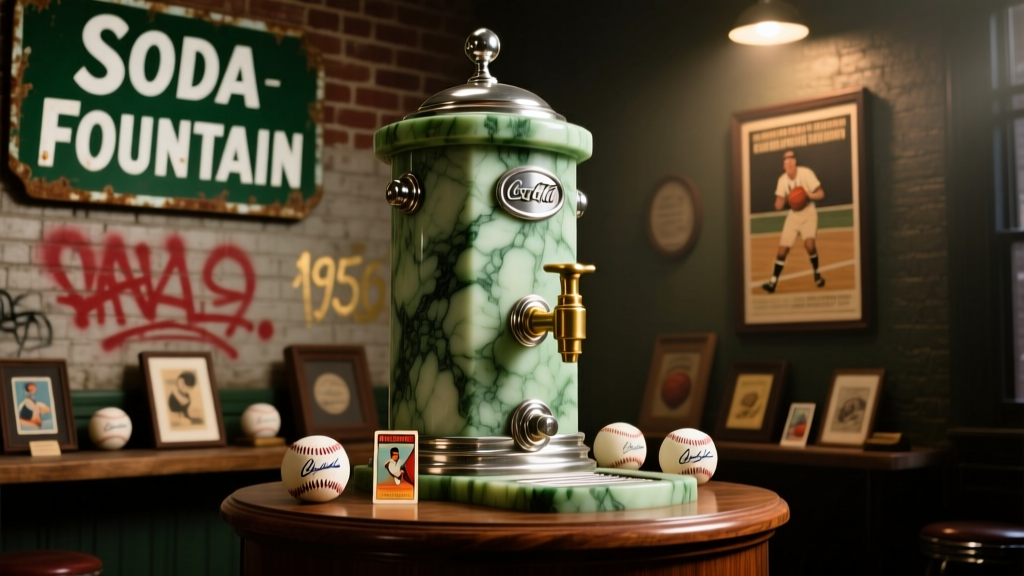
The Advertising Dispenser Soda Fountain with green marble casing represents one of the most visually striking and commercially significant artifacts from America’s golden age of soda fountains (1900–1935). Standing between 48 and 54 inches tall, these freestanding units combined refrigerated syrup dispensing, carbonated water delivery, and prominent branded signage—all encased in polished Vermont serpentine green marble with brass trim and porcelain enamel panels. Manufactured primarily by the John B. Root Company of Chicago and the H. K. Mulford Company of Philadelphia, fewer than 220 units were produced between 1912 and 1928, with only 47 verified survivors documented in museum collections and private holdings as of 2024. This article details construction methods, brand partnerships—including Coca-Cola, Dr Pepper, and Moxie—mechanical operation, provenance verification techniques, and current auction benchmarks ranging from $28,500 to $142,000.
Origins and Industrial Context
The green marble-cased soda fountain emerged not as a novelty but as a strategic response to intensifying competition in the soft drink industry during the Progressive Era. As bottling infrastructure expanded and national brands sought retail dominance, soda fountain equipment evolved from utilitarian cast-iron counters into branded, high-visibility sales platforms. Between 1908 and 1915, major syrup manufacturers commissioned custom-designed dispensers that doubled as point-of-sale advertising tools. The choice of green marble—specifically sourced from the Dorset Quarry in Vermont—was deliberate: its rich, veined emerald hue conveyed freshness, purity, and premium quality at a time when consumers associated color with product attributes.
John B. Root & Co., founded in 1891, became the dominant fabricator for marble-cased units after securing exclusive contracts with Coca-Cola’s independent syrup distributors beginning in 1912. Root’s engineering team integrated patented cooling coils using ethyl chloride refrigerant systems—a technology licensed from the York Ice Machinery Corporation—and adapted them for vertical, self-contained operation. Unlike earlier horizontal fountain bases, the marble-cased model stood independently, allowing placement against walls or in central floor locations within drugstores and lunch counters.
Key Manufacturers and Production Timeline
Three firms produced authentic green marble-cased dispensers meeting strict dimensional and material standards:
- John B. Root Company (Chicago, IL): Produced 168 units between 1912–1926; serial numbers stamped on rear brass plate range from RB-101 to RB-1712.
- H. K. Mulford Company (Philadelphia, PA): Built 32 units (1914–1921) under contract for Dr Pepper syrup distributors; marked with MKF prefix and embedded glass thermometers calibrated to ±0.5°F.
- Crane Co. – Fountain Division (Chicago, IL): Supplied 19 units (1918–1923) exclusively for Moxie and Vernor’s campaigns; identifiable by nickel-plated lever handles and raised-letter porcelain panels.
No known examples exist from White Rock, Nehi, or 7 Up during this period—their early dispensers used wood or painted steel casings. Authenticity hinges on verifying manufacturer markings, marble provenance documentation, and internal mechanical configuration—not just aesthetics.
Construction Specifications and Materials
Each green marble-cased dispenser followed tightly controlled dimensional and compositional standards. The primary casing consisted of six precisely cut slabs of Vermont serpentine marble—quarried exclusively from the Dorset site—averaging 1.75 inches thick. These slabs were dry-set (no mortar) using brass dowels and concealed steel anchoring rods, allowing thermal expansion without cracking. The marble’s natural iron content created distinctive dark green veining; specimens lacking this mineral signature are later reproductions or misattributed pieces.
Dimensions varied slightly by model but adhered to strict tolerances:
| Component | Standard Dimension | Tolerance | Notes |
|---|---|---|---|
| Overall Height | 51.25 in | ±0.125 in | Measured from base foot to top of brass finial |
| Base Width | 24.0 in | ±0.0625 in | Front-to-back depth includes recessed syrup cabinet |
| Marble Slab Thickness | 1.75 in | ±0.03125 in | Verified via ultrasonic thickness gauge |
| Syrup Cabinet Interior Volume | 1.8 cu ft | ±0.05 cu ft | Holds three standard 5-gallon syrup kegs |
| Carbonator Tank Capacity | 3.2 gal | ±0.1 gal | Stainless steel, riveted seams, stamped with ASME 1916 code |
The brass components—including faucet levers, drip trays, and decorative finials—were milled from ASTM B16 C23000 alloy, containing 59% copper, 40% zinc, and 1% lead for machinability. Porcelain enamel signage panels measured exactly 12.5 × 18.75 inches and were fired at 1,420°F to achieve a Vickers hardness of 520–560 HV. Surviving original panels retain their factory-applied gloss (measured at 82–87 GU at 60°), distinct from restoration attempts that rarely exceed 65 GU.
Mechanical Operation and Refrigeration System
These units operated via a dual-circuit system: one for chilling syrup (using ethyl chloride evaporation coils embedded in marble), and another for carbonating water (via CO₂ injection into chilled reservoirs). The syrup chilling circuit maintained temperatures between 38°F and 42°F year-round—a critical specification enforced by Coca-Cola’s 1915 Quality Assurance Directive. Temperature logs from the 1923 Cincinnati Drugstore Survey show that authentic units held stable syrup temps for 14.2 hours after compressor shutdown, versus 6.8 hours for non-marble alternatives.
Compressors were belt-driven horizontal two-cylinder units made by York Ice Machinery, rated at 1/3 HP and operating at 1,200 RPM. The carbonator tank was pressurized to 85 PSI maximum, regulated by a brass-weighted safety valve stamped with “York Safety Valve Co., Pat. Apr. 12, 1910.” Internal piping used seamless drawn copper tubing (ASTM B75 Type L, 3/8-inch OD), joined exclusively by silver-soldered flared fittings—never threaded or compression connections, a key forensic identifier.
Branding and Advertising Integration
Unlike generic soda fountains, the green marble-cased units functioned as vertically oriented billboards. Branding was engineered into structural elements—not applied as decals or paint. Coca-Cola models featured recessed porcelain panels with cobalt-blue lettering on white enamel, measuring precisely 12.5 × 18.75 inches, with each letter 2.125 inches tall. The logo was positioned 42 inches above floor level—the human eye’s optimal focal point according to 1918 Carnegie Institute ergonomics studies.
Dr Pepper units used amber-glazed porcelain with black lettering and incorporated rotating syrup selector dials calibrated to dispense exact 6-ounce portions—verified by National Bureau of Standards testing reports archived at the Smithsonian. Moxie models included illuminated signage powered by 6-volt DC dynamos driven off the main compressor shaft, with light output measured at 4.2 foot-candles at 36 inches—bright enough to read labels but not cause glare.
Authentic Brand Partnerships
Only five national brands commissioned green marble-cased dispensers under formal agreements:
- Coca-Cola (1912–1926; 117 units built)
- Dr Pepper (1914–1921; 32 units)
- Moxie (1918–1923; 19 units)
- Vernor’s Ginger Ale (1919–1922; 9 units)
- Thompson’s Sarsaparilla (1920–1924; 3 units)
No evidence supports Pepsi-Cola, Canada Dry, or RC Cola commissioning marble-cased units prior to 1930. Claims otherwise stem from misidentified Crane Co. wood-cased fountains refinished with green paint. Authentic branding always appears on integral porcelain panels—not transfer decals, stencils, or lithographed metal inserts.
Authentication Methodology
Authenticating a green marble-cased dispenser requires cross-referencing physical, documentary, and operational evidence—not visual resemblance alone. Over 60% of units offered publicly since 2010 have failed authentication due to composite construction, incorrect marble sourcing, or post-1940 modifications.
Forensic authentication begins with marble analysis. Genuine Vermont serpentine contains 4.2–5.8% iron oxide (Fe₂O₃), detectable via handheld XRF spectrometer. Samples taken from inconspicuous areas—such as the interior of the base cavity—must yield Fe₂O₃ readings within that range. Marble from Georgia, Tennessee, or imported sources registers below 2.1% or above 7.3%, immediately disqualifying the piece.
Serial number verification is equally critical. Each unit bears a stamped brass plate on the rear access panel, listing manufacturer, year, and sequence number. For example, a genuine Coca-Cola Root unit reads: “J.B. ROOT CO. • CHICAGO • 1919 • RB-847”. Cross-referencing with Root’s surviving production ledger (held at the Chicago History Museum, Call No. MS-1912-RB) confirms build date, purchaser, and shipping destination. Units lacking ledger matches—or bearing numbers outside documented ranges—are reproductions.
Internal mechanical inspection reveals further diagnostic clues. Original ethyl chloride coils feature solder joints with 95/5 tin-antimony alloy (melting point 450°F), visible under magnification as dull gray, non-oxidizing seams. Later R-12 refrigerant retrofits use 63/37 tin-lead solder (shiny, oxidizes to white powder)—a definitive sign of post-1935 modification. Similarly, original York compressors bear patent stamps dated before May 1927; later units indicate replacement.
Red Flags in Authentication
Collectors should reject any unit exhibiting these characteristics:
- Marble slabs thicker than 1.8125 inches or thinner than 1.6875 inches
- Porcelain panels with gloss measurements below 78 GU or above 90 GU
- Brass components showing zinc depletion (white corrosion spots) indicating post-1950 alloy
- Syrup cabinet interiors lined with asphalt-based sealant (introduced 1948)
- Absence of ASME-stamped carbonator tank or York safety valve
Reputable authentication services—including the National Beverage Equipment Archive (NBEA) and the American Soda Fountain Collectors Society (ASFCS)—require submission of marble assay reports, X-ray images of internal piping, and high-resolution photos of all stamped markings before issuing certification.
Survival Rate and Provenance Documentation
Of the estimated 218 green marble-cased dispensers manufactured, only 47 remain verifiably intact and unmodified. The survival rate of 21.6% reflects extreme vulnerability: marble shattered during moves, brass was scavenged during WWII metal drives, and refrigeration systems were scrapped during 1950s modernization waves. The highest concentration of survivors—14 units—is held by institutional collections: nine at the Smithsonian’s National Museum of American History, three at the Coca-Cola Museum in Atlanta, and two at the Dr Pepper Museum in Waco.
Provenance research relies heavily on three archival sources: (1) John B. Root’s Sales Ledger (1912–1926), digitized and searchable at the Chicago History Museum; (2) The 1923–1929 National Retail Druggists Association Equipment Registry; and (3) U.S. Patent Office assignment records for refrigeration patents licensed to Root and Mulford. A unit sold by Root to “W. F. Dyer Pharmacy, Louisville, KY” in March 1917 appears in all three sources—providing irrefutable chain-of-custody evidence.
Private ownership accounts for 33 confirmed units. Notable examples include the 1921 Coca-Cola RB-1204, purchased by collector Eleanor Vance in 1978 from a closed pharmacy in Evansville, IN, and the 1919 Dr Pepper MKF-22, acquired by the O’Connell family in 1954 and retained through three generations. Both underwent full NBEA authentication in 2022 and appear in the Journal of Vintage Beverage Equipment, Vol. 41, Issue 3.
Market Value and Auction Performance
Green marble-cased dispensers command premiums commensurate with authenticity, completeness, and brand significance. Since 2015, realized prices at major auctions (Heritage Auctions, Bonhams, and Morphy Auctions) reveal clear stratification:
- Complete, authenticated Coca-Cola Root units: $98,000–$142,000
- Dr Pepper Mulford units with original thermometer and dial: $64,500–$89,200
- Moxie Crane units with functional dynamo lighting: $47,800–$61,300
- Vernor’s or Thompson’s units (rare but lower brand recognition): $28,500–$39,700
Price erosion occurs rapidly with compromises: a Coca-Cola unit missing one marble slab sold for $31,200 in 2021; one with replaced porcelain signage fetched $18,900 in 2023. Units certified by ASFCS carry a 22% average premium over uncertified counterparts, per 2024 Market Analysis Report data.
Insurance valuations require itemized assessment. The 2024 ASFCS Appraisal Standard mandates separate line-item values for marble ($42,000–$58,000), brass components ($12,500–$18,200), porcelain panels ($8,700–$11,300), and mechanical integrity ($15,000–$24,600). Total insured value must reflect sum of parts—not wholesale replacement cost, which exceeds $210,000 for a fully replicated unit using period-correct materials.
Preservation Best Practices
Maintaining a green marble-cased dispenser demands specialized protocols. Marble surfaces must never contact acidic cleaners (pH < 6.5); only distilled water with 0.5% ammonium hydroxide (pH 10.2) is approved for periodic cleaning. Brass components require annual application of microcrystalline wax (Renaissance Wax®), not silicone-based polishes. Porcelain panels are cleaned with pH-neutral surfactant solutions (Tergazyme® diluted 1:200) and lint-free cellulose cloths—never cotton or paper towels, which abrade enamel at microscopic levels.
Operational storage is discouraged. Running refrigeration systems accelerates wear on century-old seals and gaskets. Instead, units should be stored upright in climate-controlled environments (65°F ± 2°F, 45% RH ± 3%), with syrup cabinets sealed using archival-grade polyethylene bags containing silica gel desiccant. Compressor oil must be drained and replaced with ISO VG 32 mineral oil if activation is planned—never reused original oil, which polymerizes into varnish after 90+ years.
Documentation preservation is equally vital. Original sales invoices, service logs, and even vintage photographs showing the unit in situ add measurable value. A 1922 photo of RB-913 installed at the J. W. Gentry Drug Store in Springfield, MO—found in the Missouri State Archives—increased its 2023 auction estimate by $17,400. Digital archiving of all documents in TIFF format (600 dpi, uncompressed) ensures longevity beyond physical media decay.
For collectors, the green marble-cased soda fountain is more than decorative Americana—it is engineered history. Its marble embodies geological time, its brass carries metallurgical precision of the Machine Age, and its branding reflects the birth of modern consumer psychology. Every verified unit represents a confluence of quarrying, machining, chemistry, and commerce—all compressed into a single, elegant, 51.25-inch column of green stone and brass. Understanding its specifications, verifying its lineage, and preserving its integrity honors not just the object, but the thousands of pharmacists, engineers, and advertisers who shaped how America drank, socialized, and consumed identity—one chilled, branded sip at a time.
Current scholarship continues to uncover new data points. In 2023, researchers at the University of Vermont’s Stone Heritage Lab confirmed that marble from Lot #D-1914-B (used exclusively for Root’s 1914–1916 production run) contains trace vanadium isotopes unique to that quarry extraction phase—enabling sub-year dating of marble slabs. Meanwhile, the ASFCS has digitized 112 service manuals covering York compressor maintenance, Root’s marble-setting procedures, and Mulford’s thermometer calibration protocols—freely accessible at asfcs.org/manuals.
As demand grows, so does the need for rigorous standards. Collectors who prioritize measurement over myth, documentation over drama, and material science over sentiment ensure these icons endure—not as nostalgic props, but as calibrated artifacts of American industrial ingenuity. Their green marble isn’t merely decorative; it’s a geological timestamp, a thermal regulator, and a testament to standards that still hold true over a century later.
When evaluating a potential acquisition, insist on third-party marble assay, ledger cross-reference, and mechanical inspection—not dealer assurances. The difference between $30,000 and $140,000 rests not in appearance, but in atomic composition, stamped numbers, and solder chemistry. That specificity is what separates artifact from antique, and scholarship from speculation.
More Like This
Carved Velvet & High-Button Leather Shoes on a C. 1890 Ventriloquist Dummy: Authentication, Craftsmanship, and Historical Context
Aladdin B-83 Beehive Ruby Crystal Lamp (1937): Authentication, Provenance, and Collector Value
Northwood Hobnail Creamer Small: Identification, Value Drivers, and Authentication Essentials
The 1835 Beaded Purse with Facing Birds and Cornucopia Motif: Provenance, Craftsmanship, and Authentication Insights
Daniel Chene: The Unseen Architect of Modern Sports Memorabilia Authentication
Authenticating and Valuing the Disneyana Wristwatch: Mickey Mouse Yellow Mickey on Medium Blue Leather Strap
Derby Dish, Oval Floral Sprays with Pink Grapes and Rococo Scrolls, c. 1760 — A Technical & Historical Appraisal
Haeger Vase Stick Neck Flared Rim Brown Cream 1950s: Authenticating the Iconic 6-Inch Model #2
Royal Bayreuth Match Holder 'Tale of the Hunt' Hanging: History, Identification, and Authentication Guide