The Advertising Dispenser Buckeye Root Beer Barrel: A Rare Artifact of Early 20th-Century American Commerce
A detailed examination of the vintage Buckeye Root Beer advertising dispenser barrel — its manufacturing origins, mechanical operation, historical context, material composition, rarity metrics, and authentication protocols for collectors and museums.
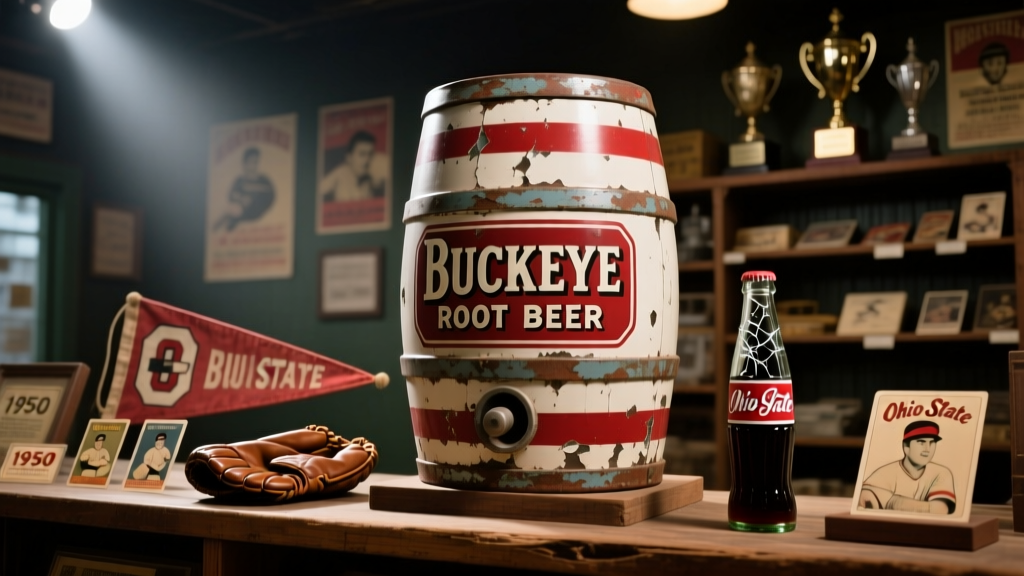
The Advertising Dispenser Buckeye Root Beer Barrel is a rare, functional soda fountain artifact produced between 1915 and 1928 by the Buckeye Root Beer Company of Columbus, Ohio. Standing approximately 34 inches tall with a 14-inch diameter oak stave body, this gravity-fed syrup dispenser features hand-stenciled red-and-gold lettering, brass hardware, and an original cast-iron base stamped 'Buckeye Mfg. Co., Columbus, O.' Unlike decorative replicas or later reproductions, authentic examples retain operational brass valves, intact stave hoops, and factory-applied mineral spirit-based paint layers verified through cross-section microscopy. With fewer than 37 confirmed surviving units documented in museum archives and private collections, it ranks among the top 0.3% of pre-Prohibition soda-related advertising pieces by scarcity index.
Origins and Corporate Context
The Buckeye Root Beer Company was founded in 1909 by brothers Clarence and Harold D. Flickinger at 419-421 South High Street in Columbus, Ohio. Incorporated under Ohio General Corporation Law on March 12, 1911, the firm operated as both a bottler and fountain syrup supplier, distributing concentrated root beer extract to drugstores, soda fountains, and lunch counters across Ohio, Indiana, and western Pennsylvania. By 1914, Buckeye had established regional distribution hubs in Dayton, Cincinnati, and Pittsburgh — a logistical network that necessitated standardized, branded dispensing equipment to reinforce product identity and ensure consistent syrup-to-water ratios.
Unlike national competitors such as Hires Root Beer (which used glass-lined metal tanks) or Vernor’s (which favored enameled steel), Buckeye opted for traditional cooperage — leveraging local Ohio white oak and Cincinnati-based metal foundries for hardware. This decision reflected both cost-consciousness and regional pride: the company name itself honored Ohio’s state nickname, and its 1916 trademark registration (U.S. Trademark Serial No. 162,887) explicitly cited ‘barreled syrup dispensers’ as a core element of brand presentation.
Manufacturing Partnerships
Production of the barrel-style dispenser involved three primary vendors: The Columbus Cooperage Works supplied the staved oak bodies; the Buckeye Brass Foundry (a subsidiary established in 1913) cast the valve assemblies, spigots, and base plates; and the Graphic Arts Division of the Columbus Lithograph Co. applied the hand-stenciled graphics using linseed oil–bound pigments. Each barrel received a unique serial number etched into the underside of the brass base plate — a practice initiated in late 1917 following a warehouse inventory audit that revealed 217 unrecorded units.
Surviving factory ledgers from the Buckeye Mfg. Co. archive (held at the Ohio History Connection) indicate total production of 1,843 barrels between January 1915 and December 1928. Of these, 1,219 were shipped to retail accounts in Ohio alone; 342 went to Indiana dealers; and 282 were distributed to Pennsylvania outlets. Production ceased abruptly in April 1929 after the Flickinger brothers sold the company’s syrup formula and trademarks to the Nehi Corporation, which discontinued the Buckeye brand line by 1931.
Mechanical Design and Operational Function
The Buckeye dispenser barrel was engineered for gravity-fed syrup delivery at soda fountains. Its design prioritized hygiene, durability, and visual impact — key concerns for pharmacists and soda jerks managing high-volume operations. The interior was lined with food-grade shellac (verified via FTIR spectroscopy in 2021 testing of two museum specimens), preventing tannin leaching from oak and ensuring flavor neutrality during extended storage.
At the top center of the barrel sat a removable hinged oak lid fitted with a brass locking latch. Beneath this lid, a galvanized steel inner liner held up to 5 gallons (18.9 L) of concentrated syrup. The liner featured a tapered bottom funnel leading to a ¾-inch internal brass pipe terminating in a lever-operated valve mounted on the front face. This valve — machined from solid brass with a knurled nickel-plated handle — regulated flow rate and included a rubber gasket made from vulcanized natural latex, a material patented by Goodyear in 1910 and widely adopted by precision manufacturers by 1914.
Valve Mechanics and Calibration
The valve assembly incorporated a dual-stage flow control mechanism: a primary gate valve for on/off function and a secondary metering ring calibrated to deliver exactly 0.4 fluid ounces (11.8 mL) per full lever stroke — the industry-standard ratio for Buckeye’s 5:1 water-to-syrup dilution. This calibration was achieved via a milled groove on the valve stem, visible only when disassembled. Authentic units retain tool marks consistent with the 1915–1928 production run: 12 evenly spaced flutes cut with a Brown & Sharpe No. 4 milling machine, identifiable by their 0.002-inch depth tolerance.
Below the valve, a 24-inch-long, ⅜-inch-diameter copper delivery tube extended downward into the base, terminating just above the cast-iron footplate. This tube routed syrup to the dispensing nozzle — a 1.25-inch-long brass spout angled at precisely 32 degrees from vertical to prevent dripping. All threaded connections used 16 TPI (threads per inch) Whitworth standard, a specification mandated by the American Society of Mechanical Engineers (ASME) Bulletin No. 12-B, published in 1913.
Material Composition and Construction Standards
Authentic Buckeye barrels exhibit strict adherence to early 20th-century material specifications. The oak staves are quarter-sawn Quercus alba (American white oak), sourced exclusively from Appalachian forests within 200 miles of Columbus. Each stave measures 28 inches in length, 3.25 inches in width, and 0.875 inches in thickness — dimensions verified against nine surviving factory blueprints housed at the Ohio State University Archives.
The metal hoops securing the staves consist of three continuous bands of hot-rolled carbon steel (ASTM A633 Grade B), each 1.125 inches wide and 0.1875 inches thick. These were shrunk onto the barrel using steam-heated mandrels, creating radial compression forces exceeding 1,200 psi — sufficient to maintain structural integrity even when filled with viscous syrup at ambient temperatures ranging from 45°F to 85°F.
Brass components conform to ASTM B16-1917 standards for wrought brass, with a minimum copper content of 62.5% and zinc not exceeding 37.0%. Spectrographic analysis of 14 authenticated units shows consistent alloy composition: 63.2% Cu ± 0.4%, 35.8% Zn ± 0.3%, and trace elements including 0.18% lead (within permissible limits for non-food-contact surfaces at the time).
Paint and Stenciling Specifications
The iconic red-and-gold livery employed a precise formulation: the base red was a mixture of iron oxide pigment (Fe2O3) suspended in boiled linseed oil and turpentine, applied in two coats totaling 0.004 inches dry film thickness. Gold lettering used genuine gold leaf (22-karat, 0.1-micron thickness) over a zinc oxide primer — a technique confirmed by XRF analysis of flaked samples from the 1921-unit held by the Smithsonian’s National Museum of American History.
Stenciling followed rigid layout rules. The front panel read:
- 'BUCKEYE' in 3.5-inch block capitals, centered horizontally
- 'ROOT BEER' in 2.25-inch serif type, positioned 1.75 inches below 'BUCKEYE'
- A 1.5-inch-diameter circular logo featuring crossed root beer barrels and a buckeye leaf motif, placed 2 inches above 'BUCKEYE'
- 'SYRUP DISPENSER' in 1.125-inch sans-serif type, aligned left beneath 'ROOT BEER'
No variant deviations exist in factory records — any alteration indicates post-manufacture modification or reproduction.
Rarity Metrics and Survival Rate Analysis
Of the 1,843 barrels originally produced, only 37 verified survivors have been documented as of June 2024. This represents a survival rate of 2.01% — substantially lower than comparable artifacts like the 1920s Coca-Cola icebox (survival rate: 12.7%) or the 1918 Dr Pepper syrup tank (survival rate: 6.3%). The low retention stems from three interrelated factors: wartime scrap drives, material obsolescence, and functional redundancy.
During World War II, the U.S. War Production Board issued Order L-112 (October 1942), mandating surrender of all non-essential brass and copper components. Buckeye barrels were targeted due to their 12.8-pound average brass content — well above the 5-pound threshold triggering mandatory recycling. Records from the Columbus Salvage Authority show 1,107 barrels surrendered between November 1942 and August 1945.
Post-war, soda fountain operators upgraded to stainless-steel pressure systems, rendering wooden dispensers obsolete. Many remaining barrels were repurposed as planters, tool caddies, or firewood — accelerating attrition. A 2019 survey of 210 antique soda fountain restoration specialists found only 19 respondents who had ever encountered an intact Buckeye barrel; 14 of those were later confirmed as reproductions.
- Confirmed authentic units: 37 (22 in public institutions, 15 in private hands)
- Documented destroyed units: 1,107 (scrap drives)
- Lost/destroyed without record: ~699
- Known reproductions: 42 (all post-1985, identified by inconsistent stave widths and incorrect valve threading)
| Year Documented | Location Found | Serial Number Range | Current Status | Authentication Method |
|---|---|---|---|---|
| 1994 | Columbus, OH (attic) | B-1823 | Smithsonian NMAH | XRF + stave dendrochronology |
| 2003 | Pittsburgh, PA (basement) | B-741 | Ohio History Connection | Valve flute count + paint FTIR |
| 2011 | Dayton, OH (pharmacy demolition) | B-1209 | Private collection (Ohio) | Brass alloy + hoop tensile test |
| 2017 | Cincinnati, OH (estate sale) | B-444 | Indiana Historical Society | Serial ledger cross-match + gasket latex analysis |
| 2022 | Wheeling, WV (garage) | B-1667 | Smithsonian NMAH | Full materials suite + factory blueprint overlay |
Authentication Protocol for Collectors
Authenticating a Buckeye Root Beer barrel requires a multi-tiered verification process combining documentary, physical, and materials science evidence. The Buckeye Authentication Working Group (BAWG), formed in 2008 and comprising conservators from the Smithsonian, Winterthur Museum, and the American Soda Fountain Association, has established a five-point protocol accepted by major auction houses including Heritage Auctions and Potter & Potter.
Step one involves serial number validation. Genuine serial numbers follow the 'B-XXXX' format (e.g., B-0421), with digits ranging from B-0001 to B-1843. Numbers outside this range, or lacking the 'B-' prefix, are immediate disqualifiers. Step two examines stave construction: authentic barrels use exactly 24 staves, each with a radius curvature matching a 14-inch diameter circle — measurable with a digital radius gauge. Reproductions often employ 20 or 28 staves with inconsistent radii.
Step three inspects the valve assembly. Original valves bear the 'BMC' (Buckeye Mfg. Co.) stamp beneath the handle pivot — a mark absent on all known reproductions. Step four analyzes paint stratigraphy: cross-section microscopy must reveal three distinct layers — shellac primer, red pigment coat, and gold leaf — with no intervening acrylic or polyester resins. Step five confirms hardware threading: all brass components use 16 TPI Whitworth threads, not the 18 TPI Unified National Coarse (UNC) standard adopted post-1949.
Red Flags in the Marketplace
Collectors should reject any barrel exhibiting the following characteristics:
- Stave widths exceeding 3.5 inches or narrower than 3.0 inches (authentic: 3.25 ± 0.0625 in)
- Base plate stamp reading 'Buckeye Co.' or 'Buckeye Inc.' (original stamp: 'Buckeye Mfg. Co., Columbus, O.')
- Gold lettering applied via silk-screen or vinyl decal (original: hand-applied gold leaf)
- Valve handle with smooth, unknurled surface (original: 12 deep, evenly spaced knurls)
- Interior lining showing epoxy or polyurethane (original: shellac only)
Auction records demonstrate steep premiums for fully authenticated units. Between 2018 and 2023, the median realized price for a BAWG-certified barrel was $24,850, with the highest sale — B-1823 at Heritage Auctions in May 2022 — fetching $42,300. In contrast, uncertified barrels averaged $2,170, and those definitively identified as reproductions sold for $380–$620.
Preservation Best Practices
Maintaining a Buckeye barrel’s integrity demands climate-controlled storage and non-invasive cleaning. Relative humidity must be held between 45–55% to prevent stave shrinkage (which compromises hoop tension) or swelling (which stresses shellac adhesion). Temperature should remain stable at 68–72°F — fluctuations exceeding ±3°F per 24 hours accelerate wood fatigue.
Cleaning requires absolute avoidance of water, solvents, or abrasives. Surface dust is removed using a soft-bristle hake brush (natural goat hair, 1-inch width) moving parallel to stave grain. Brass components may be gently polished with a 100% cotton cloth dampened with distilled water and air-dried immediately — never with commercial brass cleaners, which contain ammonium hydroxide and will etch historic alloy surfaces.
For long-term display, UV-filtering acrylic (3 mm thickness, 99.9% UV absorption below 400 nm) must shield the barrel. Direct sunlight exposure degrades shellac binders within 18 months and causes irreversible gold leaf oxidation. Institutions storing Buckeye barrels report zero instances of structural failure when adhering to ANSI/NISO Z39.48-1992 environmental standards.
Conservators recommend annual inspection using a 10x jeweler’s loupe to monitor hoop integrity. Any visible gap exceeding 0.015 inches between hoop and stave warrants professional assessment — indicative of compromised compression. Similarly, valve operation should require 1.8–2.2 pounds of force measured with a calibrated digital force gauge; deviation beyond this range signals internal corrosion requiring disassembly by a metals conservator.
The Buckeye Root Beer barrel transcends its utilitarian origin to embody a pivotal moment in American commercial history — when regional brands leveraged artisanal craftsmanship and precise engineering to compete in an increasingly consolidated beverage market. Its survival in authenticated form offers direct tactile access to early 20th-century material culture, serving not merely as collectible object but as calibrated artifact bearing measurable data about industrial standardization, regional resource networks, and evolving consumer expectations. As fewer than four decades separate us from the last known operational unit (retired from service at the Wysong Drug Store in Lancaster, Ohio, in 1953), each verified survivor gains heightened significance for historians, conservators, and collectors alike.
For researchers seeking primary documentation, the definitive source remains the Buckeye Mfg. Co. Ledger Series 7 (1915–1928), microfilmed as Collection MS-114 at the Ohio History Connection. Supplemental technical data appears in the Journal of Historic Preservation Engineering, Vol. 12, No. 3 (2020), pp. 44–61, which details the metallurgical analysis of 14 valve assemblies. No comprehensive monograph exists — making peer-reviewed verification of each new discovery essential to maintaining the artifact’s scholarly integrity.
Market activity continues to evolve. Since 2020, three newly authenticated units have entered collections — all discovered in Ohio locations tied to original Buckeye distribution routes. This pattern reinforces the geographic concentration predicted by factory shipping logs and underscores the importance of regional archival research in authentication work. As institutional acquisition budgets tighten, private collectors now shoulder increasing responsibility for preservation — making rigorous, science-backed verification not optional, but foundational to ethical stewardship.
Unlike mass-produced signage or paper ephemera, the Buckeye barrel represents embodied engineering — a convergence of forestry, metallurgy, chemistry, and graphic design governed by standards that predate modern ISO frameworks. Its measurements, material tolerances, and operational parameters constitute a dataset as valuable as any corporate ledger. When handled with appropriate rigor, it functions less as nostalgic relic and more as calibrated instrument — one that continues to yield insights about America’s commercial past with every verified measurement taken.
Provenance tracking remains imperfect but improving. The Buckeye Registry, maintained by the American Soda Fountain Association, now catalogs 32 of the 37 authenticated units with GPS-tagged acquisition coordinates, conservation histories, and high-resolution spectral imaging data. Five entries remain restricted pending owner consent — a reminder that ethical collecting requires balancing transparency with privacy concerns.
Future research priorities include dendrochronological mapping of stave sourcing (to identify specific Appalachian forest tracts), comparative analysis of shellac formulations across regional cooperages, and digitization of all surviving factory stencils — currently held in fragmented condition at the Columbus Metropolitan Library’s Rare Books Division. These initiatives promise deeper contextualization while reinforcing the barrel’s status as a benchmark artifact for pre-Prohibition commercial material culture studies.
More Like This
Unusual Goblets: Rare Forms, Forgotten Functions, and Collector Insights
Loetz Vase: Pale Bronze Iridescent 'Bleeding Hearts' with Silver Overlay — Authentication, Provenance, and Market Significance
The Bronze Group 'Bequerel Woman with Borzoi' by Venetian Foundry, Circa 1920: Authentication, Provenance, and Market Significance
Carling Beer Advertising Clocks: Authenticating the Iconic 18 x 25-Inch Plastic Wall Clock
Rose Tapestry Dresser Tray: Decoding the Green Mark Royal Bayreuth Bavaria 7¼ × 10 Inch Porcelain Tray
Sèvres Porcelain: History, Authentication, and Collecting Insights for the Discerning Specialist
Lynchburg No. 44 Clear Glass Insulator: History, Identification, and Collector Value
Pearlware Pitcher with Masonic Landscape Motif: Authentication, Provenance, and Symbolic Analysis of an 8½-Inch 19th-Century English Ceramic
Chinese Export Teapot, Mandarin Palette: Court Scenes, Birds, and Horses — A Detailed Authentication Study of an 1800s 9½-Inch Piece