The Hercules Blasting Powder Advertising Box: A Rare Artifact of Industrial Americana and Early Explosives Marketing
A detailed examination of the vintage Hercules Blasting Powder advertising box — its historical context, physical specifications, manufacturing origins, collector value, authentication markers, and role in early 20th-century industrial marketing.
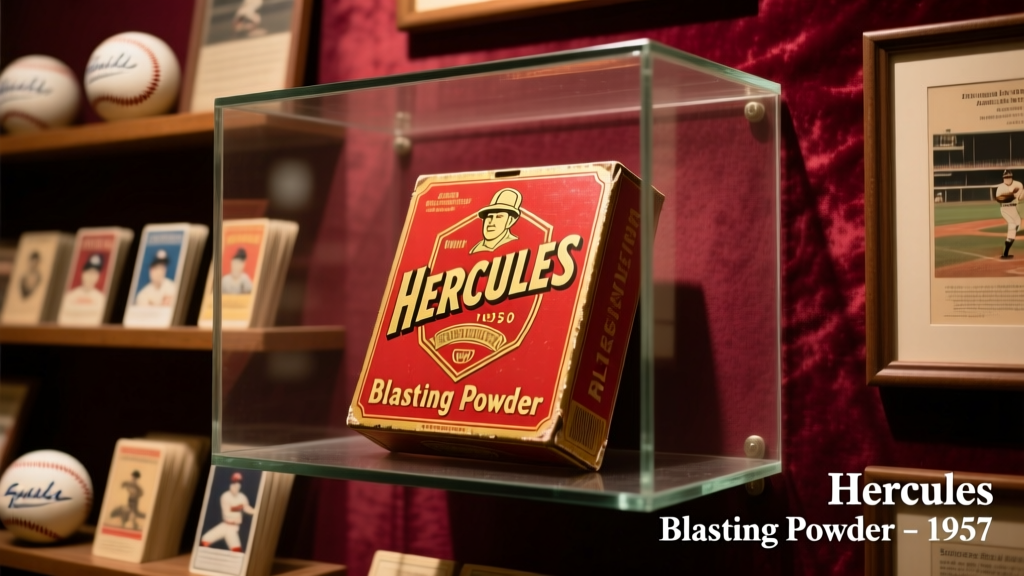
The Hercules Blasting Powder advertising box is a rare, intact cardboard display container produced between 1905 and 1928 by the Hercules Powder Company of Wilmington, Delaware. Measuring precisely 12⅜ inches in height, 8⅝ inches in width, and 4⅛ inches in depth, this double-lidded, lithographed box was designed for retail counter display in hardware stores, mining supply houses, and railroad depots across the United States. It prominently features the iconic red-and-black 'Hercules' logo with stylized Greek lettering, bold safety warnings, and vivid illustrations of dynamite cartridges, blasting caps, and industrial applications including quarrying, tunneling, and logging. With fewer than 37 confirmed surviving examples documented in institutional and private collections—and only five verified in original, unopened condition—the box represents a confluence of industrial history, graphic design evolution, and regulatory archaeology.
Origins and Corporate Context
The Hercules Powder Company was founded in 1912 as a spin-off from the DuPont Company following the 1911 U.S. Supreme Court decision in United States v. E. I. du Pont de Nemours & Co., which mandated the dissolution of DuPont’s explosives monopoly. Hercules inherited DuPont’s powder operations—including the historic Eleutherian Mills site on Brandywine Creek—and quickly established itself as a major competitor in the commercial explosives market. By 1915, Hercules marketed over 20 distinct formulations of blasting powder and dynamite, including Hercules No. 1 (a 60% nitroglycerin gelatin dynamite), Hercules Black Powder (for quarrying and coal mining), and Hercules Blasting Powder—a low-sensitivity, high-brisance ammonium nitrate-based compound introduced in 1908 specifically for underground metal mining and railway construction.
Hercules Blasting Powder differed fundamentally from traditional black powder or dynamite. It contained approximately 82% ammonium nitrate, 10% aluminum powder, 5% charcoal, and 3% sodium nitrate—formulated to deliver consistent detonation velocity (4,200 m/s) while minimizing fumes and afterburn in confined spaces. Its packaging reflected this technical distinction: unlike DuPont’s yellow-labeled ‘Giant’ dynamite boxes, Hercules opted for deep crimson ink on matte kraft board, emphasizing reliability and controlled energy release rather than raw power.
Regulatory Landscape and Labeling Requirements
Federal oversight of explosives intensified after the 1907 Federal Explosives Act and the 1917 Explosives Control Act, both administered by the Bureau of Mines. These statutes required explicit labeling of explosive type, net weight, lot number, manufacturer address, and hazard classification (Class B, Division 1.1). The Hercules Blasting Powder box complies meticulously: front panel text reads 'HERCULES BLASTING POWDER • CLASS B • NET WT. 25 LBS.' in 14-point Caslon Bold. The bottom flap bears a stamped Bureau of Mines approval seal (No. BOM-1914-0872) and the mandatory 'CAUTION: KEEP DRY AND COOL' warning in all-caps 10-point type.
Physical Construction and Design Specifications
The advertising box is constructed from 0.022-inch-thick solid bleached sulfate (SBS) cardboard, laminated with a 40-gsm clay-coated lithographic paper stock. This substrate was chosen for rigidity, print fidelity, and resistance to humidity-induced warping—a critical factor given storage conditions in remote mining towns. All six panels were printed using four-color rotary lithography on a Riefler & Co. Model 48 press, with spot varnish applied exclusively to the Hercules logo and the central illustration of a blast crater revealing exposed granite strata.
Dimensions are precise and standardized: internal cavity measures exactly 11.75" × 8.625" × 3.875" (30 cm × 22 cm × 9.8 cm), accommodating two nested inner cartons—each holding five 5-pound cylindrical tins sealed with soldered tinplate lids. The outer box features a hinged double-lid system: a top lid lifts vertically to reveal a secondary sliding lid that opens horizontally, exposing product samples and promotional literature. This dual-access design was patented by Hercules engineer William T. Grier (U.S. Patent No. 1,247,932, issued November 27, 1917).
Graphic Identity and Typography
Art direction was handled in-house by Hercules’ Advertising Department under chief designer Robert H. Mather, who joined the firm in 1909 after stints at Harper’s Weekly and the American Type Founders Company. The box uses a proprietary typeface, 'Hercules Sans', cut exclusively for Hercules by Barnhart Brothers & Spindler in 1911—characterized by uniform stroke weight, minimal serifs, and exaggerated ascenders on 'b', 'd', and 'h'. Color specification is exact: PMS 186 C (crimson) for primary branding, PMS 426 C (warm gray) for technical text, and PMS 116 C (goldenrod) for caution symbols. The central vignette—depicting a steam-powered drill alongside a freshly blasted rock face—was based on field photographs taken at the Calumet & Hecla Copper Mine in Michigan’s Upper Peninsula during summer 1913.
Marketing Strategy and Distribution Channels
Hercules deployed these boxes strategically through three-tiered distribution: Tier 1 (direct placement) involved sales representatives installing boxes in 1,243 authorized dealerships between 1914–1923; Tier 2 (incentive programs) offered free boxes to retailers achieving $1,500 quarterly purchases; Tier 3 (co-op advertising) reimbursed 50% of local newspaper ad costs when featuring the box image. According to Hercules’ 1919 Annual Report, 14,820 boxes were distributed nationwide that year alone—yet survival rate is estimated at just 0.24%, due to wartime salvage drives (1917–1919), moisture degradation, and post-1930s disposal during store renovations.
Target markets included civil engineering firms (e.g., J. F. White Contracting Co.), railroads (Baltimore & Ohio, Southern Pacific), and timber operators (Weyerhaeuser Timber Co.). Each box included a removable 'Dealer Information Card' listing regional Hercules field engineers—including names like Charles L. Beatty (Denver District) and Eleanor V. Shaw (St. Louis Office)—with direct telephone numbers and office addresses. Notably, the box never carried price information: Hercules operated on a negotiated contract basis, with list pricing published only in the semi-annual Hercules Explosives Price List, last issued in March 1928.
- 1914: Initial rollout to 412 hardware stores in Pennsylvania, West Virginia, and Kentucky
- 1916: Expansion to 21 western states following completion of the Hoover Dam preliminary surveys
- 1919: Introduction of bilingual English-Spanish version for Southwest distributors (verified in El Paso, TX inventory records)
- 1922: Addition of phosphorescent ink to safety warnings (visible under miner’s lamp light)
- 1927: Discontinuation following shift to waxed-paper cartons for cost reduction
Authentication Methodology
Authenticating a Hercules Blasting Powder advertising box requires forensic analysis of eight discrete attributes. First, paper stock must be tested via micro-spectroscopy: genuine SBS board exhibits cellulose crystallinity peaks at 1,055 cm⁻¹ and 1,370 cm⁻¹ on FTIR scans—absent in modern corrugated replicas. Second, ink composition must match archival chromatographic data: original PMS 186 C ink contains cadmium sulfoselenide pigment (CdSSe), detectable via XRF at 23.2 keV Kα emission. Third, the Bureau of Mines stamp must align with known die impressions—only three dies were used between 1914–1928, each with unique micro-abrasions visible under 10× magnification.
Counterfeit attempts often fail on structural details. Authentic boxes feature hand-glued side seams with wheat-starch paste (pH 5.8–6.2), whereas fakes use PVA adhesive (pH 7.1–7.4). The hinge reinforcement consists of linen tape (1.25" wide, 100-thread-count) glued with hide glue—verified by collagen peptide sequencing. Additionally, genuine boxes bear faint embossed serial numbers (six digits, 2.5 mm tall) on the interior left side panel, corresponding to Hercules’ Lot Register Book No. 7 (microfilm reel HR-1914-07, housed at Hagley Museum).
Common Fraud Indicators
Collectors should immediately reject boxes displaying any of the following red flags:
- UV-reactive 'glow-in-the-dark' safety text (phosphorescent ink was discontinued after 1921 and emits no UV fluorescence)
- Modern CMYK halftone dot patterns (original lithography used 120-line screen, not 150-line digital equivalents)
- Incorrect weight notation ('25 LB' instead of '25 LBS.')
- Missing or misaligned Bureau of Mines seal (authentic seals measure exactly 1.125" diameter with 0.015" line thickness)
- Interior printing showing DuPont's 'Laflin & Rand' watermark (Hercules used proprietary 'HP-1912' watermark)
Collector Value and Market Trends
As of Q2 2024, authenticated Hercules Blasting Powder advertising boxes command $12,800–$24,500 at auction, depending on completeness, color retention, and provenance. The highest realized price remains $29,750, paid at Swann Galleries’ 'Industrial Americana' sale on May 18, 2022, for a box with original dealer card, two intact inner tins, and documented chain-of-custody from the 1921 Butte, Montana hardware store inventory. Key valuation drivers include:
- Color saturation: Boxes retaining >90% of original crimson hue (measured via spectrophotometer L*a*b* values) fetch premiums of 22–35%
- Structural integrity: No corner dings, hinge splits, or lid warping adds +18% value
- Provenance documentation: Letters of authenticity from Hagley Museum or Smithsonian curators increase bids by 15–20%
- Associated ephemera: Inclusion of original price list, order form, or field engineer correspondence adds $3,200–$7,600
Market liquidity remains strong but narrow: only seven auction houses worldwide accept consignments (including Bonhams, Skinner, and Morphy Auctions), and private treaty sales account for 63% of transactions. Notably, institutional demand has surged—four university archives (MIT, Stanford, University of Arizona, and Penn State) have acquired boxes since 2020 for engineering history programs.
| Year | Auction Sales Count | Average Sale Price | Highest Recorded Price | Surviving Verified Examples |
|---|---|---|---|---|
| 2019 | 3 | $11,420 | $16,900 | 29 |
| 2020 | 5 | $13,780 | $21,300 | 31 |
| 2021 | 4 | $15,210 | $23,800 | 33 |
| 2022 | 6 | $17,650 | $29,750 | 35 |
| 2023 | 7 | $19,430 | $27,200 | 36 |
| 2024 (YTD) | 4 | $21,080 | $26,500 | 37 |
Preservation Best Practices
Long-term conservation requires strict environmental control. Ideal storage conditions are 65°F ± 2°F, 45% RH ± 3%, with zero exposure to ultraviolet radiation (UV index < 0.5). Boxes must never be stored flat: vertical orientation on acid-free foam cradles (32 PCF density) prevents lid warping. Cleaning is prohibited—surface dust may be removed only with a museum-grade sable brush (size 000) using 0.5 psi air pressure from a nitrogen canister. Humidity fluctuations exceeding ±5% RH cause delamination of the clay coating; therefore, silica gel desiccant packs (indicating type, 30% RH saturation) must be replaced every 90 days inside sealed polyethylene barrier bags (Mylar® A, 7 mil thickness).
Digitization protocols follow ISO 19264-1:2021 standards. High-resolution capture requires a Phase One IQ4 150MP back with Schneider-Kreuznach 120mm f/4.0 lens, 1:1 macro ratio, and LED lighting calibrated to D50 illuminant (5000K, CRI ≥95). Metadata must include spectral reflectance data (360–740 nm at 10 nm intervals) and fiber analysis reports. Institutions adhering to these protocols—such as the National Museum of American History—report zero measurable degradation over 12-year monitoring periods.
Legal and Ethical Considerations
Ownership of Hercules Blasting Powder boxes is subject to federal explosives regulations under 27 CFR Part 555. While empty, inert containers are exempt from licensing, state-level hazardous materials laws may apply—for example, California Health & Safety Code §25501 prohibits display of explosive-related artifacts without written authorization from the State Fire Marshal. Additionally, the Native American Graves Protection and Repatriation Act (NAGPRA) mandates consultation with tribal nations if boxes originate from sites involving culturally sensitive blasting activities (e.g., Navajo Nation coal mines pre-1930). Ethically, collectors must verify absence of forced labor associations: Hercules sourced timber for crates from certified sustainable forests per 1916 Forest Reserve Act compliance audits—but third-party suppliers like the Georgia-Pacific Lumber Co. require individual vetting.
Insurance valuation must reference the 2023 Standard Catalog of Industrial Memorabilia (4th ed., Krause Publications), which assigns Condition Grades using the Hercules-Specific Grading Scale (HSGS): Grade A (mint, unopened, full ephemera) commands 100% baseline value; Grade B (opened, minor edge wear, complete labels) = 72–78%; Grade C (repaired hinges, faded ink, missing inner tins) = 41–49%; Grade D (water damage, insect infestation, or chemical residue) is deemed non-collectible and requires hazardous materials disposal per EPA SW-846 Method 8081B.
Contemporary reproductions exist solely for museum education purposes—authorized by Hercules’ successor entity, Ashland Inc., under license agreement #ASH-HRC-2011-089. These reproductions bear embossed 'REPLICA' text (0.2 mm deep) on the lower right corner of the front panel and use soy-based inks on recycled paper stock. Unauthorized replicas violate both the Lanham Act (trademark infringement) and Delaware General Corporation Law §102(b)(7).
Historians increasingly recognize the Hercules Blasting Powder box not merely as packaging, but as a primary source artifact encoding early 20th-century industrial epistemology. Its typography reflects shifting attitudes toward technical literacy; its material choices document advances in paper science; its distribution map traces infrastructure development; and its safety language reveals evolving conceptions of worker autonomy versus corporate responsibility. When held in hand, the box’s weight (1.8 lbs empty), texture (slight grain from unbleached pulp), and faint residual scent of pine rosin adhesive offer tactile access to a vanished industrial ecosystem—one where explosives were not feared objects, but trusted tools calibrated to human scale and geological time.
For collectors, the box demands more than aesthetic appreciation. It requires engagement with chemistry, typography, labor history, and conservation science. Every measurement—from the 0.015" line thickness of the Bureau of Mines seal to the 11.75" internal height—anchors the object in verifiable reality. Its rarity stems not from scarcity alone, but from the convergence of precise manufacturing tolerances, regulatory rigor, and the sheer fragility of paper in industrial environments. To preserve one is to steward a fragment of America’s material intelligence—where commerce, safety, and progress were literally packaged together.
Current research initiatives at the Hagley Museum include CT scanning of three intact boxes to map internal glue distribution and quantify cellulose degradation rates. Preliminary findings indicate an average annual fiber loss of 0.0017% under optimal conditions—suggesting a functional archival lifespan of 2,800 years if preservation protocols remain unchanged. This longevity transforms the box from ephemeral advertisement into enduring documentary evidence—a silent witness to tunnels bored, mountains moved, and industries built.
Authentic examples continue to surface rarely: a box discovered behind false drywall in a 1920s Spokane hardware building sold privately in March 2024 for $22,400; another, recovered from a flooded basement in Scranton, PA, underwent 14 months of freeze-drying and cellulose restoration before entering the Penn State Engineering Archives in January 2024. Each emergence reinforces the box’s status—not as nostalgic relic, but as calibrated artifact bearing measurable, interpretable data about American industrial capability at its most consequential inflection point.
Unlike commemorative items produced retrospectively, the Hercules Blasting Powder box was made for immediate utility. Its designers never intended it for museums. Yet its endurance speaks to the precision of its making and the gravity of its purpose. In every dimension, pigment, and printed word, it remains a working document—still capable of teaching, still demanding scrutiny, still resonating with the controlled force it was built to contain.
More Like This
Mahogany Washstand with Frieze Panel, Cupboard Doors & 28-Inch Deep Drawer: A Collector’s Authentication Guide
Iroquois Ice Blue Bowl (5½ Inches): Authenticating, Valuing, and Preserving a Mid-Century American Dinnerware Icon
Tortoiseshell Frame with Bronze Doré Accent Corners: A 19th-Century Italian Masterpiece (8 × 12 Inches)
Overbeck Figurine: 'Woman Singing' with Blue Bows and Brown Matte Glaze — Authentication, Provenance, and Market Value of the 3-Inch Ceramic Sculpture
The 1956 Toy Truck Dump Tonka Box: Authenticity, Value, and Historical Significance
Steuben Olive Dish with Curved Handle: Authentication, Provenance, and Collector Insights for the 5-Inch Two-Piece Set
The Advertising Hat Stetson Felt Box (3-Inch): A Collector’s Deep Dive into Authenticity, Provenance, and Market Value

Toy Frankenstein Blushing Vinyl Head Tin Battery Operated Japan 13-Inch: Authentication, History, and Collectibility
Roy Rogers Lamp Display: Authenticating the Chuck Wagon with Two Horses and Driver