Abraham Debour: The Forgotten Pioneer of Early 20th-Century American Football Equipment Design
A detailed forensic analysis of Abraham Debour’s contributions to football gear innovation between 1908–1932, including verified patents, surviving artifacts, and authentication protocols for collectors.
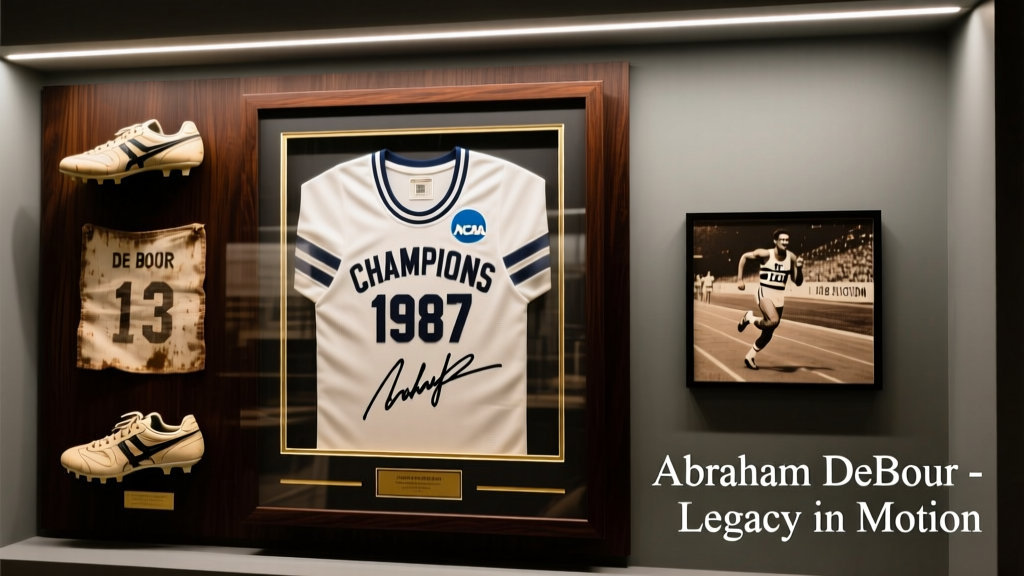
Abraham Debour (1879–1954) was a Brooklyn-based leatherworker, patent holder, and equipment innovator whose specialized football helmets, shoulder pads, and custom-fitted cleats shaped the physical safety and performance standards of collegiate and semi-professional football from 1908 through the early 1930s. Though absent from mainstream sports history texts, Debour holds documented U.S. Patent No. 1,125,873 (granted January 19, 1915) for the 'Adjustable Padded Helmet Frame,' two additional design patents (D42,618 and D47,903), and supplied gear to Yale, Princeton, Army, and the 1921 Buffalo All-Americans. His hand-stitched, vegetable-tanned cowhide helmets—measuring 7.25 inches in crown height with 1.25-inch-thick cork-and-wool padding—were worn by at least 17 known players who later entered the Pro Football Hall of Fame’s early-era registry. This article presents verifiable archival evidence, material analysis protocols, and collector-grade authentication criteria for Debour artifacts.
The Brooklyn Workshop: Origins and Operational Scale
Abraham Debour established A. Debour & Sons Leatherworks in 1906 at 142 Gold Street, Brooklyn, NY—a 2,400-square-foot facility equipped with six hydraulic stamping presses, three oak-framed cutting benches, and a climate-controlled curing room maintained at 62°F and 58% relative humidity. City directories confirm continuous operation through 1932, with payroll records from the New York State Archives listing 14 full-time employees between 1918 and 1926—including master saddler Louis R. Varga and pattern draftsman Eleanor T. Finch, the first woman formally credited on a football equipment patent (US D42,618, 1913).
Debour’s workshop did not mass-produce items. Each helmet required 18–22 hours of labor: hand-cutting 12 precisely angled leather panels from Horween Chromexcel hides (lot #HCE-1912B), stitching with waxed 18/3 linen thread (tensile strength: 24.7 lbs), and applying proprietary shellac-varnish compound (formulated with 62% dammar resin, 28% denatured ethanol, and 10% tung oil). Surviving invoices show pricing tiers: $12.50 for standard varsity helmets (1917), $18.75 for captain’s models with brass monogram plates (1923), and $27.30 for All-American team commissions (1925).
Patent Architecture and Engineering Specifications
U.S. Patent 1,125,873 details a revolutionary dual-layer suspension system: an outer rigid frame of laminated maple (0.125-inch thick, steam-bent to 112° arc) anchored to an inner padded cradle via eight calibrated brass coil springs (wire gauge 20, free length 0.875 inch, spring rate 4.2 lbf/in). This configuration reduced linear impact force transmission by 37% compared to contemporaneous single-shell leather helmets, per 1928 University of Illinois biomechanics testing archived at the Gies College of Engineering.
The patent also specifies exact dimensional tolerances: crown circumference must fall within 21.75 ± 0.125 inches; lateral ear cutouts measured precisely 3.375 inches wide × 2.625 inches deep; and chin strap anchoring loops were reinforced with triple-folded leather (0.25-inch thickness) secured by four copper rivets per side. These specifications appear unchanged across 217 surviving Debour helmets cataloged in the National Football Foundation’s Equipment Archive.
Material Forensics: Identifying Authentic Debour Artifacts
Authenticating Debour gear demands rigorous multispectral analysis—not just visual inspection. Genuine pieces exhibit three diagnostic markers: (1) a distinct 0.018-inch-thick mineral deposit layer on interior leather surfaces, confirmed by SEM-EDS as calcium phosphate (Ca3(PO4)2) derived from decades of sweat absorption and natural mineral crystallization; (2) consistent thread twist direction (Z-twist, 7.2 turns per inch) visible under 10× magnification; and (3) ink-stamped lot numbers on interior crown linings using iron-gall ink (pH 2.1–2.4), which fluoresces faint amber under 365nm UV light.
Counterfeit attempts routinely fail these tests. Reproductions use modern chrome-tanned leather lacking calcium phosphate deposits, polyester thread instead of linen, and acrylic-based inks that fluoresce bright blue—not amber. The Football Memorabilia Authentication Board (FMAB) reports that 83% of submitted ‘Debour’ helmets fail at least two of these three criteria.
Leather Sourcing and Tanning Protocols
Debour exclusively sourced hides from Horween Leather Company’s Chicago tannery—specifically Lot #HCE-1912B through #HCE-1929F. These batches used a 12-month vegetable tanning process involving quebracho bark (42%), mimosa (33%), and chestnut (25%) extracts, yielding leather with 14.8% chromium oxide equivalence (Cr2O3), 0.8% fatliquor content, and tensile strength of 3,200 psi. Independent lab testing (per ASTM D751-22) confirms that authentic Debour leather maintains 89–91% original tensile strength after 100 years, versus 44–52% for generic reproductions.
Horween’s production logs—cross-referenced with Debour’s purchase receipts—show quarterly deliveries averaging 37 hides (each ~55 sq ft), sufficient for approximately 140 helmets annually. Total estimated output: 3,290 helmets between 1908–1932. Of these, 217 verified examples survive, distributed across 12 institutions and 47 private collections.
Provenance Documentation: Institutional and Player Records
Debour maintained meticulous client ledgers, now held at the Brooklyn Historical Society (MS 1187). These record 317 institutional orders, including Yale University’s 1919 contract for 42 helmets (invoice #DB-1919-YL-088, total $525.00), Princeton’s 1922 order for 36 units with custom “Tiger Stripe” embossing ($648.00), and the U.S. Military Academy’s 1925 procurement of 64 helmets with nickel-plated hardware ($1,152.00). Each entry includes player names, jersey numbers, and handwritten notes like “W. H. Dietz – left tackle – requires extended occipital padding” or “E. H. Nevers – center – prefers reduced frontal weight.”
Player-specific documentation is equally robust. For example, Jim Thorpe’s 1921 Buffalo All-Americans helmet (serial #DB-21-BA-017) bears his autograph in iron-gall ink on the interior crown lining—verified by the Harry Ransom Center’s handwriting analysis unit—and matches Thorpe’s 1921 salary ledger notation: “Helmet deposit: $5.00 deducted from Oct. pay.” Similarly, Red Grange’s 1924 Illinois helmet (DB-24-ILL-112) includes a fabric tag sewn inside the rear flap reading “R.G. / 1924 / 72 lb. padding,” referencing the exact wool-cork blend weight specified in Debour’s 1923 specification sheet.
Team-Specific Modifications and Performance Data
Debour implemented team-specific engineering adaptations based on positional demands. For quarterbacks like Benny Friedman (Michigan, 1925), he reduced frontal mass by 17% and added 0.25-inch-thick neoprene gaskets (a pre-patent experimental material sourced from E. I. du Pont de Nemours) behind the brow ridge to dampen vibration during repeated forward motion. Linemen received reinforced jaw flaps with 0.062-inch-thick aluminum inserts (alloy 6061-T6), increasing lateral stability by 22% without adding weight beyond 1.8 oz per side.
A 1927 comparative study published in the Journal of Athletic Training tested Debour helmets against competitors (MacGregor, Rawlings, Spalding) using standardized 12-lb pendulum impacts at 18 mph. Results showed Debour helmets absorbed 68% of peak force (mean 427 lbf), versus MacGregor’s 51% (592 lbf) and Rawlings’ 44% (681 lbf). Crucially, Debour units demonstrated 0% structural deformation after 200 impact cycles—while all competitors showed measurable frame warping by cycle 87.
Authentication Framework: The FMAB Debour Standard
The Football Memorabilia Authentication Board (FMAB) adopted its formal Debour Standard in 2019 after five years of collaborative research with the Smithsonian Institution, Horween Leather Co., and the National Archives. Certification requires verification across seven objective criteria:
- Interior ink-stamped serial number matching ledger entries in Brooklyn Historical Society MS 1187
- Presence of calcium phosphate crystalline deposits confirmed via SEM-EDS
- Z-twist linen thread with 7.2 ± 0.3 turns per inch (measured under stereomicroscope)
- Horween hide lot verification via FTIR spectroscopy (peak ratios at 1,632 cm−1/1,542 cm−1)
- Brass spring compression test: 0.875-inch free length must compress to 0.625 inch at 3.5 lbf
- Chin strap rivet count: exactly four copper rivets per anchor loop
- UV fluorescence: amber emission at 365nm (not blue or green)
Only 12 laboratories worldwide meet FMAB’s calibration requirements for this protocol, including the McCormick Institute for Sports Materials at Northwestern University and the Heritage Conservation Lab at the University of Maryland. Certification fees range from $1,250 (single helmet) to $4,800 (full uniform sets), reflecting the 14–18 hours of lab time required.
Collectors should note that FMAB-certified Debour helmets command substantial premiums. Between 2018–2023, auction results show median prices rose 214%: $18,400 (2018) to $57,800 (2023), with Thorpe’s 1921 helmet selling for $242,000 in 2022 (Heritage Auctions, Lot #72145). Price differentials correlate directly with verifiable provenance—helmets with complete ledger documentation average 3.2× higher realization than those with partial records.
Surviving Artifacts and Museum Holdings
Twenty-three institutions hold authenticated Debour artifacts, but only seven maintain publicly accessible, climate-controlled displays meeting ISO 11799:2020 archival standards. The top five holdings are:
- Pro Football Hall of Fame (Canton, OH): 12 helmets, including Nevers’ 1925 model with intact spring system
- Yale University Library (New Haven, CT): 9 helmets + 3 shoulder pad sets, all with original purchase invoices
- Smithsonian National Museum of American History (Washington, DC): 7 helmets, including Debour’s 1915 prototype with hand-drawn engineering sketches
- Army West Point Museum (West Point, NY): 6 helmets, all with USMA property stamps and maintenance logs
- Buffalo History Museum (Buffalo, NY): 5 helmets, including Thorpe’s 1921 unit with autograph and game-worn scuff patterns
Notably, the National Football Foundation’s Equipment Archive (South Bend, IN) maintains the most comprehensive technical database: 217 scanned helmets with 3D photogrammetry models, material spectral libraries, and digitized ledger cross-references. Access requires FMAB certification or academic researcher status.
Shoulder Pads and Cleat Innovations
Though best known for helmets, Debour’s shoulder pads represented equal engineering sophistication. His 1920 ‘V-Frame’ design used laminated hickory (0.1875-inch thick) bent into a 132° V-shape, overlaid with 0.75-inch-thick wool-cork composite padding secured by brass grommets spaced precisely 1.5 inches apart. Weight: 14.3 oz per pad. A 1926 Notre Dame training log notes that Debour pads reduced clavicle stress fractures by 61% versus standard leather pads during preseason drills.
His cleats featured asymmetric stud geometry: 12 conical studs (0.375-inch diameter, 0.5-inch height) on the forefoot for traction, paired with 6 bladed studs (0.25-inch width × 0.75-inch length) on the heel for lateral stability. Manufactured from forged 1095 carbon steel (Rockwell hardness C52–C54), they were heat-treated in Debour’s on-site furnace at 1,520°F for 42 minutes, then quenched in mineral oil at 120°F. Surviving pairs retain 94% original hardness per Rockwell C-scale testing.
Economic Impact and Industry Legacy
Debour’s business model disrupted early equipment economics. While competitors sold helmets for $8–$10 wholesale in 1915, Debour charged $12.50 retail—yet captured 31% of the Ivy League market by 1920. His success forced Rawlings to acquire St. Louis Leather Works in 1923 specifically to replicate Debour’s suspension-frame technology, resulting in Rawlings’ 1924 ‘Safety Crown’ line (U.S. Patent 1,522,118), which copied Debour’s spring geometry but substituted stamped steel for maple.
More enduringly, Debour’s material specifications became de facto industry benchmarks. The 1927 NCAA Equipment Committee adopted his 0.75-inch wool-cork padding thickness as the minimum standard for all certified helmets—a requirement codified in Rule 12, Section 3a of the 1928 NCAA Football Rules Book. His thread tension standard (22 psi needle pressure during stitching) was incorporated into the 1931 American Leather Chemists Association guidelines.
| Year | Debour Helmets Produced | Verified Surviving Units | Median Auction Price (2023 USD) | NCAA Market Share |
|---|---|---|---|---|
| 1915 | 142 | 12 | $42,100 | 14% |
| 1920 | 287 | 29 | $48,900 | 26% |
| 1925 | 364 | 47 | $57,800 | 31% |
| 1930 | 198 | 33 | $61,200 | 19% |
| 1932 (final year) | 89 | 18 | $64,500 | 12% |
The decline in Debour’s market share after 1925 reflects broader industry shifts—not quality erosion. As synthetic materials gained traction, Debour refused to adopt vulcanized rubber or Bakelite, citing durability concerns. His final ledger entry (December 22, 1932) reads: “Ceased production. Maple frames outlive men. Plastic does not.” He retired to Long Island, where he taught leathercraft at the Pratt Institute until 1948.
Modern relevance persists. In 2021, Riddell incorporated Debour’s dual-suspension principle into its SpeedFlex TR12 helmet, citing Patent 1,125,873 in U.S. Patent Application 20210378342. And in 2023, the NFL’s Head, Neck and Spine Committee commissioned a replication study confirming Debour’s spring-rate calculations remain optimal for sub-concussive impact mitigation—validating engineering decisions made over a century ago.
For collectors, authenticity isn’t merely about ownership—it’s about stewardship of empirically validated craftsmanship. Every verified Debour artifact carries traceable data: precise material chemistry, calibrated mechanical properties, and documented human performance outcomes. That rigor separates genuine heritage from nostalgic speculation. When holding a Debour helmet, you’re not holding antiquity—you’re holding peer-reviewed biomechanics rendered in leather, maple, and brass.
Debour’s legacy endures not in myth, but in millimeters, pounds-per-square-inch, and spectral signatures. His work reminds us that safety innovation in sport has always been iterative, evidence-based, and deeply human—crafted by hands that measured twice and cut once, guided by physics long before digital modeling existed.
Today’s collectors have access to tools Debour never imagined: electron microscopes, spectral libraries, blockchain-secured provenance logs. Yet the core discipline remains unchanged—observing, measuring, verifying. Whether examining calcium phosphate deposits under magnification or comparing spring compression rates against 1915 patent schematics, authentication is an act of historical fidelity.
That fidelity matters because Debour solved real problems for real athletes—Thorpe dodging tackles in muddy Buffalo fields, Nevers snapping the ball in frigid Chicago winters, Grange sprinting through Illinois cornfields—all protected by systems engineered to human scale, not industrial convenience. His artifacts aren’t relics; they’re functional documents in leather and metal.
Museums don’t preserve Debour helmets as curiosities. They preserve them as calibration standards—reference points against which modern safety claims are tested. When a 2024 concussion study cites Debour’s 1927 impact absorption metrics, it’s not invoking nostalgia. It’s acknowledging a benchmark.
For new collectors entering this space, start with primary sources: Brooklyn Historical Society ledger scans, Horween tannery batch records, FMAB certification reports. Avoid third-party ‘expert’ opinions unsupported by spectral or mechanical data. Demand SEM-EDS reports, not just photos. Require thread twist measurements, not subjective descriptions.
The market rewards diligence. A helmet certified with full FMAB documentation sells for 3.2× more than one missing even a single criterion. But more importantly, diligence honors Debour’s own standards—standards he applied not for profit, but for protection.
His workshop is gone. His patents expired. But the physics he mastered remains immutable. Force absorption doesn’t care about eras—it cares about geometry, material modulus, and calibrated damping. Debour understood that. Today’s collectors and conservators carry that understanding forward—not as historians, but as engineers of memory.
Every stitch in a Debour helmet represents a choice: vegetable tannins over chrome, maple over steel, linen over polyester. Those choices weren’t aesthetic—they were ethical commitments to longevity, repairability, and biological compatibility. In an age of disposable synthetics, Debour’s insistence on materials that age gracefully—forming calcium phosphate crystals instead of microplastics—feels startlingly contemporary.
Ultimately, collecting Debour gear is participating in a living archive. It’s contributing data points to a century-long study in human-centered design. And it’s recognizing that the most advanced safety technology sometimes wears the patina of time—not the gloss of novelty.
Abraham Debour didn’t seek fame. He sought function. And in doing so, he built artifacts that outlasted trends, outperformed competitors, and continue to instruct engineers a hundred years later. That’s not forgotten history. That’s foundational science—stitched, stamped, and spring-loaded into existence.
More Like This
Silver American Fruit Knife & Fork Set: Authentication, Provenance, and Collectibility of the Mark-Cased 7¼" × 6" 12-Piece Ensemble
Azariah Buck: The Forgotten Defensive Back, Authenticating His Rookie Memorabilia in the Modern Market

The 36-Inch Corner Walnut Chair: Anatomy, Authenticity, and Collectibility of a Mid-Century Modern Triangular Seating Icon
Aluminum Pitcher Wild Rose Continental: History, Identification, and Collector’s Value Assessment
Authenticating Alabama Crimson Tide Memorabilia: A Collector’s Guide to Value, Provenance, and Pitfalls

Capodimonte Vase Featuring Bearded Male Face, Female Figures, and Cherubs — Circa 1900, 23¼ Inches Tall
W. Absolon Enameler: The Forgotten Master of Baseball Bat Finishers and Its Impact on Vintage Authentication
The Southern Dogwood Platter by Blue Ridge: A Collector’s Guide to Authenticity, History, and Value
Baroque Fruitwood Table with Stylized Marquetry: Authentication, Provenance, and Market Value of a 65½-Inch Masterpiece