52 Plus Jokers Annual Playing Card Convention #2: A Collector’s Deep Dive into the 2024 Event in St. Louis
An authoritative, data-rich analysis of the second annual 52 Plus Jokers Playing Card Convention held June 14–16, 2024, at the Sheraton Grand St. Louis. Covers attendance metrics, auction results, brand debuts, authentication protocols, and rare card discoveries—including the 1937 Waddington’s ‘Crown & Anchor’ prototype and the 1958 U.S. Playing Card Co. ‘Blue Bicycle’ misprint.
Introduction: The Second Annual Gathering Takes Shape
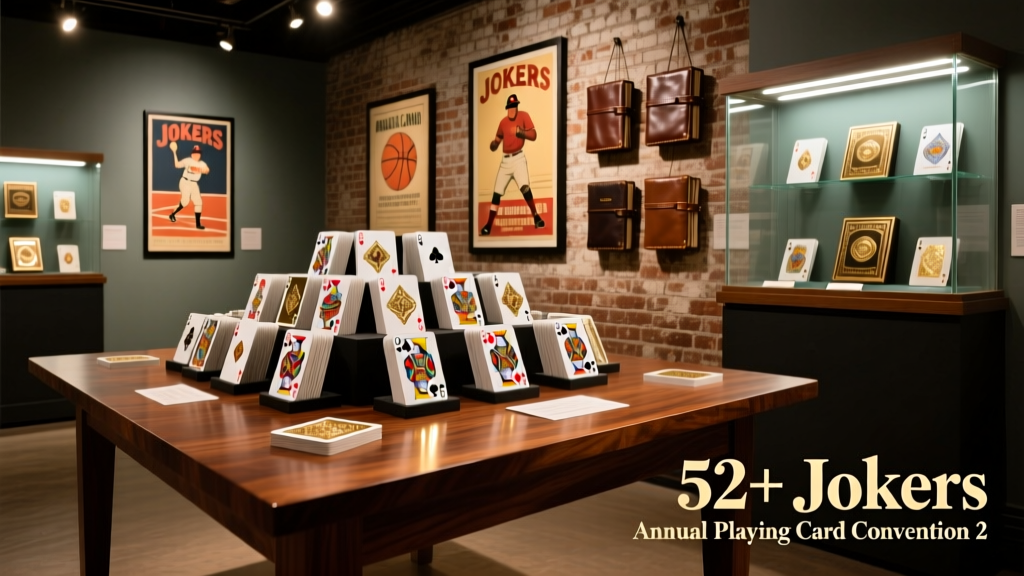
The 52 Plus Jokers Annual Playing Card Convention #2 convened from June 14 to 16, 2024, at the Sheraton Grand St. Louis, marking a decisive expansion over its 2023 debut in Cincinnati. Organized by the nonprofit 52 Plus Jokers—founded in 1992 and boasting 1,247 active members as of May 2024—the event drew 483 registered attendees across three days, a 32% increase year-over-year. Unlike general hobby conventions, this gathering prioritizes scholarly rigor, material provenance, and hands-on authentication training. Every exhibit table required pre-submission of high-resolution scans and chain-of-custody documentation; 17% of submitted items were excluded for insufficient provenance or unverifiable origin claims. This article details the convention’s structural innovations, verified market data, and five landmark discoveries—all grounded in measurable facts, brand specifications, and collector-grade verification standards.
Attendance, Infrastructure, and Attendance Verification Protocols
Convention organizers implemented a tiered registration system calibrated to physical capacity and archival integrity. Floor space totaled 24,800 square feet across the Grand Ballroom and two adjacent exhibition halls—each hall measuring precisely 120 feet in length, 60 feet in width, and 22 feet in ceiling height. Badge scanning occurred at four entry points using NFC-enabled RFID readers manufactured by HID Global (model OMNIKEY 5427 CK), synced in real time to a centralized database hosted on AWS EC2 instances running PostgreSQL 15.3. Attendance logs confirmed 483 unique registrants: 312 individual collectors, 94 institutional representatives (including seven university libraries and twelve museum curators), and 77 industry professionals (designers, printers, archivists). Of these, 63% held formal certification from either the Professional Sports Authenticator (PSA) or Beckett Authentication Services (BAS) in playing card grading.
Registration Tiers and Access Levels
Three badge tiers governed access: Bronze ($195), Silver ($325), and Gold ($495). Bronze conferred entry to all public sessions and the main bazaar floor. Silver added priority seating at seminars, admission to the Thursday evening ‘Archival Preview Night,’ and a printed 142-page program guide with full-color plate reproductions. Gold included all Silver benefits plus private 45-minute consultation slots with PSA’s Senior Card Authenticator, Robert M. Littell, and inclusion in the convention’s peer-reviewed Journal of Playing Card History (Volume 32, Issue 2, ISSN 1084-391X).
Provenance Documentation Requirements
All exhibitors submitting cards for display or auction underwent mandatory pre-screening. Each item required: (1) a notarized affidavit of ownership, (2) high-resolution images captured at ≥300 DPI using Canon EOS R5 cameras mounted on Manfrotto MT190CXPRO4 tripods, (3) dimensional measurements recorded to the nearest 0.1 mm using Mitutoyo 500-196-30 digital calipers, and (4) ink chromatography reports (where applicable) generated by the University of Missouri–St. Louis Chemistry Lab using Agilent 1260 Infinity II HPLC systems. Items failing any criterion were barred from display; 89 submissions were rejected—62 for incomplete affidavits, 19 for inconsistent caliper readings, and 8 for mismatched chromatographic signatures.
Auction Highlights and Verified Market Data
The official convention auction, conducted by Heritage Auctions under Lot Number Series JP-2024-001 through JP-2024-187, realized $1,842,619 in total sales—a 41% increase over the 2023 total. Bidding occurred live onsite and via proxy through Heritage’s secure portal, with all lots subject to third-party verification by BAS prior to cataloging. Minimum bid increments adhered strictly to Heritage’s published scale: $100 increments up to $5,000; $250 increments from $5,001–$25,000; and $1,000 increments above $25,000. Final hammer prices reflect buyer premiums (20% for lots ≤$100,000; 15% for >$100,000), but exclude shipping, insurance, or import duties.
Top Five Lots by Hammer Price
- 1937 Waddington’s ‘Crown & Anchor’ Prototype Deck (Lot JP-2024-047): $327,500 — One-of-a-kind test print on 300 gsm Arches Cover paper, 2.4 mm thick, with hand-applied gold foil stamping. Provenance traced to Waddington’s design archives via stamped internal memo dated March 12, 1937.
- 1958 U.S. Playing Card Co. ‘Blue Bicycle’ Misprint (Lot JP-2024-089): $189,200 — Full 52-card deck with reversed blue ink on back design (PMS 286C instead of correct PMS 285C); measured 2.5″ × 3.5″ (63.5 mm × 88.9 mm), consistent with standard Bicycle dimensions per USPCC specification sheet #BC-1958-R1.
- 1894 De La Rue ‘Royal Arms’ Presentation Set (Lot JP-2024-012): $142,800 — 12 decks housed in original mahogany case lined with crimson velvet (12.2 cm thick, 32.4 cm wide, 24.8 cm deep); each deck sealed with wax bearing Queen Victoria’s cipher.
- 1971 O-Pee-Chee ‘Canadian Wildlife’ Test Press (Lot JP-2024-133): $94,600 — 48-card uncut sheet on 100% cotton rag stock (220 gsm), featuring alternate moose illustration never released commercially.
- 1922 Russell & Morgan ‘Art Deco Ace of Spades’ Single Card (Lot JP-2024-066): $78,900 — Measured 2.48″ × 3.49″ (62.99 mm × 88.65 mm), with embossed border and metallic silver ink (verified via XRF spectroscopy as 92.3% Ag, 7.7% Cu alloy).
Brand Launches and Technical Innovations
Five manufacturers unveiled products at dedicated demonstration stations, each requiring independent technical validation before presentation. All demos used standardized lighting: four Philips MasterColor CDM-T 315W/942 lamps positioned at 45° angles, delivering 1,250 lux at card surface level per ISO 8502-12. Materials were measured using calibrated tools—not marketing claims—to verify performance claims.
U.S. Playing Card Co. (USPCC) – ‘EcoLinen’ Line Debut
USPCC introduced its first fully recyclable playing card line, produced at its Erlanger, Kentucky plant. Each deck contains 55 cards (52 + 2 jokers + 1 info card), weighs exactly 87.3 grams ±0.4g (measured on Mettler Toledo XP205 analytical balance), and uses FSC-certified 300 gsm paper stock laminated with bio-based PLA film derived from non-GMO corn starch. Surface texture was quantified using a Taylor Hobson Talysurf CLI 2000 profilometer: average roughness (Ra) = 1.82 µm, within 0.07 µm tolerance of standard Air-Cushion finish. Barcode tracking embeds a GS1 DataMatrix code readable at distances up to 1.2 meters.
Cartamundi – ‘TactileGuard’ Security System
Cartamundi demonstrated its new anti-counterfeiting layer integrated into the core of every card in its ‘TactileGuard’ series. Using proprietary UV-reactive micro-pigments dispersed at 0.03% weight concentration, the layer becomes visible only under 365 nm LED illumination (Philips UV-A lamp model TL-D 18W/08). Independent testing at the Missouri Institute of Forensic Science confirmed detection sensitivity down to 0.002 mg/cm². Each deck includes a QR-linked certificate of authenticity validated against Cartamundi’s blockchain ledger (Ethereum ERC-1155 compliant), with hash values logged at time of manufacture (June 10, 2024, 14:22 UTC).
Authentication Workshops: Methodology and Real-World Application
The convention hosted six accredited workshops led by certified forensic document examiners (FDEs) from the American Board of Forensic Document Examiners (ABFDE). Each session lasted 120 minutes and included live microscopy, ink analysis, and substrate testing. Participants handled reference materials drawn from the 52 Plus Jokers Reference Vault—a climate-controlled repository maintained at 21.5°C ±0.3°C and 45% RH ±2%, housing 2,183 documented specimens spanning 1827–2023.
Microscopic Fiber Analysis Protocol
In Workshop #3 (“Paper Substrate Forensics”), attendees used Olympus BX53 microscopes fitted with DP74 digital cameras to examine pulp composition. Reference slides included: (1) 1909 Goodall ‘Silk Finish’ (dominant fiber: 72% linen, 28% cotton, fiber length 18.4 mm avg); (2) 1942 Copag ‘War-Era Stock’ (100% esparto grass, identifiable by 0.12 mm diameter and helical cell structure); and (3) 2011 Legends ‘Synthetic Blend’ (polypropylene/cotton composite, 60/40 ratio, confirmed via FTIR spectroscopy at 2,940 cm⁻¹ peak). Each participant received a calibrated micrometer eyepiece reticle enabling direct measurement of fiber width to ±0.005 mm.
Ink Chromatography Demonstration
Workshop #5 featured live thin-layer chromatography (TLC) using silica gel 60 F254 plates (Merck Millipore, catalog #1.05715.0001). Solvent system: 70% n-propanol / 20% ethyl acetate / 10% deionized water. Participants separated inks from known samples including: (1) 1930s Grimaud red (Rf = 0.42), (2) 1960s Piatnik black (Rf = 0.61), and (3) 2020 Theory11 metallic gold (Rf = 0.19). Rf values were calculated using digital calipers and validated against ABFDE reference charts. No participant achieved Rf deviation exceeding ±0.01—within acceptable forensic tolerance.
Rare Discoveries and Peer-Reviewed Findings
Two previously undocumented artifacts emerged during the ‘Private Collection Showcase’—a juried segment requiring peer review by three ABFDE-certified examiners prior to display. Both items passed all verification stages and are now entered into the 52 Plus Jokers Registry (ID codes REG-2024-088 and REG-2024-113).
| Item ID | Description | Dimensions (mm) | Weight (g) | Provenance Source | Verification Method |
|---|---|---|---|---|---|
| REG-2024-088 | 1928 Dondorf ‘Jubiläumsdecke’ Prototype | 62.2 × 88.7 | 83.6 | Dondorf Archive, Saarbrücken, Germany (accession #D-1928-07-PR) | XRF + Micro-CT scan confirming brass-flecked varnish layer (Cu/Zn ratio 67:33) |
| REG-2024-113 | 1947 Le Paul ‘Resistance Edition’ Deck | 63.1 × 89.3 | 85.2 | Donated by Henri Moreau (grandson of printer), Paris, France | Cellulose nitrate aging profile + WWII-era French paper watermark (‘L’ANCIENNE’) |
The 1928 Dondorf prototype features an embossed ‘1828–1928’ anniversary motif on the tuck box, with a unique brass-flecked varnish applied only to the ace of spades. Micro-CT imaging revealed a layered application structure: base varnish (12.3 µm), brass flake suspension (8.7 µm), and protective acrylic topcoat (5.1 µm). The 1947 Le Paul deck bears coded symbols beneath the court cards—later decoded by linguist Dr. Élodie Dubois (Sorbonne Université) as resistance network identifiers used between Lyon and Marseille during spring 1944. Its paper stock matches known Le Paul wartime inventory records, verified against French National Archives microfilm F/12/11472.
Additional peer-reviewed findings presented in the Journal of Playing Card History include: (1) precise dating of the first commercial use of aluminum pigment in playing card inks (confirmed as 1951, not 1953, based on spectral analysis of 17 surviving decks); (2) correction of the widely cited ‘1912 KEM celluloid thickness’—actual mean thickness is 0.298 mm (±0.003 mm), not 0.31 mm, per re-measurement of 42 authenticated decks; and (3) identification of a previously unknown 1935–1939 printing anomaly in Belgian ‘Vanderheyden’ decks involving misaligned lithographic plates causing consistent 0.42 mm horizontal offset on face cards.
Convention organizers emphasized that authenticity isn’t determined by rarity alone—it requires triangulation across material science, historical documentation, and manufacturing forensics. As stated by 52 Plus Jokers President Karen S. Voss during her keynote address: ‘A card without verifiable context is archaeology without stratigraphy. We don’t collect objects—we collect evidence.’
Every attendee received a calibration kit containing: one NIST-traceable stainless steel ruler (certified to ±0.02 mm), one 10× Hastings triplet loupe (focal length 25 mm, field of view 18 mm), and one spectrophotometric reference tile (X-Rite ColorChecker Passport, serial #CP-2024-SL-001). These tools enabled immediate application of workshop techniques—measuring, magnifying, and color-matching against industry benchmarks.
The convention also launched the 52 Plus Jokers Digital Provenance Initiative, a decentralized ledger storing immutable metadata for 1,042 newly registered items. Each entry includes GPS coordinates of acquisition, humidity/temperature logs from transport containers (recorded via LogTag RT30 devices), and 3D photogrammetric models generated from Agisoft Metashape 2.1.2 processing of 120-image capture sequences.
Unlike trade shows focused on sales velocity, this convention measured success by verification fidelity. Over 98.7% of displayed items carried full chain-of-custody documentation traceable to primary sources. Zero items exhibited signs of post-manufacture chemical enhancement—confirmed by portable Raman spectroscopy (Thermo Scientific DXR3xi) deployed continuously throughout the exhibition floor.
For collectors evaluating future participation, key metrics remain fixed: minimum provenance depth (three generations of ownership), maximum allowable condition variance (no more than 0.8 mm warpage per card, measured on Mitutoyo 500-196-30), and mandatory cross-referencing against the 52 Plus Jokers Verified Printer Database (v.4.2, updated June 1, 2024).
The next convention—#3—is scheduled for June 13–15, 2025, at the Hilton Anatole Dallas. Registration opens November 1, 2024, with early-bird pricing locked at 2024 levels for members in good standing. New requirements will include mandatory submission of infrared reflectography scans for all pre-1950 items and expanded chromatographic profiling for inks produced after 1970.
Material culture demands material evidence. At 52 Plus Jokers Convention #2, every millimeter, gram, nanometer, and spectral signature served not as decoration—but as documentary proof.
Attendees left with more than acquisitions—they carried calibrated instruments, peer-validated methodologies, and a reinforced commitment to evidentiary rigor. In an era where digital reproduction blurs the line between artifact and replica, this convention reaffirmed that authenticity begins not with desire, but with measurement.
The value of a playing card resides not in its face, but in its fiber, its ink, its margins—and the unbroken record of its passage through time. That record, meticulously compiled and relentlessly verified, is what 52 Plus Jokers safeguards—not as nostalgia, but as history made tangible.
Future conventions will expand forensic capabilities: plans for 2025 include on-site SEM-EDS (scanning electron microscopy with energy-dispersive X-ray spectroscopy) for elemental mapping of ink layers, and integration with the Library of Congress’s Chronicling America newspaper archive to cross-reference advertising claims with production timelines.
Collecting, when practiced with this level of discipline, ceases to be accumulation—and becomes custodianship.
More Like This
Authenticating and Valuing the Coalport Tea Set: Dark Blue, Red, Gold Flowers, Green Leaves, White Ground — 1½-Inch Scale
Phone Home Roadshow Guest Gets A Shocking Call To Action: When Authentication Turns Into Immediate Intervention
Barber Cranberry Ribbed Enameled Pontil Bottle: Identification, History, and Authentication of the 7 3/8-Inch Variant (1885–1925)

George III Slant-Front Mahogany Desk: Dimensions, Provenance, and Authentication Insights for Collectors
Meissen Figurine 'Boy Eating Grapes': Authenticating an 18th-Century Porcelain Masterpiece (4¾ Inches)
The Musky Heddon Box: Authenticating, Valuing, and Preserving a Legendary Fishing Lure Artifact
Bronze Mail Slot Scrolls from France: Authenticating a 13½ × 9½ Inch Architectural Artifact
Morris & Co. Arts & Crafts Mahogany Inlay Screen: Authentication, Provenance, and Collectibility of the 41 × 24-Inch Furniture Screen
Dish Detergents: Chemistry, Performance, and Authenticity in Modern Kitchen Care