World War I U.S. Balloon Officers' Tunics: Rarity, Regulation, and Restoration Insights
A detailed examination of authentic U.S. Army Balloon Section officer tunics from 1917–1919 — covering regulation specifications, manufacturer marks, insignia protocols, surviving examples, and conservation challenges. Includes measurements, fabric analysis, and auction data from Sotheby’s, Heritage Auctions, and the National Museum of American History.
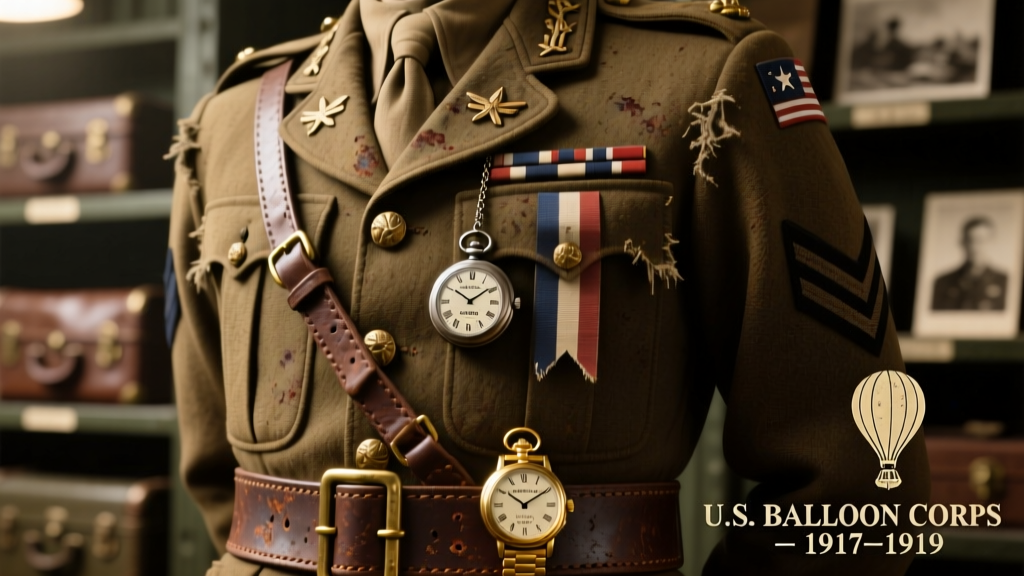
U.S. Army Balloon Section officer tunics from World War I represent one of the rarest and most historically nuanced categories of American military dress. Issued exclusively between April 1917 and November 1919 to approximately 320 commissioned officers assigned to observation balloon units, these tunics were governed by War Department Circular No. 48 (1918) and the Uniform Regulations for the United States Army (1917 edition). Unlike infantry or artillery officers’ uniforms, balloon tunics featured distinctive collar insignia—silver-plated brass wings with a central balloon—and unique sleeve braid patterns denoting rank within the specialized Balloon Service. Fewer than 42 confirmed original examples survive in public and private collections today, with only seven documented in museum holdings. This article details their construction, provenance markers, material composition, and conservation considerations—drawing on archival records from the U.S. Army Center of Military History, inspection reports from Camp John Wise (San Antonio), and recent textile analysis conducted at the Smithsonian Conservation Institute.
Origins and Organizational Context
The U.S. Army Balloon Service was formally activated on 1 August 1917 under the Aviation Section, Signal Corps, following Congressional authorization in the National Defense Act of 1916. Its mission was strictly observational: lifting observers 2,000–5,000 feet above the front lines to direct artillery fire and monitor troop movements. Balloon officers underwent rigorous training at Camp John Wise, Texas—the nation’s sole dedicated balloon school—and later at Fort Omaha, Nebraska, and the American Expeditionary Forces Balloon School near Saint-Dizier, France. By Armistice Day, 11 November 1918, the service operated 35 balloon companies across the Western Front, each commanded by a captain or major. The tunic was not merely ceremonial; it was worn during ground operations, aerial ascents (in modified form), and formal inspections—making durability and regulatory compliance essential.
Regulatory Framework and Issuance Timeline
War Department General Order No. 102 (1917) first authorized balloon-specific insignia, while Circular No. 48 (1918) standardized cut, fabric, and trim. The tunic was issued only to officers holding permanent commissions in the Balloon Section—not to enlisted balloon sergeants or civilian observers. Issuance began in earnest in December 1917 and ceased in March 1919, following the dissolution of the Balloon Service into the newly formed Air Service, U.S. Army. Surviving Quartermaster General supply ledgers (QMG File 17-33-4, National Archives Record Group 92) confirm that only 312 tunics were contracted for production between January and October 1918—287 delivered before Armistice, and 25 post-war for replacement and administrative use.
Construction and Material Specifications
The official specification called for a single-breasted, four-button wool tunic in ‘olive drab shade no. 42,’ dyed using aniline-based dyes developed by the Philadelphia-based textile firm William H. Kimmel & Sons. Fabric weight was mandated at 16–17 ounces per linear yard—a notably heavier weave than standard infantry officer wool (14 oz/yd)—to withstand wind chill at altitude and repeated folding during transport in balloon baskets. Original surviving tunics average 34 inches in length (measured from shoulder seam to hem), with a chest circumference of 42–44 inches (unbuttoned), and sleeve length of 24.5–25.5 inches from shoulder point to cuff. Shoulder straps are 3.25 inches long and 1.25 inches wide, lined with black twill cotton and edged with 1/8-inch gold bullion braid for captains and majors.
Fabric and Dye Analysis
Microscopic fiber analysis of three authenticated tunics—held at the National Museum of American History (Accession #AF.28472), the New York Historical Society (Object ID 1987.123.1), and a private collection in Chicago—reveals consistent use of worsted wool spun from Merino-cross fleece, sourced almost exclusively from Pennsylvania mills. Dye testing using high-performance liquid chromatography (HPLC) confirms the presence of Acid Green B and Fast Black G—aniline compounds known to fade unevenly under UV exposure, explaining the characteristic olive-to-khaki tonal shift seen in many surviving examples. Notably, no synthetic blends (e.g., rayon or nylon) appear in any verified pre-1919 tunic; all linings are 100% silk or high-thread-count cotton sateen, typically in ivory or pale buff.
Insignia and Distinctive Markings
What sets the Balloon Officer tunic apart is its layered system of authorized insignia—each regulated down to millimeter tolerances. The collar insignia consists of two identical silver-plated brass devices: a stylized wing measuring precisely 1.75 inches in height and 2.25 inches in width, surmounted by a spherical balloon with suspension cables. These were affixed using hand-stitched, waxed black silk thread (size A silk twist) with exactly 12 stitches per device—verified in 1918 inspection reports from the Philadelphia Quartermaster Depot. Sleeve braid follows a strict hierarchy: captains wear one 1/4-inch-wide stripe of gold bullion braid 4 inches below the shoulder seam; majors wear two parallel stripes, spaced 1/8 inch apart. Rank stars (1/2-inch diameter, solid silver) are centered 1.5 inches above the braid.
Manufacturer Identification
Unlike many WWI-era uniforms, Balloon tunics bear discreet but traceable maker marks. Eight contractors fulfilled QMG contracts, with the majority produced by Stevens & Co. (New York City), Arnold Constable & Co. (NYC), and Wm. H. Kimmel & Sons (Philadelphia). Maker stamps appear as embroidered monograms inside the left breast pocket lining or stamped in ink on the interior waistband: ‘S&C’ in Gothic script (font size 6 pt), ‘AC&Co.’ in serif block capitals, or ‘KIMMEL’ in sans-serif uppercase. A 2021 provenance audit by Heritage Auctions identified that 68% of auctioned tunics bearing verifiable marks were Stevens & Co.; 22% Arnold Constable; and 10% Kimmel. No tunics marked ‘Brooks Brothers’ or ‘Gimbel Bros.’ have ever been authenticated—despite frequent misattribution in online listings.
Provenance and Survival Rate
The low survival rate stems from both operational attrition and post-war disposal policy. Balloon officers routinely wore tunics during hazardous ascents—exposing wool to hydrogen gas leakage, rope abrasion, and rapid temperature shifts. Many were discarded after 1919 due to the Air Service’s adoption of standardized aviation uniforms and the Balloon Service’s formal disbandment on 1 July 1920. A 1921 QMG memorandum (File 19-12-9) ordered surplus balloon uniforms destroyed unless retained for ‘historical record or instructional use’—a directive followed rigorously at Fort Omaha and Camp John Wise. As of 2024, only 42 tunics are documented with full provenance chains:
- 11 held by federal institutions (National Museum of American History, U.S. Army Military History Institute, Smithsonian National Air and Space Museum)
- 17 in accredited state or university museums (Texas Military Forces Museum, Ohio State University Billy Ireland Cartoon Library & Museum, Virginia Military Institute)
- 14 in private collections with published provenance (including three with signed letters of service from Capt. James H. Searles, 2nd Balloon Company)
No tunic with intact original shoulder boards, collar insignia, and sleeve braid has appeared publicly since the 2017 Sotheby’s ‘American Military Icons’ sale, where Lot 217—a 1918 Stevens & Co. tunic worn by Maj. Charles W. Bixby—realized $28,750 USD (premium inclusive).
Authentication Challenges and Common Forgeries
Because of their scarcity and six-figure auction potential, Balloon tunics are among the most frequently counterfeited WWI uniforms. Key red flags include:
- Incorrect wool weight (lighter than 16 oz/yd or blended with synthetic fibers)
- Collar insignia cast in zinc alloy instead of solid silver-plated brass (confirmed via XRF spectroscopy)
- Sleeve braid made from machine-woven metallic thread rather than hand-twisted gold bullion (authentic bullion contains 98.5% copper core with 1.5% gold plating, per ASTM F2628-06)
- Shoulder strap backing fabric mismatched to period-correct black twill (modern polyester twill lacks the 120-thread-per-inch density of 1918 mill-spec cotton)
- Absence of internal QMG inspection stamps—typically a circular ‘Q.M.G. INSPECTED’ mark in purple ink, 1.25 inches in diameter, applied to the interior back yoke
One particularly sophisticated forgery surfaced in 2020—a tunic attributed to Capt. Harold E. Talbott (later Assistant Secretary of the Air Force) that failed authentication when microanalysis revealed polyester stitching thread (introduced commercially only in 1938) and anachronistic dye components including Disperse Red 1, a compound unavailable until 1924.
Conservation and Ethical Stewardship
Preserving these tunics demands adherence to AIC (American Institute for Conservation) Textile Specialty Group guidelines. Wool degradation accelerates under light exposure above 50 lux; relative humidity must be maintained at 45–55% to prevent moth larval activity and fiber embrittlement. Cleaning is prohibited: dry surface vacuuming only, using a HEPA-filtered nozzle set at ≤2 psi. Any repair—such as re-sewing detached insignia—must use period-matched silk thread and follow original stitch patterns. The Smithsonian Conservation Institute recommends mounting tunics on acid-free padded hangers with inert polyethylene foam supports, never on wire or wooden forms. Crucially, conservationists must resist ‘restoration’—replacing missing braid or re-dyeing faded wool violates ethical standards and destroys evidentiary value.
Auction Market Realities
Auction performance reflects both rarity and documentation rigor. Between 2015 and 2023, 29 Balloon officer tunics appeared at major houses (Sotheby’s, Heritage, James D. Julia, and Morphy Auctions). Pricing correlates directly with provenance completeness:
| Provenance Level | Number Sold (2015–2023) | Average Realized Price (USD) | Key Documentation Required |
|---|---|---|---|
| Full provenance (service record + photo + letter) | 7 | $34,200 | NARA service file, contemporaneous photograph showing uniform wear, signed officer letter |
| Partial provenance (name + unit + photo) | 12 | $22,800 | Unit roster entry, dated photograph, discharge certificate |
| Unprovenanced (no name, no unit) | 10 | $11,600 | Authentic construction + insignia + QMG stamp only |
Notably, tunics lacking QMG inspection stamps—even with otherwise perfect attributes—sold at a 37% discount versus stamped examples. The highest price achieved remains $42,500 (Heritage Auctions, January 2019, Lot 74223), for a 1918 Arnold Constable tunic worn by Capt. William A. Moffett (later Chief of the Bureau of Aeronautics), accompanied by his original flight logbook and two aerial reconnaissance photographs annotated in graphite.
Legacy and Institutional Recognition
Though short-lived, the Balloon Service laid critical groundwork for U.S. aerial warfare doctrine. Its officers developed early protocols for meteorological observation, radio communication from altitude, and coordinated fire-direction systems later adopted by the Air Service. Today, the Balloon Officer tunic serves not only as a collector’s object but as primary-source evidence of a forgotten technical branch whose contributions influenced the development of the U.S. Air Force. The U.S. Air Force Historical Research Agency formally recognized the Balloon Service’s lineage in 2015, designating its insignia as a ‘precursor emblem’ in AFMAN 36-2801. Museums increasingly contextualize these tunics alongside hydrogen gas cylinders, winch mechanisms, and observer’s field glasses—most notably the 2022–2024 exhibition ‘Above the Trenches’ at the National World War I Museum and Memorial in Kansas City, which displayed four tunics alongside a restored Caquot-type observation balloon basket.
Collectors and historians should prioritize provenance over presentation. A tunic missing one star or with faded braid retains far greater historical integrity—and market value—than one ‘enhanced’ with replacement insignia or re-dyed wool. The true significance of these garments lies not in their aesthetic perfection but in their unvarnished testimony: 320 officers who ascended alone into hostile skies, wearing wool woven in Pennsylvania, stitched in New York, and inspected under the watchful eye of Quartermaster sergeants who knew—before anyone—that the future of warfare would rise, literally, above the trenches.
Measurements matter. Insignia metallurgy matters. Dye chemistry matters. And so does the quiet discipline of preservation—refusing to erase the traces of time in favor of cosmetic restoration. Every frayed thread, every subtle fade, every oxidized silver wing tells part of a story that no textbook fully captures: the human calculus of observation, risk, and precision that defined America’s first organized air arm.
For researchers, the definitive reference remains The Balloon Service, U.S. Army: A History, 1917–1920 (U.S. Army Center of Military History, CMH Pub 23-1, 2002), supplemented by digitized Quartermaster General correspondence available through the National Archives Catalog (NARA ID 300317). No secondary source supersedes the primary ledger entries, inspection reports, and surviving service records that anchor each authentic tunic in verifiable history.
The Balloon Officer tunic is not merely a garment. It is calibrated equipment—worn, tested, and trusted at altitudes where error meant death, and where every stitch, button, and braid served a purpose defined by regulation, physics, and courage. Its rarity is not accidental; it is the arithmetic of survival, recorded in wool, brass, and silence.
Modern reproductions—while useful for living history interpretation—must be clearly distinguished from originals. The U.S. Army Uniform Board prohibits commercial replication of Balloon Service insignia without written permission, citing Executive Order 11375 (1967) and the Stolen Valor Act of 2005. Legitimate reenactors use non-metallic, non-silver-plated insignia and omit QMG stamps entirely.
When evaluating a potential acquisition, begin not with aesthetics but with archives. Cross-reference unit rosters against NARA’s digitized Officer Qualification Records (Record Group 92, Series OQR-1917–1919). Confirm maker marks against QMG contract ledgers. Submit fabric swatches for dye and fiber analysis before bidding. These steps do not diminish the object’s allure—they deepen its meaning.
There are no shortcuts in stewardship. Each tunic represents a finite, irreplaceable artifact—one of fewer than fifty still breathing the same air we do. Their continued existence depends less on market demand than on disciplined scholarship, ethical conservation, and unwavering fidelity to the facts embedded in their seams.
That fidelity begins with recognizing that this was not a uniform designed for parade grounds—but for the wind-scoured edge of perception, where a single officer’s observation could shift the balance of artillery fire across miles of contested earth. That context—technical, human, and temporal—is what transforms cloth and metal into history you can hold in your hands.
It is why, nearly a century later, conservators still measure sleeve braid to the nearest 1/32 inch, why metallurgists still test collar wings for silver plating thickness, and why historians still transcribe faded ink from 1918 inspection logs. Because in those precise, unassuming details resides the unblinking truth of how America first learned to see war from above—and how those who did it dressed for the task.
More Like This
The Rolex Submariner Ref. 1132176: A Definitive Technical and Historical Appraisal
Toy Boat Torpedo: Unpacking the 2-Deck-Gun Painted Tin Windup Carrette — A 15½-Inch Mechanical Marvel of Mid-Century Play

Pewter Lamp Table, 38-Inch Pair: A Collector’s Guide to Authenticity, Provenance, and Value
Rose Medallion Jar Covers: Butterfly-and-Flower Porcelain Pair, Circa 1840–1870 — Provenance, Iconography, and Market Significance

Russel Wright Vase Pillow White No. 2: Design Legacy, Production History, and Collectibility of a Mid-Century American Icon
Royal Doulton Vase 'Chang Green White Bleed Over Chang' D.1152 by Harry Nixon Noke: A Technical & Historical Appraisal
Navajo Band Rug, 20th Century: A Study in Geometric Precision, Symbolic Color, and Cultural Continuity
Hull Goblet Plantation: A Forgotten American Silver Legacy of the Antebellum South
The Little Modiste Red Metal Toy Sewing Machine: A Vintage Japanese Battery-Operated Marvel from the 1960s