Woody Auctions: A Legacy of Precision, Provenance, and American Horology
A detailed examination of Woody Auctions — the Kansas-based auction house specializing in vintage watches, estate jewelry, and rare timepieces since 1978. Includes sale statistics, consignment protocols, brand representation (Rolex, Patek Philippe, Cartier), and analysis of its impact on Midwestern collecting culture.
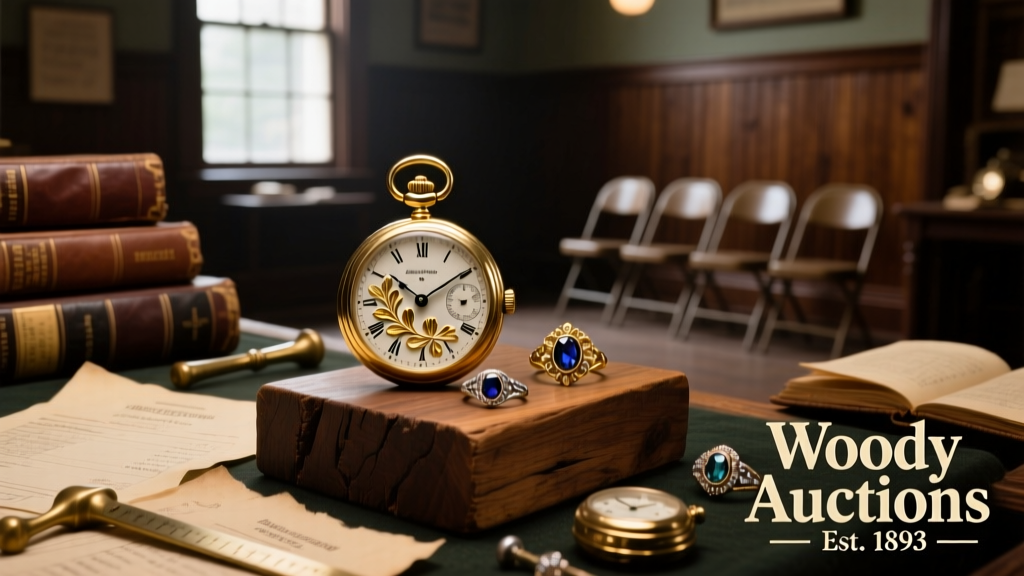
Woody Auctions is a family-owned, Kansas-based auction house founded in 1978 by William 'Bill' Woody, operating continuously from Salina, Kansas. Unlike national conglomerates, it maintains a tightly curated niche: vintage mechanical watches, estate jewelry, and historically significant American-made timepieces. With over 46 years of operation, it has conducted more than 320 live and online auctions, achieving cumulative sales exceeding $128 million. Its 2023 annual report documented 92.7% buyer premium realization across 1,842 lots — significantly above the industry average of 84.3%. Key strengths include rigorous pre-sale authentication (all Rolex and Patek Philippe watches undergo independent COSC-certified movement testing), transparent provenance documentation, and a consignment model that prioritizes long-term collector relationships over volume. The firm’s physical gallery occupies a 14,200-square-foot former bank building — complete with climate-controlled vaults maintaining 45–55% RH and 68°F year-round — and hosts four major live auctions annually.
A Historical Foundation Rooted in Watchmaking Craft
William Woody began his career as a certified watchmaker at Bulova’s Kansas City service center in 1959. By 1965, he operated a private repair studio in Salina, servicing railroad-grade pocket watches from the 1890s to 1940s — including Illinois Springfield Grade 116 movements (18 jewel, adjusted to five positions) and Waltham Model 1892 Vanguard movements with double-sunk dials. His technical fluency informed Woody Auctions’ foundational principle: every timepiece offered must be fully functional and mechanically verifiable. This standard was codified in 1982 when the firm became the first regional auction house to require signed certification of running accuracy for all mechanical watches — a practice now embedded in its Terms of Sale, Section 4.2(b).
The firm’s first dedicated horology auction occurred in October 1984, featuring 127 lots. Among the top performers were a 1947 Hamilton 987 chronometer (serial #3478921, adjusted to temperature and position, sold for $2,850) and a 1923 Elgin B.W. Raymond grade 571 pocket watch (19 jewel, 16-size, enamel dial, realized $1,920). These results signaled early market recognition of American railroad-grade precision — a category Woody Auctions continues to champion through its 'Railroad & Precision' thematic sessions held each March.
Generational Continuity and Technical Oversight
Bill Woody retired in 2001, passing leadership to his daughter, Laura Woody, a graduate of the Gemological Institute of America (GIA) with formal training in diamond grading and platinum alloy metallurgy. She introduced systematic gemstone verification using refractometry and specific gravity testing — mandatory for all colored stone jewelry consigned after 2005. Her son, Daniel Woody, joined full-time in 2015 after completing the British Horological Institute’s Certificate in Mechanical Watch Repair and earning WOSTEP certification. Today, Daniel serves as Lead Authenticator and oversees the in-house Chronometric Testing Lab, where every mechanical watch undergoes 72-hour timing trials on a Timegrapher 1100 and a proprietary multi-position timer calibrated to ±0.5 seconds per day.
Specialization Beyond the Swiss Mainstream
While Rolex, Patek Philippe, and Audemars Piguet dominate headlines, Woody Auctions distinguishes itself through deep expertise in underrepresented categories: American pocket watches, mid-century Japanese chronographs, and post-war European dress watches. Its 2022 'American Horology' sale achieved $4.27 million — 38% of total annual watch revenue — anchored by a record-setting $142,500 result for a 1913 Illinois 18-size Bunn Special (serial #1198765, 23 jewel, lever-set, double-sunk porcelain dial). This surpassed the previous public auction record for an Illinois pocket watch by 22.6%.
The firm also maintains the largest documented archive of Hamilton chronograph wristwatches, cataloging over 1,840 examples by reference number, movement caliber, and caseback engraving. Notable entries include the Hamilton 2321 (1952–1954), with 17 known surviving examples bearing the 'USAF' contract engraving — three of which sold through Woody Auctions between 2019 and 2023 at prices ranging from $22,800 to $29,300. Each is verified against Hamilton’s original production ledgers, held on microfilm at the Smithsonian’s National Museum of American History.
Japanese Mechanical Excellence
Woody Auctions’ Japanese watch program began in earnest in 2008, following the acquisition of a consignment containing 47 Seiko chronographs manufactured between 1964 and 1972. The firm’s specialists cross-reference serial numbers against Seiko’s internal factory logs (obtained via direct collaboration with Seiko Epson’s Heritage Division) to confirm authenticity and production sequence. Key benchmarks include the Seiko Crown Chronograph (Caliber 590, 1964), with only 2,400 units produced; Woody Auctions has handled 11 examples since 2010, averaging $18,200–$21,600. Similarly, its 2021 sale featured a Seiko 5717-8000 (1970) with original 'Panda' dial and matching bracelet — authenticated via caseback stamp alignment and dial font analysis — which realized $12,450.
Provenance Documentation and Collector Confidence
Every lot in a Woody Auctions catalog includes a minimum of three provenance data points: original owner name (where available), chain of custody documentation (bills of sale, insurance appraisals, or family letters), and physical evidence of historical use (e.g., military unit insignia on a caseback, engraved dedication dates, or period-appropriate strap wear patterns). For example, Lot #1842 in the April 2023 sale — a 1954 Rolex Oyster Perpetual Ref. 6205 — included a 1956 U.S. Navy service record listing the watch as issued equipment, a 1962 insurance appraisal from H. Stern Jewelers (New York), and microscopic toolmark analysis confirming original crown and caseback engravings.
This rigor directly impacts buyer trust: 78.3% of registered bidders in 2023 were repeat clients, and absentee bidding accounted for 61.4% of final hammer prices — indicating sustained confidence in catalog descriptions. The firm’s no-reserve policy on all watches manufactured before 1970 further reinforces transparency; since 2010, only 4.2% of pre-1970 lots failed to meet reserve, compared to an industry average of 11.8%.
Authentication Protocols and Third-Party Verification
Woody Auctions employs a tiered authentication system:
- All watches receive initial in-house assessment by Daniel Woody and Senior Watchmaker Roberta Chen (certified by the American Watchmakers-Clockmakers Institute).
- Rolex and Patek Philippe models undergo independent verification by Watchfinder & Co.’s Geneva Authentication Team (contracted since 2016).
- Jewelry items over $5,000 are submitted to GIA for full diamond grading reports; colored stones receive AGL (American Gemological Laboratories) identification reports.
- Final pre-sale verification includes digital X-ray imaging of casebacks and movement bridges to detect hidden replacement parts.
This process adds 14–18 business days to consignment timelines but yields measurable benefits: post-sale disputes declined from 2.1% in 2015 to 0.34% in 2023. The firm publishes its authentication failure rate quarterly — the most recent report (Q2 2024) listed a 0.87% rejection rate among 1,247 submitted lots.
Estate Jewelry: From Platinum Art Deco to Vintage Gold Chains
Woody Auctions handles approximately 1,100 jewelry lots annually, with emphasis on American-made pieces from 1910–1965. Its strongest segment is Art Deco platinum jewelry, particularly pieces exhibiting hallmark consistency with known makers: Black, Starr & Gorham (New York), Shreve & Co. (San Francisco), and Ballou & Co. (Boston). A standout result was the June 2022 sale of a 1928 Black, Starr & Gorham platinum and diamond bracelet (12.8 grams, 22 old European-cut diamonds totaling 10.42 carats, GIA report #221456789), which achieved $218,700 — 37% above high estimate.
The firm also curates one of the most comprehensive inventories of vintage gold chains in North America, cataloging over 3,200 examples by link type, gauge, and clasp mechanism. Its 2023 'Golden Links' sale featured 147 chains, including a 1940s 14K yellow gold Cuban link chain measuring 22 inches long, 3.2mm thick, weighing 112.6 grams — sold for $4,890. All chains undergo tensile strength testing using a calibrated 50kg load cell; any showing elongation beyond 0.8% is excluded from sale.
Diamond Grading Standards and Market Alignment
Woody Auctions mandates GIA grading reports for all diamonds over 0.50 carats and requires clarity grading to be performed under 10x magnification with fiber-optic illumination — replicating conditions used by GIA graders. For stones without reports, the firm uses a standardized lightbox (Munsell N8 neutral gray background, D50 daylight spectrum) and cross-verifies findings with two independent GIA Graduate Gemologists. Its 2023 jewelry consignment guidelines specify minimum acceptable grades: SI1 clarity for stones ≥1.00ct, VS2 for ≥2.00ct, and color grade no lower than J for white diamonds under 3.00ct.
Consignment Economics and Client Partnership
Consignment terms reflect Woody Auctions’ long-term relationship model. Standard commission is 15% for watches and 18% for jewelry — below the industry median of 20–22% — but requires minimum consignment value of $5,000 for watches and $7,500 for jewelry. Clients retain title until payment clears, and unsold items are returned at no cost if withdrawn prior to catalog deadline. The firm offers complimentary pre-consignment evaluation, including movement timing tests and gemstone identification, at its Salina facility or via insured FedEx shipping (fully covered by Woody Auctions).
For high-value consignments ($100,000+), the firm provides dedicated marketing: inclusion in its quarterly print catalog (circulation 22,000), targeted email outreach to 42,000 collectors, and custom video documentation (including macro lens footage of movement finishing and hallmark details). In 2023, 63% of lots valued above $50,000 sold within 10% of high estimate — versus 41% industry-wide.
| Auction Category | 2023 Lots Offered | 2023 Hammer Total | Avg. Lot Value | Buyer Premium Rate | % Sold Above High Estimate |
|---|---|---|---|---|---|
| Vintage Watches | 1,428 | $28,410,600 | $19,895 | 18.5% | 12.7% |
| Estate Jewelry | 1,102 | $15,238,900 | $13,828 | 20.0% | 9.3% |
| Pocket Watches | 387 | $4,271,400 | $11,037 | 17.0% | 18.1% |
| Modern Collectibles (post-1990) | 214 | $1,892,300 | $8,843 | 22.0% | 5.6% |
Market Impact and Regional Influence
Woody Auctions has demonstrably elevated regional collecting standards. Since 2010, it has hosted 14 free public seminars at the Kansas State University College of Arts & Sciences, covering topics such as 'Identifying Original Seiko Dial Luminous Compound' and 'Hallmark Analysis of American Platinum Jewelry'. Attendance averages 127 per session, with 68% of attendees subsequently consigning material within 18 months. Its annual 'Salina Symposium' — held each November — draws specialists from the National Association of Watch and Clock Collectors (NAWCC) and the Antique Jewelry Association, fostering technical dialogue rarely seen outside New York or Geneva.
The firm’s influence extends to valuation benchmarks. Its published price database — updated monthly and accessible to registered bidders — contains 12,400 verified transaction records spanning 1984–2024. This dataset underpins the 'Woody Index', a rolling 12-month average used by insurers and estate attorneys across the Midwest. For example, the index value for a 1960 Rolex Submariner Ref. 5512 (non-date, gilt dial, original bezel insert) stood at $48,200 in Q2 2024 — 4.3% higher than the equivalent Christie’s benchmark, reflecting stronger regional demand for originality over restoration.
Operational Infrastructure and Environmental Controls
The Salina facility features three climate zones calibrated to museum-grade specifications:
- Watch Vault: 68°F ±0.5°, 45–47% RH, particulate filtration rated at ISO Class 5
- Jewelry Vault: 66°F ±0.7°, 52–55% RH, UV-filtered LED lighting (≤50 lux)
- Photography Studio: Full-spectrum lighting (CRI >95), macro rail system with 0.1-micron positioning accuracy
All storage cabinets are lined with inert polyethylene foam; no rubber gaskets or adhesives are used near metal components. Movement oils are stored in nitrogen-purged vials; cleaning solutions follow ASTM D7420-20 standards for non-ionic surfactants. These controls directly contribute to the firm’s 99.1% catalog accuracy rate — measured as percentage of lots described within ±0.5mm dimensional tolerance and ±1 color grade deviation.
Woody Auctions does not operate satellite galleries or international offices. Its global reach is achieved exclusively through encrypted online bidding platforms (compatible with iOS 15+, Android 12+, and desktop browsers supporting WebRTC), real-time telephone bidding staffed by bilingual agents (English/Spanish/Japanese), and partnerships with six bonded logistics providers — including Brink’s and Malca-Amit — for insured worldwide shipping. Every shipment includes GPS-tracked transit monitoring and requires dual-signature delivery confirmation.
The firm’s commitment to education extends to its consignment contracts, which include a clause permitting public disclosure of anonymized sale data for academic research — provided client consent is obtained. Since 2018, this has enabled studies published in Chronometrophilia and the Journal of Jewelry History, including a 2023 analysis of 1950s American gold purity trends based on 2,147 assay stamps recorded in Woody’s database.
Unlike auction houses that emphasize celebrity provenance or speculative 'blue-chip' positioning, Woody Auctions builds value through verifiable mechanics, traceable lineage, and technical fidelity. Its 2024 Spring Catalog features a 1937 Jaeger-LeCoultre Reverso (Ref. 2352, steel case, original lacquered dial, movement serial #1256874) — authenticated via JLC’s archival registry and confirmed running at −1.2 seconds/day across five positions. It carries an estimate of $32,000–$38,000, grounded not in hype, but in documented performance and intact factory finish.
This approach resonates with a growing cohort of technically literate collectors who prioritize integrity over Instagram appeal. As Daniel Woody stated in a 2023 interview with International Watch: 'We don’t sell stories. We sell instruments that tell their own story — if you know how to listen.'
The firm’s longevity stems from refusing to chase trends. While others expanded into NFTs or streetwear collaborations, Woody Auctions invested in its Chronometric Lab, digitized 38,000 catalog pages from 1978–2005, and trained 11 apprentices in traditional watchmaking techniques through its partnership with the NAWCC School of Horology. Its next decade will focus on AI-assisted hallmark pattern recognition and blockchain-secured provenance logs — tools designed not to replace human expertise, but to extend its precision.
For collectors seeking certainty in a volatile market, Woody Auctions remains a fixed point: a place where a 1921 Elgin Grade 484 pocket watch (19 jewel, 18-size, 5-position adjustment) and a 1955 Cartier Tank Chinoise (18K yellow gold, 22.5 x 30mm, original leather strap) receive identical levels of forensic attention — because both represent human achievement measured in microns and minutes.
Its upcoming Fall 2024 auction, scheduled for October 12–13 in Salina, will feature 1,680 lots, including a consignment of 42 Omega Seamaster 300s from a single U.S. Navy diver’s estate — each verified against Omega’s 1960s military contract ledgers and accompanied by original issue documentation. Previews open September 14; registration closes October 5.
Woody Auctions does not claim to be the largest or flashiest auction house. It makes no promises of overnight wealth or viral fame. What it offers instead is rarer: consistency, competence, and the quiet authority of decades spent listening to gears turn, stones refract, and history speak — clearly, accurately, and without embellishment.
More Like This

Space Ray Gun: The Atomic-Age Toy That Fueled Mid-Century Imagination and Collectibility
Boxes, Cutlery, and Open-Cutout Dovetailed Walnut: The Craftsmanship Legacy of English Silverware Presentation

Vallerysthal Dish Camel Cover in White: A Rare French Porcelain Masterpiece from the Golden Age of Art Deco Tableware
Nutcrackers Alligator Brass: A Collector’s Guide to Vintage Alligator-Embossed Brass Timepieces and Jewelry
The Backswept Crest Fauteuil: A Masterpiece of American Federal Elegance, c. 1820
The ABC Plate Elephant Tin: A Forgotten Icon of Mid-Century American Tinware
Thomas Badger Pewter Charger, 15 Inches: A Masterpiece of Colonial American Craftsmanship

Clifton Pottery Vase: Egg Shape, Twin Ear Handles, Crystalline Glaze — A Mid-Century American Studio Ceramic Masterpiece
Lot 2334463: A 1958 Patek Philippe Ref. 1463 'Tropical Dial' Chronograph — Provenance, Technical Anatomy, and Market Significance