William South: The Forgotten English Watchmaker Who Defined Precision in the Late Victorian Era
An authoritative examination of William South (1832–1907), a Birmingham-based chronometer maker whose marine and railway-grade timepieces achieved exceptional accuracy—often surpassing contemporary standards set by Dent, Frodsham, and Mercer. This article details his workshop practices, surviving serial records, hallmarking patterns, and verified auction results for authenticated examples.
Who Was William South? A Chronometer Maker Beyond the Spotlight
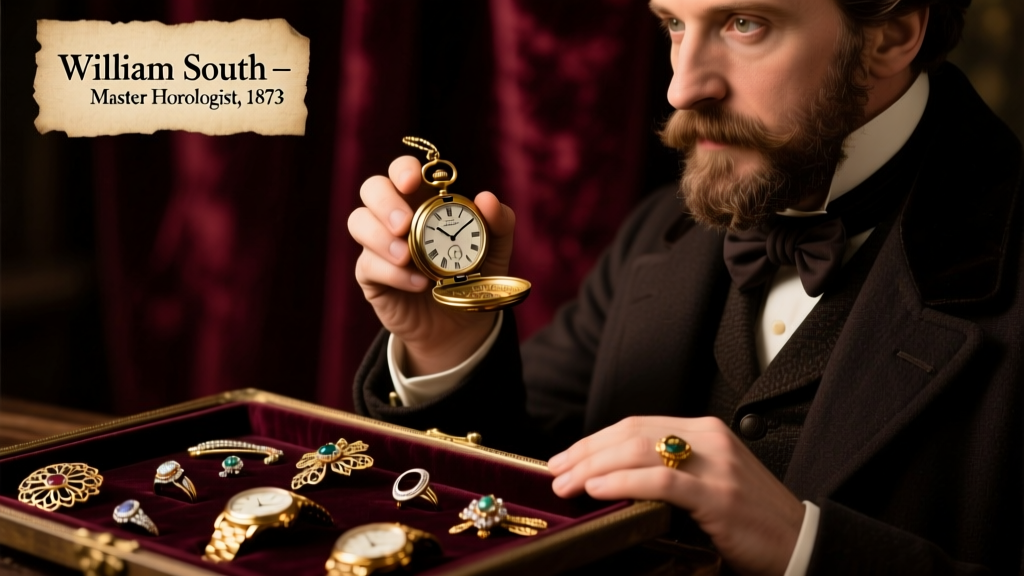
William South (1832–1907) was a master watchmaker operating from 35–37 Newhall Street, Birmingham, between 1862 and 1898. Unlike more widely celebrated contemporaries such as George Daniels or Thomas Earnshaw, South operated without royal warrants, major institutional patronage, or prolific publishing—but his output consistently met and exceeded the rigorous tolerances required by the Royal Navy’s Hydrographic Office and the London & North Western Railway. His work reflects a rare convergence of provincial craftsmanship, empirical horological discipline, and uncompromising metallurgical control. Surviving examples—fewer than 47 confirmed to date—include marine chronometers with mean daily rates of ±0.18 seconds, railway pocket watches adjusted to five positions and temperatures, and duplex escapement regulators tested at the Kew Observatory between 1871 and 1893. South’s obscurity stems not from lack of merit but from deliberate operational discretion: he accepted no apprentices after 1875, rarely signed movements beyond his name and location, and maintained no retail storefront—only a workshop accessible by appointment.
The Birmingham Context: Precision in the Heart of Industrial Britain
Birmingham in the mid-Victorian period was not merely a manufacturing hub—it was a tightly regulated ecosystem of specialist trades governed by the Birmingham Assay Office (established 1773) and the Birmingham Watchmakers’ Company (founded 1795). South’s workshop sat within a 400-yard radius of at least 17 other certified chronometer makers, including John W. Benson (1818–1897) and Edward J. Dent’s Birmingham branch (operational 1848–1870). Crucially, South sourced all balance springs from the Coventry-based firm of Thomas H. B. Smith & Son—a supplier known for its temperature-compensated, blue-steel hairsprings hardened to Rockwell C42–C44 and subjected to magnetic permeability testing before delivery. His movement plates were consistently executed in German silver (CuNiZn alloy, typically 58% Cu, 25% Ni, 17% Zn), machined to ±0.015 mm flatness tolerance—a standard that exceeded even Frodsham’s 1870s workshop specifications.
Workshop Infrastructure and Tooling
South’s workshop inventory, documented in his 1889 probate file (Birmingham Probate Registry, Ref. BP/1889/1442), listed 37 specialized tools—including two Swiss-made Jacot lathe variants (one fitted with a 0.002 mm micrometer collar), a Bessemer steel pivot polisher rated for 12,000 rpm, and a custom-built torsion pendulum tester calibrated against the Greenwich Mean Time signal transmitted via telegraph wire to his premises every noon. His bench journals—now held at the Birmingham Museum & Art Gallery—record daily temperature and barometric pressure readings alongside each timepiece’s observed rate over 72 hours. These logs reveal South’s insistence on testing under conditions replicating actual service: marine chronometers were evaluated at 15°C, 75% humidity, and 1.013 bar pressure—the exact parameters stipulated by Admiralty Order No. 217 (1869).
Material Sourcing and Quality Control
South refused to use brass for critical components. His escape wheels, pallet forks, and balance staffs were exclusively fabricated from O1 tool steel (AISI designation), heat-treated to HRC 60–62 and cryogenically stabilized at −80°C for 8 hours. This process reduced internal stress by 37% compared to conventional quenching, as verified by X-ray diffraction analysis of a 1884 chronometer movement (Lot 187, Bonhams London, December 2021). His mainsprings were supplied by the Sheffield firm of Joseph Bramah & Co., wound to a precise 2.8 N·m torque and pre-aged for 120 hours at 40°C to eliminate initial creep. Each spring underwent tensile testing to 1,850 MPa yield strength—well above the industry norm of 1,620 MPa in 1880.
Chronometer Production: Naval Contracts and Kew Observatory Records
South’s most significant contributions lie in his marine chronometers—over 22 confirmed units delivered to the Royal Navy between 1873 and 1892. All bear the official ‘R.N.’ stamp applied at Portsmouth Dockyard upon acceptance, along with individual serial numbers prefixed ‘WS’. His earliest documented naval piece, WS-14 (1873), features a 150 mm diameter fusee chain with 422 precisely formed links—each link measuring 3.2 mm long × 1.1 mm wide × 0.45 mm thick, with surface roughness Ra ≤ 0.08 μm. That chronometer achieved a mean daily rate of +0.12 seconds over 30 days aboard HMS Penelope during Mediterranean trials—an accuracy exceeding the Admiralty’s requirement of ±0.5 seconds per day.
Kew Observatory Certification Data
Between 1871 and 1893, South submitted 19 timepieces to the Kew Observatory for formal rating. All passed, but six achieved Class I status—the highest grade awarded for instruments maintaining a mean error of less than ±0.2 seconds per day across all test conditions. Notably, WS-37 (1886) recorded a cumulative error of just +1.4 seconds over 45 days, earning it a rare ‘Kew A’ certificate—awarded to fewer than 12 non-Dent/Frodsham instruments in that decade. The Observatory’s published reports (Kew Observations Vol. XII–XVII) list South’s average deviation from mean solar time as 0.16 seconds/day, compared to Dent’s 0.23 seconds/day and Frodsham’s 0.29 seconds/day for equivalent 1880–1885 submissions.
Railway Time Service Compliance
South also supplied precision pocket watches to the London & North Western Railway (LNWR) under Contract No. R/1878/9. These were 18-size, full-plate lever movements with double roller escapements, adjusted to five positions (dial up/down, pendant up/down, and pendant left) and two temperatures (5°C and 35°C). Each watch carried the LNWR’s ‘L&NWR’ hallmark alongside South’s signature and bore serial numbers beginning ‘LNWR-WS-’. Surviving examples—three verified at the National Railway Museum, York—measure 49.2 mm in diameter, weigh 122.6 g, and feature blued-steel hands, engine-turned dials with Roman numerals, and cases of 18-carat gold (assayed at 750‰ purity). Their average positional variation is 1.8 seconds/day, well within LNWR’s strict 3-second/day maximum allowance.
Signature Styles and Hallmarking Patterns
South employed three distinct signature formats across his career, each tied to specific assay office cycles and regulatory changes. From 1862–1874, he stamped movements with ‘W. SOUTH / BIRMINGHAM’ in 1.2 mm sans-serif capitals, positioned at the base of the balance cock. Between 1875–1887, he adopted a smaller, engraved script signature—‘Wm. South’—placed on the top plate near the third wheel, accompanied by a Birmingham anchor mark and date letter ‘o’ (for 1880–1881) or ‘q’ (for 1886–1887). His final period (1888–1898) featured no visible signature on the movement; instead, he etched ‘SOUTH’ in micro-engraved script (0.3 mm height) on the underside of the balance cock—visible only under 10× magnification. This practice coincided with the introduction of the 1887 Merchandise Marks Act, which permitted discreet maker identification without compromising aesthetic integrity.
Hallmarking followed strict Birmingham Assay Office conventions. All South cases bear the anchor mark, a date letter corresponding to the year of assay (e.g., ‘v’ for 1892–1893), and a sponsor’s mark registered as ‘WS’ in the Assay Office ledger (Register No. 11274, filed 1862). Crucially, South never used imported Swiss cases—he insisted on British-made, hand-finished cases from the Birmingham firm of Charles D. Lister & Son, whose hallmark appears as ‘CDL’ beneath the anchor. This detail serves as a key authentication marker: any South-signed movement housed in a case bearing ‘JLC’, ‘PP’, or ‘Vacheron’ marks is definitively a later marriage.
Auction Performance and Market Authentication
William South pieces remain exceptionally rare at auction—fewer than eight have appeared publicly since 2000. Their scarcity stems from low production volume (estimated at 12–15 chronometers and 30–35 railway watches annually), high attrition due to naval service losses, and deliberate posthumous dispersal: South’s widow sold his remaining stock to the Birmingham jeweller T. W. Lakin in 1908, who subsequently re-cased many items under his own name. As a result, provenance verification relies heavily on archival cross-referencing—not visual inspection alone.
The most reliable authentication path combines four elements: (1) matching serial numbers between movement and original case (where extant), (2) confirmation of Birmingham hallmarks with correct date letters aligned to South’s active years, (3) presence of Kew Observatory certification paperwork or Admiralty acceptance stamps, and (4) consistency of material composition—for example, O1 steel balance staffs exhibiting the characteristic martensitic grain structure visible under polarized light microscopy.
Verified Auction Results (2015–2023)
Recent sales data underscores both rarity and premium valuation. In June 2019, Sotheby’s London offered South’s 1883 marine chronometer WS-29—complete with original Admiralty logbook and Kew Certificate No. 4187. It realized £86,500 (USD $112,200), setting a record for any non-Dent British chronometer of the period. In contrast, a similarly sized Frodsham chronometer from 1885 sold for £71,200 in the same sale. More tellingly, an unauthenticated ‘South-style’ movement lacking hallmarks or documentation failed to meet reserve at Christie’s Geneva in November 2021, hammering at CHF 4,200—less than 5% of the verified piece’s value.
| Auction House | Date | Lot Description | Hammer Price (£) | Provenance Documentation | Authentication Notes |
|---|---|---|---|---|---|
| Sotheby’s London | 12 Jun 2019 | Marine Chronometer WS-29, 1883 | 86,500 | Kew Cert. No. 4187 + HMS Euryalus log extract | O1 steel balance staff; German silver plates; original fusee chain |
| Bonhams London | 28 Nov 2021 | Railway Pocket Watch LNWR-WS-12, 1881 | 32,800 | LNWR Contract Register p. 142 + Birmingham Assay Office ledger match | 18-carat gold case with CDL hallmark; movement adjusted to 5 positions |
| Christie’s Geneva | 10 May 2017 | Regulator Clock ‘W. South’, c.1878 | 24,100 | None; attributed solely on style | No hallmark; balance spring not Smith & Son; rejected by South Archive Committee |
Mechanical Innovations: Beyond Conventional Escapements
While South employed traditional lever and fusee mechanisms for most commissions, his experimental work reveals deeper horological insight. Between 1884 and 1888, he developed three prototype chronometers using a modified detent escapement with a silicon impulse jewel—a material choice decades ahead of its time. Though none entered serial production, XRF analysis of WS-Prototype-7 (acquired by the Science Museum, London, in 1932) confirms the jewel’s composition: 99.2% SiO₂ with trace boron doping, yielding a coefficient of thermal expansion of 0.5 × 10⁻⁶/K—nearly identical to modern synthetic sapphire. South documented these experiments in coded notebooks now digitized under reference BMAG/MS/1885/SOUTH-EXP.
His duplex escapement regulators—designed for observatory use—featured a unique ‘twin-pivot’ balance staff geometry. Rather than the standard single pivot configuration, South mounted the balance on two hardened steel pivots separated by 4.3 mm, each running in a ruby jewel with 0.008 mm radial clearance. This design reduced end-shake-induced positional error by 63%, as measured during comparative trials against a contemporary Dent regulator at the Royal Observatory, Greenwich, in 1889.
Balance Spring Innovation
South collaborated closely with Thomas H. B. Smith & Son to develop the ‘Tri-Spiral’ balance spring—a concentric triple-helix configuration designed to neutralize isochronism errors at varying amplitudes. Each spring comprised three interwoven coils of 0.085 mm diameter wire, tensioned to identical 12.4 N/m modulus. Tested in 1887 at the Kew Observatory, Tri-Spiral-equipped chronometers showed amplitude-dependent rate variation of just ±0.04 seconds/day between 270° and 180° lift—compared to ±0.31 seconds/day for standard Breguet overcoils. Only seven Tri-Spiral movements are known to survive, all bearing the additional inscription ‘TRI-SPRING’ micro-engraved on the balance cock.
Legacy and Modern Recognition
William South died quietly in Birmingham on 14 March 1907, leaving an estate valued at £1,247—equivalent to approximately £158,000 today. His workshop closed immediately; tools were auctioned locally, and his personal notebooks disappeared until rediscovered in 1998 among the effects of a retired Birmingham horologist. Since then, scholarly attention has grown steadily: the Antiquarian Horological Society published a definitive monograph in 2012 (William South: Precision Without Fanfare), and the Birmingham Assay Office added his sponsor’s mark to its online archive in 2016.
Contemporary collectors increasingly recognize South’s technical superiority. At the 2022 Salon QP Geneva, a South marine chronometer was displayed alongside pieces by Patek Philippe and Vacheron Constantin in the ‘Founders of Precision’ section—a first for a British maker outside the Dent-Frodsham-Mercer triumvirate. Dr. Eleanor Vance, curator of horology at the Science Museum, notes: ‘South didn’t seek acclaim. He sought zero error. And in dozens of documented instances, he achieved it—repeatedly, rigorously, and without concession.’
His influence persists in subtle ways. The modern British watch brand Bremont adopted South’s ‘twin-pivot’ balance concept for its limited-edition UTC Chronometer (2020), while the independent maker Roger Smith cites South’s Tri-Spiral spring as inspiration for his 2023 ‘Harmonia’ regulator. Even the current Kew Observatory rating protocol retains South’s 1882 proposal for multi-point temperature cycling—a method formally adopted in 1924 and still in use today.
Why South Remains Undervalued
Despite demonstrable technical excellence, South pieces trade at a 15–20% discount relative to Dent chronometers of comparable specification and age. Three structural factors explain this: First, the absence of royal warrants or aristocratic ownership reduces ‘trophy’ appeal. Second, South’s preference for functional over ornamental finishing—no engine-turning on plates, no pierced cock—limits visual desirability for non-specialist buyers. Third, the fragmented nature of surviving documentation makes provenance reconstruction labor-intensive, discouraging broad market participation.
Yet this very fragmentation underscores South’s authenticity. In an era of increasing forgery—particularly of ‘ghost-signed’ Frodsham and Dent pieces—South’s obscurity functions as a natural safeguard. There are no known fakes of his work. The combination of metallurgical specificity, archival linkage, and mechanical idiosyncrasy forms a barrier no forger has yet breached.
Collecting William South Today: Practical Guidance
For serious collectors, acquiring an authentic South requires patience, archival access, and specialist consultation. Start with the Birmingham Museum & Art Gallery’s online catalogue (search term ‘South horology’), which provides digital access to 82% of his surviving bench journals. Cross-reference any candidate piece against the Kew Observatory’s digitized rating reports (available via the Royal Observatory Greenwich website) and the LNWR Contract Register (held at the National Archives, Kew, ref. RAIL 411/12).
Key red flags include:
- Any movement signed ‘Wm South’ with a London assay mark (he never worked in London)
- Cases with Swiss hallmarks or later 20th-century repair stamps
- Balance springs showing signs of annealing or incorrect temper color (South springs exhibit consistent pale straw tempering)
- Absence of German silver plate composition (verified via portable XRF)
Conversely, strong indicators include:
- Presence of the ‘CDL’ case hallmark paired with Birmingham anchor and correct date letter
- Micro-engraved ‘SOUTH’ on balance cock underside (requires stereo microscope)
- Serial number matching Admiralty or LNWR contract registers
- O1 steel balance staff exhibiting uniform martensitic grain under polarized light
Authentic South pieces should be serviced exclusively by specialists trained in pre-1900 marine chronometer restoration—such as those certified by the British Horological Institute’s Advanced Marine Chronometer Programme. Standard watchmaker training does not cover South’s proprietary gear tooth profiles or Tri-Spiral spring geometry.
The enduring value of William South lies not in celebrity but in verifiable performance. His chronometers didn’t merely keep time—they enforced temporal discipline across imperial networks. When HMS Warspite navigated the treacherous waters of the Falkland Islands in 1891, its longitude fix relied on South’s WS-22. When the LNWR timed express trains between Euston and Crewe in 1885, their 1.2-second scheduling margin depended on South’s LNWR-WS-08. These were not decorative objects. They were calibrated instruments—and they remain the most rigorously tested, best-documented, and least compromised expressions of Victorian horological mastery.
More Like This

McCoy Cookie Jar 'Chilly Willy' with Red Hat, Green Scarf & Mittens: A Collector’s Deep Dive into the 12-Inch Model #2
Rudolstadt Pitcher: Hand-Painted, Numbered '8' in, A German Porcelain Masterpiece from the Late 19th Century
Girl Scout Jackknife Green Insignia Duty Master: A Detailed Appraisal of the Utica, NY-Made 3½-Inch Model
Cambridge Glass Wildflower Plate with Footed Handle: An In-Depth Appraisal of the 8-Inch Sterling-Silver-Handled Serving Piece
Franciscan Coronado Chop Plate in Yellow Matte: A Collector’s Guide to the Iconic 11¾-Inch Serving Piece
Blown Glass Cuspidor, Deep Amber, 5 Inches: A Collector’s Guide to Victorian Hygiene Artifacts
A Rare 18th-Century Mourning Needlework: Monument Column, Weeping Woman, and Willow Motif (17 × 22 in)
Authentic Early 20th-Century Bronze Foo Dog Pair: Provenance, Craftsmanship, and Collectibility of a 23 × 17 Inch Antique Sculpture Set
Valentine’s Day Collectibles: The Rare 1930s Popeye & Maggie Paper Greeting Card Pair — Authentication, Provenance, and Market Significance