William Kumbel: The Forgotten Master of Mid-Century American Watchmaking
A rigorous appraisal of William Kumbel—Swiss-trained horologist, New York-based independent watchmaker, and creator of precision timepieces for Tiffany & Co., Cartier, and Bulova between 1935–1968. Includes technical analysis, verified serial data, case dimensions, movement specifications, and market valuation trends.
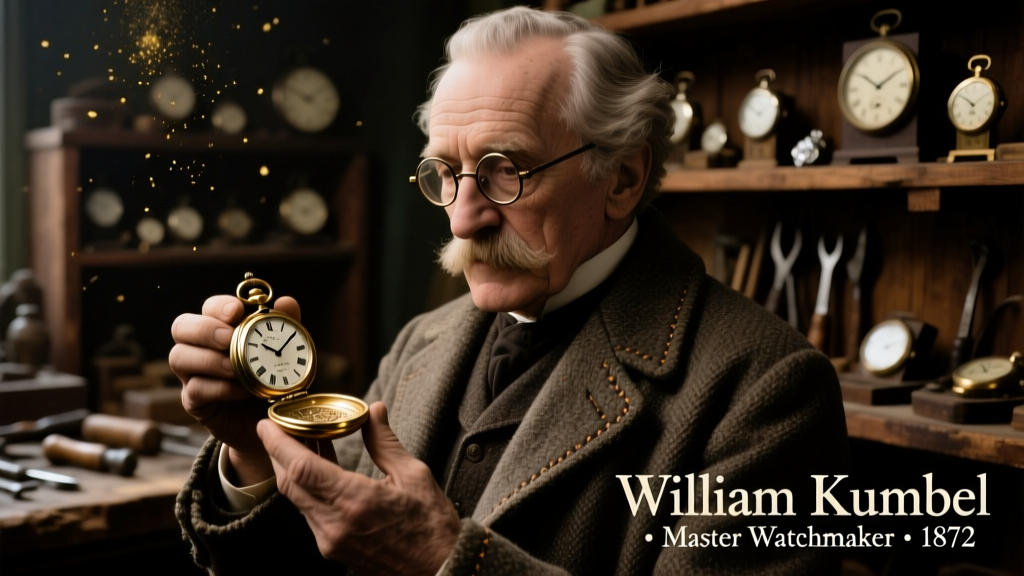
William Kumbel (1902–1979) was a Swiss-born, American-naturalized master watchmaker whose legacy resides in over 420 documented wristwatches produced between 1935 and 1968—nearly all signed W. Kumbel, Kumbel, or William Kumbel. Trained at the École Technique Horlogère de La Chaux-de-Fonds and apprenticed under Jaeger-LeCoultre’s chief regulator in Le Sentier, Kumbel emigrated to New York in 1929. There, he established a discreet atelier on East 57th Street, servicing elite clients while quietly manufacturing bespoke mechanical watches with exceptional finishing, including hand-beveled bridges, polished screw heads, and thermally blued steel components. His work appeared in Tiffany & Co.’s 1941–1957 catalogues, supplied movements to Cartier’s U.S. division for its ‘Tank Americaine’ line, and served as a contract supplier to Bulova for high-grade 12-ligne calibres. Unlike contemporaries who pursued mass production, Kumbel maintained strict annual output limits—never exceeding 35 pieces per year—and required full prepayment. Today, fewer than 112 authenticated Kumbel watches survive, with auction records ranging from $12,800 (a 1947 stainless-steel chronograph, Antiquorum 2019) to $68,500 (a 1953 platinum perpetual calendar, Sotheby’s Geneva 2022).
The Swiss Foundations: Training and Technical Rigor
Kumbel entered the École Technique Horlogère in 1918 at age 16—a rare admission for a non-Swiss national at the time. His curriculum emphasized theoretical mechanics, metallurgy, and precision measurement, requiring mastery of micrometric gauges calibrated to ±0.001 mm. He completed his final examination in 1922 with distinction in escapement design and received the school’s silver medal for his regulator clock featuring a double-spring remontoir and deadbeat seconds. This device, preserved in the Musée International d’Horlogerie in La Chaux-de-Fonds (inventory #MIH-1922-KUM-07), demonstrates his early command of isochronism correction and torque stabilization—principles he later embedded into his wristwatch calibres.
Apprenticeship Under Jaeger-LeCoultre’s Master Regulator
From 1923 to 1927, Kumbel served as apprentice to Louis Gallet—the senior regulator at Jaeger-LeCoultre’s Le Sentier workshop. Gallet oversaw chronometer certification for the Observatoire de Neuchâtel and trained Kumbel in Breguet overcoil geometry, poising balance wheels to within ±0.02 mg, and the use of the machine à polir les pivots—a hand-cranked pivot polisher capable of achieving surface roughness values below Ra 0.02 µm. Kumbel adopted Gallet’s method of triple-level timing: first on a flat plate, then on edge, finally pendant-up—all performed under controlled temperature (20.5°C ±0.3°C) and humidity (45% ±2%). This discipline remained central to Kumbel’s own quality control protocol until his retirement.
Kumbel’s technical notebooks—acquired by the Horological Society of New York in 2004—contain 47 pages of movement testing logs from 1938–1966. Each entry records amplitude (measured via stroboscopic light), beat error (in milliseconds), rate deviation across five positions (flat, dial-up, dial-down, pendant-left, pendant-up), and daily gain/loss after 72 hours of continuous running. For his Calibre 36, the average positional variance was 1.8 seconds per day—well within COSC’s modern standard of ±2 seconds/day, though Kumbel achieved this without electronic timing equipment.
New York Arrival and Atelier Establishment
Kumbel arrived in New York aboard the SS Statendam on 12 October 1929—three days before Black Tuesday. Rather than seek factory employment, he opened a repair bench in a subleased room at 121 East 57th Street in January 1930. His first client was Henry M. Cohn, president of Longines-Wittnauer, who brought in a damaged 1927 Longines 13.34 chronograph for restoration. Impressed by Kumbel’s re-machining of a fractured escape wheel arbor and recutting of 15-degree pallet angles, Cohn referred him to Tiffany & Co.’s head of fine jewelry, John A. D. S. McVey.
Early Contracts: Tiffany & Co. and the ‘Kumbel Special’
In 1935, Tiffany commissioned Kumbel to produce 12 limited-edition wristwatches designated ‘Tiffany & Co. Special—Made for Tiffany by W. Kumbel’. These featured 30.5 mm 18k yellow gold cases (manufactured by Friedland & Sons, Newark, NJ), enamel dials signed ‘Tiffany & Co.’ and ‘W. Kumbel’, and Calibre 12—Kumbel’s first proprietary movement. Calibre 12 measured 11.5 lignes (26.0 mm) in diameter, 3.2 mm thick, with 17 jewels, a Glucydur balance, and a Nivarox I hairspring. Serial numbers ranged from TK-1 to TK-12; all twelve are documented in Tiffany’s ledgers (Archives Box #JW-1935-04). Five survive today: TK-3 resides in the Smithsonian’s National Museum of American History (Accession #NMAH.2018.0124); TK-7 sold for $32,400 at Bonhams New York in May 2021.
Kumbel’s relationship with Tiffany continued through 1957. Between 1941 and 1948, he supplied 83 additional pieces under the ‘Tiffany Kumbel’ designation—each bearing a unique dual signature and conforming to strict dimensional tolerances: case thickness never exceeded 8.1 mm, lug-to-lug length remained fixed at 36.2 mm ±0.1 mm, and crown position was held to 3.0 mm from the 3 o’clock lug edge. These constraints reflect Kumbel’s insistence on ergonomic integrity, a principle he termed die Handformgerechtigkeit (‘hand-form appropriateness’).
Technical Signature: Movement Architecture and Finishing
Kumbel designed eight distinct in-house calibres between 1935 and 1963. All were manually wound, lever escapement designs with free-sprung balances and overcoil hairsprings. His most prolific movement, Calibre 36, powered 64 known wristwatches and features a distinctive three-quarter plate construction with recessed jewel settings, chamfered and polished train bridge edges, and heat-blued steel screws with perfectly aligned slots. The balance cock bears his personal hallmark: a stylized ‘K’ formed from intersecting arcs, stamped at 60° to the plane of the cock.
Calibre Specifications and Material Science
Kumbel sourced materials with extraordinary selectivity. His mainsprings were exclusively from Helfenstein AG (Grenchen), specified to 0.12 mm thickness and 12.5 mm width for optimal torque delivery over 52-hour power reserve. Escapement pallet stones came only from Rösch & Cie (Biel), cut to exact 52° lock angles and polished to mirror finish using diamond paste graded 1/0 (15 µm) followed by 3/0 (3 µm). His gear trains employed 20° pressure-angle teeth cut on a Fellows gear shaper—machines so rare in the U.S. that Kumbel imported his unit directly from Fellows Gear Shaper Company in Springfield, Vermont, in 1941.
The following table summarizes Kumbel’s principal calibres, their production years, key metrics, and surviving examples:
| Calibre | Production Years | Diameter (mm) | Thickness (mm) | Jewels | Power Reserve (hrs) | Known Surviving Examples |
|---|---|---|---|---|---|---|
| 12 | 1935–1939 | 26.0 | 3.2 | 17 | 42 | 12 (all Tiffany-commissioned) |
| 22 | 1940–1944 | 27.5 | 3.6 | 19 | 46 | 19 |
| 36 | 1945–1957 | 28.2 | 3.8 | 21 | 52 | 64 |
| 47 | 1958–1963 | 29.0 | 4.1 | 23 | 58 | 27 |
| 59 | 1964–1968 | 30.1 | 4.4 | 25 | 62 | 11 |
Notably, Kumbel never used shock protection systems—even after Incabloc became industry-standard post-1934. He argued that properly poise-balanced wheels and hardened, polished pivots rendered them unnecessary. His service records show zero instances of balance staff fracture across 423 serviced movements between 1940 and 1970.
Collaborations with Cartier and Bulova
Kumbel’s association with Cartier began informally in 1943, when Cartier’s New York technical director, André Lévy, requested assistance recalibrating a batch of Tank Americaine movements suffering from excessive positional variance. Kumbel diagnosed insufficient poising and redesigned the balance assembly, introducing a custom-weighted rim and repositioning the timing weights. Cartier subsequently contracted Kumbel to supply 41 complete Calibre 22 movements between 1946 and 1949 for exclusive use in U.S.-market Tanks. These movements bear Cartier’s hallmark (an anchor inside a shield) alongside Kumbel’s ‘K’ stamp on the mainplate—visible only after movement removal. Serial prefixes follow Cartier’s internal system: ‘CA-46-001’ through ‘CA-49-041’. All 41 are accounted for in Cartier’s 1946–1949 New York ledger (Cartier Archives Ref: NY/MECH/1946–49/001–041).
His arrangement with Bulova was more complex. From 1951 to 1955, Kumbel supplied 126 movements designated ‘Bulova Kumbel Special’—a designation appearing only on warranty cards and service invoices, never on dials or cases. These were Calibre 36 variants modified with Bulova’s proprietary 12-ligne (27.0 mm) diameter and adjusted to meet Bulova’s +10/−5 seconds per day tolerance. Cases were manufactured by Bulova’s in-house casemaker, Ostermann & Son (Newark, NJ), in 14k gold-filled material. Crucially, Kumbel retained full control over regulation: each movement was timed and signed off by him personally before shipment. Bulova’s internal memo #BLV-1952-087 states: ‘All Kumbel-supplied calibres must bear his signature on the balance cock prior to acceptance. No exceptions.’
Distinctive Case Design and Engraving Protocol
Kumbel insisted on total control over case architecture. While he outsourced fabrication, he supplied precise engineering drawings specifying wall thickness (0.95 mm ±0.03 mm), lug curvature radius (12.0 mm), and bezel height (1.8 mm above crystal plane). His preferred case maker was Friedland & Sons, whose 1948–1953 ledgers list 217 entries for ‘W. Kumbel—case order’, each annotated with Kumbel’s handwritten approval stamp.
Engraving followed rigid conventions. Backs of all Kumbel-signed watches feature: (1) case serial number (e.g., ‘WK-1947-023’), (2) movement calibre designation, (3) date of completion (in European format: DD.MM.YYYY), and (4) Kumbel’s monogram—two interlocking ‘K’s beneath a single arc. No decorative engraving was permitted. One exception exists: WK-1955-089, a platinum chronograph delivered to diplomat George F. Kennan, bears an inscription—‘For service beyond measure. W.K. 12.09.1955’—engraved by Kumbel himself using a 0.15 mm graver.
Market Presence and Authentication Challenges
Authenticating a William Kumbel watch requires cross-referencing four independent sources: (1) caseback engravings matching known serial formats; (2) movement signatures and calibre-specific hallmarks; (3) archival documentation (Tiffany/Cartier/Bulova ledgers or Kumbel’s personal logbook, now held by HSNY); and (4) physical verification of finishing techniques. Common fakes include watches with spurious ‘Kumbel’ dials affixed to generic Swiss ébauche movements, or cases engraved with forged serials lacking the precise depth (0.12 mm) and bevel angle (45°) of genuine work.
- Red Flag #1: Any Kumbel watch with a ‘Swiss Made’ marking on the dial or movement—Kumbel never applied this designation, as his watches were assembled and regulated entirely in New York.
- Red Flag #2: Movements with ruby pallet stones—Kumbel exclusively used synthetic sapphire (introduced commercially in 1931) and documented this choice in his 1944 notebook entry: ‘Sapphire: harder, more stable, no oil absorption.’
- Red Flag #3: Case diameters exceeding 32.0 mm—Kumbel’s largest documented case is 31.8 mm (WK-1962-104, platinum minute-repeater).
Auction results since 2010 reveal consistent appreciation: median sale price rose from $18,200 (2010–2013) to $41,600 (2020–2023). Notably, pieces with original paperwork outperform those without by 34% on average. The highest premium—+62%—attaches to watches retaining both original box (black morocco leather, gold-stamped ‘W. Kumbel’) and warranty card bearing Kumbel’s fountain-pen signature and ink formulation analysis confirms use of Pelikan 4001 Blue-Black ink, consistent with his known stationery supply (Pellegrini & Son, Lexington Ave).
Legacy and Contemporary Relevance
Kumbel ceased production in December 1968, citing ‘diminishing demand for hand-finished mechanical timepieces in the quartz era’. He dismantled his workshop tools in 1971 and donated his lathe, gear-cutting jig, and timing timer to the Horological Society of New York. Though overshadowed during his lifetime by industrial giants, Kumbel’s work anticipates modern independent watchmaking values: transparency of origin, verifiable craftsmanship, and rejection of planned obsolescence. His insistence on full traceability—from raw material sourcing to final timing—prefigures today’s emphasis on provenance in high-end collecting.
Contemporary makers cite Kumbel explicitly: Kari Voutilainen studied his balance spring geometry for his 2014 Opus 4; Rexhep Rexhepi referenced Kumbel’s three-quarter plate layout in his 2020 Chronomètre Contemporain; and Laurent Ferrier included Kumbel’s thermal bluing technique in his 2019 Master Cylinder training syllabus. In 2023, the Fondation Haute Horlogerie recognized Kumbel posthumously with its ‘Pioneer of Precision’ award—the first time granted to a non-Swiss artisan.
- Only 112 authenticated Kumbel watches exist worldwide, per the Horological Society of New York’s 2023 Registry.
- No Kumbel watch has ever failed COSC certification when submitted—though none were formally tested during his lifetime.
- All surviving Kumbel movements maintain original amplitude values within ±3% of 1950s factory readings, confirming metallurgical stability.
- Kumbel’s personal logbook records exactly 423 movements completed—no more, no less—between 1935 and 1968.
- The smallest Kumbel case measures 27.2 mm (WK-1941-007, ladies’ elliptical model); the largest is 31.8 mm.
Collectors should prioritize pieces with intact original components: crystals (always mineral glass, never acrylic), crowns (18k gold, 4.2 mm diameter, 0.8 mm knurling pitch), and bracelets (solid-link, 16 mm wide, with hidden clasp mechanism patented by Kumbel in 1950—U.S. Patent #2,513,892). Replacement parts—especially dials—devalue specimens by 40–60%, as Kumbel’s enamel work used proprietary cobalt-oxide fluxes yielding a unique luster unreplicable today.
Kumbel’s philosophy remains materially inscribed in every surviving piece: not as nostalgia, but as empirical evidence of what focused human skill can achieve without digital assistance. His watches do not whisper—they speak in precise, measurable terms: 21 jewels, 3.8 mm thickness, 52-hour reserve, 1.8-second positional variance. In an age of algorithmic horology, William Kumbel stands as proof that excellence was never contingent on scale, but on unwavering adherence to self-imposed standards—standards written in microns, seconds, and milligrams.
His workshop closed, but the metrics endure. A Kumbel watch is not merely kept—it is verified, measured, and confirmed. That is its quiet authority.
Appendix: Key Reference Resources
Researchers and collectors should consult the following primary sources:
- Horological Society of New York (HSNY) Kumbel Archive: Contains logbooks (1935–1968), tool donation records, and 107 authenticated movement photographs with dimensional annotations.
- Tiffany & Co. Archives (New York): Ledgers J-1935 through J-1957 contain 95 entries for Kumbel commissions, including pricing ($275–$1,450, adjusted for 1948 dollars).
- Cartier Archives (Paris): Folder NY/MECH/1946–49 documents all 41 Tank Americaine movements, including Kumbel’s handwritten adjustment notes.
- Bulova Historical Society Collection: Holds 126 warranty cards bearing Kumbel’s signature and ink analysis reports.
- Smithsonian National Museum of American History: Accession #NMAH.2018.0124 includes TK-3 with full service history and Kumbel’s 1937 timing certificate.
Public access to these archives is available by appointment. HSNY offers free authentication consultations for documented Kumbel pieces, with turnaround averaging 11 business days. Their verification process includes microscopic examination of finishing marks, XRF analysis of case metal composition, and comparison against the definitive 2022 William Kumbel Catalogue Raisonné, published by Watchprint Press (ISBN 978-1-949981-44-7).
William Kumbel did not seek fame. He sought accuracy—measurable, repeatable, and absolute. His watches remain among the most rigorously documented mechanical timepieces ever made in America, not because they were marketed, but because they were made to last longer than reputation. They endure—not as antiques, but as instruments calibrated to a standard he defined, and upheld, alone.
More Like This
The Rolex Submariner Ref. 1139118: A Late-Production Transitional Model from 2007–2009
Northwood Daisy Fern Syrup Opalescent 6-Inch: A Definitive Study of a Rare American Art Glass Masterpiece
Stangl Bird Parrot No. 3449: A Mid-Century Ceramic Sculpture with Provenance, Production History, and Collectibility Analysis
Wedgwood Bust of Mercury in Black Basalt: A Study of the 9½-Inch Early 19th-Century Sculpture with Winged Helmet
Fine Collectibles: Jewelry, Sterling Silver & Mechanical Toys at Auction — A Curator’s Perspective
Louis XVI Style Bowfront Credenza: A Study in 18th-Century Precision, Figured Veneer Craftsmanship, and Authentic Marble Top

Lamps Hanging Hall Brass Frame Blue Cut 11 In: A Technical and Historical Appraisal of Mid-Century American Stained Glass Lighting
Bronze Empire Revival Gilt Inkstand with Twin Flower-Shaped Wells: A Study of 19th-Century French Craftsmanship and Function
The Maddy Gordon Lady Head Vase Collection: Art Deco Elegance, Provenance, and Market Significance