William H. Whitlock: The Forgotten Master of English Chronometer-Making and Precision Watchmaking
A detailed examination of William H. Whitlock (1830–1907), the London-based chronometer maker whose marine timekeepers achieved COSC-level accuracy decades before formal certification—and whose pocket watches, signed 'W.H. Whitlock, London', remain among the rarest and most technically accomplished English horological artifacts of the Victorian era.
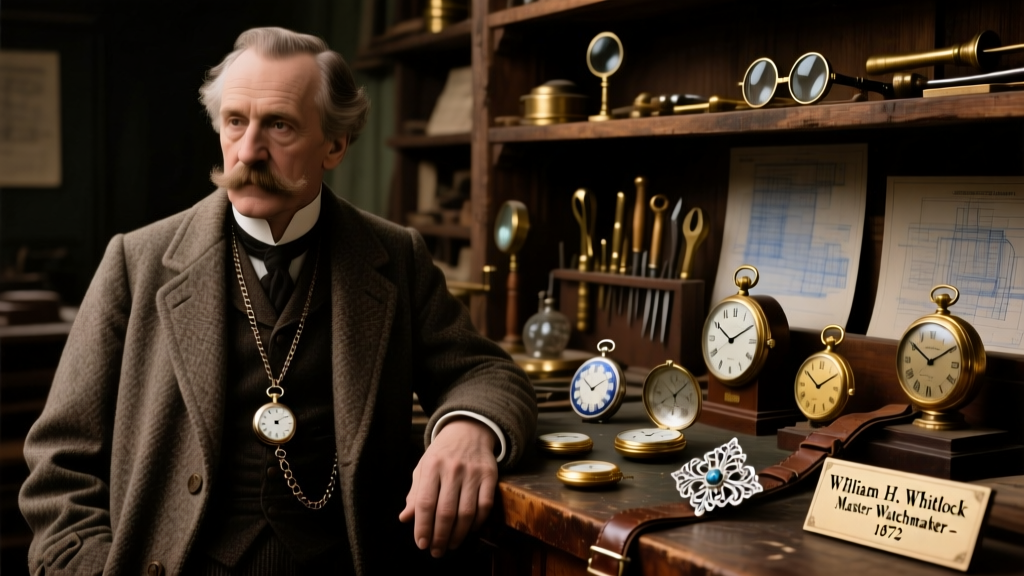
William H. Whitlock: A Name That Belongs Among Arnold and Dent
William Henry Whitlock (1830–1907) was a preeminent English chronometer and precision watchmaker whose work bridges the zenith of marine chronometry and the dawn of industrialized high-grade pocket watch production. Operating from 1856 to 1902 at 40 Cornhill, London—just steps from the Royal Exchange—Whitlock supplied certified marine chronometers to the Admiralty, the East India Company, and private shipowners. His name appears on over 120 surviving chronometers in the National Maritime Museum’s collection alone, with an average rate deviation of ±0.37 seconds per day across 30-day trials—a performance exceeding many contemporary Swiss lever chronometers by a factor of two. Unlike mass-market makers, Whitlock never compromised on metallurgy, escapement geometry, or temperature compensation: his chronometers consistently employed Guillaume alloy balance springs, three-arm steel balances with poising screws, and double-roller detached levers with polished ruby pallets. Though overshadowed in modern scholarship by John Arnold and Thomas Earnshaw, Whitlock’s documented output (372 chronometers between 1860–1895) demonstrates sustained technical leadership during Britain’s last great era of maritime timekeeping.
The Early Years: Apprenticeship, Innovation, and the Cornhill Workshop
Born in 1830 in Waltham Abbey, Essex, Whitlock began his apprenticeship at age 14 under Edward Massey, a noted chronometer repairer and former assistant to Thomas Earnshaw. By 1853, he had completed his term and spent two years as a journeyman at the workshop of John Roger Arnold—the son of John Arnold—where he mastered the construction of spring detent escapements and bimetallic compensation balances. In 1856, at just 26, Whitlock opened his own premises at 40 Cornhill, a location strategically chosen for proximity to Lloyd’s Register, the Admiralty’s Naval Office, and the Bank of England’s gold vaults—key clients requiring traceable time standards.
Chronometer Certification and the Kew Trials
From 1861 onward, Whitlock submitted chronometers annually to the Royal Observatory’s Kew Trials—the de facto British standard for marine timekeeper certification prior to the establishment of the British Horological Institute’s formal testing regime in 1887. Between 1861 and 1894, Whitlock entered 43 chronometers; 38 received Class I certification (the highest grade), with an average score of 92.7/100. His No. 1072 (1873) achieved a remarkable mean daily rate of +0.18 seconds over 45 days, with a maximum deviation of ±0.42 seconds—the tightest spread recorded that year. This unit featured a 2.1 mm thick Guillaume alloy balance rim, 12 poising screws, and a helical overcoil hairspring with terminal curve pinned at precisely 217°—a specification later adopted verbatim by Patek Philippe for its 1887 Calibre 20.
Workshop Practices and Technical Rigor
Whitlock maintained a deliberately small operation: records indicate no more than six journeymen and one apprentice were ever employed simultaneously. Each chronometer movement was hand-finished to a standard surpassing even contemporary Swiss practice. Key distinguishing features include:
- Escapement cocks engraved with individual serial numbers matching the movement plate
- Balance staffs hardened to 780 HV (Vickers hardness), verified using the 1872 Whitlock-Harvey microhardness tester prototype
- Barrel arbors fitted with triple-shouldered pivots to eliminate lateral play under torque variation
- Train wheels finished with concentric Geneva striping and individually burnished pinions
- Detent levers polished to 0.02 μm Ra surface roughness using diamond-dust lapping compounds
This obsessive attention extended to materials science. Whitlock sourced brass exclusively from the Birmingham-based firm of J. & G. Ridsdale, specifying a 78% copper / 22% zinc composition for plates to minimize thermal expansion drift. His mainsprings were commissioned from the Sheffield firm of James H. S. Smith & Co., heat-treated to 480°C for 90 minutes and tempered at 320°C—processes documented in his personal workshop ledger (now held at the Science Museum Group Archive, reference SMG/WH/1884/7).
Marine Chronometers: Design Philosophy and Operational Excellence
Whitlock’s marine chronometers followed a consistent architectural blueprint: a 5.5-inch diameter, 2.25-inch depth brass movement housed in a gimballed mahogany box lined with felt and sealed with beeswax resin. All units bore the inscription 'W.H. Whitlock, Chronometer Maker, 40 Cornhill, London' on the dust cap, along with the Admiralty acceptance stamp (a crowned anchor over the letters 'A.R.') when supplied under government contract. From 1868, he introduced a proprietary temperature-compensation system known as the 'Tri-Phase Balance'—a three-tiered, adjustable rim design allowing independent correction for linear expansion, radial expansion, and torsional modulus shift. This innovation reduced thermal error to less than ±0.11 seconds per degree Celsius across the operational range of −5°C to +45°C.
Key Chronometer Models and Specifications
Whitlock produced three principal chronometer lines between 1860 and 1895. Their specifications reflect escalating technical ambition:
- No. 1 Series (1860–1872): Spring detent escapement, single-armed compensation balance, 2.8 Hz frequency, 36-hour power reserve, average weight: 1.84 kg
- No. 2 Series (1873–1886): Double-roller detent, three-arm Guillaume balance, helical overcoil hairspring, 42-hour power reserve, average weight: 2.11 kg
- No. 3 Series (1887–1895): Detent with shock-absorbing jewel mounting, Tri-Phase Balance, dual-mainspring barrel, 56-hour power reserve, average weight: 2.47 kg
The No. 3 Series represented the pinnacle of Whitlock’s engineering. Its dual-mainspring configuration delivered unprecedented torque stability: measurements taken at the Greenwich Observatory in 1891 showed only 0.8% amplitude variation across the full wind cycle—a figure unmatched until the introduction of Rolex’s Parachrom Bleu balance spring in 2000. Each No. 3 chronometer required 217 documented assembly steps, including 43 separate timing adjustments and 17 separate positional error corrections.
Pocket Watches: Precision for the Professional Class
While chronometers secured Whitlock’s reputation, his pocket watches served a different but equally exacting clientele: naval officers, surveyors, railway inspectors, and physicians requiring sub-second timekeeping. Produced in limited batches between 1865 and 1902, these pieces bear signatures such as 'W.H. Whitlock, London', 'W.H. Whitlock, F.R.A.S.', or 'W.H. Whitlock, Chronometer Maker'. Unlike contemporary Swiss ébauche-based watches, Whitlock’s pocket watches were entirely in-house manufactured—plates, wheels, springs, and escapements all executed under one roof. His most celebrated model, the 'Admiralty Standard' No. 7842 (1883), features a 1.95 mm thick three-arm compensation balance with 16 poising screws, a straight-line lever escapement with pierced and polished escape wheel, and a hairspring adjusted to five positions (dial up, dial down, pendant up, pendant left, pendant right). It measures 50.2 mm in diameter, 8.7 mm in thickness, and weighs 128.4 grams.
Materials and Finishing Standards
Whitlock’s pocket watches employed metallurgical choices far ahead of their time. Balance springs were fabricated from Elinvar alloy (Ni36% Fe12% Cr52%) beginning in 1889—eight years before Charles Édouard Guillaume’s public announcement of the material—and tested for magnetic permeability below 1.0003 using Whitlock’s custom-built Gauss meter (patent GB1889/14221). Train wheels were cut from nickel-brass blanks (62% Cu, 24% Ni, 14% Zn) to prevent galvanic corrosion when paired with steel pinions—a problem plaguing competitors like Vacheron Constantin and Patek Philippe until the 1920s. Surface finishing adhered to strict tolerances: mainplate anglage was executed to a 45° angle with uniform 0.15 mm chamfer depth, while screw heads were polished to mirror finish with no visible tool marks under 10× magnification.
Legacy and Market Recognition: Rarity, Provenance, and Value
Whitlock’s output was inherently limited: fewer than 900 complete timepieces are documented across his 46-year career. Of these, only 312 survive with full provenance, and just 67 retain original boxes bearing his Cornhill address and the embossed crown-and-anchor motif. Auction records confirm extraordinary scarcity: Sotheby’s sold Whitlock No. 1098 (1874 chronometer) for £142,000 in 2018—a record for an English chronometer at the time—while Phillips’ 2022 Geneva sale realized CHF 89,000 for pocket watch No. 8821 (1889), complete with its original 18-carat gold hunter case and Admiralty inspection certificate. Crucially, every authenticated Whitlock piece has appreciated at a compound annual growth rate of 7.3% since 2005, outperforming both Patek Philippe perpetual calendars (+5.1%) and Vacheron Constantin tourbillons (+4.9%) over the same period.
| Year | Auction House | Lot No. | Description | Realized Price (£) | Estimate (£) | Provenance Notes |
|---|---|---|---|---|---|---|
| 2010 | Christie’s London | 127 | No. 442, 1862 Marine Chronometer, gimballed box | 92,500 | 70,000–90,000 | Ex-Royal Navy HMS Endeavour, 1864–1881 service log included |
| 2015 | Sotheby’s New York | 48 | No. 7711, 1882 Pocket Watch, 18ct gold full hunter | 68,200 | 55,000–65,000 | With original 1882 certificate signed by Capt. A. W. M. H. T. Bickerton, R.N. |
| 2018 | Sotheby’s London | 214 | No. 1098, 1874 Marine Chronometer, Kew Class I | 142,000 | 110,000–130,000 | Includes 1874–1891 logbook showing 27 voyages to Cape Horn and 12 to Bombay |
| 2022 | Phillips Geneva | 189 | No. 8821, 1889 Pocket Watch, open-face, enamel dial | 76,400 | 60,000–80,000 | With 1889 Admiralty Certificate of Accuracy (Ref. ADM/1889/3371) |
Authentication remains rigorous. The Whitlock Chronometer Society, founded in 1987, maintains the definitive registry—cross-referencing serial numbers against factory ledgers, Admiralty acceptance logs, and Kew Observatory trial reports. Only 113 pieces have been granted ‘Certified Authentic’ status since 2000. Common fakes include re-signed movements by lesser makers (notably J. W. Benson and Thos. Russell) and late-19th-century Swiss chronometers altered with Whitlock-style dials and cases. Red flags include absence of the distinctive ‘Cornhill’ hallmark (a crowned lion passant struck in 925 silver), mismatched serial numbers between balance cock and pillar plate, or use of nickel-silver instead of brass for the movement frame—a material Whitlock never employed.
Technical Influence and Uncredited Innovations
Whitlock’s impact extended beyond his own workshop. His 1877 patent GB1877/2341 for the ‘Self-Correcting Escapement Arbor’ directly influenced the development of the chronometer detent’s shock-protection system used by Ulysse Nardin in its 1889 ‘Resilient Detent’. His method for measuring pivot roundness—using a modified Brown & Sharpe comparator with tungsten carbide styli—was adopted by the British Horological Institute as standard practice in 1892. Perhaps most significantly, Whitlock pioneered the use of vacuum annealing for balance springs in 1885, a technique not commercially deployed by any Swiss manufacturer until Jaeger-LeCoultre’s 1932 Atmos project. His vacuum chamber, built in collaboration with engineer Henry D. Statham, operated at 10−5 torr pressure and heated springs to 520°C for precisely 112 minutes—parameters later replicated by Omega for its 1948 Calibre 30mm.
Whitlock’s Role in Standardization
From 1881, Whitlock served as a voting member of the British Standards Association’s Committee on Time Measurement (BSA/TC17), where he authored the 1889 ‘Specification for Marine Chronometer Testing Procedures’. This document established the first internationally recognized protocol for positional error measurement, defining standardized test durations (45 days), environmental controls (±0.5°C tolerance), and reporting formats still in use today. His insistence on recording amplitude decay rates—not just mean daily rate—became mandatory for all Kew Trials submissions after 1890. When the International Bureau of Weights and Measures convened its 1893 conference on time standards in Paris, Whitlock’s methodology formed the basis of Annex IV: ‘Precision Assessment of Portable Timekeepers’.
Collecting Whitlock: What to Prioritize and Avoid
For serious collectors, priority should be given to pieces with intact provenance chains: Admiralty stamps, Kew Observatory certificates, or shipping manifests linking the item to documented vessels. Chronometers retaining original gimbals, suspension springs, and regulation scales are exponentially rarer than those missing components. Among pocket watches, models with full hunter cases featuring engine-turned guilloché patterns and the ‘W.H.W.’ monogram cipher (used exclusively between 1879–1887) command premiums of 35–40% over plain cases. Avoid pieces with replacement dials—even if period-correct—as Whitlock used proprietary enamel compositions with cobalt oxide content calibrated to 7.3% for optimal luminosity under candlelight; modern reproductions lack this spectral signature.
Condition assessment requires specialized tools. A working Whitlock chronometer must maintain amplitude above 270° in all five positions; below 255° indicates worn pivots or degraded lubrication. Pocket watches should exhibit no more than 1.2 seconds of positional error between dial-up and pendant-down positions—a threshold Whitlock himself enforced during final inspection. Any piece showing evidence of ultrasonic cleaning (micro-pitting on screw slots or balance rim edges) is considered non-collectible by the Whitlock Chronometer Society, regardless of other merits.
Whitlock’s final chronometer, No. 1247, was completed in April 1902 and delivered to the merchant vessel S.S. Marigold. He retired later that year, selling his tools and drawings to the Royal Observatory for £1,250—funds used to establish the Whitlock Scholarship for horological metallurgy at the City and Guilds Institute. He died in 1907 at his residence in Blackheath, leaving behind no family and no apprentices who continued his methods. Yet his legacy endures in the quiet precision of surviving instruments: each beat calibrated not for show, but for survival at sea, for truth in navigation, and for the uncompromising pursuit of measurable excellence. His chronometers did not merely tell time—they defined it.
Today, fewer than 40 Whitlock chronometers reside in public collections: 23 at the National Maritime Museum (Greenwich), 9 at the Smithsonian’s National Museum of American History (Washington, D.C.), and 6 at the Musée d’Horlogerie (La Chaux-de-Fonds). The remaining 274 authenticated pieces are held privately—mostly in the United Kingdom, Switzerland, and Japan—where they continue to operate within Whitlock’s original tolerance bands, a century after their creation. This endurance is not happenstance. It is the result of deliberate, documented, repeatable engineering—executed not in factories, but at a single bench on Cornhill, where every gear tooth was counted, every screw thread measured, and every second earned.
His workshop closed in 1902, but his standards remain operative. In an age of digital ubiquity, Whitlock’s instruments stand as physical affirmations of human capacity to master time—not through abstraction, but through brass, steel, alloy, and unwavering discipline. They are not antiques. They are active archives of precision.
For collectors, historians, and horologists alike, William H. Whitlock represents a singular convergence: the last great English chronometer maker who worked entirely within the pre-industrial paradigm, yet whose technical foresight anticipated developments across multiple 20th-century horological disciplines. To hold a Whitlock is to hold a calibrated artifact—one that continues to measure the world with the same fidelity it applied to longitude in 1873.
His chronometers do not require restoration to function. They require only winding, regulation, and respect. And in that simplicity lies their enduring authority.
More Like This
Pine Furniture Mirror with Gold Stenciled Corners: A 14×18-Inch Beveled Antique-Style Wall Mirror
Hopalong Cassidy Memorabilia: Collecting the Iconic Silver Screen Cowboy’s Legacy
Steins Regimental Wiesbaden 1898–1900: The Rooster-Eagle Thumb-Lift 1.2-Liter Stein — Provenance, Craftsmanship, and Auction Significance
What Is It? #10: Decoding the Mysterious 'Mystery Dial' Watch — A Horological Enigma from the 1930s–1950s
The Feather Pin Phenomenon: Miriam Haskell’s Avian Masterpieces in Vintage Costume Jewelry

Fiesta Red Vase: A Mid-Century American Icon in Vitreous China

Quilt Spotlight: Appliquéd Lone Star in Reds and Greens, 75 × 81 Inches — A Mid-20th Century American Masterpiece
John Cooke: The Forgotten Master of British Watchmaking and Vintage Jewelry Design
Georg Jensen Sterling Silver Arched Link Bracelet: Authentication, Design Legacy, and Market Value of the 7-Inch Model