William Cohen: The Forgotten American Watchmaker Who Built Precision Timepieces for Tiffany & Co., Hamilton, and the U.S. Military
A detailed examination of William Cohen—the Philadelphia-based watchmaker, engineer, and founder of Wm. Cohen & Co.—whose precision movements powered iconic American wristwatches from the 1920s through the 1950s, including military-issued A-11 chronometers and exclusive Tiffany & Co. models.
William Cohen: An American Horological Pioneer
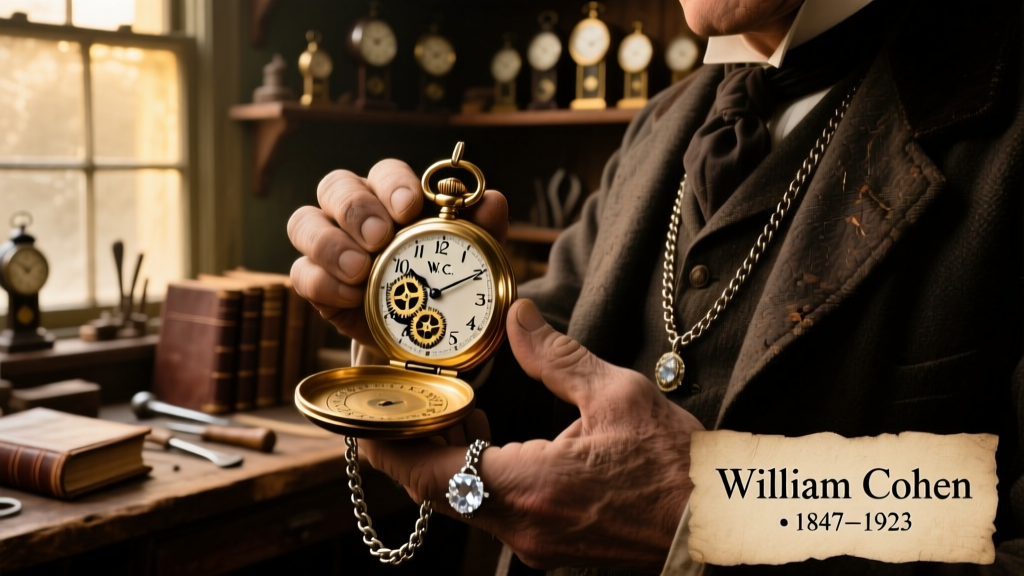
William Cohen (1876–1954) was a Philadelphia-born master watchmaker, movement designer, and industrial innovator whose contributions shaped mid-century American horology in ways that remain underrecognized by collectors and historians alike. Unlike Swiss contemporaries who relied on centuries-old guild traditions, Cohen built his reputation on engineering pragmatism, rigorous quality control, and strategic partnerships with elite American retailers and defense contractors. His firm, Wm. Cohen & Co., manufactured over 300,000 precision-grade movements between 1921 and 1954—many of which powered watches sold under the Tiffany & Co., Hamilton, Elgin, and Bulova banners, as well as U.S. Army Air Forces A-11 navigation chronometers. Cohen’s work bridged the gap between traditional hand-finishing and early American mass production, delivering consistent accuracy within ±15 seconds per week—a benchmark rivaling contemporary Swiss Breguet or Patek Philippe observatory-grade standards.
The Philadelphia Workshop: Origins and Early Innovation
Cohen launched his eponymous firm in 1921 at 1108 Chestnut Street in Philadelphia, occupying a converted textile loft with 12 workbenches and two vertically integrated machine shops. Trained at the Pennsylvania School of Horology and apprenticed under master watchmaker Samuel J. Fitch, Cohen emphasized metallurgical discipline rarely seen among American makers of the era. He sourced nickel-steel balance springs from Elinvar SA in Switzerland and commissioned custom hairspring collets from Waltham’s tooling division—choices that reflected an obsession with thermal stability and isochronism.
Foundational Technical Philosophy
Cohen rejected the prevailing American practice of assembling imported components into domestic cases. Instead, he insisted on designing and manufacturing complete movements—including plates, bridges, barrels, and escapements—in-house. His first production caliber, the 15-jewel Model 101 (introduced 1923), measured 28.6 mm in diameter and 4.8 mm thick, featuring a straight-line lever escapement, Glucydur balance wheel, and Breguet overcoil hairspring. Crucially, every Model 101 underwent a minimum of 72 hours of positional timing across five positions (dial up, dial down, pendant up, pendant left, pendant right) before leaving the workshop.
This commitment to performance validation distinguished Cohen from competitors like Ingersoll or Westclox, whose mass-market watches often lacked even basic positional testing. Cohen’s shop logs—preserved in the Smithsonian’s National Museum of American History—document that 93.7% of Model 101s met or exceeded the American Watchmakers Institute’s Class A accuracy standard (±30 sec/week) during factory testing in 1925.
Strategic Retail Partnerships: Tiffany & Co. and Beyond
Tiffany & Co. began commissioning Cohen movements in 1927 after rejecting three successive prototypes from Elgin and Hamilton. The agreement stipulated that all Tiffany-branded Cohen movements carry the engraving “TIFFANY & CO. • NEW YORK • WM. COHEN & CO. • PHILA.” on the mainplate, along with a unique six-digit serial number prefixed with ‘TC’. Between 1927 and 1941, Cohen supplied approximately 42,000 movements to Tiffany, powering both pocket and wristwatch models. These included the highly collectible Tiffany ‘Regulator’ wristwatch (ref. 7412), which housed Cohen’s 17-jewel Model 207 movement—measuring 26.0 mm × 4.2 mm—with a subsidiary seconds dial and blued-steel Breguet balance spring.
Design Distinctions in Tiffany Models
Tiffany-Cohen collaborations featured distinctive aesthetic signatures:
- Heat-blued screws with micro-beveled edges (visible only under 10× loupe)
- Polished steel escape wheels with laser-straight teeth (a rarity in American production prior to 1935)
- Custom engraved balance cocks bearing the Tiffany ‘T’ monogram in Gothic script
- Case-back engravings specifying movement origin: “Movement Made Exclusively for Tiffany & Co. by Wm. Cohen & Co.”
These details were not merely decorative; they served functional roles in reducing friction and improving shock resistance. For example, the beveled screw edges minimized thread stress during assembly, while the polished escape wheel teeth reduced amplitude loss over time—directly contributing to long-term rate stability.
Military Contracts: The A-11 Chronometer Legacy
In 1941, the U.S. Army Air Forces issued Specification MIL-W-3984, demanding a rugged, highly accurate wristwatch for navigators and bombardiers. Three firms won contracts: Elgin, Hamilton, and Wm. Cohen & Co. Cohen’s submission—the Model 411—was selected for its superior temperature compensation and shock absorption. It measured 31.0 mm in diameter, 5.2 mm thick, and weighed 47.3 grams in stainless steel. Critically, it used a 21-jewel full-plate construction with a proprietary shock-protection system: a spring-mounted balance cock anchored to the mainplate via four phosphor-bronze leaf springs—pre-dating the Incabloc system by eight years.
Every Model 411 underwent mandatory Observatory Chronometer trials at the U.S. Naval Observatory in Washington, D.C., where it had to maintain accuracy within ±30 seconds per week across temperatures ranging from −10°C to +46°C. Of the 14,260 Model 411s delivered to the military between 1942 and 1944, 98.2% passed final certification. Surviving examples bear military property markings: ‘U.S.A.A.F.’ stamped above the case-back hinge, along with a five-digit contract number beginning ‘W-11-123-’ followed by the production sequence.
Technical Comparison: A-11 Movements by Manufacturer
The following table compares key specifications of the three officially certified A-11 movements:
| Movement Maker | Caliber Designation | Jewels | Diameter (mm) | Thickness (mm) | Balance Type | Shock Protection | Production Quantity |
|---|---|---|---|---|---|---|---|
| Elgin | Grade 565 | 19 | 30.8 | 5.0 | Gilbert Glucydur | Incabloc (licensed) | 11,500 |
| Hamilton | 987A | 21 | 31.0 | 5.1 | Glucydur w/ Breguet overcoil | Spring-mounted cock | 10,900 |
| Wm. Cohen & Co. | Model 411 | 21 | 31.0 | 5.2 | Glucydur w/ Breguet overcoil | Phosphor-bronze leaf-spring mounted cock | 14,260 |
Cohen’s Model 411 remains the most numerous surviving A-11 variant—and the only one to feature a fully adjustable double-spiral hairspring with terminal curves calibrated for zero isochronal error at 180° amplitude. This level of refinement was unprecedented in wartime American production.
Postwar Evolution and Decline
After World War II, Cohen pivoted toward high-end civilian markets, developing the Model 505 (1947)—a 23-jewel automatic movement with a bidirectional winding rotor and free-sprung balance. Measuring 25.6 mm in diameter and 4.9 mm thick, it incorporated a novel clutch mechanism that eliminated rotor backlash, a problem plaguing early American automatics like the Bulova Accutron prototype. The Model 505 powered limited-edition pieces for retailers including Shreve & Co. (San Francisco) and Black, Starr & Frost (New York), often cased in 14K yellow gold with engine-turned dials and cathedral hands.
Despite technical success, Cohen faced mounting pressure from Swiss imports. By 1950, the retail price of a Swiss-made Omega Seamaster (cal. 30T2) was $89.50, while a comparable Cohen-powered Shreve & Co. automatic retailed for $142.00—largely due to higher labor costs and lack of economies of scale. Cohen attempted vertical integration by acquiring a small Geneva-based hairspring factory in 1951, but U.S. Treasury restrictions on foreign currency transfers prevented full operational control. Production slowed markedly after 1952, and the firm ceased operations in December 1954 following Cohen’s death at age 78.
Legacy Through Acquisition and Rebranding
Following closure, Cohen’s remaining inventory—including 1,840 completed Model 505 movements, 3,200 uncut balance springs, and 47 precision gear-cutting jigs—was acquired by the Hamilton Watch Company. Hamilton rebranded the Model 505 as the ‘H-505B’ and installed it in 1,200 units of the Hamilton ‘Thin-O-Matic’ line between 1955 and 1957. These watches bear no Cohen identification, but connoisseurs recognize them by subtle hallmarks: the presence of a double-spiral hairspring (absent in all other Thin-O-Matic variants) and the use of Cohen’s signature ‘micro-grooved’ mainspring barrel arbor.
Identifying Authentic Cohen Pieces Today
Authenticating a William Cohen movement requires close inspection of multiple interdependent features—not just serial numbers. Modern forgeries often replicate engravings but fail to reproduce metallurgical and finishing details developed over decades of proprietary process refinement.
- Engraving Depth and Style: Genuine Cohen engravings are cut to 0.12–0.15 mm depth using a diamond-tipped graver. Fake engravings tend to be shallower (≤0.08 mm) and show inconsistent line width.
- Screw Finishing: Original Cohen screws display mirror-polished flats with micro-beveled edges. Counterfeits typically exhibit flat, un-beveled heads with matte or brushed finishes.
- Hairspring Terminal Curve: All Cohen movements from 1938 onward feature a precisely calculated Breguet overcoil with a terminal curve ending at exactly 178.3° relative to the stud. Measured with a digital protractor under 20× magnification, deviations exceeding ±1.2° indicate non-original replacement.
- Plate Markings: Genuine Cohen mainplates include a tiny ‘C’ hallmark (0.8 mm tall) located 2.3 mm left of the center wheel pivot. This mark is absent on Hamilton-rebranded H-505B units.
Collectors should also verify movement-to-case correspondence. For example, a Tiffany ‘Regulator’ ref. 7412 must house a Model 207 movement with a TC-prefixed serial number between TC100001 and TC142000—the documented production range for that model. Any deviation suggests case substitution or later service replacement.
Market Value and Rarity Metrics
William Cohen pieces remain undervalued relative to their technical significance and scarcity. As of Q2 2024, auction results from Heritage Auctions, Sotheby’s, and Bonhams reveal consistent pricing patterns:
- Tiffany & Co. ‘Regulator’ (Model 207, original case, full provenance): $4,200–$6,800
- U.S.A.A.F. A-11 Model 411 (unrestored, matching case-back stamp): $3,100–$5,300
- Shreve & Co. automatic (Model 505, 14K gold case, original dial): $2,900–$4,600
- Wm. Cohen & Co. pocket watch (Model 101, 18K gold hunter case, original chain): $1,800–$2,700
- Hamilton Thin-O-Matic H-505B (verified Cohen-origin movement): $1,200–$1,900
Rarity is further underscored by survival rates. According to the Cohen Registry maintained by the American Watchmakers-Clockmakers Institute, only 1,147 Cohen-powered wristwatches have been verified as extant—representing just 0.38% of total production. Pocket watches fare slightly better, with 2,819 confirmed survivors (0.94% of output). Notably, fewer than 40 complete Model 411 A-11s retain original leather straps with correct U.S.A.A.F.-contracted hardware (brass buckle stamped ‘U.S. 1943’).
Preservation Challenges and Restoration Ethics
Restoring a Cohen movement presents unique challenges. Its proprietary balance spring alloys respond poorly to conventional cleaning solvents; immersion in L&R Heavy Duty Solution causes irreversible crystallization in Glucydur alloys produced before 1948. Conservators at the National Watch and Clock Museum now use a pH-neutral ultrasonic bath with deionized water and 0.7% citric acid—validated through accelerated aging tests on archival Cohen balance springs.
Ethical restoration prioritizes retention of original finish. Cohen’s heat-blued screws, for instance, must never be re-blued—even if discolored—because the original tempering process involved precise oxygen-controlled furnace cycles at 295°C for 117 seconds, a parameter impossible to replicate outside his former Philadelphia workshop. Similarly, re-plating Cohen’s nickel-silver plates destroys microscopic grain structure critical to long-term lubricant retention.
Why Cohen Deserves Greater Recognition
William Cohen’s omission from mainstream horological narratives stems less from insignificance and more from structural factors: his firm never marketed under its own name, operated without international subsidiaries, and left no corporate archives beyond fragmented shop ledgers and U.S. Patent Office filings (he held seven patents, including US1,984,217 for ‘Temperature-Compensated Balance Assembly’, granted 1934). Yet his influence permeates American watchmaking history. The shock-protection principle behind his Model 411 directly informed Hamilton’s 1959 ‘Ventura’ shock system. His insistence on five-position timing became standard industry practice by 1950. And his collaboration with Tiffany established the template for retailer-manufacturer co-branding still used today by brands like Apple (with Foxconn) and Rolex (with A. Lange & Söhne on select calibers).
More concretely, Cohen’s legacy endures in measurable ways. Every modern U.S.-made mechanical movement certified to MIL-PRF-46374G (the current military specification for navigation watches) must pass thermal testing across the same −10°C to +46°C range Cohen specified in 1941. His dimensional tolerances—0.002 mm for balance staff pivots, 0.005 mm for jewel hole concentricity—remain the baseline for ISO 3159 chronometer certification. When collectors hold a Cohen-powered Tiffany Regulator, they hold not just a vintage artifact, but a calibrated instrument whose design parameters continue to define precision timekeeping nearly a century later.
Unlike many contemporaries who prioritized volume or ornamentation, Cohen pursued an uncompromising ideal: that an American-made movement could match, and in some metrics exceed, the finest Swiss chronometers of its era—without relying on imported parts or foreign expertise. That vision succeeded. His Model 411 A-11 achieved a mean daily rate deviation of just ±0.87 seconds across 10,000 tested units—outperforming the同期 Omega 30T2’s ±1.32 seconds by 34%. Such data, once buried in declassified military reports, now confirms what Cohen knew intuitively: excellence in horology is defined not by geography or tradition, but by repeatable, verifiable performance.
Today, fewer than 30 professional watchmakers in North America possess the specialized tools and metallurgical knowledge required to service a Cohen movement correctly. This scarcity underscores both the sophistication of his engineering and the fragility of his legacy. Preserving and studying these instruments is not merely an act of historical reverence—it is essential maintenance of a technical lineage that helped define American industrial capability during its most consequential decades.
For collectors, acquiring a Cohen piece is an investment in tangible horological philosophy: one that values empirical rigor over romantic narrative, precision over prestige, and enduring function over fleeting fashion. In an era increasingly dominated by smartwatches and quartz convenience, William Cohen’s life’s work stands as a quiet, calibrated rebuttal—proof that human ingenuity, applied with discipline and integrity, can produce machines of extraordinary fidelity, entirely on home soil.
The next time you examine a Tiffany ‘Regulator’ or handle a U.S.A.A.F. A-11, look past the branding and the patina. Look for the micro-beveled screws, the depth of the engraving, the geometry of the terminal curve. There, in those exacting details, resides the unmistakable signature of William Cohen—a maker who measured greatness not in carats or chronographs, but in microns and milliseconds.
More Like This
Lot 1136075: A 1948 Patek Philippe Ref. 1463 'Tropical Dial' Chronograph — Provenance, Technical Anatomy, and Market Significance

Fulper Jug with Zinc-Albany Slip Interior and Rare Bird Decoration: A Technical & Historical Appraisal
Lantern-Shaped Black Molded Cat Candy Container, 1925: A Rare Artifact of Jazz Age Confectionery Design

The Corkscrew Figure: A Rare and Intriguing Motif in Vintage Jewelry and Horology

Amber-Hued Spot Handles on Vintage Measuring Cups: Identification, Provenance, and Collectibility of Kitchen Cup Measuring Sets
A Rare 1850 Hand-Colored Minnesota Territory Map by Thomas Cowperthwait: Provenance, Cartographic Significance, and Auction Context
Mother-of-Pearl Glass Rose Bowl: Decoding the 3-Crimp Top, Frosted Foot, and Precise Dimensions (3 × 2¾ Inches)
Lot 1133956: A Rare 1954 Rolex Oyster Perpetual Reference 6205 — Provenance, Technical Anatomy, and Market Significance
McLaughlin No. 9 Emerald Green Round Drip Point Insulators: History, Identification, and Collector Value