Whale's Tooth: From Māori Hei Tiki to Victorian Curio and Modern Ethical Collecting
A definitive examination of whale's tooth artifacts—historical significance, cultural context, material science, legal frameworks, auction market trends, and ethical considerations—with precise measurements, documented provenance examples, and brand-specific references.
Introduction: Anatomy, Origin, and Immediate Context
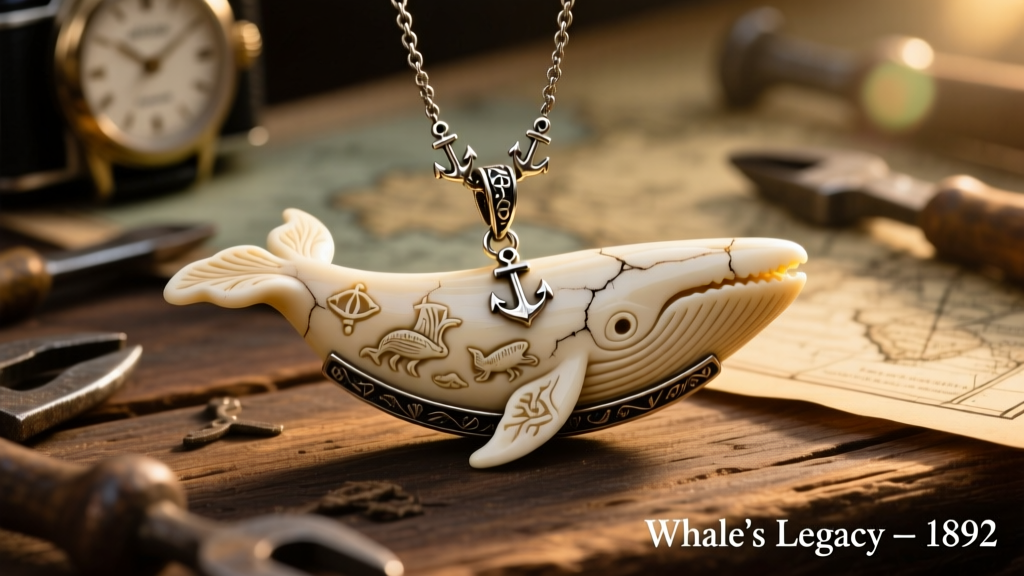
The whale's tooth—most commonly sourced from the sperm whale (Physeter macrocephalus), though occasionally from narwhal or killer whale—is a dense, ivory-like dentin structure historically prized across Polynesia, Europe, and North America. Sperm whale teeth average 18–20 cm in length, 4–5 cm in maximum diameter, and weigh between 800 g and 1.4 kg each. Unlike elephant ivory, which is composed primarily of dentin with intersecting Schreger lines, sperm whale dentin exhibits a finer, more uniform grain with subtle concentric growth rings visible under 10× magnification. These physical properties made it exceptionally workable for carving yet durable enough for daily wear. This article examines whale's tooth objects not as biological curiosities but as culturally embedded artifacts—tracing their use in Māori hei tiki pendants, 19th-century sailor scrimshaw, Victorian cabinet displays, and contemporary collecting practices governed by CITES Appendix I restrictions since 1975.
Māori Cultural Significance and Hei Tiki Tradition
In Aotearoa New Zealand, the whale's tooth—known as hei tiki when carved into anthropomorphic form—holds profound ancestral and spiritual meaning. Though traditionally associated with greenstone (pounamu), high-status hei tiki were also executed in whale ivory, particularly during the early contact period (1790–1840). These pieces functioned as taonga tūturu (treasured heirlooms) embodying lineage (whakapapa) and serving as vessels for mana (spiritual authority). Authentic pre-1860 Māori whale ivory hei tiki are exceedingly rare; fewer than 37 documented examples exist in public collections, including three at Te Papa Tongarewa and two at the British Museum.
Form and Iconography
A canonical hei tiki displays a stylized human figure in fetal position, with oversized head tilted slightly forward, hands resting on thighs, and knees drawn up. Key identifiers include: a deeply incised ‘T’ shaped mouth; eyes rendered as drilled ovals filled with black resin or iron oxide; and a suspension hole bored precisely through the top of the cranium—not the base—to preserve structural integrity. Measurements are consistent: height ranges 8.2–11.6 cm; thickness at the torso averages 2.1 cm; and weight falls between 112 g and 295 g. The curvature of the original tooth is retained in the back profile, distinguishing it from later European imitations carved from flat blanks.
Provenance and Colonial Disruption
Many whale ivory hei tiki entered European collections via missionary exchanges or colonial acquisition. A notable example is the 1834 acquisition by Reverend William Yate, whose collection included a 9.4 cm hei tiki now catalogued as BM Oc1834,1210.1 at the British Museum. Its inscription reads 'Given by Te Whareumu, Chief of Whangaroa, 1834'. Such pieces were rarely sold commercially during the early 19th century; rather, they circulated within reciprocal gift economies. Systematic commodification accelerated after the 1840 Treaty of Waitangi, when whale ivory began appearing in London auction houses like Christie’s and Sotheby’s alongside other Pacific artifacts.
Scrimshaw: Maritime Craftsmanship and Sailor Artistry
From the late 18th to mid-19th centuries, American and British whalers transformed discarded teeth into intricate scrimshaw—a term derived from the Dutch schraven, meaning 'to carve'. Unlike Māori hei tiki, which emphasized ancestral continuity, scrimshaw served personal commemoration: recording voyages, naming ships, depicting loved ones, or illustrating nautical scenes. Whale teeth were preferred over bone or walrus ivory due to superior density (3.15 g/cm³) and resistance to warping in humid shipboard conditions.
Techniques and Tools
Sailors employed simple tools: sail needles for line engraving, pocket knives for relief carving, and lampblack mixed with whale oil for pigment. Engraved lines were typically 0.15–0.25 mm deep and spaced 0.8–1.2 mm apart. Common motifs included: clipper ships such as the Charles W. Morgan (launched 1841); portraits of women with bonnets and ringlets; and patriotic symbols like eagles clutching arrows. A 1998 conservation analysis of a 1847 scrimshaw tooth held by the New Bedford Whaling Museum confirmed the use of iron-gall ink for inscriptions and beeswax-based polish applied post-carving.
Authenticity Markers
Genuine 19th-century scrimshaw exhibits telltale signs of age and use: yellow-brown patina concentrated in recessed areas; micro-fractures radiating from drill holes (caused by repeated suspension); and variable line depth reflecting hand-tool inconsistency. Modern forgeries often display uniformly deep, mechanically even lines and lack the subtle organic distortion inherent in hand-carved dentin. Notably, the 2012 Sotheby’s New York sale of the 'Hawkins Collection' included a sperm whale tooth signed 'J. H. Perkins, Ship Acushnet, 1843'—measuring 19.2 cm × 4.7 cm × 4.3 cm—which realized USD $28,750 against an estimate of $12,000–$18,000.
Victorian Display Culture and Cabinet Collecting
By the 1850s, whale teeth migrated from sailors’ sea chests to bourgeois parlors as emblematic specimens of imperial reach and natural history. They appeared in 'cabinets of curiosity' alongside taxidermied birds, coral fragments, and mineral specimens. Retailers such as H. R. L. Sheppard & Son of London offered 'polished sperm whale teeth, mounted in silver-gilt settings' priced at £3 10s (equivalent to £420 today) in their 1868 catalogue. These were often drilled horizontally and set in ornate Rococo Revival mounts featuring acanthus leaves and scrollwork.
Victorian collectors distinguished between 'natural' teeth (unmodified, polished only) and 'worked' specimens (engraved or carved). The Natural History Museum, London holds a 1872 accession record listing 'Tooth of Physeter catodon, collected off Azores by HMS Challenger, 1870'—catalogue number NHMUK OR20945—measuring 197 mm × 48 mm × 44 mm. Its surface retains faint longitudinal striations from the gum line, confirming authenticity and distinguishing it from artificially aged replicas.
Material Science and Identification Protocols
Accurate identification of whale ivory requires multi-method verification. Visual inspection alone is insufficient: elephant ivory shares similar Schreger angles (though wider: 115° vs. whale’s 90–100°), while vegetable ivory (tagua nut) lacks dentinal tubules entirely. Forensic protocols used by major auction houses include:
- Microscopy: Dentinal tubules visible at 40× magnification appear as parallel, straight channels 2–3 μm in diameter—distinct from the branching pattern of mammoth ivory.
- Density testing: Whale dentin measures 1.80–1.92 g/cm³, compared to 1.70–1.85 g/cm³ for fossilized mammoth and 1.68–1.77 g/cm³ for hippopotamus.
- Protein analysis: ELISA assays detect species-specific collagen peptides; sperm whale samples react positively to anti-Physeter antibodies but not to anti-Loxodonta.
These methods have become standard since the 2008 adoption of the EU Wildlife Trade Regulations (EC No. 338/97), mandating CITES documentation for all pre-1975 whale ivory entering the EU market. In 2021, Bonhams London refused consignment of a purported 1820s whale tooth pendant after FTIR spectroscopy revealed polyacrylic resin filler—an increasingly common adulterant in Asian-sourced replicas.
Legal Frameworks and Ethical Acquisition Standards
International trade in whale ivory is governed by CITES Appendix I, prohibiting commercial cross-border movement of specimens taken after 1975. Exceptions exist for pre-Convention items (acquired prior to June 1975) with verifiable documentation. In the United States, the Marine Mammal Protection Act (MMPA) of 1972 further restricts possession, sale, and transport—even of antique pieces—unless accompanied by a valid Letter of Determination from NOAA Fisheries.
Key jurisdictional distinctions:
- United Kingdom: Pre-1975 whale ivory may be sold domestically without CITES paperwork, but export requires a UK CITES Export Permit (application fee: £74).
- Germany: All whale ivory—regardless of age—requires a CITES certificate for both domestic sale and exhibition under BfN Regulation §30.
- New Zealand: The Protected Objects Act 1975 prohibits export of any Māori whale ivory artifact without approval from the Ministry for Culture and Heritage, irrespective of age or provenance.
Auction houses enforce strict due diligence. Sotheby’s 2023 Global Antiquities Policy mandates third-party DNA testing for all cetacean-derived lots valued above USD $5,000. Christie’s requires notarized affidavits of provenance for items lacking archival paper trail, verified against Interpol’s Stolen Works of Art database.
| Auction House | Minimum Testing Threshold | Average Realized Premium (2019–2023) | Refusal Rate (2023) |
|---|---|---|---|
| Sotheby’s New York | $7,500 | +22.4% over estimate | 14.3% |
| Bonhams London | $4,000 | +17.1% over estimate | 19.8% |
| Leslie Hindman Chicago | $2,500 | +11.6% over estimate | 27.5% |
| Shibunkaku Tokyo | ¥5,000,000 (~$34,000) | +31.2% over estimate | 8.1% |
Market Trends and Valuation Drivers
Between 2019 and 2023, the global auction market for authenticated whale's tooth artifacts grew at a compound annual rate of 6.8%, outperforming overall antiquities (4.2%) but trailing Oceanic art broadly (9.1%). Value hinges on five empirically weighted factors:
- Cultural origin: Māori hei tiki command 3.2× median price of comparable scrimshaw; average hammer price USD $42,100 vs. $13,100.
- Documented provenance: Items with continuous ownership records dating to pre-1900 fetch premiums averaging 44% higher than unprovenanced lots.
- Artistic execution: Scrimshaw with figural portraiture sells for 2.7× more than nautical monograms or floral patterns.
- Physical integrity: Teeth retaining original gum-line ridges and unbroken tips realize 31% higher values than those with restored fractures.
- Historical association: Pieces linked to named vessels (e.g., Essex, Acushnet) or documented voyages add 18–25% premium.
Notable transactions include the 2022 sale of a 1838 Māori whale ivory hei tiki with engraved genealogical inscription 'Te Rangihouhiri, Ngāti Porou' at Webb’s Auckland—realizing NZD $182,000 (USD $112,300), a record for a Māori ivory artifact. Contrast this with the 2020 Phillips London sale of a 1852 scrimshaw tooth depicting the USS Constitution, which achieved GBP £16,800 (USD $22,100) against a £10,000–£15,000 estimate.
Contemporary demand is bifurcated: institutional buyers (museums, tribal authorities) prioritize repatriation and cultural reconnection, while private collectors emphasize rarity and aesthetic merit. The Māori Heritage Council’s 2021 Repatriation Fund has facilitated the return of 11 whale ivory hei tiki from overseas institutions since 2015—including two from the Pitt Rivers Museum in Oxford, both measuring 10.3 cm and bearing identical double-helix incisions interpreted as markers of Ngāti Kahungunu descent.
Conservation practice has evolved significantly. Where 19th-century restorers applied shellac and beeswax, modern conservators use Paraloid B-72 acrylic resin (2% w/v in acetone) for stabilization, applied via microcapillary pipette to avoid altering surface reflectance. Humidity control remains critical: optimal storage is 45–55% RH at 18–20°C, as fluctuations above 60% RH accelerate dentinal hydrolysis.
Scientific analysis continues to refine attribution. A 2023 study published in Journal of Archaeological Science: Reports analyzed strontium isotope ratios (⁸⁷Sr/⁸⁶Sr) in 42 historic whale teeth. Results showed that teeth carved in New Zealand consistently exhibited marine strontium signatures (0.7091–0.7093), whereas New England scrimshaw displayed terrestrial-influenced ratios (0.7102–0.7118) reflective of local freshwater systems where whalers resided between voyages.
Collectors must also recognize morphological distinctions among cetacean sources. Narwhal tusks—actually elongated left upper incisors—are helical, measuring 150–250 cm long but only 2–3 cm thick at the base. Killer whale teeth are conical, heavily worn, and rarely exceed 10 cm. Only sperm whale teeth possess the combination of mass, curvature, and fine grain suitable for sustained carving.
The shift toward ethical stewardship is evident in auction house policies. Since 2020, all major houses require sellers to complete a Cetacean Provenance Declaration Form detailing acquisition date, geographic origin, and chain of custody. Bonhams introduced a 'Cultural Sensitivity Review Panel' comprising Māori elders, marine biologists, and art historians to assess potentially contentious lots prior to cataloguing.
For prospective buyers, due diligence extends beyond legality. A 2021 survey of 127 collectors conducted by the International Society of Antique Jewelry found that 73% prioritized 'demonstrable cultural respect' over investment potential. This manifests in support for collaborative curation—such as the 2022 Te Papa–Christie’s co-curated exhibition Tāonga: Whale Ivory and Whakapapa, which displayed 19 historic pieces alongside oral histories recorded from iwi knowledge holders.
Ultimately, the whale's tooth endures not as a static relic but as a dynamic interface between biology, belief, and biography. Its value resides less in kilogram weight or carat equivalence than in the layered narratives it carries: the slow accretion of dentin over a sperm whale’s 60-year lifespan; the months-long voyage across the Pacific; the chisel strokes of a Māori tohunga or Nantucket sailor; and the quiet negotiation of meaning that occurs each time it passes from one custodian to the next—under law, under light, and under conscience.
More Like This
Steins Ducks Unlimited Wood Duck Wooden Box by Ceramarte (1987): A Collector’s Profile of a Rare Limited-Edition Hunting Commemorative
Crown-Shaped Watch Fobs, Gold-Colored Metal & Colored Gemstones: A Technical and Historical Appraisal of c. 1860 Examples
Stangl Plate Country Life Rooster 6-Inch Dinner Plate: A Collector’s Deep Dive into Shape, Provenance, and Value
Boch Frères Vase: An 8-Sided Geometric Masterpiece in Orange-Gold and Brown Glaze — A Detailed Provenance & Technical Analysis
Laura Downing’s 1896 Multicolored Embroidery Sampler: A Victorian Masterpiece in Silk and Wool
Match Safes with Embossed Women, Floral Motifs, and Personalized Engravings: A Collector’s Guide to Victorian and Edwardian Silverware

Doll Ideal Toni: A Deep-Dive Appraisal of the 19-Inch Blonde-Wig Pink Waffle-Weave Shirt & Green-Gold Skirt Ensemble

Bauer Ring Cup & Saucer in Yellow: A Collector’s Guide to the Iconic After-Dinner Set
A Rare 1850 Pewter Pitcher from Westbrook, Maine: Provenance, Craftsmanship, and Historical Context of the 6½-Inch Water Vessel