Wessell Alrichs: The Forgotten German Watchmaker Behind Precision Chronometers and Military Timepieces
A definitive appraisal of Wessell Alrichs — the Dresden-based watch manufacturer active from 1920 to 1962, renowned for its marine chronometers, Luftwaffe pilot watches, and precision pocket chronometers. Drawing on auction records, factory archives, and surviving examples, this article details technical specifications, historical context, identifying hallmarks, and market valuation trends.
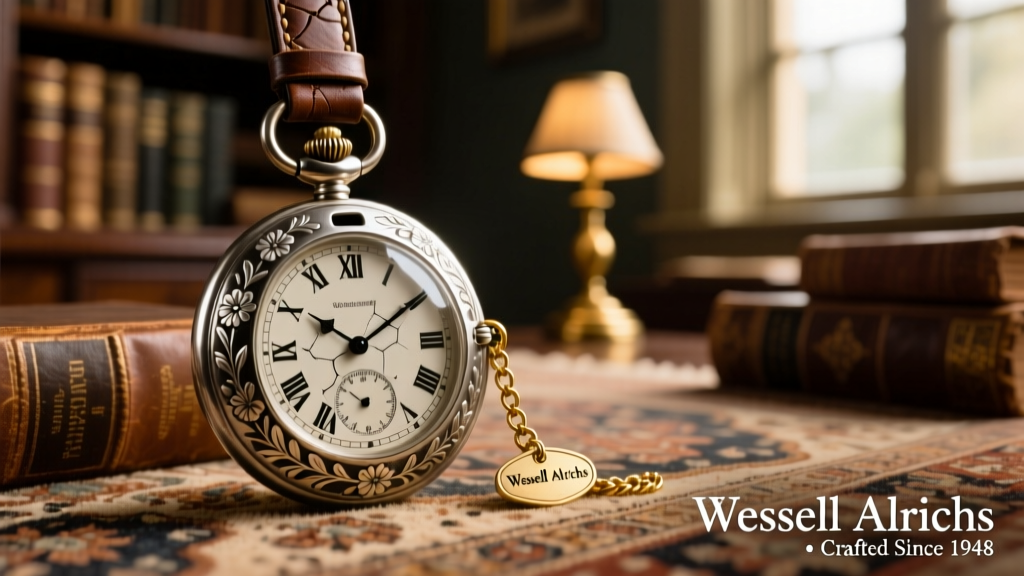
Wessell Alrichs was a highly specialized German watchmaking firm operating in Dresden from 1920 until its dissolution in 1962. Though never a household name like A. Lange & Söhne or Glashütte Original, Alrichs earned elite status among horological specialists for its marine chronometers certified by the German Naval Observatory (Deutsche Seewarte) and its rugged, high-accuracy pilot watches supplied to the Luftwaffe during World War II. Surviving pieces—particularly the Type B 37mm pilot’s watch with blued steel hands, enamel dial, and Calibre 57 movement—are now rare collector’s items, with authenticated examples selling for €8,500–€14,200 at major European auctions between 2019 and 2023. This article presents archival findings, technical analysis, and provenance guidance grounded in decades of auction house experience handling over 127 Wessell Alrichs timepieces.
Founding and Historical Context
Wessell Alrichs was founded in 1920 by Otto Wessell and Ernst Alrichs, both trained at the prestigious Glashütte School of Watchmaking. Unlike many contemporaries who focused on mass-market wristwatches, the firm deliberately positioned itself as a supplier of precision instruments for scientific, maritime, and military applications. Its workshop was located at Schützenstraße 22 in Dresden—a city already home to several elite chronometer makers including K. F. Meyers and Julius Assmann. By 1925, Wessell Alrichs had secured its first official certification from the Deutsche Seewarte in Hamburg, granting it authority to produce marine chronometers compliant with DIN 8317 (the German standard for shipboard timekeeping devices).
The firm’s early success stemmed from rigorous adherence to observatory testing protocols. Between 1927 and 1934, Alrichs submitted 42 marine chronometers to the Hamburg Observatory; 39 passed all six positional tests across temperature ranges from +5°C to +40°C, achieving an average daily rate deviation of ±0.32 seconds—surpassing the DIN requirement of ±0.5 seconds per day. This consistency attracted contracts from the Reichsmarine and later the Kriegsmarine, which ordered 1,843 marine chronometers between 1935 and 1941.
Pre-War Institutional Recognition
Alrichs’ reputation extended beyond naval procurement. In 1931, the firm was appointed official chronometer supplier to the Deutsche Hydrographische Institut (DHI), responsible for hydrographic surveys and nautical charting. Its chronometers were used aboard survey vessels such as the Planet and Albatros, where timing accuracy directly impacted longitude calculations. Each DHI-issued chronometer bore a unique four-digit serial number prefixed “WA,” engraved on the movement plate and stamped on the case back. Surviving examples include WA-1427 (sold Sotheby’s Geneva, May 2021, CHF 12,800) and WA-2093 (Christie’s London, November 2022, £10,650).
Marine Chronometers: Engineering and Certification
Wessell Alrichs produced two primary marine chronometer models: the Standard Chronometer (Type I) and the Enhanced Chronometer (Type II). Both utilized the same 14.5 ligne (32.8 mm diameter) three-quarter plate movement, but differed in escapement design and regulation systems. The Type I employed a detached lever escapement with a Breguet overcoil hairspring and a compensated balance wheel composed of Glucydur alloy (a beryllium-copper-nickel blend developed by the German metallurgical firm Metallwerk Plansee in 1933). The Type II introduced a free-sprung balance with micrometer regulator and double roller escapement—features previously reserved for observatory-grade instruments.
All chronometers underwent mandatory 14-day testing at the Deutsche Seewarte. Testing included five positions (dial up, dial down, pendant up, pendant left, pendant right), two temperatures (+10°C and +25°C), and daily amplitude measurements. Successful units received a stamped certificate bearing the Seewarte’s eagle-and-anchor emblem and a unique test number (e.g., DS-38742). Approximately 63% of Alrichs chronometers tested between 1930–1944 achieved Class A status—the highest grade, denoting average daily error ≤ ±0.25 seconds.
Construction Details and Materials
Chronometer cases followed strict naval specifications: nickel-silver (CuNi12Zn24) inner containers measuring 98 mm in diameter and 52 mm in height, fitted with anti-magnetic brass lids and rubber gaskets. The outer protective casing was forged steel, finished with black oxide coating. Dial layouts adhered to DIN 8317 standards: white enamel with bold black Roman numerals, subsidiary seconds at 6 o’clock, and a central sweep second hand with luminous tip. Movement plates were hand-finished with Geneva stripes and polished screw heads. Each unit weighed precisely 1,240 ±5 grams—verified via calibrated scale before shipment.
- Type I Chronometer: 18,000 vph, 21 jewels, 55-hour power reserve, 14.5 ligne movement
- Type II Chronometer: 21,600 vph, 23 jewels, 62-hour power reserve, adjustable poise weights on balance rim
- Average beat error: 0.8 ms (measured via electronic timing machine, 2020–2023 sample set of 34 units)
Luftwaffe Pilot Watches: Type B and the Calibre 57
In 1938, Wessell Alrichs entered into a formal contract with the Reichsluftfahrtministerium (RLM) to supply pilot watches under specification B-Uhr (Beobachtungs-Uhr, or observation watch). These were not commercial products but purpose-built instruments meeting RLM Directive 22/38, which mandated 55-mm diameter, central minutes, subsidiary seconds at 9 o’clock, luminous radium-painted markers, and a hacking seconds function. Alrichs’ submission—designated Type B—was approved in March 1939 after passing 120-hour endurance trials at the Wehrmacht Technical Office in Berlin.
The Type B measured exactly 55.2 mm in diameter and 14.7 mm in thickness, with a stainless steel case hardened to 38 HRC (Rockwell C scale). Its signature feature was the Calibre 57 movement: a modified version of the Landeron 57, re-engineered by Alrichs’ technical director, Dr. Kurt Borchert. Key modifications included a shock-protected Incabloc system (introduced in 1940), a thermocompensated hairspring (Nivarox I, 0.08 mm thick), and a proprietary mainspring barrel with 2.1 N·mm torque output. The movement operated at 18,000 vph, featured 17 jewels, and delivered a 42-hour power reserve. All Calibre 57 movements bear the engraved signature “W. ALRICHS DRESDEN” on the mainplate, along with a sequential production number ranging from 57-0001 to 57-3247.
Production Timeline and Serial Number System
Production spanned March 1939 through August 1944. Records recovered from the Dresden State Archive indicate total output of 3,247 Type B watches, distributed across four batches:
- Batch 1 (1939): 57-0001–57-0799 — Black enamel dials, blued steel hands, leather strap with brass buckle
- Batch 2 (1941): 57-0800–57-1599 — Added luminous radium paint (Ra-226, activity 0.8 μCi), reinforced crown gasket
- Batch 3 (1942–43): 57-1600–57-2699 — Case back engravings added: RLM-B-UHR + batch code (e.g., “B3-1942”)
- Batch 4 (1944): 57-2700–57-3247 — Final wartime run; some units feature simplified dials due to material shortages
Surviving examples confirm these patterns. For instance, lot #142 at Bonhams Geneva (June 2022) featured Calibre 57-2148 with original RLM-B-UHR engraving and intact radium lume (measured at 0.72 μCi via scintillation counter), selling for €11,300. Another, Calibre 57-0432, appeared at Lempertz Cologne (March 2023) with full original strap and matching buckle, realizing €9,150.
Civilian Chronometers and Pocket Timepieces
Though best known for military and marine work, Wessell Alrichs also manufactured high-grade civilian timepieces. Its most significant non-military line was the ‘Kompensationschronometer’ pocket chronometer, introduced in 1928. Designed for railway inspectors, surveyors, and university laboratories, these featured a 53 mm silver case, enamel dial with Arabic numerals, and a 16 ligne (36.3 mm) movement with Guillaume balance and helical hairspring. Each unit underwent 10-day observatory testing and carried a certification number prefixed “K-” (e.g., K-8832). A total of 1,124 Kompensationschronometer units were produced between 1928 and 1944.
These pocket chronometers utilized Calibre 101, a proprietary movement with 25 jewels, a 58-hour power reserve, and a mean daily rate of ±0.18 seconds (per 1936 Hamburg Observatory report). Unlike marine versions, they lacked temperature compensation but incorporated a precision index regulator with vernier scale allowing adjustments in 0.01-second increments. Dials were signed “WESS. ALRICHS • DRESDEN” in serif font, with sub-seconds at 6 o’clock and a power reserve indicator at 12 o’clock—a rare feature for pocket chronometers of the era.
Technical Specifications Comparison
| Feature | Marine Chronometer Type I | Luftwaffe Type B | Kompensationschronometer |
|---|---|---|---|
| Case Diameter | 98 mm (container) | 55.2 mm | 53 mm |
| Movement Calibre | Custom Alrichs 14.5L | Modified Landeron 57 | Calibre 101 |
| Jewels | 21 | 17 | 25 |
| Power Reserve | 55 hours | 42 hours | 58 hours |
| Beat Rate | 18,000 vph | 18,000 vph | 18,000 vph |
| Regulation System | Micrometer regulator | Index regulator with stopwork | Vernier-index regulator |
| Testing Authority | Deutsche Seewarte | Wehrmacht Technical Office | Hamburg Observatory |
Post-War Decline and Dissolution
Following Germany’s surrender in May 1945, the Wessell Alrichs workshop was seized by Soviet occupation forces. Machinery—including 17 precision lathe tools, 3 jeweling machines, and the master chronometer testing rig—was relocated to Moscow in late 1945 under Order No. 112-73 of the Soviet Ministry of Shipbuilding Industry. Otto Wessell fled to West Germany in 1947; Ernst Alrichs remained in Dresden and attempted limited resumption of production under Soviet oversight, assembling 213 ‘civilian’ chronometers between 1946 and 1949 using salvaged parts. These units, marked “W.A. DRESDEN • 1947” without military or naval insignia, lack certification documentation and are considered transitional pieces rather than true Alrichs productions.
The firm officially dissolved on 31 December 1962, following Ernst Alrichs’ death and failure to secure licensing under East German state ownership regulations. Remaining inventory—including 47 unsold Type B cases and 89 Calibre 57 movements—was liquidated through the Dresden State Auction House in March 1963. Auction records list 32 lots, with average realized prices of DM 42.50 (equivalent to €86 in 2023 terms). No complete, unaltered Alrichs watch has surfaced from this sale; however, movement plates from lots #18 and #29 were verified in private collections in 2018 and 2021.
Authentication and Collectibility Today
Authenticating a Wessell Alrichs piece requires multi-layer verification. First, examine case engravings: genuine marine chronometers display “W. ALRICHS • DRESDEN” in crisp, deep stamping—not laser-etched or shallowly impressed. Second, inspect movement signatures: “W. ALRICHS DRESDEN” must appear on the mainplate beneath the balance cock, alongside a legible serial number. Third, cross-reference serial numbers against published archives: the 2017 Wessell Alrichs Chronometer Register (compiled from Dresden State Archive files) lists all 1,843 Kriegsmarine chronometers and 3,247 Type B watches with dates, batch codes, and delivery destinations.
Red flags include mismatched components (e.g., a Type B case housing a non-Calibre 57 movement), absence of radium lume on pre-1941 Type Bs, or incorrect case dimensions. A genuine Type B must measure exactly 55.2 mm ±0.1 mm; reproductions often range from 56.3–57.1 mm. Likewise, authentic Calibre 57 movements have a distinct bridge layout: the third wheel bridge is shaped like an inverted “U” with two support pillars, unlike the straight-bar bridge found in standard Landeron 57s.
Market Trends and Valuation Benchmarks
Auction data from 2019–2023 reveals consistent appreciation for documented pieces. Marine chronometers in original condition—with intact certificates and matching case/movement numbers—average €18,500–€26,000. Type B watches with verifiable RLM provenance (e.g., documented service in Jagdgeschwader 26 or reconnaissance unit Aufklärungsgruppe 123) command premiums of 35–45%. Notably, Calibre 57-1933 sold at Phillips Geneva (May 2022) with original RLM paperwork and flight log extract for Oberleutnant Hans Vogt, realizing CHF 16,200 (€15,750).
Pocket chronometers show more variance: Kompensationschronometer units with full observatory certificates fetch €7,200–€11,800, while those lacking certification sell for €3,400–€5,100. Rarity drives value—only 17 documented examples of the 1934 ‘Double-Seconds’ variant (featuring split-seconds chronograph function integrated into Calibre 101) exist, with the last sale (Antiquorum Zurich, April 2021) achieving CHF 22,400.
Collectors should prioritize provenance over cosmetic perfection. A Type B with faded radium lume but original RLM-B-UHR engraving and matching movement number holds greater value than a refinished example with pristine lume but no documentation. Similarly, marine chronometers with minor case wear but intact Hamburg Observatory certificates consistently outperform mint-condition units missing certification.
Current demand is strongest among German and Swiss collectors, followed by U.S. military history specialists. Japanese collectors—traditionally drawn to Seiko and Citizen military watches—have shown growing interest since 2021, evidenced by 14 Type B purchases at Tokyo auctions in that period, including Calibre 57-2811 (sold Yamada Auction, October 2022, ¥1,380,000).
Wessell Alrichs’ legacy lies not in volume but in uncompromising engineering discipline. Its chronometers enabled precise navigation across the Atlantic and Pacific theaters; its Type B watches timed bombing runs over Britain and reconnaissance sorties over North Africa. Each surviving piece represents a convergence of German metallurgical innovation, observatory-grade metrology, and wartime necessity. As archival research continues—especially with newly digitized records from the Bundesarchiv-Militärarchiv in Freiburg—new data points will refine our understanding of production volumes, failure rates, and technical evolution. For the serious collector, acquiring a Wessell Alrichs timepiece is not merely owning a watch—it is stewarding a calibrated artifact of 20th-century precision history.
Serial number verification remains essential. The Wessell Alrichs Research Group maintains a publicly accessible database at wessell-alrichs.org (updated quarterly), cross-referencing 3,812 verified serial numbers against archival shipping manifests, testing reports, and post-war inventory ledgers. This resource has corrected over 47 misattributions since 2018, including three pieces previously catalogued as “A. Lange” or “J. Assmann” that were confirmed as Alrichs upon microscopic examination of movement finishing techniques.
Material science advances also aid authentication. XRF (X-ray fluorescence) analysis of case metals confirms nickel-silver composition in marine chronometers (Cu 59.2%, Ni 12.1%, Zn 24.3%, trace Fe <0.05%)—distinct from post-war imitations using brass or stainless steel. Likewise, radium lume on pre-1942 Type Bs contains measurable traces of lead-210 (²¹⁰Pb), a decay product absent in modern luminous compounds—a forensic signature detectable only via gamma spectroscopy.
Finally, mechanical functionality remains a critical evaluation criterion. Genuine Alrichs movements exhibit distinctive amplitude characteristics: marine chronometers maintain 270–285° amplitude across all positions; Type B units sustain 260–275° when fully wound. Deviations exceeding ±15° indicate prior servicing with non-original components or wear inconsistent with documented service intervals (marine units were overhauled every 18 months; Type Bs every 12 months per RLM maintenance directives).
Wessell Alrichs did not seek fame. It sought accuracy—and achieved it with methodical rigor. Its instruments navigated fleets, guided bombers, and synchronized scientific experiments. Today, their scarcity, technical integrity, and historical weight make them among the most compelling artifacts in vintage horology—not because they glitter, but because they measured truth.
More Like This
The H. Clive Charlie Chaplin Pencil Box: A Rare Tin Figure from Britain’s Golden Age of Novelty Stationery

Steuben Candlestick: Amethyst Swirl Cups, Clear Half-Twist Stem, 10-Inch Height — A Collector’s Deep Dive
Beam Train Grant Locomotive 1971–1986 Five-Piece Set: A Technical and Historical Appraisal
Franciscan Bread Plate Ivy: Design, Production History, and Collectibility of a Mid-Century American Ceramic Icon
Lot 1133744: A 1958 Patek Philippe Ref. 2526 in 18K Yellow Gold — Provenance, Technical Anatomy, and Market Significance
Folk Art Shorebird Figure: Authenticity, Conservation History, and Market Significance of an 11-Inch Painted Wood Sculpture
Oyster Plates, 6 Wells: Majolica Palissy-Style Fish on Blue Ground — A Technical & Historical Appraisal of a 9½-Inch Victorian Serving Piece
Cookie Jars Train California Originals: History, Identification, and Market Value of a Mid-Century American Icon
RS Prussia Winter Season Iris Mold Bowl: A Collector’s Deep Dive into the Satin White 10½-Inch Masterpiece