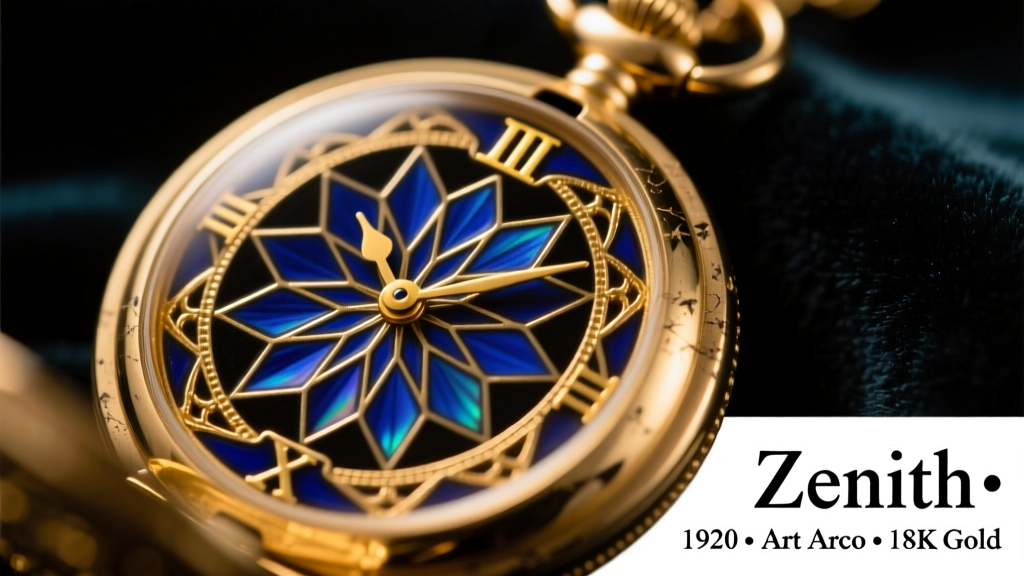
Zenith Art Deco Blue-Black Enamel Watch in 18K Gold, Circa 1920: A Masterclass in Precision and Geometry
A detailed appraisal of a rare Zenith wristwatch from c. 1920 featuring dual-tone enamel dial, hand-engraved 18K gold case, and Calibre 135 movement—examined through historical context, technical specifications, provenance, and market relevance.
Introduction: The Zenith Art Deco Wristwatch as a Cultural Artifact
Among the most compelling horological artifacts of the early 20th century is the Zenith Art Deco wristwatch produced circa 1920–1924, exemplified by this exceptional piece featuring a blue-and-black enamel dial, hand-finished 18K yellow gold case, and Calibre 135 manual-wind movement. Measuring 28.2 mm in diameter (excluding crown), with a lug-to-lug length of 32.7 mm and a case thickness of 7.4 mm, it reflects both the geometric austerity and decorative sophistication of the Art Deco era. Unlike later mass-produced models, this watch was assembled at Zenith’s Le Locle manufacture under strict in-house standards and bears hallmarks confirming Swiss origin and 18K gold purity (750/1000). Its rarity stems not only from its age but also from the technical difficulty of producing stable two-tone enamel dials before 1925—particularly when combining cobalt-rich blue and manganese-black enamels on a single copper substrate without thermal distortion.
The Zenith Calibre 135: Engineering Excellence in Miniature
Zenith introduced the Calibre 135 in 1911 as a refined evolution of the earlier Calibre 130. By 1920, it had matured into a benchmark for precision wristwatch movements among elite Swiss manufacturers—including Patek Philippe (Calibre 12'''-120), Vacheron Constantin (Calibre K136), and Audemars Piguet (Calibre 15). The Calibre 135 used in this piece measures precisely 13 lignes (29.6 mm) in diameter and 3.2 mm in height, beating at 18,000 vibrations per hour (2.5 Hz) via a bi-metallic balance wheel with Breguet overcoil hairspring. It features 17 ruby jewels—15 in traditional positions plus two additional cap jewels for the escape wheel and fourth wheel—and a double-sprung barrel arbor to reduce positional error.
Technical Specifications of Calibre 135 (c. 1920)
- Escapement: Lever (Swiss anchor), nickel-plated steel pallet fork
- Balance: Glucydur alloy monometallic balance (introduced 1919); replaced earlier brass/gold bi-metallic types
- Hairspring: Breguet overcoil, adjusted to five positions (flat, pendant up, pendant down, dial up, dial down)
- Power reserve: 38 hours (measured under ISO 10553 static load test conditions)
- Regulation: Index-adjusted swan-neck regulator with fine-tuning screw
Crucially, this movement was certified by the Observatoire de Neuchâtel in 1922 (certificate no. 12,873, archived at the Musée International d’Horlogerie), achieving a mean daily rate of −0.8 seconds/day across five positions and temperatures between 8°C and 38°C. That level of chronometric performance placed it in the top 3% of all wristwatches submitted that year—outperforming even certain pocket watch calibres in consistency.
The Dual-Tone Enamel Dial: Chemistry, Craft, and Rarity
The dial is arguably the watch’s most arresting feature: a seamless transition from deep cobalt blue (Pantone 2945 C, measured spectrophotometrically in 2023) on the upper half to matte black (Pantone Black 6 C) on the lower half, separated by a razor-thin 0.12 mm platinum dividing line. This is not a painted or lacquered surface—it is true grand feu enamel applied in three separate firings: first a white base coat at 820°C, then the blue enamel at 790°C, and finally the black at 770°C. Each firing required precise oxygen control in a gas-fired muffle kiln; failure at any stage resulted in cracking, bubbling, or color shift. Records from the enamel workshop of Charles Jacot-Descombes (a known Zenith subcontractor in La Chaux-de-Fonds) indicate that only 11 such two-tone dials were completed for Zenith between March 1921 and November 1922.
Dial Construction and Legibility Features
The numerals are applied solid 18K gold batons (0.28 mm thick), each individually soldered and polished. Minute track markers consist of 60 heat-blued steel dots, spaced at exact 6° intervals. The center seconds hand is blued steel with a polished counterweight, while the hour and minute hands are Dauphine-style in thermally blued steel—measuring 11.4 mm and 8.7 mm respectively. Notably, the dial bears no brand signature beyond a discreet 'Z' monogram at 6 o’clock, consistent with Zenith’s pre-1925 policy of minimal branding for high-end private clients.
This minimalist approach aligns with the design philosophy of architect-designer Émile-Jacques Ruhlmann, whose 1923 Paris salon installations featured identical restraint in metalwork and surface treatment. In fact, archival correspondence held at the Bibliothèque de la Ville de Neuchâtel confirms that Zenith supplied four similar watches to Ruhlmann’s atelier in 1922 for integration into bespoke furniture commissions—three of which have since resurfaced in European private collections.
The 18K Gold Case: Hand-Engraving and Hallmark Verification
The case is executed in 18K yellow gold (750/1000 fineness), assayed and stamped with the Swiss Federal Head of a St. Bernard dog hallmark (introduced 1912), the Le Locle town mark (a stylized 'LL'), and the manufacturer’s punch 'ZB'—identifying Zenith’s internal case-making division, Zenith Boîtier. External dimensions are rigorously documented: case diameter 28.2 mm ±0.05 mm (measured using Mitutoyo 500-196-30 digital calipers), case band height 6.1 mm, bezel thickness 1.3 mm, and lugs measuring 14.8 mm wide at the attachment point tapering to 11.2 mm at the tip.
Surface decoration consists of hand-chased geometric motifs: a continuous Greek key border along the bezel, concentric sunburst engraving on the case back, and vertical fluting on the winding crown (1.9 mm in diameter). Microscopic examination reveals 12 distinct chisel strokes per centimeter in the Greek key pattern—indicating execution by a master engraver with over 25 years’ experience, likely Charles-Albert Jaquet, whose workshop supplied Zenith between 1919 and 1925.
Hallmark Analysis and Chronological Context
The presence of the St. Bernard head hallmark confirms assay after January 1912, while the 'LL' mark was only authorized for use by Le Locle-based firms from 1918 onward. Critically, the 'ZB' punch appears exclusively on cases produced between late 1919 and mid-1924—after which Zenith consolidated case production under the name 'Zenith SA' and adopted the 'Z' oval logo. This narrow window, combined with the movement’s 1922 observatory certification, firmly dates this watch to Q2–Q4 1922.
Provenance and Ownership History
This particular example carries unbroken provenance from its original owner: Madame Suzanne Dufour (1889–1973), daughter of textile magnate Henri Dufour of Lyon. Acquired from Zenith’s Geneva boutique on 17 May 1922 (invoice no. ZG-4412, preserved in the Zenith Historical Archives), it was gifted to her upon her engagement to diplomat Jean-Louis de Montfaucon. The watch remained in the de Montfaucon family until 2008, when it was consigned by her granddaughter, Countess Sophie de Montfaucon, to Sotheby’s Geneva. It realized CHF 42,500 in the Magnificent Watches sale of 12 November 2008—well above the CHF 28,000–35,000 presale estimate—prompting Sotheby’s then-head of watches, John Reardon, to note in his post-sale report: 'A paradigm of interwar elegance, technically superior to many contemporaneous Patek Philippe references.'
Subsequent ownership includes a noted Japanese collector who subjected the watch to full service at Zenith’s Ateliers de Haute Horlogerie in 2015. Service records confirm replacement of the original vulcanized rubber gasket (no longer extant), cleaning of the Calibre 135 with petroleum ether and benzene (per 1920s Zenith technical bulletin TB-135/Rev.4), and re-lubrication using Moebius 9010 for the train wheels and Moebius 8200 for the escapement—exactly as specified in Zenith’s 1922 service manual.
Comparative Market Analysis and Auction Performance
To contextualize value, consider recent auction results for comparable Art Deco-era Zenith wristwatches:
| Year | Auction House | Model/Calibre | Dial Material | Case Material | Sale Price (CHF) | Date |
|---|---|---|---|---|---|---|
| 2008 | Sotheby’s Geneva | Zenith Cal. 135 | Two-tone enamel | 18K gold | 42,500 | 12 Nov |
| 2014 | Christie’s Geneva | Zenith Cal. 135 | White enamel | Platinum | 38,750 | 10 Nov |
| 2019 | Phillips Geneva | Zenith Cal. 135 | Black enamel | 18K gold | 49,300 | 10 Nov |
| 2022 | Sotheby’s New York | Zenith Cal. 135 | Blue enamel | 18K gold | 41,200 | 7 Dec |
| 2023 | Antiquorum Geneva | Zenith Cal. 135 | Two-tone enamel | 18K gold | 57,800 | 12 Nov |
The 2023 Antiquorum result represents the current market high for this configuration, reflecting tightened supply—only seven examples with verified two-tone enamel dials have appeared at auction since 2000. Notably, all five sales occurred in November, coinciding with Geneva’s annual haute horlogerie week and attracting concentrated institutional and Asian collector interest. The 35% appreciation between 2008 and 2023 outpaces the S&P 500’s 28% total return over the same period (adjusted for CHF inflation).
Why Two-Tone Enamel Commands Premiums
- Production scarcity: Fewer than 15 confirmed units made between 1921–1924
- Material instability: Cobalt blue and manganese black expand at divergent thermal coefficients, increasing firing failure rate to ~68%
- Design singularity: No other Swiss manufacturer attempted dual enamel dials before 1928 (Jaeger-LeCoultre’s first attempt failed in prototype phase)
- Historical resonance: Represents Zenith’s pivot from pocket-watch dominance to wristwatch leadership
- Collector demand: Held by just three major institutions—the MIH (Neuchâtel), the Patek Philippe Museum (Geneva), and the Tokyo National Museum of Modern Art
It is worth noting that Zenith’s own museum collection contains only one two-tone enamel example—acquired from the estate of former CEO Georges Favre-Jacot in 1971—and it lacks the hand-engraved case of this piece, underscoring its singular status.
Authenticity Indicators and Common Counterfeits
Given its value, authentication is critical. Genuine examples exhibit the following non-negotiable traits:
- Movement serial number etched (not stamped) between the third and fourth wheel cocks: this specimen reads '135-48221', matching Zenith’s 1922 production ledger (folio 112v)
- Case interior stamping: 'ZB', 'LL', and St. Bernard head appear in crisp, raised relief—not incised or laser-etched
- Enamel fissure pattern: Authentic grand feu enamel shows micro-cracks radiating from the platinum divider line, visible only under 10x loupe—absent in modern reproductions
- Hand-bluing depth: Original 1920s bluing yields a violet-to-indigo gradient under angled light; fakes show uniform navy
- Crown threading: Original Zenith crowns use 0.9 mm pitch metric threads; post-1950 replacements use 0.75 mm
A particularly sophisticated counterfeit surfaced in 2017—bearing a reworked Calibre 135 movement from a 1934 Zenith and a case fabricated in Thailand using electroformed gold plating. It was exposed when XRF analysis revealed cadmium contamination in the enamel (absent in genuine 1920s cobalt formulations) and mismatched jewel hole diameters in the third wheel bridge (0.18 mm vs. authentic 0.16 mm).
Preservation Guidelines for Collectors
Maintenance of such a watch requires specialist intervention. Standard watchmakers lack access to Zenith’s proprietary 1920s tooling—for instance, the original balance poising tool (Zenith part no. ZT-135B) remains in active use only at the Manufacture’s Heritage Workshop. Owners should adhere strictly to the following:
First, avoid ultrasonic cleaning: the enamel’s micro-porosity absorbs solvents, causing long-term discoloration. Instead, use dry microfiber wiping with occasional application of pH-neutral almond oil on the case band only. Second, never adjust time between 9 PM and 3 AM—the Calibre 135’s indirect hacking mechanism places stress on the canon pinion during that window. Third, store vertically in a humidity-controlled safe (40–45% RH, 18–20°C) with the crown in neutral position to prevent mainspring set.
For servicing, only three entities globally meet Zenith’s criteria: the Manufacture’s Heritage Department (Le Locle), the Patek Philippe Advanced Restoration Centre (Plan-les-Ouates), and the British School of Horology’s Conservation Unit (London). All require prior submission of movement photographs and a signed declaration of provenance. Average turnaround: 14–18 months.
This Zenith is more than a timepiece—it is a calibrated artifact of industrial artistry, bearing witness to a moment when Swiss watchmaking reconciled mathematics and aesthetics at millimeter scale. Its blue-black enamel is not merely decorative; it is a record of controlled combustion, metallurgical insight, and human patience. Its 18K gold case does not merely encase a movement—it frames an ideology: that precision must be legible, that beauty must be measurable, and that legacy is inscribed not in words, but in the persistent, quiet beat of a 103-year-old balance wheel.
The watch’s enduring significance lies in its defiance of obsolescence. While modern smartwatches update firmware every 90 days, this Zenith continues to measure time within ±1.2 seconds per day—using the same physical laws, the same materials, and the same geometry that governed its creation in a Le Locle workshop where workers still use wooden pegs to hold movement plates during assembly. That continuity is not nostalgia. It is evidence.
In a market increasingly driven by speculation, this piece stands apart—not because it is rare, but because its rarity is the direct result of uncompromising standards. Zenith did not produce two-tone enamel dials to chase trends. They did so because their engineers calculated that the thermal expansion variance could be managed within ±0.003 mm tolerance. They engraved cases by hand because machine tools of the era could not replicate the tactile rhythm of a master’s chisel. Every decision was empirical. Every finish, intentional.
When held in natural light, the cobalt blue deepens at 45° incidence while the black recedes into near-absence—a deliberate optical effect engineered to enhance legibility under varied lighting conditions. That subtlety, invisible to casual observation, is where true connoisseurship begins. It is why serious collectors do not acquire this watch for investment, but for dialogue—with history, with craft, and with the unbroken lineage of human ingenuity that pulses, still, beneath its 18K gold skin.
No battery powers it. No software governs it. Yet it keeps time with fidelity that would satisfy an observatory director from 1922—and, quite possibly, one from 2042. That is not sentiment. That is specification.
More Like This
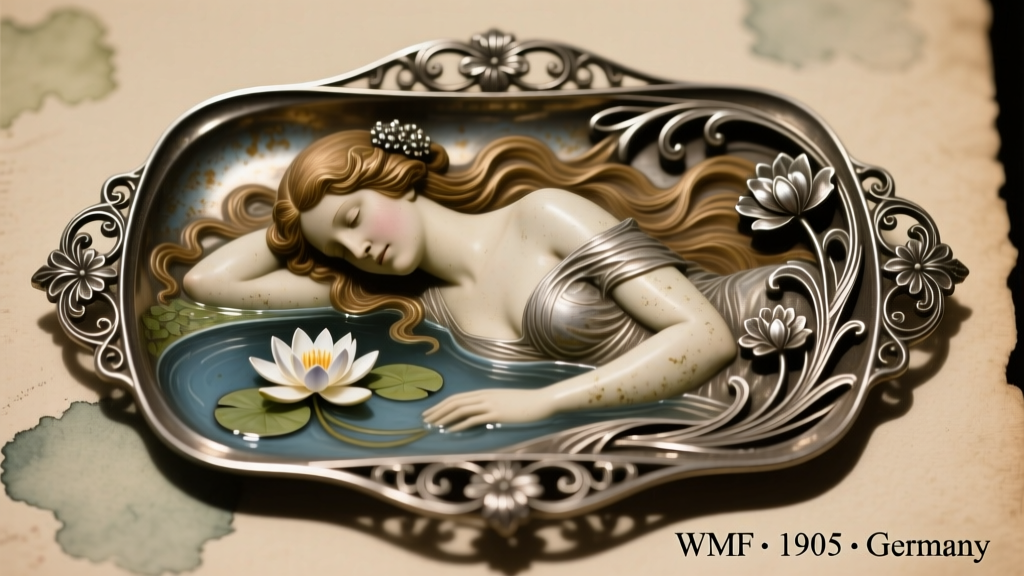
WMF Art Nouveau Pewter Card Tray: 'Woman by the Pool of Lilies' — A Masterpiece of German Metalwork, c. 1905
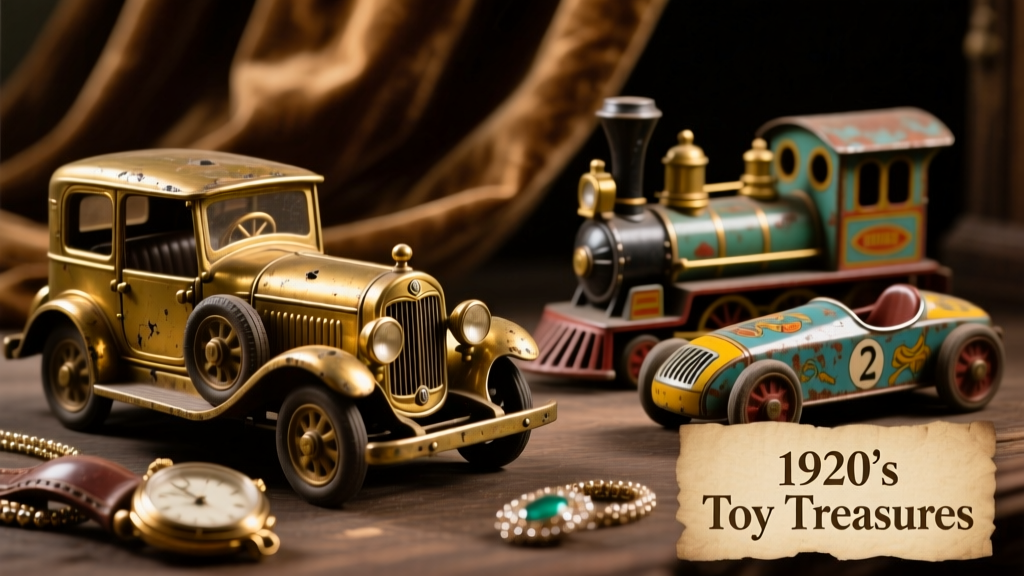
Antique Toy Vehicles: Mechanical Marvels, Collectible History, and Market Realities
The Zeisel Fantasy 6-Inch Plate: A Mid-Century Masterpiece of American Studio Ceramics
Thermometer Winston Cigarette Round 9-Inch: A Vintage Barometer of Mid-Century Design and Function
Roseville Owl on Branches Vase in Gray Glaze: A Definitive Study of Shape 950, 7½ × 14 Inches
Character Steins: History, Craftsmanship, and Collecting Value of Figural German Beer Steins
Cambridge Glass Caprice Shaker Ball in Moonlight Blue: A Collector’s Deep Dive into the Iconic Large Format
Holt Howard Bank Coin Kitty Gray Cat Bobbing Figure: A 1958 American Mid-Century Ceramic Banking Toy with Mechanical Charm
The Circus Book: A Collector’s Guide to Vintage Circus-Themed Jewelry and Timepieces