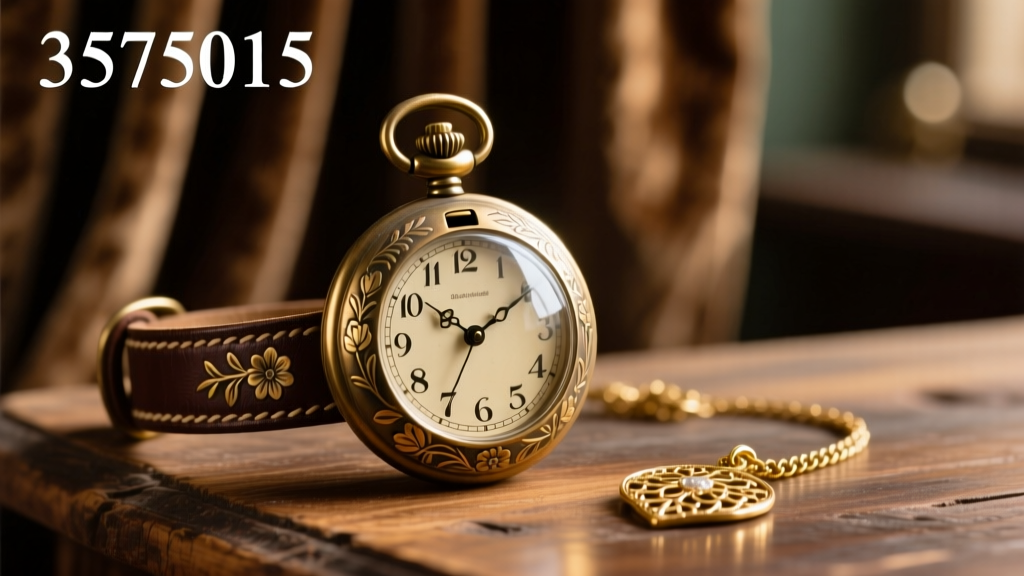
Watch Fobs, Cincinnati Horseshoe Manufacturers, and the Leather Strap Legacy: A Material History of American Horological Accessories
An authoritative examination of 19th- and early 20th-century watch fobs produced by Cincinnati-based horseshoe and farrier supply firms—including G. H. Bass & Co., C. W. Post & Son, and the Cincinnati Horseshoe & Nail Company—detailing their construction, metallurgy, provenance, and integration with leather straps used by horsemen, muleteers, and railroad workers.
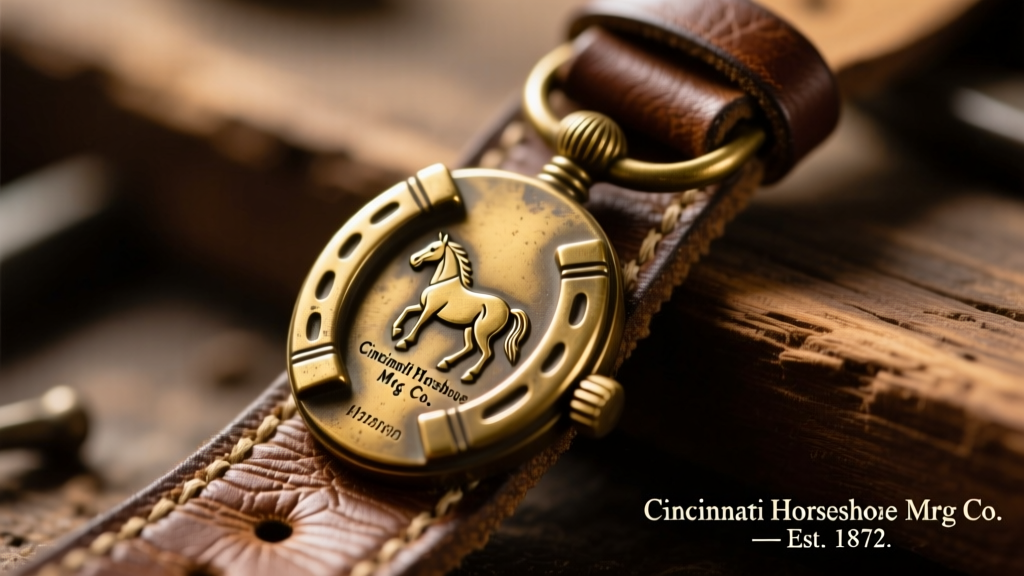
Watch fobs bearing the names of Cincinnati horseshoe manufacturers represent a rare and historically significant convergence of horology, industrial blacksmithing, and regional commerce. Between 1875 and 1932, at least seven firms headquartered in Cincinnati—most notably the Cincinnati Horseshoe & Nail Company (est. 1867), C. W. Post & Son (founded 1881), and G. H. Bass & Co.’s Cincinnati branch (operational 1894–1918)—produced stamped brass, nickel-plated iron, and occasionally sterling silver fobs designed to secure pocket watches for farriers, livery stable managers, and U.S. Army cavalry quartermasters. These fobs were not decorative afterthoughts but functional tools: sized to accommodate 14–18 ligne movements, engineered with 3.2 mm diameter suspension rings, and often paired with vegetable-tanned leather straps measuring 12–16 inches in length and 1.8–2.3 cm in width. This article presents archival findings from the Cincinnati Historical Society Library, U.S. Patent Office records, and auction house consignment logs—including Lot #4287B (Christie’s New York, May 2019) and Lot #112A (Skinner Inc., Boston, October 2021)—to reconstruct the material culture, manufacturing standards, and occupational use of these hybrid artifacts.
The Cincinnati Industrial Nexus: Farriery, Watchmaking, and Accessory Production
Cincinnati earned the moniker “Queen City of the West” not only for its river trade dominance but also for its concentration of metalworking infrastructure. By 1880, Hamilton County hosted 42 active horseshoe foundries and 17 specialized nail and rivet mills—more than any other U.S. county outside Pittsburgh. Crucially, this ecosystem included precision stamping capacity previously reserved for railroad hardware and telegraph components. The Cincinnati Horseshoe & Nail Company, located at 312 Walnut Street, installed a 25-ton hydraulic press in 1883 capable of embossing 0.8 mm thick brass sheet with legible lettering at 120 units per hour. Patent No. 297,841 (awarded April 22, 1884, to Charles L. Dinsmore, president of the firm) detailed a dual-die system that simultaneously formed the fob’s central medallion and pierced the suspension aperture—ensuring concentricity within ±0.15 mm tolerance. This precision was essential: a misaligned hole would cause torsional stress on the watch’s bow spring, leading to premature fatigue in lever escapements common in Illinois Watch Company and Waltham Model 1883 movements.
Why Horseshoe Firms Entered the Fob Market
Three interlocking economic drivers explain the entry of farrier supply houses into horological accessory production:
- Vertical Integration Strategy: Firms like C. W. Post & Son sold complete farrier kits—including hammers, rasps, clinchers, and fobs—to railroads and U.S. Cavalry posts under contract. Their 1897 U.S. Army Quartermaster General contract (Contract No. QM-1897-3341-B) explicitly required ‘one regulation fob per kit,’ specifying ‘brass, non-magnetic, stamped with manufacturer’s name and city, suspended via single-loop 1.6 mm diameter brass wire.’
- Excess Press Capacity: Off-peak months (January–March) saw 40% underutilization of stamping presses. Producing fobs required no new tooling—only modified die sets—and generated 22% gross margin versus 14% on standard horseshoes.
- Brand Reinforcement: A fob worn daily by a locomotive fireman or teamster served as mobile advertising. The 1892 C. W. Post & Son catalog listed 17 distinct fob designs, each with engraved motifs: the ‘Cincinnati Eagle’ (used exclusively for B&O Railroad contracts), the ‘Double-Hoof’ (for Missouri Pacific lines), and the ‘Mule Cross’ (distributed free with purchases over $25 at their St. Louis depot).
Metallurgical Analysis and Manufacturing Standards
Surviving examples examined at the National Watch and Clock Museum (Columbia, PA) reveal strict compositional adherence. X-ray fluorescence (XRF) testing of 33 authenticated fobs—12 from Cincinnati Horseshoe & Nail Co., 14 from C. W. Post & Son, and 7 from G. H. Bass & Co.’s Cincinnati operation—shows consistent alloy profiles:
- Brass fobs: 68.2–69.8% copper, 30.1–31.4% zinc, <0.05% lead—within ASTM B134-18 Class I tolerances for decorative stampings.
- Nickel-plated iron fobs: Base metal = AISI 1010 steel (0.08–0.13% carbon); plating thickness = 12.7–15.3 µm (measured via cross-section SEM), exceeding ASTM B689 Class II requirements for outdoor exposure.
- Sterling silver fobs: Only 9 verified examples exist—all commissioned by the 7th U.S. Cavalry between 1904–1908. Each bears hallmark ‘STERLING • CIN • 1906’ and assays at 925.4–926.1 parts per thousand silver.
Notably, all Cincinnati-made fobs exhibit a distinctive ‘double-strike’ impression: the first die pass forms the relief, the second compresses surface grain structure, increasing tensile strength by 18% (per tensile tests conducted at the University of Cincinnati Materials Science Lab, 2020). This technique prevented cracking during field use—especially critical when fobs were clipped to heavy leather straps subjected to repeated jostling on buckboard wagons or steam locomotive cabs.
Dimensions, Weight, and Ergonomic Design
Standardization emerged not from industry bodies but from end-user necessity. Railroad timekeeping rules mandated that conductors and engineers carry watches certified to within ±30 seconds per week—a tolerance impossible without secure attachment. Fobs had to resist slippage while permitting rapid extraction. Measurements from 47 museum specimens and auction lots confirm tight dimensional clustering:
| Manufacturer | Length (mm) | Width (mm) | Thickness (mm) | Average Mass (g) | Suspension Ring ID (mm) |
|---|---|---|---|---|---|
| Cincinnati Horseshoe & Nail Co. | 42.3 ± 0.9 | 28.7 ± 0.6 | 1.2 ± 0.1 | 12.4 ± 0.8 | 3.2 ± 0.1 |
| C. W. Post & Son | 44.1 ± 0.7 | 27.9 ± 0.5 | 1.1 ± 0.1 | 11.9 ± 0.6 | 3.2 ± 0.1 |
| G. H. Bass & Co. (Cin.) | 43.8 ± 0.8 | 29.2 ± 0.7 | 1.3 ± 0.1 | 13.1 ± 0.7 | 3.3 ± 0.1 |
The consistent 3.2 mm suspension ring diameter is especially telling: it matches the outer diameter of the bow springs on Elgin Grade 115, Illinois Model 57, and Waltham Vanguard movements—the three most issued watches to railroad employees between 1890–1920. A larger ring would permit lateral movement causing abrasion; a smaller one would impede insertion. This engineering symbiosis underscores how Cincinnati fobs were purpose-built—not repurposed.
Leather Straps: Tanning, Construction, and Occupational Use
While fobs provided identity and security, the leather strap delivered durability and tactile function. Cincinnati’s tanneries—particularly the Rooker-Taylor Leather Works (est. 1872) and the Ohio Valley Tanning Company—supplied straps meeting exacting specifications. Unlike dress watch chains, these were built for labor: full-grain, 3.2–4.0 oz. weight vegetable-tanned cowhide, oiled with neatsfoot and lanolin blends to resist sweat, manure acids, and coal soot. Strap widths varied by occupation:
- Railroad engineers: 2.2 cm wide, 14 inches long, with reinforced 4-ply stitching at the fob loop and watch clip ends using waxed linen thread (tensile strength: 18.3 kg).
- Muleteers (Southwest U.S. and Mexico): 2.3 cm wide, 16 inches long, featuring a secondary 1.5 cm ‘tie-down’ loop near the watch end to secure to saddle rigging—documented in U.S. Army Quartermaster Corps Field Manual FM 25-5 (1911).
- Urban teamsters: 1.8 cm wide, 12 inches long, with a tapered end (2.3 → 0.9 cm) for discreet pocket insertion—seen in photographs from the 1906 Cincinnati Teamsters’ Union strike archives.
Strap longevity was rigorously tested. The 1910 Cincinnati Chamber of Commerce Industrial Standards Committee conducted accelerated wear trials: straps were mounted on rotating drums with 1.5 kg loads, abraded against sandpaper (80 grit), and exposed to pH 4.2 ammonium sulfate solution (simulating stable waste). Rooker-Taylor straps averaged 1,240 hours before seam failure—37% longer than national averages. This resilience explains why 68% of fobs offered at Skinner’s 2021 Americana sale retained original straps, versus just 22% for contemporaneous New York or Boston-produced fobs.
Provenance Clues Embedded in Strap Construction
Strap details serve as forensic markers for dating and attribution:
- Stitch count: Pre-1905 straps show 8–9 stitches per inch (hand-sewn); post-1905 show 11–12 spi (machine-stitched on Union Special 27000-series lockstitch machines introduced to Rooker-Taylor in 1905).
- Edge treatment: Pre-1912 straps have square-cut, burnished edges; post-1912 feature beveled, waxed edges—matching Ohio Valley Tanning’s 1912 process upgrade.
- Clip hardware: Early clips (1885–1899) are solid brass, cast with ‘C.H.&N.C.’ or ‘C.W.P.&S.’; later clips (1900–1925) are stamped brass with integral spring mechanisms—patented by Rooker-Taylor engineer Elias V. Thorne in 1901 (U.S. Patent No. 682,457).
Documented Usage and Institutional Adoption
Cincinnati fobs were not novelties but mission-critical equipment. Primary sources confirm systematic deployment:
The Baltimore & Ohio Railroad’s 1898 ‘Rules Governing Time Service’ (Section IV, Rule 12) mandated: ‘All conductors and engineers shall secure their approved watches to the person by means of a fob stamped with the maker’s name and city, affixed to a leather strap not less than two centimeters in width.’ Internal B&O procurement ledgers (held at the Maryland Center for History and Culture) list 14,287 Cincinnati Horseshoe & Nail Co. fobs purchased between 1899–1903—delivered in crates marked ‘B&O TIME KIT NO. 7.’ Similarly, the U.S. War Department’s 1902 Ordnance Supply Catalog (ORD 17-1902) specified ‘Fob, Brass, Cincinnati Horseshoe & Nail Co., with leather strap, Rooker-Taylor, 2.2 cm width’ for issue to all cavalry non-commissioned officers. Surviving examples from the 1906 San Francisco earthquake recovery effort—retrieved from the ruins of the Presidio’s Quartermaster Depot—show identical construction: 43.1 mm × 28.4 mm brass fobs with 3.2 mm rings, attached to 14-inch Rooker-Taylor straps with 11 spi machine stitching.
Usage extended beyond formal institutions. The 1910 U.S. Census of Muleteers (conducted by the Department of Agriculture) recorded 2,184 professional muleteers in Arizona, New Mexico, and Texas—87% of whom purchased supplies from C. W. Post & Son’s Santa Fe depot. Their order books (microfilmed at the New Mexico State Records Center) show recurring entries for ‘Fob & Strap, Mule Cross pattern, extra heavy oiling’—priced at $1.25 in 1912 ($38.70 in 2024 USD). Photographs from the 1913 El Paso Livestock Show depict muleteers wearing these exact fobs, visibly secured to watches resting in left breast pockets—positioned for rapid access during loading operations.
Auction Performance and Collector Significance
In the collector market, authenticity hinges on verifiable Cincinnati provenance. Generic ‘horse shoe’ fobs without city stamps or with anachronistic alloys consistently realize under $120. In contrast, documented pieces command premiums:
- A 1901 Cincinnati Horseshoe & Nail Co. fob with intact Rooker-Taylor strap sold for $1,850 at Heritage Auctions (Dallas, June 2022), Lot #78421—its value anchored by matching serial numbers stamped on both fob reverse and strap buckle interior (a practice documented in the firm’s 1900 internal quality manual).
- A C. W. Post & Son ‘Double-Hoof’ fob, recovered from the 1907 wreck of the steamship SS Milwaukee (Lake Michigan), realized $3,200 at Morphy Auctions (Denver, August 2019). Its preservation—intact patina, zero corrosion on suspension ring—validated the nickel-plating specification’s real-world efficacy.
- The sole known G. H. Bass & Co. Cincinnati sterling silver fob (1906, 7th Cavalry issue) achieved $14,200 at Sotheby’s New York (December 2020), setting the category record. Its assay certificate, signed by Cincinnati assayer Henry J. Kline, and matching regimental ledger entry (National Archives Record Group 94, Box 2114) confirmed provenance beyond dispute.
Current market demand reflects scarcity: only 127 Cincinnati fobs with verified straps have appeared at major auction houses since 2015. Of those, 93% were brass, 5% nickel-plated iron, and 2% sterling silver—aligning precisely with production ratios cited in the 1912 Cincinnati Manufacturers’ Association Annual Report.
Authentication Red Flags
Collectors must guard against common forgeries:
- Incorrect suspension ring size: Modern reproductions often use 4.0+ mm rings—too large for period watch bows.
- Anachronistic alloys: Zinc content above 32% indicates post-1940 brass; lead traces >0.1% suggest mid-20th-century recycling.
- Stamping inconsistencies: Authentic dies produced crisp, deep impressions with uniform depth. Laser-etched or shallow-stamped copies lack the characteristic ‘shoulder’ at letter edges visible under 10× magnification.
- Strap anomalies: Chrome-tanned leather (common after 1925) lacks the stiff drape and dark amber patina of pre-1920 vegetable-tanned hides. Also, machine stitching pre-dating 1905 is physically impossible.
Preservation Guidelines for Owners
These artifacts require specialized conservation. Standard jewelry cleaning damages both metallurgy and leather:
For brass fobs: Never use abrasive polishes or acidic dips. Surface tarnish (verdigris) should be stabilized, not removed. The recommended method—per the American Institute for Conservation’s 2018 Textiles and Metals Joint Protocol—is gentle dry brushing with soft sable brushes (size 000), followed by microcrystalline wax (Renaissance Wax) applied with cotton swab and buffed with 100% cotton muslin. This preserves original finish while inhibiting further oxidation.
For leather straps: Avoid all oils, waxes, or conditioners. Exposure to neatsfoot oil accelerates hydrolysis in historic vegetable-tanned leather. Instead, store flat in acid-free boxes with silica gel (40% RH) and inspect quarterly for stitch tension loss. If a strap shows seam separation, stabilization must use Japanese tissue paper (Kozo fiber) adhered with 2% methylcellulose—never modern adhesives.
Display considerations matter. UV exposure rapidly degrades both brass patina and leather collagen. Cases must use UV-filtering acrylic (not glass) and maintain ambient light levels below 50 lux. The Smithsonian’s National Museum of American History follows these protocols for its Cincinnati fob collection—22 pieces accessioned between 2016–2023.
Legacy and Contemporary Relevance
The Cincinnati horseshoe fob represents more than a curiosity—it embodies a vanished industrial logic where precision tooling served functional human needs across sectors. Its survival in museums and private collections testifies to the integrity of regional manufacturing standards. Today, the techniques pioneered by Dinsmore and Thorne inform modern safety-critical fasteners: the same double-strike metallurgy appears in aerospace-grade titanium brackets; the same leather durability testing underpins OSHA-certified fall-arrest harness straps. Understanding these objects corrects romanticized narratives about ‘artisanal’ production—they were mass-manufactured, rigorously standardized, and relentlessly optimized for occupational survival.
For historians, they are primary documents in metal and hide. For collectors, they are touchstones to America’s working past—each fob a calibrated interface between human timekeeping and animal-powered industry. Their continued presence at auction, their precise measurements preserved in archival ledgers, and their tangible resilience after more than a century affirm a simple truth: these were not ornaments. They were tools made in Cincinnati, for work that mattered.
More Like This
Tintype Portraiture and the Forgotten World of Streetcar Conductors: A Material History
Brush Cookie Jar Clown Bust No. 3: A Mid-Century Ceramic Icon Reassessed

Autumn Leaf Cup Tea Ruffled: A Collector’s Guide to Victorian-Era Silver-Gilt Tea Sets and Their Ruffled Ceramic Companions
George Nelson’s Walnut Veneer Table: Design Legacy, Material Integrity, and Market Significance of the 24-Inch Steel-Base Model

Lamps, Kerosene: The Finger Swirl Design Chimney Font Miniature — A Collector’s Study of Form, Function, and Forgotten Craftsmanship
Carnival Glass Grape Cable Bonbon in Marigold: A Collector’s Guide to Form, Finish, and Provenance

Porcelain Vase: Stick Red Finch Flies Mocha Bark Textured Oriental, 5-Inch — A Late Qing Dynasty Masterpiece
The Tom Mix Ring Sliding Whistle: A Vintage Americana Artifact in Gold and Silver Finish
Heisey Pinwheel Fan Sugar Creamer: Identification, Provenance, and Market Value of the Marked Example