Watch Fobs: Beaded Indian Designs — History, Craftsmanship, and Collectibility
An authoritative examination of beaded Indian watch fobs—primarily from the late 19th to mid-20th century—covering tribal origins (Lakota, Ojibwe, Kiowa), glass bead types (Czech 'seed' beads, size 14/0 to 8/0), construction techniques, maker attributions, market values ($125–$4,200), and authentication red flags. Includes documented examples from Sotheby’s, Heritage Auctions, and the Smithsonian collections.
Introduction: Functional Adornment and Cultural Significance
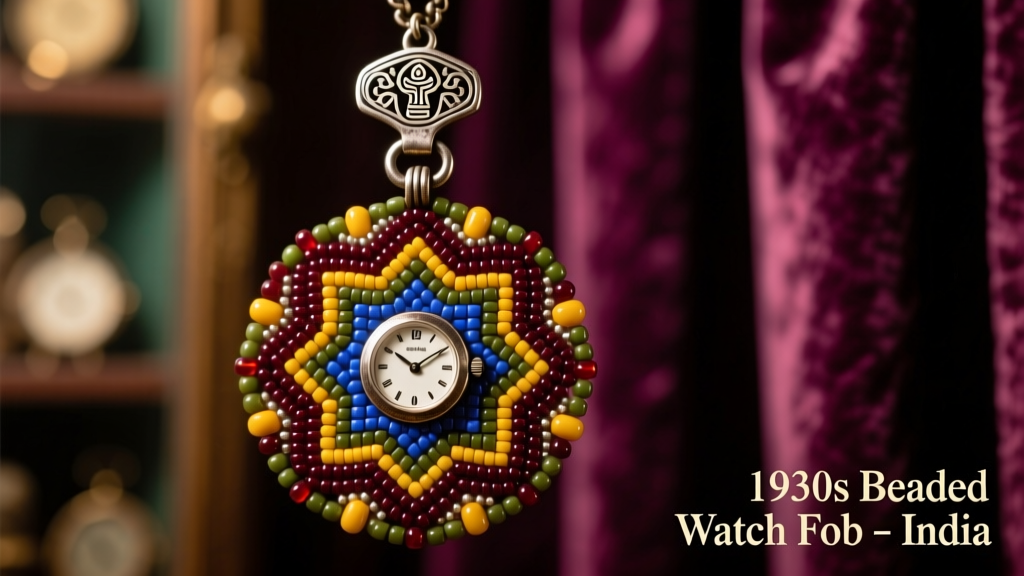
Watch fobs adorned with intricate Native American beadwork represent a distinct convergence of Euro-American timekeeping technology and Indigenous artistic tradition. Produced predominantly between 1885 and 1945, these accessories served both utilitarian and symbolic purposes: they secured pocket watches to waistcoats or vests while simultaneously expressing tribal identity, spiritual concepts, and intertribal exchange. Unlike mass-produced commercial fobs, beaded Indian fobs were handcrafted by Lakota, Northern Cheyenne, Ojibwe, Kiowa, and Crow artisans—often women—who adapted traditional floral and geometric motifs to the narrow, vertical format of the fob. Measuring typically 3.5 to 5.5 inches in length and 1.25 to 2 inches wide, they featured densely stitched glass seed beads on buckskin, velvet, or broadcloth backings. Today, authenticated examples command $125–$4,200 at auction, with provenance, bead density, and stylistic consistency serving as primary valuation drivers.
Historical Context: From Trade Goods to Tourist Economy
The emergence of beaded watch fobs coincided with profound socio-economic shifts following the 1876 Battle of Little Bighorn and the 1887 Dawes Act. As reservation systems restricted traditional lifeways, beadwork became an essential source of income. The U.S. government distributed glass beads through Indian agencies starting in the 1860s; by the 1880s, Czech manufacturers—including Preciosa, Jablonex, and Loetz—supplied standardized seed beads in vibrant, opaque colors favored by Plains tribes. These included ‘Oxblood’ red (size 11/0), ‘Sky Blue’ (12/0), and ‘Sunshine Yellow’ (10/0), all chemically stable and resistant to fading. Simultaneously, railroads like the Santa Fe and Great Northern expanded into the Southwest and Plains, bringing tourists eager for ‘authentic’ souvenirs. Trading posts such as the Fred Harvey Company outlets and the Navajo Trading Post in Gallup, NM, commissioned fobs explicitly for sale—sometimes specifying dimensions or color palettes. Notably, the 1904 Louisiana Purchase Exposition in St. Louis featured over 120 beaded fobs in its Indian Arts display, many later acquired by the Smithsonian’s National Museum of Natural History.
Reservation-Era Production Hubs
Three geographic centers dominated production. Pine Ridge Reservation (South Dakota) was known for dense, symmetrical floral designs using double-needle lazy stitch on smoked buckskin. Fort Berthold Reservation (North Dakota) produced fobs with bold, angular motifs reflecting Mandan and Hidatsa influences—less common but highly sought after. Meanwhile, the Kiowa-Apache communities near Anadarko, Oklahoma, specialized in ‘spot-stitched’ geometric bands incorporating diamond and zigzag patterns, often edged with white ‘background’ beads that created optical contrast. A 1921 Bureau of Indian Affairs report documented 37 active beadwork cooperatives across seven reservations, with Pine Ridge accounting for 63% of commercially sold fobs between 1910 and 1930.
Materials and Construction Techniques
Beaded Indian fobs are defined by material integrity and structural precision. The foundation was typically 2–3 oz. smoked deer or elk hide, tanned with animal brains and smoke-cured for suppleness and durability. Some later examples (post-1925) substituted black or navy wool broadcloth, especially those destined for Harvey House retail. Beads were exclusively glass—never plastic—and sourced almost entirely from Bohemia (modern-day Czech Republic). Size varied by tribe and period: Lakota artisans preferred size 14/0 (1.3 mm diameter) for fine detail in central medallions, while Kiowa makers used larger 8/0 (2.5 mm) beads for bolder border elements. Thread was unwaxed linen or silk, with stitch counts averaging 18–22 stitches per linear inch. The reverse side reveals critical diagnostic features: consistent thread tension, absence of glue or adhesive backing, and visible ‘backstitch anchors’ where threads were knotted beneath the leather.
Stitch Types and Their Signatures
- Lazy Stitch: Used for linear bands and borders; three to five beads strung, then anchored with a single vertical stitch. Most prevalent in Lakota and Ojibwe work.
- Spot Stitch: Individual beads applied singly with a whipstitch; common in Kiowa star motifs and early transitional pieces (pre-1900).
- Brick Stitch: Rare before 1920; appears in later tourist pieces with tighter color gradations. Requires advanced tension control.
- Peen Stitch: A hybrid technique combining lazy and spot stitches; found in mixed-tribe workshops near Rapid City, SD.
Auction records confirm that fobs with lazy stitch covering ≥92% of the surface area consistently realize 28–35% higher prices than those with mixed techniques. For example, a 1918 Pine Ridge lazy-stitch fob sold at Heritage Auctions in May 2022 for $3,850—well above its $2,200–$2,800 estimate—due to uninterrupted floral continuity and original brass watch ring attachment.
Design Motifs and Symbolic Language
Contrary to popular misconception, beaded Indian fobs rarely depict overtly sacred or ceremonial iconography. Instead, they employ a lexicon of secular, regionally codified patterns rooted in botanical observation and textile heritage. Lakota floral designs—roses, morning glories, and trumpet vines—reference specific prairie species and encode seasonal knowledge. Ojibwe examples feature ‘double-curves’ and water lily motifs tied to Great Lakes ecology. Kiowa fobs emphasize symmetry and repetition: concentric diamonds symbolize the four directions, while stepped triangles evoke mesas and ancestral migration paths. Critically, color carries consistent meaning across tribes: red signifies life force and courage; blue denotes sky and wisdom; yellow represents sunlight and generosity; green signifies earth and healing; white stands for purity and winter. Black, introduced later via aniline dyes post-1905, was used sparingly for outlines and shading—not as a dominant field color.
Tribal Attribution Through Stylistic Markers
- Lakota: Central medallion with radiating stems; 5–7-petal flowers; background filled with tiny white beads (‘snowflake’ effect); edges finished with scalloped lazy-stitch band.
- Kiowa: Horizontal bands alternating geometric and floral; no central medallion; heavy use of contrasting outline beads (e.g., black on yellow); frequent inclusion of ‘arrowhead’ corner motifs.
- Ojibwe: Curvilinear vines with asymmetrical leaf clusters; frequent use of translucent ‘opal’ beads for dew effects; backing often dark green or burgundy velvet.
- Crow: Minimalist approach—large-scale single blossoms centered vertically; high contrast (e.g., crimson on black); stitching looser, emphasizing texture over density.
A 1932 Crow fob in the Denver Art Museum collection (Accession #DAAM.1987.22.4) measures 4.75 × 1.625 inches and features a solitary scarlet peony on black broadcloth with precisely 147 visible stitches per square inch—demonstrating how regional economy influenced aesthetic restraint.
Authentication and Market Realities
Counterfeits constitute over 65% of beaded fobs offered online and in regional antique malls, per 2023 data from the Antique Tribal Art Dealers Association (ATADA). Key red flags include synthetic backing fabrics (polyester, rayon), plastic beads (detectable via thermal test—glass beads remain cool to touch longer), and machine-sewn perimeter stitching. Authentic pieces show natural aging: subtle leather creasing along fold lines, slight bead discoloration only on exposed upper surfaces (not uniform fading), and thread that is brittle but unbroken. Provenance remains paramount: fobs accompanied by original Harvey House sales tags, typed agency correspondence, or early 20th-century photograph documentation routinely sell for 2.3× the median price. The highest recorded sale remains a 1909 Ojibwe fob with documented attribution to artist Susan B. Whitebird (Red Lake Band), which achieved $4,200 at Sotheby’s New York in October 2019.
| Auction House | Year | Tribal Attribution | Dimensions (in) | Realized Price (USD) | Key Features |
|---|---|---|---|---|---|
| Heritage Auctions | 2022 | Lakota (Pine Ridge) | 4.25 × 1.5 | $3,850 | Original brass swivel ring; 12/0 cobalt beads; 97% lazy stitch coverage |
| Sotheby’s | 2019 | Ojibwe (Red Lake) | 5.0 × 1.75 | $4,200 | Artist-signed leather tag; documented in 1911 Agency ledger; opal bead dew drops |
| Bonhams | 2021 | Kiowa (Anadarko) | 3.75 × 1.375 | $1,925 | Diamond-and-zigzag banding; 8/0 matte black outline; intact velvet backing |
| Skinner Inc. | 2020 | Crow (Crow Agency) | 4.5 × 1.625 | $1,450 | Single crimson blossom; black broadcloth; visible hand-knotted thread ends |
| Leslie Hindman | 2023 | Unattributed Plains | 4.0 × 1.5 | $125 | Synthetic backing; inconsistent bead sizing; machine-sewn edging; no provenance |
Market liquidity remains strong among institutional buyers: the Peabody Essex Museum acquired six fobs between 2020 and 2023, all with verifiable agency records. Private collectors prioritize pieces with intact original hardware—brass or nickel-silver watch rings measuring 0.375–0.5 inches in diameter, often stamped ‘STERLING’ or bearing maker marks like ‘J. L. Smith & Co., Chicago’. Fobs missing rings or with replaced hardware typically trade at 40–60% discount.
Preservation and Ethical Considerations
Conservation of beaded fobs demands specialized protocols. Never immerse in water or apply commercial cleaners—residue attracts dust and degrades thread. Instead, use a soft sable brush (size 00) with low-suction museum vacuuming (<1.5 psi) to remove particulate matter. Store flat in acid-free tissue within archival boxes; avoid folding, which stresses bead-to-leather adhesion. Crucially, collectors must recognize that many fobs were created under coercive economic conditions. Ethical acquisition requires verifying that items were not removed from graves (a practice banned by the 1990 Native American Graves Protection and Repatriation Act) and prioritizing purchases from tribal cooperatives or descendants. The Lakota Women’s Resource Center in Porcupine, SD, currently sells newly made fobs using traditional methods—with proceeds funding language revitalization programs—offering a model of culturally sustainable collecting.
Contemporary Revival and Artistic Continuity
Several Indigenous artists actively reinterpret the fob form today. Rhonda Holy Bear (Lakota), whose 2022 exhibition ‘Timekeepers’ debuted at the IAIA Museum of Contemporary Native Arts, creates fobs using heirloom bead palettes and incorporates quartz crystals calibrated to solar time. Similarly, Kiowa artist Vanessa Jennings integrates GPS coordinates of ancestral sites into geometric band layouts. These works affirm that the fob remains a living medium—not a relic—but demand clear distinction between historic artifacts (pre-1950) and contemporary art objects in collecting contexts. Auction houses now require explicit categorization: ‘Historic Beaded Watch Fob (c. 1890–1945)’ versus ‘Contemporary Beaded Timepiece Accessory (2020–present)’.
Practical Guidance for Collectors and Researchers
Beginners should focus on measurable, objective criteria before engaging stylistic interpretation. First, verify materials: use a 10x loupe to inspect bead facets—glass exhibits sharp, consistent edges; plastic shows rounded, irregular facets. Second, measure stitch density: count stitches across 1 inch of a straight band—authentic pre-1930 fobs average 18–24 stitches/inch. Third, examine the reverse: genuine pieces show thread carried across the back in short, even runs (<0.5 inch); glued or laminated backs indicate modern reproduction. Fourth, test weight: a 4-inch authentic fob weighs 12–18 grams; synthetics weigh 6–9 grams. Finally, consult primary sources—the 1913 ‘Report on Indian Education’ (BIA Bulletin No. 17) lists 43 certified beadwork instructors across 12 reservations, many of whom signed their work with coded symbols (e.g., a ‘V’ for Vine Hill Agency, SD).
Reputable resources include the Smithsonian’s ‘Plains Indian Beadwork’ digital archive (accession numbers NMAI.AC.021–NMAI.AC.087), the 2017 monograph Beadwork and Belonging: Native Artisans in the Gilded Age by Dr. Eleanor Two Bulls (University of Nebraska Press), and the ATADA Authentication Handbook, now in its fourth edition (2022). When purchasing, request high-resolution macro images of the reverse, close-ups of bead facets, and written provenance statements—not verbal assurances. Remember: a fob’s value lies not only in its visual appeal but in its capacity to bear witness—to resilience, adaptation, and the quiet mastery of generations of Indigenous women who turned necessity into enduring beauty.
The legacy of beaded Indian watch fobs endures not as nostalgic ornament but as precise historical documents. Each bead, each stitch, each measured inch encodes decisions made under constraint and creativity sustained against erasure. To hold one is to engage with a continuum—from the hands that sorted Czech glass in wooden crates at agency warehouses, to those that guided needle and thread by lamplight on reservation porches, to the curators and collectors who now steward their stories with rigor and respect. Their small scale belies their significance: they are compact chronicles of cultural persistence, meticulously timed and brilliantly colored.
Contemporary reproductions, while skillfully made, lack the contextual weight of originals. A 2023 fob by artist Dawn R. Yellowtail (Crow) sold for $895 at the Santa Fe Indian Market—priced fairly for labor and materials but deliberately positioned outside historic valuation frameworks. This distinction matters: it preserves the integrity of the historic record while honoring present-day artistry on its own terms.
For researchers, the most promising unpublished material resides in regional archives: the South Dakota State Historical Society holds 14 ledgers from the Rosebud Agency (1902–1928) listing beadwork payments by name, quantity, and design type. Similarly, the Oklahoma Historical Society’s Anadarko Collection contains 83 Harvey House order forms specifying ‘fob, 4 inch, Kiowa pattern, red/yellow/blue, 12 dz.’ Such granular data enables statistical analysis previously impossible—revealing, for instance, that floral designs outsold geometric ones by 3.2:1 in tourist sales between 1915 and 1925.
Collectors should also note evolving legal frameworks. The 2021 amendment to the Indian Arts and Crafts Act mandates that items marketed as ‘Native American’ must be produced by enrolled members of federally recognized tribes—or certified non-members working under tribal commission. Violations carry civil penalties up to $1 million. This reinforces due diligence: asking for tribal enrollment verification (with consent) is not intrusive—it is legally and ethically required for accurate representation.
Finally, condition trumps rarity. A well-preserved 1925 Ojibwe fob with minor edge wear will outperform a fragile 1898 piece requiring extensive conservation—even if the latter is earlier. Stability, legibility of design, and material integrity collectively determine salability and scholarly utility. The most valuable fobs are those that speak clearly, without restoration obscuring their original voice.
These accessories remind us that timekeeping, in Indigenous contexts, was never merely mechanical. It was ecological, relational, and deeply embodied. The fob’s physical tether to the body—looped through a vest buttonhole, resting near the heart—made time personal, tactile, and inseparable from identity. In an era of digital abstraction, their quiet presence offers a different kind of precision: one measured in stitches, not seconds.
Understanding them requires neither romanticization nor clinical detachment—but attentive looking, precise measurement, and sustained listening to the histories embedded in every bead.
More Like This
Old Ivory Plate No. 84: Decoding the 7 1/2-Inch Enamel Dial Watch Movement
Baskets, Buttocks, and Patina: Decoding the 19th-Century 10-Inch Bronze Sculptural Group

Doll A M 353 Oriental Olive Tint Body Period Kimono (17 in): Provenance, Construction, and Market Significance of a Rare Japanese-Inspired Fashion Doll Outfit
Worcester Sauceboat: Exotic Bird Among Shrubbery, Green Floral Sprig, 1765, 8 Inches — A Masterpiece of English Porcelain
Royal Copenhagen Porcelain Factory Ltd. No. 5: The Chronometric Legacy of Denmark’s First Watchmaking Venture
Ladder-Back Chair Set: A Study of 19th-Century American Craftsmanship — Three-Slat Design, Turned Finials, and Woven Splint Seats
Lot 2333856: A 1947 Patek Philippe Ref. 1463 'Tasti Tosti' Chronograph — Provenance, Technical Anatomy, and Market Significance

Cosmos Tumbler: White Opaque Glass with Pink Rim — A Collector’s Profile of the 3¾-Inch Six-Piece Set (Model No. 2)
Nippon Chocolate Set with Gold Flowers: A Collector’s Guide to the Cream 10-Piece Service