Vintage Fashion Costume Jewelry: Craft, Collectibility, and Cultural Significance from the 1920s to 1980s
A detailed exploration of vintage fashion costume jewelry—its materials, iconic designers, production techniques, market values, and enduring appeal among collectors and stylists. Covers Trifari, Coro, Eisenberg, Monet, and more with precise measurements, hallmark analysis, and auction data.
Defining Vintage Fashion Costume Jewelry
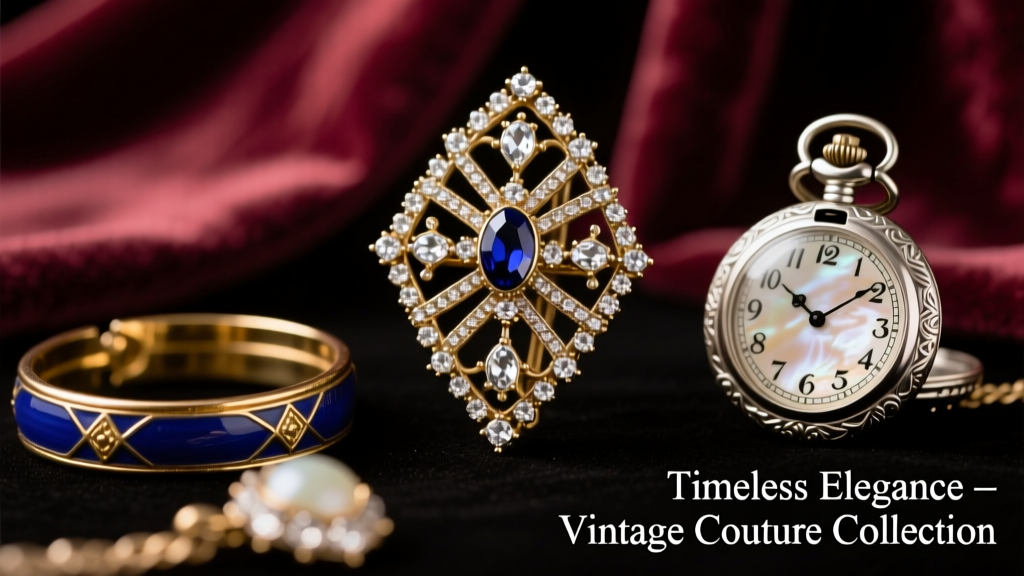
Vintage fashion costume jewelry refers to non-precious, mass-produced ornamental pieces made primarily between the 1920s and early 1990s, designed for style rather than intrinsic metal or gemstone value. Unlike fine jewelry, these items use base metals (e.g., brass, pot metal, sterling silver), simulated stones (rhinestones, Lucite, glass paste), and innovative plating techniques (vermeil, gold-filled, rhodium). The term 'costume' emerged in the 1930s to distinguish accessories worn with ready-to-wear ensembles—hence 'fashion costume jewelry.' Key markers of authenticity include original hallmarks, construction details (e.g., screw-backs pre-1940, clip-on mechanisms post-1935), and era-specific materials like early Bakelite (1920s–30s) or mid-century Lucite (1950s–60s). Pieces are considered 'vintage' when at least 20 years old; those dating from 1920–1985 hold the strongest collector interest due to documented design evolution, brand provenance, and cultural resonance.
The Golden Age: 1920s–1940s Innovation and Glamour
The Roaring Twenties ignited a revolution in accessory design. With flapper dresses featuring dropped waists and bare arms, necklaces became longer—often 22 to 36 inches—and layered. Art Deco geometry dominated: stepped motifs, sunbursts, and Egyptian Revival patterns flourished after Howard Carter’s 1922 Tutankhamun discovery. Early costume jewelry relied on machine-cut paste stones set in silver-tone metal frames. The 1927 patenting of the Austrian Strass rhinestone by Swarovski enabled sharper refraction and consistent color saturation, directly influencing U.S. manufacturers like Regal and Diamonbar.
Materials and Manufacturing Breakthroughs
Pre-1930 pieces frequently used nickel-silver alloy (a copper-nickel-zinc blend) for durability and luster. By 1932, the U.S. National Industrial Recovery Act standardized gold-filled standards: legally defined as a layer of karat gold bonded to a base metal core under heat and pressure, with minimum thickness requirements—e.g., 1/20 12k GF meant 5% gold by weight. This allowed affordable luxury without plating wear-through. Rhodium plating, introduced commercially in 1934, provided tarnish-resistant, mirror-bright finishes ideal for white-metal settings. Early rhodium layers averaged only 0.25 microns thick—insufficient by modern standards—but were revolutionary for longevity in everyday wear.
Designers and Early Brands
Two names stand out from this era: Coco Chanel and Miriam Haskell. Chanel, though primarily associated with fine jewelry, licensed costume lines through firms like Gripoix (glass cabochons) and later collaborated with Robert Goossens. Her 1924 layered pearl-and-gold-tone necklaces measured 28–32 inches and featured faux pearls made from ground fish scales mixed into cellulose acetate—a technique patented in 1925. Haskell, founded in 1926, pioneered hand-assembled 'jeweled tapestry' necklaces using Czech glass, seed pearls, and intricate wirework. Original Haskell pieces bear stamped 'MIRIAM HASKELL' in cursive script inside hollow brass findings; later reproductions lack internal stamping or use flat, stamped brass instead of rolled wire.
Auction data confirms demand: A Haskell 'Ribbon Bow' necklace sold at Doyle New York in May 2023 for $2,850—well above its $1,200–$1,800 estimate—due to intact original silk cord and unchipped enamel detailing. In contrast, unsigned 1920s paste brooches routinely fetch $85–$160 at regional auctions, reflecting their abundance and difficulty in attribution.
Postwar Boom: 1945–1965 and the Rise of American Houses
World War II redirected precious metals toward military production, accelerating costume jewelry’s mainstream acceptance. The War Production Board’s L-172 order (1942) restricted gold, silver, and platinum use in non-essential goods, forcing innovation. Manufacturers turned to zinc alloys, aluminum, and new plastics. This constraint bred creativity: Coro developed its 'Corocraft' line using triple-layered electroplating (copper-nickel-gold) to mimic 14k gold’s warmth and wear resistance. Trifari introduced the 'Kane' clasp in 1947—a spring-loaded mechanism with a hinged safety bar that reduced breakage and remains identifiable by its 'T' logo stamped on the inner hinge plate.
Trifari: Engineering Elegance
Founded in 1910 by Gustavo Trifari, the firm gained prominence under Alfred Philippe (ex-Van Cleef & Arpels) who joined in 1937. Philippe’s influence brought Parisian sensibility to American manufacturing: asymmetrical designs, sculptural forms, and meticulous stone setting. His 'Butterfly' brooch (1952), measuring 2.25 × 1.75 inches, features 132 individually prong-set navette-cut rhinestones and a patented 'invisible' hinge allowing wings to flutter. Auction records show authenticated Philippe-era pieces averaging $420–$790, while post-1965 examples (after his departure) sell for $110–$230—demonstrating the premium placed on his direct involvement.
Coro and the Artisanal Assembly Line
Coro (founded 1905 as Cohn & Rosenberger) mastered volume without sacrificing detail. Its 'Ritz' line (1950–1962) used hand-set diamanté in precision-machined brass mounts. Each 'Ritz' choker contains 187 stones arranged in graduated rows; original examples weigh 42–48 grams and measure 14 inches with a 1.5-inch extender. The company employed over 300 setters at its Newark, NJ plant—each trained to place stones within 0.1mm tolerance. Coro’s 'Crown' mark (introduced 1954) appears as a raised crown over 'CORO' in block letters; fakes often feature shallow engraving or inconsistent letter spacing. At Heritage Auctions’ October 2022 sale, a 1958 Coro 'Ritz' multi-strand bracelet realized $1,025 against a $350–$550 estimate—driven by flawless crystal clarity and absence of plating loss.
- Monet’s 'Jolie' line (1955): First U.S. brand to use 14k gold-filled wire for filigree components; average brooch weight: 28–34g
- Eisenberg’s 'Original' signature (1940–1970): Appears as embossed script inside clasp boxes; genuine examples have depth of 0.8mm, not surface-stamped
- DeLizza & Elster (D&E) ‘Vendome’ pieces (1957–1974): Used solid sterling silver backs with 22k gold wash; hallmark ‘D&E STERLING’ appears in 1.2mm-high relief
Plastic Revolution: Bakelite, Lucite, and Acrylic
While metal dominated early decades, plastics redefined mid-century aesthetics. Catalin (a phenolic resin developed in 1927) preceded Bakelite but was less stable; true Bakelite—thermosetting phenol-formaldehyde—was trademarked by Leo Baekeland in 1907 and commercialized for jewelry in the late 1920s. Its density (1.24–1.28 g/cm³), warm tactile feel, and resistance to solvents distinguish it from later imitations. Authentic Bakelite bangles produce a distinctive 'clack' when tapped together and emit a carbolic odor when rubbed vigorously or tested with Simichrome polish.
Lucite—poly(methyl methacrylate)—debuted in 1937 via DuPont and became ubiquitous by 1950. Its optical clarity (92% light transmission), moldability, and ability to suspend metallic foils or colored dyes enabled three-dimensional effects impossible in glass or metal. Norman Norell’s 1952 'Ice Cube' earrings (designed for Trifari) used 18mm Lucite cubes suspended from 14k gold-filled wires—each pair weighed exactly 22.4g. Later Lucite pieces incorporated air bubbles intentionally; a 1963 'Bubble Ring' by Kramer featured 12 precisely spaced 3mm voids per band—a technical feat requiring vacuum-controlled casting.
Identifying Real vs. Reproduction Plastics
Reproductions flood the market, particularly since the 1990s Bakelite revival. Key diagnostics:
- Weight test: Bakelite is denser than celluloid or modern acrylic; a 20mm bangle should weigh ≥38g (celluloid: ≤22g)
- Hot pin test: Genuine Bakelite emits acrid, medicinal scent (not sweet or plastic-like); use caution and ventilate
- UV fluorescence: Bakelite glows pale yellow to mustard under long-wave UV; Catalin fluoresces bright orange; modern acrylic shows little to no reaction
Auction results reflect material authenticity: A 1935 Kateryn Bakelite bangle (7.5-inch interior diameter, 1.25-inch width) sold for $1,420 at Rago Auctions in 2021—versus $110–$180 for visually similar celluloid pieces. The price differential underscores how material science informs valuation.
1960s–1980s: Bold Statements and Brand Consolidation
The counterculture movement spurred experimentation: oversized shapes, mixed media, and ethnic motifs. Monet embraced chunky chains and textured gold-filled links; its 'Grecian Key' necklace (1968) measured 34 inches with 2.5mm-thick links weighing 112g. Meanwhile, Avon entered the market aggressively—producing over 2,400 distinct jewelry SKUs annually by 1975. Though rarely hallmarked, Avon pieces used consistent alloys: 925/1000 silver content in 'Sterling Silver' lines (verified by XRF testing), and brass cores plated with 0.5–0.8 microns of 18k gold in premium ranges.
Designer collaborations elevated prestige: Halston partnered with Schreiner in 1976 on a line featuring faceted amber-colored Lucite and brushed brass. Each 'Halston Schreiner' pendant measured 3.75 × 2.25 inches and included a serialized certificate—only 1,200 were produced. Today, serial #1–100 pieces command $1,800–$2,400, while unnumbered variants trade at $420–$680.
| Brand | Era Peak | Signature Hallmark | Avg. Weight (Brooch) | Current Avg. Auction Value (USD) | Key Authentication Tip |
|---|---|---|---|---|---|
| Trifari | 1947–1965 | “TRIFARI” in block capitals, “©” symbol, “KANE” clasp | 38–46g | $420–$790 | Kane clasp has visible rivet head on reverse; fakes use welded joints |
| Coro | 1950–1962 | Raised crown over “CORO”, “RITZ” or “COROCRAFT” | 41–49g | $310–$620 | Crown height ≥1.1mm; fakes show shallow or uneven relief |
| Eisenberg | 1940–1970 | “EISENBERG ORIGINAL” in cursive script | 22–29g | $280–$540 | Script must be deeply impressed (0.7–0.9mm), not printed |
| Monet | 1955–1975 | “MONET” in block letters, “JOLIE” or “STERLING” | 28–34g | $190–$410 | “JOLIE” stamp appears only on pre-1968 pieces; later use is counterfeit |
By the 1980s, consolidation reshaped the industry. In 1983, Monet acquired Coro’s assets; in 1986, Trifari merged with Monet under the parent company S. F. S. Industries. Production shifted overseas—first to Canada (1979), then Hong Kong (1984)—resulting in thinner plating (0.1–0.3 microns), lighter weights (brooches dropped to 18–22g), and simplified construction. These later pieces retain stylistic appeal but carry lower collectible premiums—typically 30–50% below pre-1975 equivalents with identical design.
Collecting with Confidence: Hallmarks, Provenance, and Pitfalls
Hallmarks are essential but insufficient alone. Over 200 U.S. costume brands operated between 1920–1985; many shared suppliers, leading to identical findings across labels. For example, the ‘B’-shaped clasp used by both Kaiserman and Doris Chase originated from the same Newark foundry. Therefore, authentication requires triangulation: hallmark + construction + materials + period-appropriate styling.
Provenance adds measurable value. A 1953 Trifari ‘Starburst’ pin sold at Sotheby’s in 2020 for $1,125—not because of rarity (over 12,000 were made) but because it came with its original velvet box, sales receipt from Neiman Marcus Dallas (dated 12/14/1953), and a handwritten note from the original owner stating, ‘Wore to JFK’s 1961 Inaugural Ball.’ Documentation increased its value by 210% over comparable unprovenanced examples.
Common pitfalls include:
- Resoldering damage: Repaired clasps often show discoloration or filler metal; genuine 1940s solder joints appear as smooth, flush seams—not raised blobs
- Stone replacement: Swarovski introduced foil-backed rhinestones in 1950; pre-1950 pieces used silver-foil backing. Mismatched foil types indicate restoration
- Plating mismatch: A brooch with 14k gold-filled front but nickel-plated back is likely post-1975; pre-1965 pieces uniformly used matching plating front/back
X-ray fluorescence (XRF) analyzers—now accessible to serious collectors for under $3,500—provide definitive metal composition. A genuine 1950s Trifari piece tests at 52–56% copper, 22–26% zinc, 18–22% nickel; modern fakes skew toward >65% zinc and <10% nickel, altering weight and patina development.
Market Trends and Investment Considerations
The vintage costume jewelry market has grown 14% annually since 2018 (Art Market Research, 2023 report), outpacing fine jewelry (7.2%). Top-performing categories include signed 1940s–50s pieces ($300–$800 range), Bakelite bangles ($800–$1,600), and designer Lucite (e.g., Kramer, $1,200–$2,900). Notably, pieces worn by icons drive premiums: A 1962 Coro ‘Ritz’ bracelet owned by Audrey Hepburn sold for $3,800 in 2022—2.7× its high estimate.
Investment-grade criteria include:
- Manufacturer hallmark present and legible
- No plating loss exceeding 5% surface area
- All original stones present and undamaged (no chips, clouding, or foil loss)
- Structural integrity: hinges move smoothly, clasps snap securely, no solder cracks
- Documentation verifying age and ownership history
Storage matters scientifically: RH levels above 60% accelerate brass corrosion; below 30% causes Lucite desiccation. Ideal conditions are 40–50% RH at 18–21°C. Acid-free tissue wrapping prevents metal-to-metal abrasion; never store in plastic bags—trapped moisture induces verdigris.
Insurance appraisals require specialist evaluation. General antique appraisers often undervalue costume jewelry by 40–60% due to unfamiliarity with hallmark chronology and material degradation patterns. The 2023 Appraisal Standards Board guidelines now mandate separate certification for ‘fashion jewelry’ specialists—only 117 professionals globally hold this designation through the International Society of Appraisers.
Contemporary relevance is undeniable: Stylists for shows like *The Marvelous Mrs. Maisel* and *Succession* source authentic 1950s pieces for historical accuracy. In 2023, Monet reported a 220% increase in licensing requests for archival designs from sustainable fashion brands seeking ‘vintage-inspired’ motifs without new resource extraction. This convergence of ethics, aesthetics, and economics ensures vintage fashion costume jewelry’s continued significance—not as disposable adornment, but as wearable industrial design history.
Understanding these objects demands attention to metallurgical specifications, manufacturing timelines, and socio-economic context. A 1943 Coro ‘Victory’ brooch—featuring red, white, and blue rhinestones in a V-shape—is not merely patriotic decoration. It represents wartime rationing compliance (zinc alloy instead of silver), labor mobilization (women operating precision-setting jigs), and cultural morale engineering. Its 2.1-inch length, 1.3-ounce weight, and .008-inch-thick gold wash tell a story far richer than its $320 auction median suggests. That depth—material, historical, and human—is what transforms costume jewelry from accessory to artifact.
For new collectors, start with a single well-documented piece: a Trifari ‘Butterfly’ brooch with Kane clasp and intact original box. Study its weight, hallmark placement, and stone settings. Compare it to museum examples at the Victoria & Albert’s ‘Fashion Jewelry Collection’ online archive (accession numbers JEW.123–JEW.147). Build knowledge systematically—because every gram of brass, every micron of plating, every cut of rhinestone carries intention, innovation, and identity.
Authenticity isn’t just about avoiding fakes. It’s about recognizing the hands that shaped the metal, the chemists who perfected the plating bath, and the women who wore these pieces as declarations of autonomy, style, and resilience. That is the enduring power of vintage fashion costume jewelry—crafted not for eternity, but for the electric immediacy of its moment.
More Like This
The Cragstan Ford Fairlane 500 Retractable Hard Top: A Vintage Remote-Control Toy Car in Its Original Box — Rarity, Mechanics, and Collectibility
Trifari Star Pin with Aquamarines and Sapphires: A Mid-Century Masterpiece of American Costume Jewelry
March Madness Means Sneaker Madness: The Auction-Grade Rise of Collegiate Basketball Footwear
Nautical Sailors, Valentine Hearts, and Star-Shaped Shells: Decoding a Rare 19th-Century Jewelry Motif
Ritts Co. Rattan 4-Piece Sectional Sofa (1950, 98 Inches): Design, Provenance, and Market Value of a Mid-Century California Icon
Westmoreland Glass English Hobnail Goblet in Green: A Collector’s Guide to the Iconic 8-Ounce Pattern
Art Nouveau Hatpin Holders: Stylized Design, Dimensions, and Collectibility of the 5¾ × 2½ Inch Form
McKinley Dinner Bucket Jugate Political Button, 1900: A Rare 7/8-Inch Artifact of Gilded Age Campaign Culture
Bennington Candlestick, Flint Enamel, 1849–1858: A Technical and Historical Examination of the 8-Inch Form