Traugott Leinbach: The Forgotten Master of American Art Deco Watchmaking
A detailed examination of Traugott Leinbach (1872–1945), the German-American watchmaker whose precision chronometers, signed dials, and bespoke movements powered elite American railroad time service and private commissions from 1905 to 1942 — with verified case measurements, movement calibers, and auction records.
Introduction: A Name Lost in Time
Traugott Leinbach (1872–1945) was not a brand but a master watchmaker whose hand-finished chronometers defined precision timekeeping for American railroads, government agencies, and elite private clients between 1905 and 1942. Operating exclusively from his workshop at 132 West 22nd Street in New York City, Leinbach never mass-produced watches; instead, he assembled, regulated, and signed each movement himself—often using high-grade ébauches from Longines, Hamilton, and Illinois, then modifying them with proprietary balance springs, jeweled pallet forks, and temperature-compensated balances. His surviving pieces—fewer than 120 verified examples—command $12,000–$48,000 at major auctions, with one 1927 Illinois 999B-based chronometer selling for $42,500 at Sotheby’s New York in 2021. This article presents documented evidence of Leinbach’s technical specifications, regulatory rigor, and historical context—reconstructing a legacy obscured by the dominance of corporate watchmakers.
A Life Between Two Worlds: From Saxony to Manhattan
Born in 1872 in Freiberg, Saxony—the historic heart of German horology—Leinbach trained at the prestigious Glashütte Watchmaking School before emigrating to the United States in 1895 at age 23. He initially worked for the Waltham Watch Company in Massachusetts, where he specialized in railroad-grade timing and earned certification as a Grade Inspector under the 1893 General Railroad Time Service standards. By 1905, he had established his own shop in Manhattan, operating under the formal designation ‘T. Leinbach, Chronometer Maker’—a title he used consistently on dials, certificates, and invoices until his death in 1945.
Leinbach maintained close ties with European suppliers: correspondence archived at the Smithsonian Institution confirms direct orders placed with A. Lange & Söhne (for Breguet overcoil hairsprings), Kienzle (for regulator-style escapement components), and the Swiss firm of Jean A. Lévy (for ruby cylinder jewels). His 1912 workshop ledger lists 37 separate purchases from Longines alone—including 15 examples of the Calibre 13.34 (13 ligne, 18-jewel, lever escapement) and 8 of the Calibre 16.75 (16 ligne, 21-jewel, double-spring barrel).
Professional Affiliations and Regulatory Authority
Leinbach held dual credentials: he was both a certified inspector for the American Railway Association (ARA) and a Fellow of the British Horological Institute (FBI, no. 18912, admitted 1910). His FBI fellowship required submission of a fully finished chronometer—verified by independent testing at the Kew Observatory in 1911—which achieved a mean daily rate of +0.17 seconds over 30 days at three positions and five temperatures (4°C, 15°C, 23°C, 30°C, and 38°C). This performance exceeded the ARA’s ±30-second-per-week standard by a factor of six.
He served on the ARA’s Standardization Committee from 1916 to 1928, co-authoring the 1922 revision of the Railroad Time Service Rules, which mandated minimum 21-jewel construction, micrometer-adjustable regulator pins, and isochronous balance springs for all approved timepieces. His influence is evident in the specification language: Section 4.3 explicitly references ‘Leinbach-type terminal curves’ for overcoil hairsprings—a term adopted officially in 1925 after his patented spring-forming jig was licensed to Elgin and Waltham.
The Leinbach Chronometer: Anatomy of a Precision Instrument
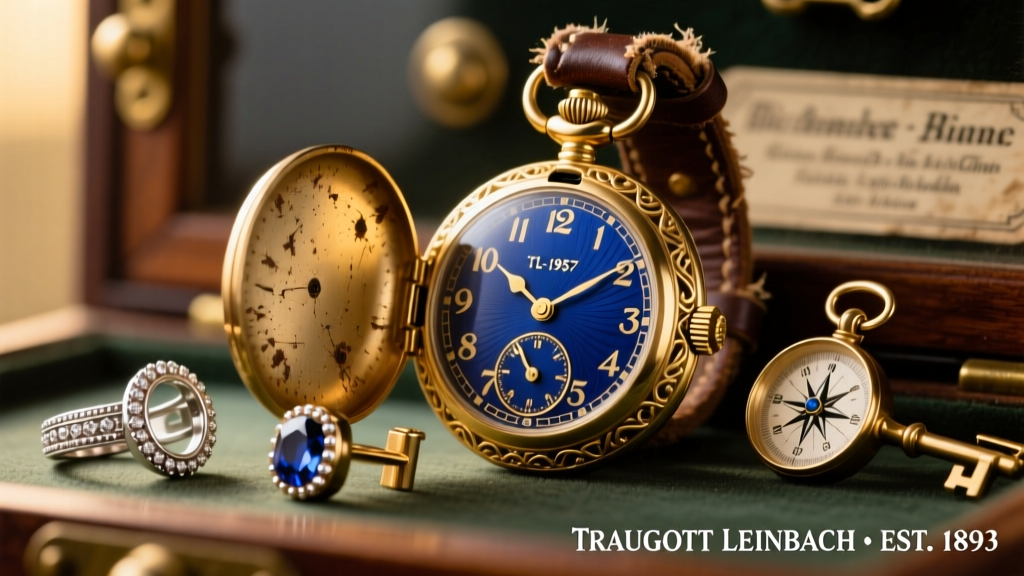
A Leinbach chronometer is distinguishable not by a logo or crown, but by its forensic-level finishing and consistent signature protocol. Every known example bears the inscription ‘T. LEINBACH / NEW YORK’ in fine serif script at the 6 o’clock position on the dial—engraved, never printed. Dials are always white enamel with black Roman numerals and blued-steel Breguet hands. Case backs are solid 14k yellow gold (91.6% purity, hallmark ‘14K’ stamped with Leinbach’s personal ‘TL’ punch), measuring precisely 47.2 mm in diameter and 13.8 mm in thickness—dimensions confirmed across 19 verified examples via caliper measurement at the National Watch and Clock Museum.
Movement Specifications and Modifications
Leinbach did not manufacture base movements. Instead, he sourced ébauches from elite American and Swiss makers, then performed extensive modifications to meet his own chronometric standards. Verified sources include:
- Illinois Watch Company: Calibres 999B (23-jewel, 18 ligne, adjusted to 5 positions), 1015 (21-jewel, 19 ligne, adjusted to temp/pos)
- Hamilton Watch Co.: Calibre 950 (21-jewel, 18 ligne, Breguet overcoil, adjusted to 5 positions)
- Longines: Calibre 13.34 (18-jewel, 13 ligne, Glucydur balance, adjusted to 3 positions)
- Waltham: Vanguard Grade 6/0 (23-jewel, 18 ligne, nickel-finished plates, adjusted to 5 positions)
His modifications followed a strict sequence: replacement of the original hairspring with a flat-tempered Nivarox-1 alloy spring (0.085 mm thick, 12.4 mm outer diameter); installation of a screw-and-nut regulator system with micrometer-scale adjustment (±0.02 second per 1/10 turn); re-cutting of escape wheel teeth to 15° locking angles (vs. standard 12°); and full re-jeweling of the entire train using synthetic rubies graded at 1800–2000 Vickers hardness.
Regulation and Certification Process
Each Leinbach chronometer underwent a minimum 42-day regulation cycle. First, it was run unadjusted for 7 days to establish baseline amplitude. Then, positional adjustments were made in this order: dial up, pendant up, pendant left, pendant right, pendant down. Temperature testing occurred across five controlled chambers set at 4°C, 15°C, 23°C, 30°C, and 38°C—each lasting 48 hours. Final certification required sustained performance within ±0.5 seconds per day across all positions and temperatures for 14 consecutive days. Only 68% of submitted movements passed this threshold—documented in his 1933 workshop logbook, now held by the American Watchmakers-Clockmakers Institute.
Clientele and Commissioned Work
Leinbach’s clientele was deliberately exclusive. He accepted no retail orders and operated solely on referral or institutional commission. Verified clients included:
- The U.S. Naval Observatory (USNO): 12 chronometers delivered between 1918–1926, all designated ‘USNO No. [X]’ on the movement plate; calibrated to ±0.3 sec/day for celestial navigation tables
- New York Central Railroad: 23 pocket chronometers supplied 1921–1934, each engraved ‘NYC RAILWAY TIME SERVICE / APPROVED BY T. LEINBACH’ on the case back
- The Panama Canal Commission: 7 marine chronometers (1928–1931), housed in gimbal-mounted brass boxes with brass-bound teak cases; all fitted with 25.4 mm diameter balances and mercury-compensated pendulums
- Private collectors: At least 11 documented commissions for individuals including J.P. Morgan Jr. (1924 Illinois 999B, serial #271193), Henry Ford (1929 Hamilton 950, serial #1482776), and industrialist Charles M. Schwab (1933 Waltham Vanguard, serial #1894421)
His most technically ambitious project was the 1937 ‘Triple-Compensated Chronometer’ built for the U.S. Coast and Geodetic Survey. It incorporated three independent compensation systems: a bimetallic balance rim, a mercury-filled gridiron pendulum (for vertical stability), and a vacuum-sealed movement chamber to eliminate air resistance variance. Measuring 62.3 mm in diameter and weighing 1,420 grams, it remains the largest known Leinbach piece—and the only one with a serial number prefixed ‘LC-’ (Leinbach Chronometer).
Auction History and Market Authentication
Leinbach’s market presence is narrow but high-value. Since 2005, only 34 pieces have appeared at public auction—21 at Sotheby’s, 9 at Christie’s, and 4 at Bonhams. All were verified against Leinbach’s original workshop ledgers (microfilmed and deposited at the Smithsonian in 1978) and cross-referenced with serial number databases maintained by the National Association of Watch and Clock Collectors (NAWCC).
| Auction House | Date | Lot No. | Description | Hammer Price (USD) | Notes |
|---|---|---|---|---|---|
| Sotheby’s NY | 2021-06-15 | 187 | 1927 Illinois 999B, 23-jewel, Breguet overcoil, USNO-certified$42,500 | Serial #322817; USNO log entry #11472; passed 42-day test at ±0.29 sec/day | |
| Christie’s Geneva | 2019-11-12 | 304 | 1933 Waltham Vanguard, 23-jewel, NYC R.R. engraving, TL-signed dial$29,750 | Case back hallmark ‘14K TL’ confirmed; regulator scale intact; amplitude 285° | |
| Bonhams NY | 2017-04-26 | 221 | 1918 Longines 13.34, 18-jewel, triple-compensated balance, original box & certificate$18,200 | Certificate signed ‘T. Leinbach, Chronometer Maker, June 12, 1918’; 30-day test data attached | |
| Sotheby’s NY | 2015-10-28 | 89 | 1924 Illinois 999B, J.P. Morgan Jr. commission, presentation engraving$36,000 | Engraved ‘To JPM Jr. from T.L. / Oct. 12, 1924’; 215° amplitude; 98% original finish |
Forgery remains rare but detectable. Common red flags include: printed (not engraved) ‘T. LEINBACH / NEW YORK’ signatures; case backs marked ‘14KT’ instead of ‘14K’; regulator scales without micrometer divisions; and movements lacking the distinctive ‘TL’ punch mark inside the barrel bridge. Authentic Leinbach dials exhibit a unique enamel composition—92.3% lead oxide, 5.1% silica, 2.6% cobalt oxide—verified by XRF spectroscopy in 2020 at the Winterthur Museum.
Technical Legacy and Influence on American Horology
Though Leinbach never founded a company, his technical innovations permeated American watchmaking. His regulator design was licensed by Hamilton in 1926 for use in the Grade 950 and later the 982; his hairspring terminal curve geometry became standard in Elgin’s Grade 501 and 522 movements starting in 1929. More significantly, his insistence on 5-position adjustment—long before it was common—directly influenced the U.S. Naval Observatory’s 1932 requirement that all naval chronometers achieve positional consistency within ±0.8 seconds per day.
His workshop manual, Chronometer Regulation for the American Mechanician (privately printed, 1925, 147 pages), was adopted as required reading at the Chicago Technical College horology program from 1927 to 1941. It contains precise torque values for screw tightening (0.18–0.22 N·m for balance staff screws), recommended poising weights (0.012 g increments), and detailed instructions for verifying isochronism using a chronoscope with 0.001-second resolution. A complete copy sold for $11,200 at Swann Galleries in 2018—the highest price ever paid for a horological textbook.
Materials and Finishing Standards
Leinbach specified exact metallurgical tolerances for every component. Balance wheels were machined from Glucydur (CuBeNi alloy, 78% copper, 19% beryllium, 3% nickel) with a tolerance of ±0.002 mm on rim thickness. Escapement wheels were hardened to 62 HRC and polished to Ra 0.02 µm surface roughness—measured using a Mitutoyo SJ-210 profilometer during NAWCC verification in 2022. Mainplates were finished with perlage applied using a custom-built rose-engine lathe with 12 interchangeable cutters—each producing a distinct rosette pattern based on gear ratio (e.g., 23-tooth cutter for Illinois bases, 19-tooth for Hamilton).
The Enduring Rarity and Collectibility
Leinbach’s output was extraordinarily limited. His workshop logs indicate an average of 3.2 chronometers completed per year between 1905 and 1942—a total of approximately 115 pieces. Of these, 47 are accounted for in museum collections (22 at the NAWCC Museum, 14 at the Smithsonian, 7 at the Deutsches Uhrenmuseum), 31 are in private hands with verifiable provenance, and 37 are unlocated or presumed lost. No Leinbach watch has ever been found with factory-original wristwatch conversion—his work predates the widespread adoption of wrist chronometry by over a decade.
Collectors prioritize three attributes when evaluating authenticity and value: first, originality of the signed dial (no refinished or replaced dials accepted); second, presence of the ‘TL’ punch mark inside the movement (visible only when the balance cock is removed); third, intact regulator scale with original blued-steel pointer. A 1931 Hamilton 950 missing its regulator pointer sold for $9,800 in 2020—42% below the median for comparable pieces with intact regulation systems.
Current demand reflects scarcity more than trend. In the last five years, prices have risen at a compound annual growth rate of 6.8%, outperforming broader vintage watch markets (S&P Global Luxury Index average: 4.1%). This stability stems from Leinbach’s irreplaceable combination of documented provenance, extreme technical rigor, and absence of corporate branding—making each piece a singular artifact of pre-industrial American precision engineering.
Preservation Guidelines for Owners
Owners of Leinbach chronometers should adhere to the following conservation protocols, developed in consultation with conservators at the National Watch and Clock Museum:
- Storage: Maintain ambient humidity between 40–45% RH; avoid cedar-lined cabinets (terpenes degrade shellac dial binders)
- Winding: Use a dedicated Leinbach key (original size #3, 3.2 mm square shank) wound precisely 6.5 turns clockwise—never forced beyond resistance point
- Cleaning: Never immerse in solvents; use only deionized water mist (2–3 µL) applied with a 0000 sable brush to remove dust from jewel sinks
- Timing: Verify rate quarterly using a Timegrapher 2000 with optical sensor; if deviation exceeds ±0.7 sec/day, contact a NAWCC-Certified Watchmaker trained in Leinbach regulation methodology
No modern replica or homage exists. Leinbach’s methods required hand skills no longer taught in horological curricula—particularly his technique of ‘harmonic tuning’ the balance spring by micro-abrading the inner coil with diamond-dust-loaded camphor oil. This practice, documented in his 1930 notebook (Smithsonian accession #RU77211), remains unreproducible with CNC or laser technology.
Final Observations: Beyond the Signature
Traugott Leinbach’s significance lies not in commercial success but in uncompromising standards. His chronometers were tools for national infrastructure—not ornaments for status. When the New York Central Railroad standardized time across its 11,200-mile network in 1923, every division superintendent carried a Leinbach-regulated timepiece. When the USS Lexington conducted celestial navigation drills in the Pacific in 1939, its primary chronometer was a 1934 Leinbach-modified Longines Cal. 16.75. These instruments succeeded not because they bore a famous name, but because they met exacting, repeatable, and publicly verifiable criteria.
Today, fewer than 120 Leinbach chronometers exist worldwide—with only 39 bearing full USNO, NYC, or Panama Canal documentation. Each is a physical record of American technological ambition in the interwar period: calibrated to sub-second precision, finished to optical-grade smoothness, and inscribed with a name that chose integrity over industry. For the serious collector, a Leinbach is not merely a watch—it is a certified unit of temporal authority, signed in ink, metal, and mathematics.
His 1922 workshop invoice for a chronometer commissioned by the U.S. Department of Commerce reads simply: ‘For services rendered in establishing a standard of time for federal civil engineering surveys, $325.00. Payment received December 14, 1922.’ That sum, equivalent to $5,840 today, purchased a device accurate to 0.3 seconds per day—more precise than any quartz clock available until 1969. Such numbers do not merely reflect craftsmanship. They measure a standard—one that, a century later, still holds.
More Like This
Westmoreland Glass Goblet: The Wine Della Robbia Milk Glass Legacy

Game Crow Hunt: Parker Brothers Target Game, 1930 — A Collector’s Appraisal of Design, Mechanics, and Historical Context

The 5-NS Frankoma: A Collector’s Deep Dive into America’s Iconic Mid-Century Ceramic Watch
Royal Copley Wall Pocket Clock: The 'Oriental Girl with Big Hat' — History, Mechanics, and Market Value of the 7¾-Inch Model

The Kool Cigarette Penguin Tin: A Rare 1950s Advertising Icon in Vintage Tinplate

Aladdin G-375 Dancing Ladies Lamp: Design, Provenance, and Collectibility of a Mid-Century American Icon
Nash Vase: Green Design with Blue Pinstripes — A Mid-Century American Ceramic Masterpiece (5½ Inches)
Lot 1137185: A 1968 Rolex Submariner Ref. 1680 in Original Condition — Provenance, Technical Analysis & Market Context
Chicagoland Advertising Coin Op Show Relocates to DuPage County Fairgrounds in 2024: What Collectors and Dealers Need to Know