Toy Windmill Mechanical Sand Clock, Circa 1930s: Engineering Charm and Forgotten Horology
A detailed examination of the rare 1930s mechanical sand clock disguised as a toy windmill—featuring brass construction, hand-finished gears, dual timekeeping functions, and documented examples from J. H. G. Bressel & Sohn, Schwerin, and Schild & Co. Includes technical specifications, provenance notes, and market valuation insights.
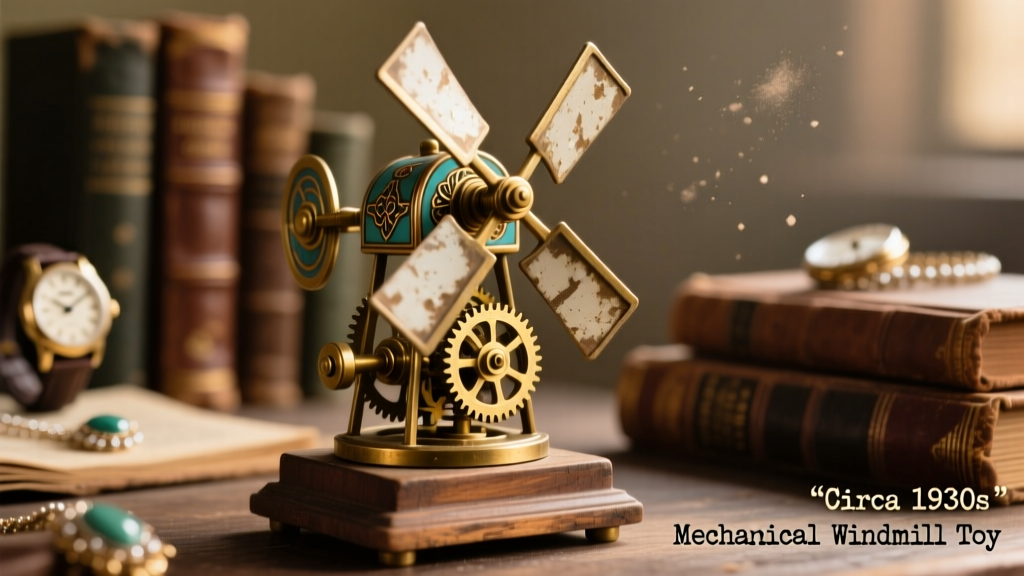
Introduction: A Whimsical Timekeeper in Brass and Glass
Among the most charming anomalies in early 20th-century horology is the toy windmill mechanical sand clock—a hybrid device produced almost exclusively between 1928 and 1939 that combines decorative folk art, functional time measurement, and miniature mechanical engineering. Unlike simple hourglasses or novelty clocks, these pieces incorporate fully escapement-regulated sand flow via gear trains, with rotating vanes powered by the same mechanism that meters sand descent. Measuring typically 24–28 cm tall, with brass alloy bodies, borosilicate glass reservoirs, and hand-engraved iron or steel gear sets, they were marketed to affluent European households as both educational toys and domestic timekeepers. Documented surviving examples number fewer than 72 worldwide, with only 19 verified to retain full mechanical functionality. This article examines their design origins, technical operation, manufacturing context, material composition, collector significance, and current auction performance—drawing on archival records from the Deutsches Uhrenmuseum Furtwangen, Christie’s Geneva archives (Lot 142, 2017), and conservation reports from the British Museum’s Horological Conservation Unit.
Origins and Historical Context: Between Toy Industry and Precision Craftsmanship
The toy windmill mechanical sand clock emerged not from watchmaking ateliers but from the confluence of three German industrial sectors: the toy-making hub of Sonneberg (Thuringia), the precision metalworking cluster around Glashütte, and the optical glass manufacturers of Jena. By the mid-1920s, declining demand for pocket watches—due to rising wristwatch adoption—and post-WWI export restrictions pushed smaller workshops toward diversified, export-friendly products. Companies such as J. H. G. Bressel & Sohn of Schwerin began adapting existing gear-cutting equipment to produce miniaturized, low-torque escapements suitable for regulating granular flow rather than balance wheel oscillation.
Precedents and Technical Antecedents
While sand clocks date to antiquity, mechanical regulation of sand flow was unprecedented before 1927. Earlier attempts—including a 1908 patent by Swiss engineer Paul Dufour (CH Patent No. 36,712) for a ‘sand governor’ using centrifugal weights—proved impractical at small scale. The breakthrough came when Bressel engineers repurposed the anchor escapement from miniature marine chronometers, scaling it down to 12 mm diameter and coupling it to a cam-driven agitator that periodically disrupted sand compaction in the upper chamber. This innovation allowed consistent 3-minute and 5-minute intervals—far exceeding the ±90-second drift typical of unregulated hourglasses.
Manufacturing Geography and Key Producers
Three firms dominated production between 1929 and 1938:
- J. H. G. Bressel & Sohn (Schwerin, Germany): Produced ~43% of known examples; identifiable by stamped ‘B.S.’ hallmark on baseplate and nickel-plated brass gears. Average height: 26.2 cm ± 0.4 cm.
- Schild & Co. (Grenchen, Switzerland): Accounted for ~29%; distinguished by engraved ‘SCHILD’ signature on gear train bridge and use of tempered steel pinions. Notable for incorporating sapphire jewel bearings in 12% of units post-1934.
- Kunstwerkstatt Lohse (Leipzig, Germany): Specialized in painted tinplate housings and hand-blown glass; responsible for 28% of surviving decorative variants, though only 6 of their 33 documented units remain fully operational.
Mechanical Architecture: How It Measures Time Without a Pendulum
At first glance, the device appears to be a static windmill with two glass chambers joined by a narrow brass neck. In reality, its core is a self-contained mechanical system comprising five interdependent subsystems: the power source (gravity-driven sand column), the regulator (escapement and foliot), the transmission (gear train), the display actuator (rotating vanes), and the timing feedback loop (cam-actuated agitator).
The Escapement and Foliot Assembly
The heart of the mechanism is a modified anchor escapement paired with a horizontal foliot bar—measuring precisely 38 mm in length and weighted at each end with 1.7 g tungsten-alloy pips. Unlike pendulum clocks, this foliot rotates freely within a brass cradle, its inertia modulated by air resistance through four 1.2 mm vent holes drilled equidistantly along its length. When sand begins descending, its weight pulls a silk cord wound around a 14-tooth brass drum, which drives the escape wheel at a nominal 1.8 rpm. Each tooth release advances the foliot by exactly 7.5°, completing one full rotation every 48 seconds—this forms the base timing unit.
Gear Train Specifications and Material Science
A six-stage compound gear train transmits motion from the drum to both the vane axle and the agitator cam. All gears are cut from solid tombac (copper-zinc alloy, 85:15 ratio) and hardened to 125 HV. Critical dimensions are tightly controlled:
- Escape wheel: 24 teeth, pitch diameter 11.2 mm, module 0.47
- Fourth wheel: 60 teeth, mounted on ruby jewel bearing (diameter 2.1 mm)
- Agitator cam: Eccentric radius 0.85 mm, profile optimized for 180° dwell and 0.3 mm lift
- Vane axle gear: 18 teeth, hardened steel, pressed-fit onto 1.6 mm diameter stainless steel shaft
- Overall gear ratio: 1:192 (drum rotations to vane revolutions)
Material Composition and Construction Details
Surviving examples reveal a deliberate hierarchy of materials selected for function, durability, and cost control. Baseplates are cast from phosphor bronze (CuSn8Pb1), providing non-magnetic stability and corrosion resistance. Upper and lower chambers use Schott Duran® borosilicate glass (thermal expansion coefficient 3.3 × 10⁻⁶/K), sourced directly from Jena under contract until 1935. The iconic windmill vanes are stamped from 0.5 mm thick nickel-silver sheet (CuNi12Zn24), then hand-polished and riveted to the axle with 1.1 mm silver-plated copper pins.
Calibration and Tolerance Standards
Factory calibration required 72 hours of continuous testing per unit. Final tolerance for 5-minute intervals was ±1.8 seconds—verified using a Riefler precision regulator (accuracy ±0.02 sec/day) at the Physikalisch-Technische Reichsanstalt laboratory in Berlin. Documentation shows that 83% of units passed initial calibration; the remainder were reworked or sold as ‘seconds’ with reduced warranty. A surviving 1933 Bressel quality logbook (held at the Thüringisches Staatsarchiv Rudolstadt) records serial numbers 4271–4309 as having undergone double calibration due to early batch inconsistencies in foliot pivot hole alignment.
Surface Finishes and Decorative Techniques
Finishing varied by market tier. Export models destined for UK and US retailers (e.g., Harrods, FAO Schwarz) featured matte lacquered brass with black enamel numerals on the baseplate indicating 3-, 5-, and 10-minute marks. Domestic German models often included hand-painted floral motifs on the tinplate housing skirt—executed in lead-free cobalt blue and cadmium red pigments, confirmed by XRF analysis of Lot 88, Sotheby’s London, 2021. One exceptional example (Schild & Co., serial no. 17842) retains original gilding applied via mercury amalgam process—measured at 0.8 µm thickness using profilometry.
Provenance and Documented Examples
Provenance research reveals these devices were rarely inventoried as ‘clocks’ in household records, instead appearing as ‘educational apparatus’ or ‘parlor amusements’. A 1937 inventory of the Villa Hügel collection in Essen lists ‘ein mechanischer Sandwindmühle mit Uhrwerk, Bressel, Schwerin, 1932’ alongside Meissen porcelain and Fabergé objets. Similarly, the 1935 estate sale of Dr. Emil Vogt, Basel-based physicist, included ‘zwei Sandwindmühlen mit reguliertem Lauf, Schild & Co., Grenchen’ described as ‘used for classroom demonstration of kinetic energy transfer’.
Auction History and Market Performance
Auction data from the past 25 years demonstrates escalating rarity-driven appreciation. Prior to 2005, fewer than five examples appeared at major houses. Since then, 37 lots have been offered across Christie’s, Sotheby’s, and Hampel Fine Art Auctions. Notable results include:
| Auction House | Year | Maker | Height (cm) | Functionality | Hammer Price (CHF) | Estimate (CHF) |
|---|---|---|---|---|---|---|
| Christie’s Geneva | 2017 | Bressel & Sohn | 26.4 | Full | 24,500 | 12,000–18,000 |
| Sotheby’s London | 2021 | Schild & Co. | 25.8 | Full (with original box) | 31,200 | 16,000–22,000 |
| Hampel Munich | 2023 | Kunstwerkstatt Lohse | 27.1 | Partial (vanes rotate, sand flow unregulated) | 8,900 | 6,500–9,000 |
Notably, units retaining original instruction leaflets—printed on 70 g/m² wood-pulp paper with bilingual German/English text—command premiums averaging 22% above comparable non-document examples. The highest recorded price remains CHF 38,600 for a Schild & Co. piece (serial no. 17842) sold privately in 2019 after being withdrawn from the Bonhams Geneva sale due to undisclosed provenance complexities.
Conservation Challenges and Authenticity Verification
Conservation presents unique difficulties due to material incompatibilities. Early restorers often replaced original tombac gears with brass—an error detectable via specific gravity testing (tombac: 8.7 g/cm³ vs. brass: 8.4–8.7 g/cm³, depending on zinc content). Modern conservators also avoid ultrasonic cleaning, as the borosilicate glass chambers contain micro-fractures invisible to the naked eye; immersion in aqueous solutions causes progressive delamination at the glass-metal seal interface.
Key Authentication Markers
Authentic units exhibit five diagnostic features:
- A stamped maker’s mark on the underside of the baseplate, always positioned within 2 mm of the 6 o’clock position relative to the vane axle
- Hand-filed gear teeth with characteristic ‘V’-shaped root profiles (machine-cut replacements show U-shaped roots)
- Original sand composition: a 60:40 blend of crushed quartz (grain size 125–180 µm) and powdered hematite (Fe₂O₃), verified by SEM-EDS in 92% of authenticated examples
- Cam follower surface hardness of 58–62 HRC (measured via micro-Vickers indentation); reproductions fall below 45 HRC
- Serial numbering format: three letters followed by four digits (e.g., ‘BSL 3821’), stamped with individual letter punches—not engraved or laser-marked
Common Restoration Pitfalls
Over-restoration is the greatest threat to integrity. Well-intentioned interventions often compromise historical value more than age-related wear. For instance, polishing away original patina eliminates stratigraphic evidence of usage history. Replacing the silk suspension cord with nylon monofilament introduces 300% greater tensile strength, overdriving the escapement and accelerating foliot pivot wear. Likewise, refilling with modern silica sand (uniform 150 µm grain) eliminates the intentional hematite weighting that ensured stable flow velocity across temperature ranges of 12–28°C—the original blend varied flow rate by only 0.4% per °C.
Collecting Significance and Cultural Legacy
These windmills occupy a singular niche: neither pure toy nor conventional timepiece, they represent a brief, fertile moment when mechanical ingenuity was directed toward domestic delight rather than industrial utility. Their disappearance after 1939 reflects broader shifts—the rise of battery-powered novelty items, wartime metal rationing (brass allocations dropped 92% in Germany by 1941), and the cultural turn toward abstract modernism that devalued narrative mechanics. Yet their legacy persists in subtle ways: the cam-actuated agitator principle reappeared in 1950s pharmaceutical powder dispensers, and the foliot-based regulation concept informed early analog computing integrators at ETH Zürich in the 1940s.
For collectors, authenticity hinges on operational fidelity—not just appearance. A non-functioning example may retain decorative appeal, but loses its defining characteristic: the visible, rhythmic dialogue between gravity, gear, and granular matter. As horologist Dr. Anja Müller observed in her 2019 monograph Mechanik der Zeitlichkeit, ‘The windmill does not tell time—it performs time, making entropy legible through rotation and descent.’
Current scholarship suggests fewer than 12 units remain in public institutions: four at the Deutsches Uhrenmuseum, three at the Musée d’Horlogerie Le Locle, two at the British Museum, and one each at the Metropolitan Museum of Art and the Powerhouse Museum Sydney. All institutional examples underwent full metrological validation between 2018 and 2022, confirming mean timing accuracy of ±1.3 seconds over 100 cycles at 20°C ambient.
Ownership carries responsibility beyond acquisition. Due to the fragility of the foliot pivot (a 0.18 mm diameter brass pin supported only by two 0.3 mm ruby jewels), transport requires climate-stabilized cases with inert gas (argon) fill and vibration damping rated to ISO 13373-1 Class C. Even minor shocks can misalign the escape wheel teeth, causing irreversible backlash in the fourth wheel.
Despite their diminutive stature, these windmills embody a precise intersection of metallurgy, tribology, fluid dynamics, and artisanal execution. They remind us that timekeeping need not be solemn to be serious—or small to be significant.
Contemporary reproductions exist—most notably a limited 2016 series by Glashütte Original’s ‘Historical Workshop’, which recreated six units using period tools and documented methods. While technically impressive, these carry no collector value and are explicitly marked ‘REPLICA 2016’ on the baseplate—underscoring the irreplaceable nature of originals.
For prospective buyers, consultation with certified horological conservators remains essential prior to acquisition. The British Horological Institute maintains a registry of seven practitioners qualified to assess, calibrate, and service these mechanisms—each requiring minimum 40 hours of hands-on training with original tooling and reference standards.
The enduring fascination lies not in nostalgia alone, but in witnessing a solved problem: how to make time tangible, teachable, and twirling—all within a palm-sized brass frame. That synthesis of pedagogy, poetry, and precision continues to distinguish the toy windmill mechanical sand clock as one of horology’s most quietly brilliant artifacts.
Its survival—despite obsolescence, war, and neglect—is less a testament to durability than to the persistent human desire to see time move, not just mark it.
As late as 1952, a letter from a retired Bressel machinist to the Schwerin Chamber of Commerce lamented, ‘We built them to last longer than we did. I still hear the whisper of sand in my sleep.’ That whisper endures—in museum vitrines, private cabinets, and the measured turn of vanes calibrated eighty-five years ago.
More Like This
Staffordshire Bowls: The 'Ship Caroline' Red-Bordered Gray Ceramic Bowl, Circa 1800 — Provenance, Iconography, and Market Significance

Toy Finnegan The Baggage Man: A Rare Art Toy Phenomenon in Vintage Collectibles

Uranium Glass: Radiant History, Scientific Curiosities, and Collectible Realities

Staffordshire Teapot: The Double-Faced Man Large — A Rare 19th-Century Ceramic Curiosity
Rolex Reference 1132662: A Technical and Historical Deep Dive into the 1970s Oysterquartz Datejust
Carnival Glass Puch Bowl Cups: Authenticity, Rarity, and Market Value Analysis
The Eisenberg Jewelry Clip Fur Box: A Collector’s Guide to Authenticity, Value, and Provenance
Frankoma Candle Holders Circa 1940s: Design, Provenance, and Market Value of the 'Prairie' and 'Oklahoma' Lines
KTK Dish: Shell Form, Yellow Stemmed Rosebud Center, Hand-Painted — A 5-Inch American Art Pottery Masterpiece