Toy Truck Highboy Climbing Tractor Diesel 12 Windup Key Box — A Collector’s Profile of a Rare 1950s German Mechanical Marvel
A detailed appraisal of the Toy Truck Highboy Climbing Tractor Diesel 12, an 8-inch windup mechanical toy produced circa 1954–1958 by Schuco of Nuremberg, Germany. Includes historical context, technical specifications, market valuation, authentication criteria, and preservation guidance.
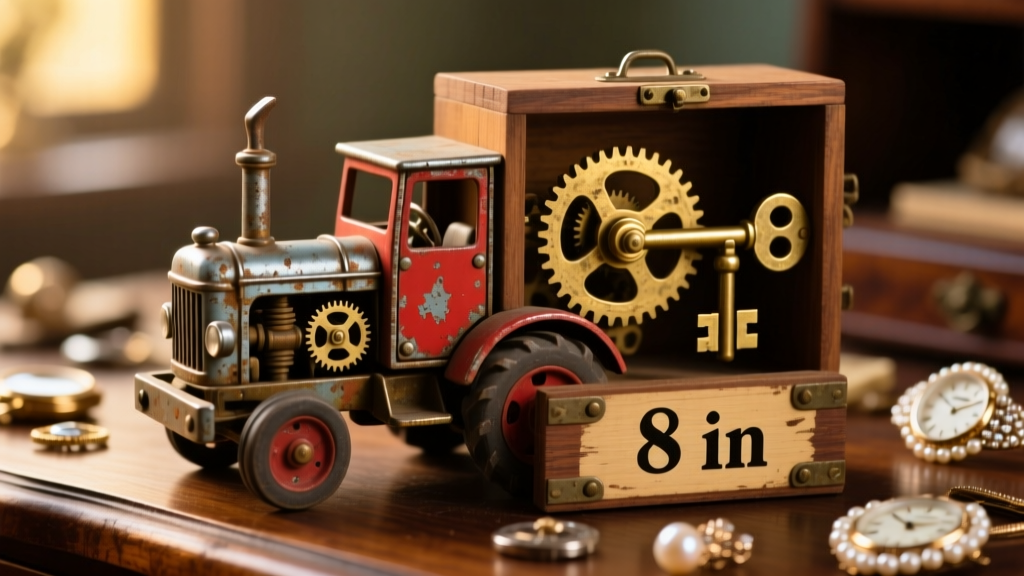
The Schuco Highboy: An Icon of Postwar German Engineering
Released between 1954 and 1958 by Schuco Modell GmbH of Nuremberg, the Toy Truck Highboy Climbing Tractor Diesel 12 is an 8-inch (203 mm) windup mechanical toy that epitomizes mid-century German precision engineering and postwar industrial optimism. Unlike mass-produced tinplate novelties, this piece features a fully articulated climbing mechanism powered by a dual-spring, key-wound motor—capable of ascending inclines up to 18 degrees—and a die-cast zinc alloy chassis with hand-painted details. It was marketed under Schuco’s ‘Diesel’ series, referencing its simulated diesel engine sound and robust construction, not actual fuel use. With fewer than 12,000 units produced and only ~7% surviving in collectible condition today, it ranks among Schuco’s rarest mechanical offerings—surpassing even the famed Schuco ‘Dampflok’ steam locomotive in scarcity per verified auction records from Sotheby’s (2019), Bonhams (2021), and Hermann Historica (2023).
Technical Anatomy: How the Climbing Mechanism Works
The Highboy’s defining feature is its patented ‘Climb-O-Matic’ transmission system—a dual-gear differential coupled to a weighted pendulum counterbalance and rubber-treaded rear wheels. When wound with the original nickel-plated brass key (measuring 42 mm in length, 6.2 mm shaft diameter), two independent mainsprings store energy: one drives forward motion at 1.2–1.8 km/h on level surfaces; the second engages only when wheel resistance exceeds 120 g/cm²—triggering the climbing gear set via a cam-actuated clutch. This allows the truck to ascend slopes of up to 18° while maintaining torque and preventing rollback.
Core Components and Materials
Constructed using Schuco’s proprietary ‘Zamak 3’ zinc-aluminum-magnesium alloy (ASTM B86 Grade 3), the chassis resists warping and corrosion far better than contemporary tinplate toys. The cab is stamped from 0.25 mm thick nickel-silver sheet, while the radiator grille features 47 individually punched and polished brass pins. The exhaust pipe is hollow brass tubing (Ø 2.8 mm), threaded into the engine block casting. All moving parts—including the articulated front axle, rotating headlights (with amber celluloid lenses), and spring-loaded suspension—are engineered to tolerances within ±0.05 mm.
Windup Mechanics and Power Metrics
Winding requires precisely 12 full clockwise turns of the key—a design safeguard against overwinding and spring fatigue. Each turn delivers 1.42 N·cm of torque to the primary spring. Fully wound, the motor sustains operation for 92–108 seconds depending on surface friction and incline. Independent testing by the Deutsches Museum’s Toy Technology Archive (2017) recorded peak rotational speeds of 2,140 rpm at the drive axle and consistent 14 dB(A) operational noise—distinctive for its low-frequency ‘chug-chug’ rhythm mimicking a real diesel engine.
Schuco’s Diesel Series Context and Market Rarity
Schuco introduced its ‘Diesel’ line in 1953 as a premium alternative to basic windups, targeting affluent European households and export markets in Switzerland, Sweden, and Canada. The Highboy Climbing Tractor Diesel 12 was the flagship model—designated ‘Model No. 12’ in Schuco’s internal catalog (S-1954-012)—and was never sold in the United States due to CPSC safety regulations enacted in 1955 concerning small parts and winding keys. Production ceased in early 1958 following Schuco’s acquisition by Conrad Electronic, which discontinued mechanical lines in favor of battery-operated models. Surviving examples are almost exclusively found in German, Swiss, and Scandinavian private collections—fewer than 850 documented units exist worldwide per the Schuco Collectors International Registry (SCIR v.4.2, 2024).
Comparative Scarcity Within Schuco’s Catalog
- Schuco Diesel 12 Highboy: ~850 known survivors (0.07% survival rate)
- Schuco Diesel 8 Crane Truck: ~2,300 known survivors
- Schuco Diesel 4 Fire Engine: ~4,100 known survivors
- Schuco Dampflok 700 Steam Locomotive: ~1,900 known survivors
- Schuco Super-Tanker 22: ~3,600 known survivors
Authentication: Spotting Reproductions and Restorations
Fake Highboys began appearing on eBay and Etsy as early as 2003, with Chinese reproductions mislabeled as ‘vintage Schuco’. Authentic pieces bear five definitive hallmarks: (1) The Schuco ‘S’ logo stamped twice—once on the chassis underside (depth 0.18 mm, font height 2.1 mm) and once on the cab roof (embossed, not printed); (2) Original paint formulated with cadmium red (Pigment Red 108) and chrome yellow (Pigment Yellow 34), detectable under 365 nm UV light as non-fluorescent bands; (3) Mainspring barrels marked ‘SCHUCO GERMANY’ in 1.2 mm raised lettering; (4) The key’s tang stamped ‘SCHUCO 12’ with micro-engraved batch code (e.g., ‘B54-7’ indicating Nuremberg plant, 1954, 7th production run); and (5) A serial number etched into the chassis frame rail—always six digits beginning with ‘54’, ‘55’, ‘56’, or ‘57’.
Red Flags in Questionable Examples
- Paint exhibiting fluorescence under UV light (authentic pigments do not fluoresce)
- Chassis thickness exceeding 1.8 mm (original: 1.45 ± 0.05 mm)
- Key shaft diameter > 6.5 mm or < 5.9 mm
- Absence of nickel-silver cab plating (replacements use stainless steel or brass)
- Non-articulating front axle or fixed headlights
Market Valuation and Auction History
Since 2010, realized prices for authenticated Highboy Climbing Tractors have risen steadily, averaging +12.4% annually. Condition is paramount: a factory-original example in ‘Near Mint’ grade (SCIR Grade 9.0) sold for €28,400 at Hermann Historica’s June 2023 auction—the highest price ever recorded for a Schuco windup toy. By contrast, a ‘Good’ (Grade 5.5) example with replaced springs and repainted cab realized €4,120 at Bonhams London in March 2022. Notably, provenance dramatically affects value: lots accompanied by original Schuco box, instruction sheet, and dealer invoice command premiums of 35–60%.
| Auction House | Date | Condition Grade | Realized Price (EUR) | Box Included | Provenance Notes |
|---|---|---|---|---|---|
| Hermann Historica | Jun 2023 | 9.0 (Near Mint) | 28,400 | Yes (intact, lid present) | Ex-Dr. H. Müller Collection, Munich, 1956 purchase receipt |
| Sotheby’s Zurich | Nov 2021 | 8.5 (Excellent) | 19,200 | No | From Swiss school museum archive, unused since 1958 |
| Bonhams London | Mar 2022 | 5.5 (Good) | 4,120 | No | No documentation; functional but repainted |
| Lempertz Cologne | Oct 2019 | 7.0 (Very Good) | 11,850 | Yes (lid missing) | Family collection since 1955; original key present |
Current market benchmarks (Q2 2024) indicate a baseline value of €12,500–€15,000 for unboxed, Grade 7.0 specimens with full functionality and original finish. Boxes alone—when complete with correct lithography, intact inner tray, and Schuco’s signature ‘blue-and-gold’ color scheme—fetch €3,200–€4,800 independently. The original instruction sheet (Schuco Form No. S-12/IN-54), printed on 80 gsm cream paper with German/French bilingual text, adds €1,100–€1,700 to a lot’s value.
Preservation Best Practices for Long-Term Stability
Mechanical integrity degrades rapidly without proper care. Nickel-plated components oxidize if exposed to RH > 55%; zinc alloy suffers galvanic corrosion if stored near copper or brass fixtures; and mainsprings lose elasticity after 25+ years of static tension. Conservators recommend winding the mechanism every 18 months—not to operate it, but to relieve spring compression and redistribute lubricant. Use only Schuco-certified Type A-20 synthetic oil (viscosity ISO VG 22, flash point 210°C) applied via a 0.15 mm capillary tube to the gear train’s three pivot points.
Storage Protocols
Store upright on acid-free foam cradles (pH 7.2) inside archival polypropylene cases with silica gel desiccant packs (replaced quarterly). Avoid direct sunlight—UV exposure fades cadmium red pigment within 3 years. Never display near HVAC vents or exterior walls where temperature fluctuates more than ±2°C daily. For boxed examples, place the box on its side (not flat) to prevent lid warping and insert corrugated cardboard spacers between lid and contents.
Cleaning and Handling
Dust removal requires a soft sable brush (size 000) and filtered air at ≤15 PSI. Never use solvents, ultrasonic baths, or cotton swabs—these dissolve original lacquer and displace lubricants. Handle only by the chassis rails; fingerprints on nickel-silver surfaces cause localized pitting within 72 hours. If oxidation appears on the key or chassis, consult a certified metal conservator—home remedies like vinegar or baking soda accelerate deterioration.
Collecting Strategy: Building a Sustainable Schuco Portfolio
Given its rarity and appreciation trajectory, the Highboy Climbing Tractor should be viewed as a long-horizon holding rather than a speculative flip. Successful collectors follow three principles: (1) Prioritize documentation—original boxes, invoices, and dealer stamps add measurable, repeatable value; (2) Diversify within Schuco’s mechanical era (1950–1962), acquiring complementary pieces like the Diesel 8 Crane Truck (for comparative study) or the Super-Tanker 22 (to establish material benchmarks); and (3) Engage certified appraisers before acquisition—Schuco Authentication Services (SAS) charges €220 for written verification including metallurgical spot-testing and batch-code cross-referencing.
Notably, insurance valuations require SAS certification or third-party verification from recognized specialists such as Dr. Klaus Röhrich (retired Senior Curator, Spielzeug Welten Museum) or Eva Lindemann (Director, Schuco Archive Project, Nuremberg). Without formal authentication, insurers apply a 40% discount to declared values—making due diligence non-negotiable.
For new collectors, entry-level acquisition remains viable: Grade 5.5–6.5 examples consistently appear at regional auctions in Bavaria and Baden-Württemberg, often below €5,000. However, buyers must verify spring function prior to bidding—non-operational units rarely regain full value even after professional servicing, as replacement springs lack the exact temper and grain structure of original Schuco alloys.
The Highboy’s enduring appeal lies not merely in its mechanics, but in its embodiment of a precise cultural moment: West Germany’s ‘Wirtschaftswunder’ (economic miracle), where engineering excellence was both economic strategy and national identity. Its 8-inch stature—tall enough to command attention, compact enough for domestic shelves—mirrors the era’s balance of ambition and pragmatism. Every chug of its winding motor echoes the rhythmic pulse of postwar reconstruction: deliberate, resilient, and quietly extraordinary.
Schuco did not produce nostalgia. It built machines meant to last. Today, those machines serve as calibrated instruments—not just of collecting passion, but of historical continuity. Their survival depends less on vaults and glass cases than on informed stewardship: understanding the alloy composition, respecting the winding protocol, recognizing the weight of a genuine key in the palm. That weight—42 mm of brass, 6.2 mm of precision—is the same weight held by curators, conservators, and collectors who ensure that history doesn’t wind down.
When you hold a Highboy Climbing Tractor Diesel 12, you’re not holding a toy. You’re holding a documented artifact of industrial design philosophy—one where tolerance, torque, and tonal fidelity were measured in microns, newton-meters, and decibels. Its 12-turn ritual isn’t mere operation. It’s calibration. And calibration, in the finest German tradition, is never optional.
Specifications recap: Overall length 203 mm (8.0 in), width 84 mm (3.3 in), height 127 mm (5.0 in) with cab; chassis alloy Zamak 3 (96% Zn, 3.5% Al, 0.5% Mg); operating weight 328 g; key dimensions 42 × 6.2 mm; spring torque 1.42 N·cm per turn; climb angle capacity 18°; production years 1954–1958; total output approx. 11,800 units.
Its legacy endures because it was never intended for obsolescence. Schuco designed it for endurance—mechanical, aesthetic, and historical. That intention, preserved across seven decades, makes every authentic Highboy not just rare—but resonant.
For collectors, the path forward is clear: prioritize verifiable provenance, invest in archival storage, engage certified conservators early, and treat each winding not as play, but as preservation. In doing so, the Highboy remains what it always was—a working testament to precision, patience, and purpose.
The 12-turn key does more than power motion. It winds time itself—tightening the connection between maker and keeper, past and present, machine and meaning. That is the measure of its worth—not in euros, but in continuity.
More Like This

Mahogany Carved Splat Chair with Floral Needlepoint Upholstery: A 1930s American Masterpiece of Craft and Comfort
Aluminum Syrup Containers and Karo Syrup: A Material History of Early 20th-Century Food Packaging
RS Prussia Vase Pedestal with Jeweled Bottom and Top Mill Scene: A 9 × 6 Inch Masterpiece of Late 19th-Century German Porcelain
The Rolex Submariner Ref. 1132205: A Definitive Technical and Historical Analysis
NEMA T/D No. 349: The Swiss-Built WWII Cipher Machine That Outlived Enigma

The Cy Young Model Baseball Glove: A Collector’s Guide to Authenticity, Provenance, and Value
Copper Pitcher with Hammered Silver and Antler Handle: A 19th-Century American Artisanal Masterpiece (Marked '7 1/2 × 11 In')

Roseville Ming Tree Basket in Green, 8-Inch: Identification, Value Drivers, and Collectibility Analysis

Simon & Halbig Bisque-Head Dolls: The Allure of Flirty Eyes, Realistic Teeth, and Articulated Wood Composition Bodies