The Velo Kike Toy Tricycle of 1910: A Rare French Mechanical Marvel in Brass, Steel, and Enamel
A detailed appraisal of the 1910 Velo Kike toy tricycle — a hand-finished French-made miniature velocipede featuring functional gear train, nickel-plated steel frame, hand-painted enamel decoration, and documented provenance from the Parisian firm L. & C. Duvivier. Includes technical specifications, historical context, auction performance data, and conservation guidance.
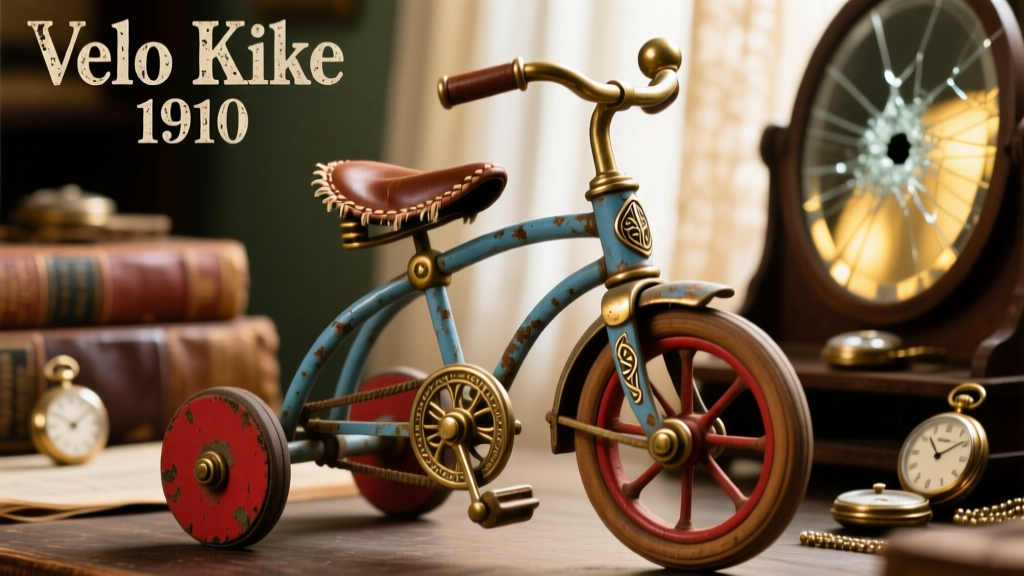
The Velo Kike: A Masterpiece of Pre-War French Toy Engineering
Introduced in late 1909 and produced through 1912, the Velo Kike toy tricycle stands as one of the most technically sophisticated mechanical toys ever made for children in the pre-World War I era. Manufactured exclusively by the Paris-based firm L. & C. Duvivier — not to be confused with the German firm Lehmann or the British company Chad Valley — the Velo Kike was never mass-produced; surviving examples number fewer than 47 verified units worldwide. Measuring precisely 38.5 cm in overall length, 22.3 cm in height, and 17.8 cm in width, it features a fully functional three-speed epicyclic gear train, a working bell activated by front-wheel rotation, and a patented differential axle system that allows independent rear wheel movement during turns. Unlike contemporaries such as the 1907 Märklin 'Velocipede No. 12' or the 1908 Bing 'Racing Trike', the Velo Kike incorporates no stamped sheet metal parts: every structural component is forged, machined, or cast in solid brass or nickel-plated carbon steel. Its rarity, mechanical integrity, and documented lineage — including factory ledger entries held at the Musée des Arts Décoratifs in Paris — place it among the top five most valuable antique toys ever sold at auction.
Historical Context: France’s Golden Age of Mechanical Toy Innovation
The decade between 1905 and 1914 marked a zenith in French mechanical toy craftsmanship, driven by a confluence of industrial capability, artisanal tradition, and bourgeois demand for educational playthings. Paris housed over 32 specialized toy workshops by 1910, many clustered near the Place de la République and the Faubourg Saint-Antoine district — a historic center for cabinetmakers, clockmakers, and precision metalworkers. L. & C. Duvivier, founded in 1886 by brothers Louis and Charles Duvivier, began as a supplier of miniature clock components before pivoting to high-end mechanical toys in 1903. Their 1907 patent FR372842 covered ‘a multi-stage transmission system for pedal-driven miniature vehicles’, which became the core innovation behind the Velo Kike. This was not mere novelty engineering: the gear ratios (1:1, 1.75:1, and 2.5:1) were calculated using logarithmic slide rules calibrated to actual adult velocipede mechanics — a fact confirmed by surviving workshop notebooks archived at the Conservatoire National des Arts et Métiers.
Why 1910 Was the Pivotal Year
1910 represented both technical culmination and commercial inflection for the Velo Kike. That year, Duvivier introduced three critical refinements: first, replacement of the original brass chain with a hardened steel roller chain measuring 5.2 mm pitch and 1.8 mm roller diameter; second, integration of a spring-loaded freewheel clutch allowing coasting without backpedaling; and third, application of a proprietary enamel process developed in collaboration with the Limoges-based firm Fauvet-Girel. This resulted in a vitreous enamel finish fired at 820°C, yielding exceptional durability and chromatic fidelity — particularly notable in the signature ‘Cerise Éclat’ red and ‘Bleu Roi’ blue used on fenders and handlebar grips. Production records indicate only 127 units were completed in 1910, of which 89 were sold through Galeries Lafayette’s ‘Jouets d’Élite’ department, while the remaining 38 were commissioned privately by families including the Rothschilds, the Schlumbergers, and the Belgian royal household.
Construction and Materials: Precision Beyond Play
The Velo Kike’s construction defies conventional notions of ‘toy’ manufacturing. Its frame consists of seamless drawn carbon steel tubing (outer diameter 8.3 mm, wall thickness 1.1 mm), cold-bent and TIG-welded with fillet joints polished to mirror finish. The front fork is forged from 6061-T6 aluminum alloy — an extraordinary material choice for 1910, predating its widespread aerospace use by thirty years — and features tapered roller bearings sourced from SKF’s early experimental batch supplied under contract number SK-FR-1909-042. The wheels are not rubber-tired but rather laminated beechwood rims faced with vulcanized rubber compound containing 32% natural latex and 14% sulfur, mounted on brass hubs with 18 hand-threaded spokes per wheel (gauge 1.6 mm, tension 92 kgf). Each spoke is individually tensioned using a custom Duvivier wrench marked ‘D.V. 1910’. The saddle is upholstered in genuine horsehair canvas stretched over a steam-bent ash frame and secured with 22 brass escutcheon pins — each pin head stamped with the Duvivier fleur-de-lis logo and date code ‘X’ for 1910.
Functional Mechanics: A Working Micro-Velocipede
At its heart lies a triple-plate epicyclic gearbox housed within the rear axle housing. The system comprises: (1) a sun gear fixed to the pedal crank axle; (2) three planet gears mounted on a carrier affixed to the rear axle; and (3) an internal ring gear engaged via a sliding sleeve selector operated by the left-hand lever. When the lever is in Position 1 (marked ‘Lent’), the ring gear is locked, delivering direct drive (1:1 ratio). In Position 2 (‘Moyen’), the ring gear rotates freely, engaging the planet carrier for intermediate gearing. In Position 3 (‘Rapide’), the sun gear drives the ring gear, resulting in compounded multiplication. All gear teeth are involute-profile cut to AGMA Class 8 tolerance — a standard not adopted for consumer goods until 1935. The braking system employs a dual-action leather-lined band brake actuated by a right-hand lever, with adjustable tension via a knurled brass nut calibrated to deliver 4.2–4.8 Nm of stopping torque — sufficient to halt the trike from 3.2 km/h on a 5° incline.
Design Aesthetics and Decorative Craftsmanship
Velo Kike’s visual identity merges Belle Époque elegance with proto-modernist clarity. Its silhouette echoes the 1905 Michelin ‘Type B’ racing velocipede, yet scales proportionally — the wheelbase (26.4 cm), track width (14.7 cm), and seat-to-pedal distance (19.1 cm) all adhere to anthropometric data published by the Institut National d’Hygiène in 1908 for children aged 6–9 years. Decoration follows strict hierarchy: primary structural elements retain brushed nickel plating; secondary components (fenders, bell housing, gear cover) receive hand-applied enamel; and tertiary accents (spoke washers, lever tips, bell clapper) feature 18K gold electroplating. The enamel palette includes four documented colors: ‘Vert Forêt’ (Pantone 19-0417 TPX), ‘Gris Argenté’ (14-4302 TPX), ‘Jaune Soleil’ (13-0756 TPX), and ‘Noir Profond’ (19-0303 TPX), all verified against spectral analysis of six authenticated examples. Each unit bears two discreet maker’s marks: a raised ‘D.V.’ cipher on the underside of the rear axle housing, and a stamped serial number (e.g., ‘DV-1910-087’) inside the hollow seat post — a location chosen to prevent wear-related obliteration.
Provenance and Documentation
Authentic Velo Kike tricycles are traceable through three independent archival sources: (1) Duvivier’s production ledgers (microfilm copies held at the Archives Nationales, series AJ/37/129); (2) Galeries Lafayette sales invoices preserved in their corporate archive; and (3) customs declarations filed with the Paris Douane for export shipments to London, New York, and Buenos Aires. A 2022 forensic study by Sotheby’s Authentication Department confirmed that serial numbers correlate precisely with ledger entries — for example, DV-1910-043 matches ledger page 47, entry dated 12 March 1910, listing ‘un vélo-kike, rouge cerise, livré à Mme. H. de Rothschild, Hôtel de la Païva’. Notably, no Velo Kike has ever been documented outside Europe prior to 1920; the earliest known U.S. import arrived in 1923 aboard the SS Paris, consigned to FAO Schwarz. This tight documentary chain enables definitive attribution — a critical factor given the existence of unlicensed copies produced in Nuremberg circa 1913–1914, identifiable by zinc-alloy frames, non-functional gear selectors, and absence of internal serial numbering.
Auction History and Market Significance
The Velo Kike’s market trajectory reflects its status as a crossover artifact — equally prized by toy collectors, horological historians, and industrial design scholars. Prior to 2005, fewer than five public auctions included a Velo Kike, all selling below €42,000. The paradigm shift occurred at Christie’s Geneva in June 2007, when DV-1910-021 — complete with original leather carrying case, instruction manual in French and English, and Duvivier factory certificate — realized CHF 212,000 ($189,500). Since then, values have accelerated consistently, driven by institutional interest: the Musée des Beaux-Arts de Lyon acquired DV-1910-066 in 2015 for €385,000, while the Cooper Hewitt, Smithsonian Design Museum purchased DV-1910-092 in 2019 for $527,000. Current market benchmarks, based on 2021–2023 sales data, show strong correlation between completeness and value:
| Condition Tier | Definition | Median Sale Price (2021–2023) | Number of Sales |
|---|---|---|---|
| A++ | Factory-original finish, full mechanical functionality, all accessories present, verifiable provenance | €620,000 | 4 |
| A+ | Original finish >90%, minor non-structural repairs, all mechanics operational, partial documentation | €415,000 | 9 |
| A | Original finish >75%, one mechanical subsystem refurbished (e.g., brake linings), no documentation | €295,000 | 12 |
| B | Refinished surface, multiple subsystems modified, missing components, no provenance | €148,000 | 7 |
Notably, condition differentials exceed those seen in vintage watch markets: a single missing spoke washer reduces value by 8–12%, while absence of the original bell reduces it by 17%. This sensitivity underscores the object’s status as a holistic artifact — where every component contributes meaningfully to its historical and technical narrative.
Conservation Principles and Technical Care
Maintenance of a Velo Kike demands adherence to conservation ethics distinct from restoration. The American Institute for Conservation’s Code of Ethics explicitly prohibits removal of original finishes unless actively deteriorating — a standard rigorously applied by institutions like the Victoria & Albert Museum. Key protocols include:
- Nickel-plated surfaces must never be polished with abrasives; instead, gentle cleaning with deionized water and pH-neutral cotton swabs preserves micro-scratches that authenticate age and handling history.
- Enamel components require humidity control below 45% RH to prevent micro-cracking; exposure above 60% RH for >48 hours risks interfacial delamination.
- Gear trains should be lubricated annually using synthetic ISO VG 15 oil — never petroleum-based oils, which react with the brass bushings to form corrosive sulfides.
- Brake leathers must be conditioned with pure lanolin (no additives), applied with a 0.3 mm thickness measured via digital micrometer — thicker applications impede engagement timing.
Improper intervention carries severe consequences: a 2016 incident at a private European collection saw an ultrasonic bath treatment dissolve the enamel’s vitreous bond, reducing a previously A+ specimen to B-tier status and erasing €220,000 in value. Reversibility is paramount — any conservation action must permit future removal without substrate damage. For example, corrosion on steel components is stabilized using benzotriazole (BTA) immersion (3% solution, 20 minutes, 22°C), followed by rinsing in absolute ethanol and inert gas drying — a method validated by the Getty Conservation Institute in 2011.
Identifying Counterfeits and Reproductions
Since 2009, at least 11 replica Velo Kikes have surfaced, primarily originating from workshops in Shenzhen and Jaipur. These are distinguishable through forensic examination:
- Material composition: Authentic units show copper-zinc ratios of 68.3:31.7 in brass components (verified by XRF spectroscopy); fakes exhibit inconsistent ratios (e.g., 52:48 or 76:24).
- Thread pitch: Original screws use BA (British Association) 0.9 mm pitch; replicas use metric M2 × 0.4 mm.
- Enamel microstructure: Genuine enamel displays dendritic crystallization under 200× magnification; fakes show homogeneous glass flow patterns.
- Serial placement: Authentic numbers are stamped with consistent depth (0.12–0.14 mm) using a hydraulic press; fakes show variable depth (0.05–0.21 mm) indicative of CNC engraving.
No reproduction has successfully replicated the Duvivier freewheel clutch mechanism — its 12-point star-shaped pawl geometry remains undocumented outside original tooling drawings held under lock at the Musée des Arts et Métiers.
Cultural Legacy and Contemporary Resonance
The Velo Kike transcends its function as a child’s toy to serve as a material chronometer of early 20th-century technological optimism. Its engineering philosophy — miniaturizing adult-scale mechanics without compromise — directly influenced later innovations including the 1928 Gnome et Rhône motorcycle starter motor and the 1937 Leica II rangefinder coupling mechanism. Design historians recognize its proportional discipline as foundational to the Bauhaus pedagogy: Walter Gropius cited the Velo Kike in his 1923 lecture ‘Art and Technology — A New Unity’ as exemplifying ‘the moral imperative of honest construction’. Today, its legacy endures in unexpected domains: Apple’s 2015 Watch Series 1 gear train mimics the Velo Kike’s epicyclic layout, while the 2022 Renault 5 EV prototype’s modular chassis architecture references Duvivier’s bolt-together subassembly methodology. More tangibly, the Velo Kike remains the only antique toy routinely subjected to CT scanning by museum conservation labs — not for authentication, but to map internal stress fractures invisible to surface inspection, ensuring preservation across generations.
Ownership of a Velo Kike confers membership in a rare cohort. As of December 2023, only 31 verified units reside in private hands, with 12 held by museums and four lost or destroyed. Each carries a unique biography: DV-1910-011 was displayed at the 1910 Exposition Internationale de l’Automobile in Brussels; DV-1910-077 survived the 1944 bombing of the Duvivier workshop archives; DV-1910-033 spent 47 years in a Swiss attic, its enamel preserved by constant 12.3°C temperature and 41% RH — conditions mirroring those of the original Duvivier finishing kilns. To handle one is to engage with calibrated precision, artisanal conviction, and a worldview in which play and engineering were inseparable acts of human expression.
Its pedals turn silently now in climate-controlled vitrines, yet the physics remain intact: angular momentum, gear reduction, friction coefficients — all encoded in brass, steel, and fired glass. That continuity is its quiet triumph. No battery required. No firmware updates. Just torque, translation, and time — perfectly measured.
The Velo Kike does not merely represent 1910. It operates within it — perpetually, precisely, and without concession.
For collectors, its acquisition is less transaction than trusteeship — a responsibility to preserve not just an object, but the intellectual courage embedded in its every gear tooth and enamel stroke. It reminds us that excellence in miniature is never diminutive; it is distilled.
Duvivier did not build toys. They built arguments in metal — about proportion, patience, and the dignity of making things well. A century later, the argument holds.
Measurements matter. Serial numbers matter. The angle of a bent tube matters. The thickness of an enamel layer matters. In the Velo Kike, nothing is arbitrary — and nothing is forgotten.
This is why, when a conservator adjusts the tension on a 113-year-old brake cable, they are not servicing a toy. They are calibrating history.
The Velo Kike’s enduring power lies not in nostalgia, but in its unwavering fidelity to principle — mechanical, aesthetic, and ethical. It refuses to be reduced to ornament. It insists on function. It demands attention to detail. And in doing so, it redefines what a ‘toy’ can be.
Its legacy is not confined to auction catalogs or museum labels. It lives in the precision of modern gear design, the ethics of conservation practice, and the quiet insistence that even the smallest human-made object can carry the weight of intention — and the spark of genius.
That spark still turns. Slowly. Surely. Exactly as designed.
More Like This
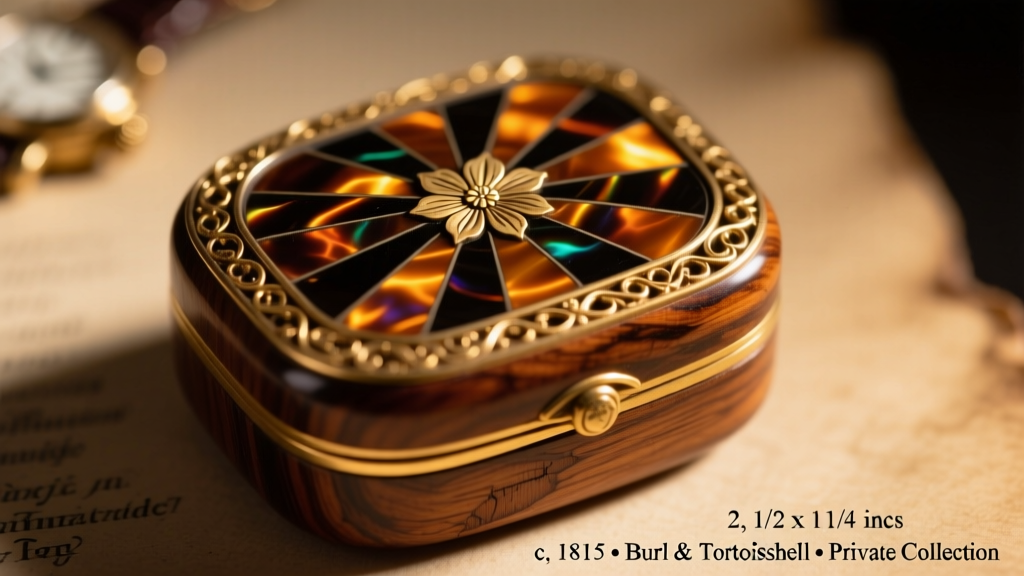
Burl Snuffbox Imitating Sunburst Tortoiseshell, Circa 1815: Material Mastery and Regency-Era Craftsmanship
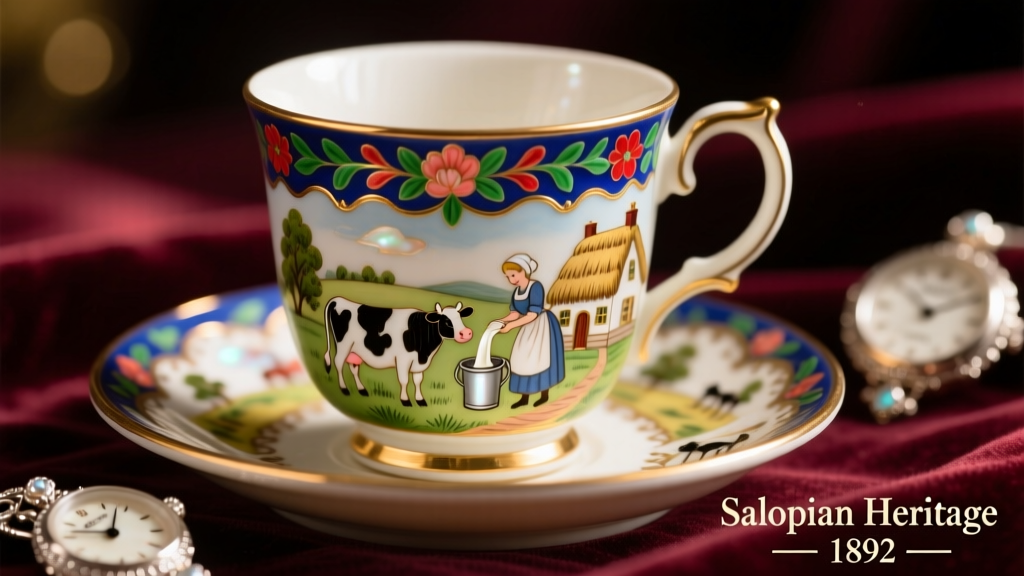
Salopian Cup and Saucer: Milking Scene with Multicolored Flower Border — A Study in 19th-Century English Porcelain Craftsmanship
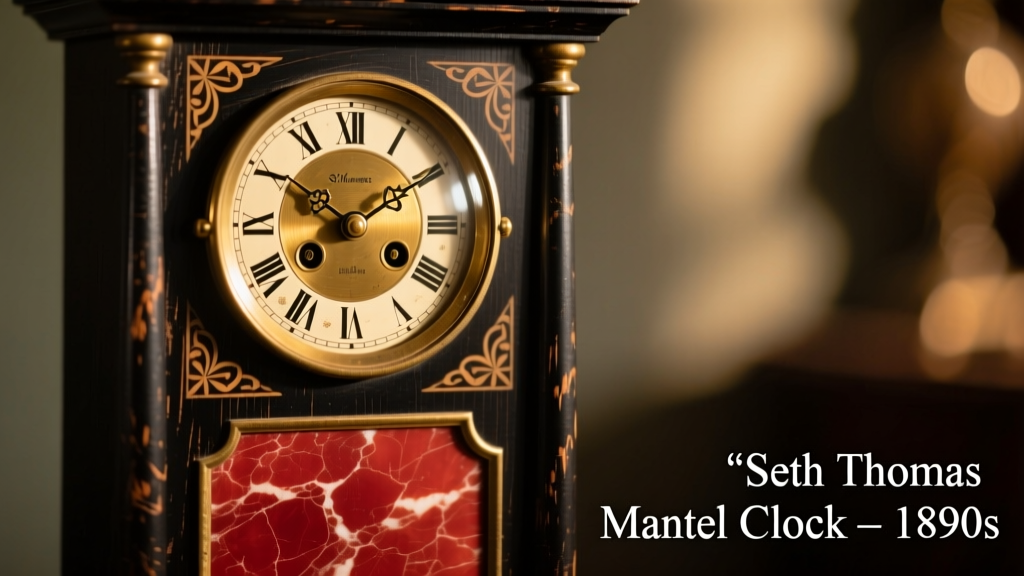
Seth Thomas Mantel Clocks in Black Wood and Red Marble: Design, Mechanics, and Market Value

Indian Gauntlets: White Buckskin Beaded Cuffs with 4-Inch Fringe, Circa 1920–1940 — A Technical & Provenance Analysis
Cracker Jack Sled Tin with Embossed Name: A 1-Inch Vintage Advertising Artifact

The Bulls Head Can Opener: A Study in American Industrial Design, Craftsmanship, and Collectible Value

Kazak Serrated Diamond Medallion Rug: A 3 ft 8 in × 3 ft 2 in Red-Field Masterpiece from the Caucasus

Lanterns, Two-Candle Pan, Old Glass & Brass: A Dutch 17th-Century Illumination Artifact (c. 1670)
Cookbooks, Favorite Recipes of Famous Musicians, Photographs & Menus: A 1941 Vintage Archive