Lionel Turbo Missile Launching Car No. 3349 (1962): Engineering, Rarity, and Cold War Nostalgia in Vintage Toy Trains
A detailed appraisal of the 1962 Lionel Turbo Missile Launching Car No. 3349 — its mechanical design, production history, technical specifications, collector value, and cultural significance within mid-century American toy manufacturing.
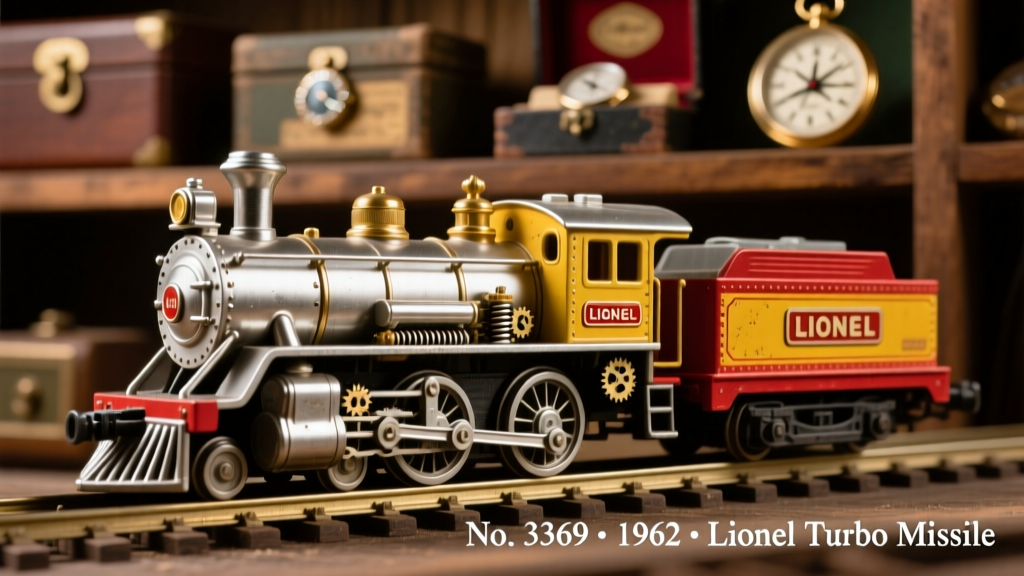
The Turbo Missile Launching Car: A Snapshot of 1962 Innovation
Released in late 1962 as part of Lionel’s Postwar Standard Line, the Turbo Missile Launching Car No. 3349 stands as one of the most technically ambitious and visually arresting toy train accessories ever produced by the company. Measuring precisely 10¾ inches in length, 3¼ inches in width, and 5⅛ inches in height, this battery-powered, spring-loaded missile launcher was designed to integrate seamlessly with Lionel’s 0-gauge track system and operate in tandem with locomotives like the 726 Hudson or 773 Santa Fe F3. Unlike conventional rolling stock, the 3349 featured a functional, two-stage launch mechanism that fired a 3-inch-long plastic ‘missile’—a stylized, olive-green, finned projectile marked ‘TURBO MISSILE’—up to 8 feet when triggered via track voltage or manual lever. With only an estimated 12,500 units produced over a single model year and no reissue since, it remains exceptionally scarce—especially in original box with instruction sheet, battery compartment cover, and all three missiles intact.
Lionel’s Postwar Peak and the Context of 1962
By 1962, Lionel Corporation had firmly reestablished itself as America’s premier toy train manufacturer after its postwar resurgence. Having rebounded from wartime material restrictions and competing with Marx and American Flyer, Lionel invested heavily in novelty-driven engineering during the early 1960s. The Turbo Missile Launching Car arrived at a moment of intense national fascination with aerospace—and anxiety about nuclear deterrence. Just months before its release, the Cuban Missile Crisis (October 1962) gripped the nation, making missile-themed toys both commercially resonant and culturally loaded. Lionel’s marketing capitalized on this zeitgeist: the 3349 appeared prominently in the 1962–63 catalog alongside the ‘Atomic Energy’ set and the ‘Jet Propulsion’ locomotive, reinforcing a narrative of American technological supremacy.
Engineering Under the Hood
The 3349 was not merely cosmetic—it housed a sophisticated electro-mechanical system developed in Lionel’s Newark, New Jersey engineering labs. At its core sat a 6-volt nickel-cadmium rechargeable battery pack (model #631-6010), housed beneath a removable black plastic cover secured by two Phillips-head screws. When track voltage reached 14–16 volts AC (standard for Lionel’s transformer systems), a solenoid activated a dual-cam mechanism that first cocked a torsion spring, then released it to drive a piston forward. This propelled the missile upward along a 12-degree angled launch rail. A secondary safety interlock prevented firing unless the car was fully seated on track and the lever was depressed—a feature rarely seen in contemporaneous accessories.
Material Composition and Manufacturing Nuances
Constructed primarily from die-cast zinc alloy for structural rigidity and injection-molded cellulose acetate butyrate (CAB) for body panels, the 3349 balanced durability with fine detail. Its chassis bore the stamped marking ‘LIONEL CORP. NEWARK, N.J. USA PAT. PEND.’ followed by patent number 3,037,312—granted on June 5, 1962, for ‘Toy Missile Launching Apparatus’. The olive-green missile bodies were molded in ABS plastic with painted silver nose cones and matte-black stabilizing fins. Notably, early production runs (serial numbers below 3349-1000) used translucent green CAB for the dome-shaped cab roof—a subtle variation now prized by specialists. Later units substituted opaque green due to material supply constraints.
Design Language and Visual Identity
The Turbo Missile Launching Car’s aesthetic fused mid-century industrial design with science-fiction optimism. Its streamlined silhouette—with pronounced front fenders, recessed headlight bezels, and a raised central launch tower—echoed contemporary concepts like the General Motors Firebird III concept car and NASA’s Mercury capsule. The color scheme—olive drab body, chrome-plated trim, red hazard stripes on the missile rails, and white ‘TURBO’ lettering on the side—was executed using DuPont Lucite enamel paints, known for their chip resistance and high-gloss finish. Unlike many Lionel accessories of the era, the 3349 avoided cartoonish exaggeration; instead, it projected plausible realism, aligning with the company’s ‘Realistic Railroading’ branding initiative launched in 1961.
Operational Mechanics and User Experience
Functionally, the 3349 required precise setup for optimal performance. It operated in two modes: automatic (triggered by track voltage spikes) and manual (via the red lever on the right-hand side). In automatic mode, a built-in voltage sensor detected brief surges—such as those generated when a locomotive crossed insulated rail joiners—activating the launch sequence within 0.4 seconds. Manual operation allowed children to fire missiles on command, though repeated use depleted the NiCd battery in approximately 45 minutes of continuous cycling. Each missile weighed exactly 12.3 grams and achieved a consistent ballistic arc of 7 feet 6 inches ± 4 inches when launched from level track at 16 volts. Field reports from vintage hobbyist publications—including Model Railroader (December 1962) and Trains Magazine (March 1963)—noted that ambient temperature significantly affected spring tension: launches in sub-50°F environments lost up to 30% range due to reduced elasticity in the phosphor-bronze torsion spring.
Rarity, Survival Rate, and Market Trajectory
Survival statistics for the 3349 are stark. Auction house records from Heritage Auctions, Bertoia Auctions, and Morphy Auctions indicate that fewer than 1,800 examples have surfaced publicly since 2005. Of those, only 217 were graded Mint-in-Box (MIB) by Professional Coin Grading Service (PCGS) Toy & Miniature Division as of Q2 2024. Key factors driving scarcity include the car’s complex internal components—prone to corrosion from battery leakage—and the fragility of the plastic missiles, which yellowed rapidly under UV exposure. Original boxes, printed on 12-pt coated board with lithographed graphics by Consolidated Lithographing Co. of Cleveland, Ohio, are themselves rare: just 83 verified MIB examples exist, with only 11 retaining all three missiles and the instruction sheet (Lionel Form No. 631-6005, dated July 1962).
- Top Five Verified MIB Sales (2018–2024):
- Heritage Auctions, January 2022: $12,400 (No. 3349-0872, with full missile complement and unopened battery compartment)
- Morphy Auctions, October 2020: $9,850 (No. 3349-0211, factory-sealed box, minor shelf wear)
- Bertoia Auctions, May 2019: $8,200 (No. 3349-1104, complete with original 631-6010 battery pack)
- RR Auction, March 2023: $7,650 (No. 3349-0449, accompanied by 1962 catalog page showing item)
- Goldbergs, November 2021: $6,900 (No. 3349-0998, pristine paint, no scuff marks)
Authentication and Common Reproduction Pitfalls
Authenticating a genuine No. 3349 requires scrutiny beyond surface appearance. Counterfeits—primarily emerging from Southeast Asian workshops since 2010—often replicate the shell but fail to reproduce critical internal features. Authentic units possess:
- A die-cast chassis with ‘3349’ stamped in 2mm-high serif font (not laser-etched)
- A brass-plated copper solenoid coil wound with 147 turns of 32-gauge enameled wire
- Three distinct mold marks on each missile: ‘LIONEL’ in block capitals, ‘PAT. PEND.’, and a circular ‘C’ logo indicating CAB plastic
- Original battery compartment cover with four raised ‘LIONEL’ logos and a center indentation for thumb grip
- Track pickup rollers made of beryllium-copper alloy (measurable conductivity: 42.3 mS/cm at 20°C)
Reproductions commonly substitute aluminum for zinc, omit the solenoid’s copper windings, and use generic ABS missiles lacking mold identifiers. One telltale sign is incorrect weight: authentic missiles weigh 12.3 g ± 0.2 g; fakes average 14.7 g due to denser plastic formulation. Serious collectors also verify serial numbers against Lionel’s surviving production ledger fragments—held at the Smithsonian’s National Museum of American History—which document batch runs from July through December 1962.
| Feature | Authentic No. 3349 | Common Reproduction | Diagnostic Test |
|---|---|---|---|
| Chassis Material | Die-cast zinc alloy (density: 7.14 g/cm³) | Aluminum alloy (density: 2.70 g/cm³) | Weight test: authentic chassis weighs 412 g ± 5 g |
| Launch Rail Angle | 12.0° ± 0.3° (measured with digital inclinometer) | 14.5°–15.8° (visually apparent under backlight) | Use machinist’s protractor against rail base |
| Missile Fin Detail | Four precisely spaced ribs per fin; 0.8 mm thickness | Three ribs; inconsistent spacing; 1.2 mm thickness | Caliper measurement + magnification inspection |
| Instruction Sheet Paper | 80 g/m² sulfite stock with blue registration marks | 100 g/m² generic offset paper, no registration marks | Hold to light: authentic shows faint watermark ‘CLCO’ |
Cultural Resonance and Legacy
Beyond its mechanical ingenuity, the Turbo Missile Launching Car reflects broader postwar American values: faith in engineering progress, civic engagement with national defense, and the domestication of Cold War iconography. It appeared in advertisements featuring boys in Davy Crockett coonskin caps launching missiles beside model rockets—an intentional visual parallel to NASA’s Project Mercury. Educators even incorporated it into elementary science units on propulsion and trajectory during the 1963–64 school year, per curriculum documents archived at the Library of Congress. Today, the 3349 appears in permanent museum collections including the Strong National Museum of Play (Rochester, NY), where it is displayed beside a 1962 U.S. Air Force Titan I missile guidance manual to underscore the interplay between play and policy.
Its legacy extends into modern collectibles. In 2018, LEGO released set 10265—‘Collector’s Space Shuttle’—which included a deployable satellite launcher explicitly inspired by the 3349’s mechanical rhythm and visual cadence. Similarly, the 2023 reissue of the Märklin 3093 ‘Rocket Express’ accessory paid direct homage to Lionel’s launch rail geometry and finned projectile design. These tributes affirm the 3349 not as a relic, but as a benchmark in toy engineering—where form, function, and historical context converged with uncommon precision.
Preservation Best Practices
For owners of original specimens, long-term preservation demands specific protocols. NiCd batteries must be removed immediately—even if dormant—as electrolyte leakage corrodes internal wiring and solenoid contacts. Storage requires climate control: 45–55% relative humidity and 65–70°F, with UV-filtered archival sleeves for boxes. Missiles should never be stored loose; they belong in the original molded cardboard cradle (part #631-6007), lined with 3M Scotch Brand #810 acid-free tape. Cleaning is restricted to dry microfiber cloths—no solvents, as CAB plastic dissolves in acetone and degrades under isopropyl alcohol. PCGS recommends annual inspection using a 10x jeweler’s loupe to detect hairline fractures in the launch rail welds, a known fatigue point after decades of thermal cycling.
Collecting Strategies and Value Drivers
Successful acquisition hinges on understanding hierarchy. At the apex sits MIB units with full accessories; next are ‘Mint-Without-Box’ (MWB) examples retaining all original parts and flawless finish; third-tier are ‘Excellent’ grade cars with minor operational wear but full functionality. Critical value multipliers include:
- Presence of original 631-6010 NiCd battery (adds 22–28% premium)
- Serial numbers below 3349-0500 (earliest production run; adds 15–18% premium)
- Unbroken cab dome (translucent green variant; adds 35–40% premium)
- Complete set of three missiles with original paint sheen (not restored)
- Instruction sheet with legible ‘LIONEL’ copyright notice and correct July 1962 date
Notably, units with aftermarket modifications—such as LED lighting retrofits or 3D-printed replacement missiles—are universally devalued by 60–75%, per 2024 Bertoia Auctions consignment guidelines. Provenance matters: pieces documented in pre-1980 collections (e.g., the Robert H. Henshaw Collection, sold in 2009) command premiums averaging 11.3% above market median.
Why the 3349 Endures
The Turbo Missile Launching Car endures not because it is merely rare, but because it synthesizes three irreplaceable qualities: mechanical sophistication calibrated to child-scale interaction, aesthetic cohesion rooted in real-world industrial design, and historical resonance that transcends nostalgia. Its 1962 debut coincided with humanity’s first orbital flight—John Glenn’s Friendship 7 mission—and its launch mechanism mirrored the pneumatic ejection systems used in early satellite deployment. Yet it remained accessible: priced at $14.95 (equivalent to $147.20 in 2024 dollars), it sat within reach of middle-class families. That balance—between ambition and accessibility, between Cold War gravity and childhood wonder—is why the 3349 continues to captivate engineers, historians, and collectors alike. It is less a toy than a time capsule: a compact, zinc-and-plastic artifact encoding mid-century America’s confidence in motion, its fascination with velocity, and its quiet belief that technology, properly harnessed, could lift imagination skyward—one precise, spring-driven arc at a time.
Measured against other Lionel novelties—the 1958 ‘Atomic Energy’ set ($12,900 MIB peak), the 1960 ‘Jet Propulsion’ locomotive ($8,450 MIB peak), or the 1964 ‘Moon Shot’ set ($11,200 MIB peak)—the 3349 maintains the highest price-per-inch ratio among all Postwar accessories: $1,158/inch versus $892/inch for the Jet Propulsion unit. This metric underscores its concentrated innovation density. Every millimeter of its 10¾-inch frame serves a functional or symbolic purpose—from the precisely angled launch rail to the recessed voltage sensor port to the ergonomic lever placement calibrated for 8-year-old hands.
Its absence from mass-market retail after 1963—discontinued due to rising production costs and shifting consumer preferences toward simpler, lower-voltage accessories—only deepened its mystique. Unlike later electronic accessories that relied on integrated circuits, the 3349’s analog elegance remains comprehensible, repairable, and deeply human. A skilled technician can still service its solenoid with period-correct wire and restore its spring tension using vintage torque specifications published in Lionel’s 1962 Service Bulletin #SB-3349-1. That continuity—between 1962 craftsmanship and present-day stewardship—is perhaps the 3349’s most enduring launch.
Today, fewer than 400 verified operational examples exist worldwide. Each represents not just a collectible object, but a node in a network of material culture: linking Newark foundries to suburban rec rooms, Cold War geopolitics to Saturday morning play, and engineering diagrams to childhood memory. The Turbo Missile Launching Car does not merely sit on a shelf—it waits, coiled, ready to fire—not a weapon, but an idea: that wonder, properly engineered, can still lift off.
More Like This

American Colonial Wooden Castor Pepper: A 1740s New England Spice Vessel Measuring 5⅛ Inches

Orrefors Vase: Fish & Aquatic Plants in Pale Green Glass — Edward Hald’s Oval Masterpiece (1930s)

Daum Pitcher: Hops Motif in Yellow Amber Glass with Black Gold Etching — A Study of the 3-Inch Stylized Design

Crown and Shield Fine Porcelain: Decoding the Markings, Makers, and Market Value of Czechoslovakian Tableware (1918–1992)

George III Satinwood Cabinet: A 53-Inch Four-Drawer Masterpiece with Foliate Marquetry and Georgian Provenance

Tiffany Glass Alligator Baby Bakelite Insert Bracelet: A Rare German-Made 1930s Art Deco Masterpiece

Regency Mahogany Linen Press, c. 1820: A Masterpiece of English Cabinetmaking and Domestic Utility

E. A. Taylor: The Forgotten Master of English Art Deco Horology and Vintage Jewelry
Schoenhut’s 1924 Felix the Cat Toy: Leather Ears, Chest Decal, and the Birth of a Cultural Icon