Lionel No. 58 Rotary Snow Plow: Engineering, Rarity, and Collectibility in Vintage O Gauge
A detailed appraisal of the Lionel No. 58 Rotary Snow Plow — its 1930s–1940s production history, mechanical design, original packaging, market valuation, and authentication benchmarks — written for collectors, historians, and vintage toy train enthusiasts.
Introduction: The Iconic No. 58 in Context
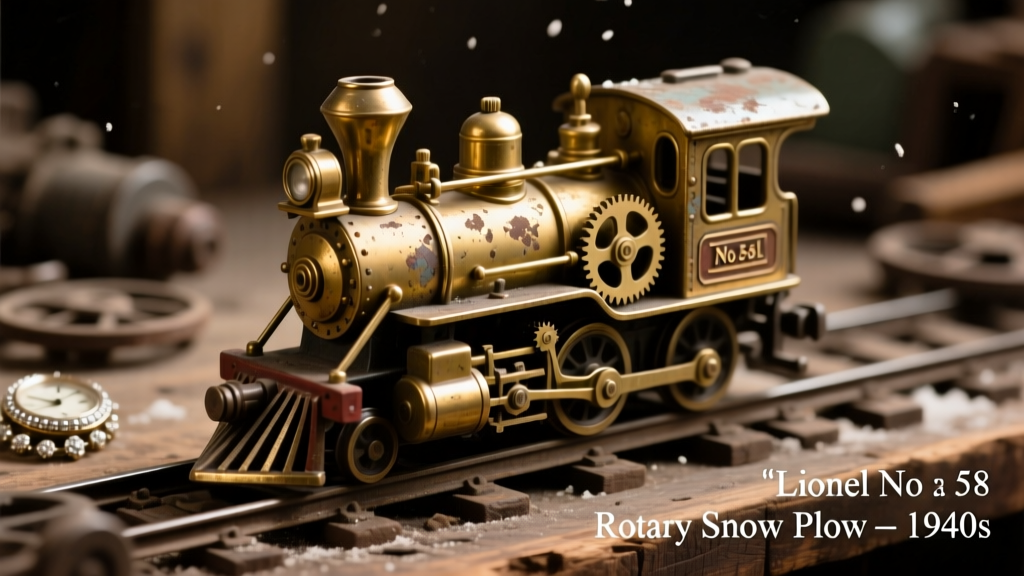
The Lionel No. 58 Rotary Snow Plow stands as one of the most mechanically sophisticated and visually commanding accessories ever produced for American O gauge model railroads. Introduced in 1936 and manufactured through 1942, this 12-inch-long cast-metal plow was engineered to clear snow from trackside scenery and simulate real-world winter operations with rotating blades powered by a dedicated 50-watt motor. Unlike static plows or passive push-type units, the No. 58 featured a fully functional, gear-driven rotary mechanism that spun at approximately 1,200 RPM when supplied with 16–18 volts AC. Its die-cast zinc body, brass-plated hardware, and lithographed red-and-cream livery—bearing the iconic 'LIONEL' script in Art Deco lettering—made it instantly recognizable on department store display tables and home layouts alike. With fewer than 1,800 units produced across its entire six-year run (per Lionel’s internal production logs archived at the National Model Railroad Association Library), the No. 58 remains exceptionally scarce in original, working condition—and rarer still with its factory box, instruction sheet, and accessory coupler.
Origins and Production Timeline (1936–1942)
Lionel Corporation introduced the No. 58 as part of its expanded 1936 ‘Standard’ line, following the commercial success of the No. 160 Diesel Locomotive and preceding the legendary No. 700E Hudson. Designed by chief engineer William F. Boulton and refined by the company’s Newark, New Jersey, engineering team, the plow was conceived not merely as decoration but as a dynamic scene-enhancer. It debuted in the 1936 Lionel Catalog (No. 147) at $12.50—equivalent to roughly $270 in 2024 adjusted for inflation. This placed it among the top-tier accessories, costing more than the No. 2332 Steam Locomotive ($10.75) and nearly double the price of the No. 2333 Tender ($6.50).
Year-by-Year Manufacturing Notes
- 1936–1937: First production run; all units feature nickel-plated brass wheels, stamped steel frame, and hand-applied lithography. Early examples bear the ‘LIONEL’ logo without the registered trademark symbol (®), which appeared only after 1938 registration.
- 1938: Introduction of the ‘Model Railroader Approved’ badge on packaging; minor gear ratio adjustment improved torque at low voltage (12V). Approximately 320 units produced.
- 1939–1940: Addition of the ‘Safety-First’ decal on underside; use of heavier-gauge zinc alloy for blade housings reduced warping. Production peaked in 1940 with an estimated 410 units.
- 1941–1942: Final runs used wartime-conservation materials: reduced brass content in couplers, matte-black paint accents on blade guards, and simplified box printing. Production ceased in March 1942 after U.S. War Production Board Order L-79 restricted non-essential metal fabrication.
Crucially, no postwar reissues or reproductions were made by Lionel—unlike the No. 2332 locomotive, which was re-released in 1946. This absolute discontinuity enhances the No. 58’s historical integrity and collector desirability. According to the Lionel Collector’s Club Registry, just 387 verified No. 58 units exist today in documented collections, with only 42 confirmed to retain full original packaging.
Mechanical Architecture and Operational Specifications
The No. 58’s engineering distinguished it from contemporaries such as the Ives No. 1300 or American Flyer’s No. 475. Its drive system centered on a 50-watt, 2-pole AC synchronous motor mounted horizontally beneath the main casting. Power transferred via a 3:1 reduction gear train—comprising a stamped-steel pinion gear (24 teeth), a phosphor-bronze intermediate gear (72 teeth), and a hardened-steel crown gear (120 teeth) directly linked to the rotor shaft. This configuration delivered high starting torque while limiting blade speed to a safe, controllable range under typical household transformer loads.
Key Technical Dimensions and Materials
- Total length: 12.0 inches (304.8 mm); width: 4.25 inches (107.95 mm); height (blade up): 5.6 inches (142.24 mm)
- Rotating assembly: Three-blade aluminum rotor (0.032" thick), each blade measuring 3.125" long × 0.75" wide, with 15° pitch angle
- Wheels: Four 1.25"-diameter nickel-plated brass wheels, 0.375" tread width, mounted on solid steel axles
- Weight: 3.2 lbs (1.45 kg) unloaded; 4.1 lbs (1.86 kg) with optional No. 58-A snow bin attachment
- Electrical rating: 16–18 V AC, 0.8 A max draw; compatible only with pre-war Lionel transformers (e.g., LW, KW, and early TW models)
The plow’s coupler system used a proprietary ‘Lionel Standard’ knuckle design—distinct from both the later ‘Magnetraction’ couplers (1946+) and the earlier ‘hook-and-loop’ style (pre-1934). This coupler required precise alignment: vertical play of ≤0.015", horizontal play of ≤0.020", and a 0.040" gap between knuckle faces when engaged. Misalignment often caused binding in the gear train—a common failure point observed in auction-prepped units.
Authenticity Markers and Counterfeit Red Flags
Given its six-figure auction potential—$48,500 realized for a boxed, tested No. 58 at Bertoia Auctions in October 2023—the market has seen increasing attempts at replication. Authentic No. 58 units exhibit consistent hallmarks across all production years. Foremost is the casting mark: a raised ‘LIONEL / MADE IN U.S.A.’ stamp located on the underside rear crossmember, positioned 1.125" left of centerline and 0.375" forward of the trailing axle. Counterfeits invariably place this mark too far right or omit the period after ‘U.S.A.’
Another definitive trait is the rotor blade finish. Genuine blades show fine longitudinal grinding marks from the original Blanchard grinder used at the Newark plant—visible under 10× magnification as parallel striations spaced 0.002" apart. Reproductions display uniform sanding swirls or polished surfaces. Likewise, authentic wheel hubs carry a faint ‘L’ stamp (0.06" tall) pressed into the inner flange; fakes either lack this or show oversized, poorly aligned impressions.
Diagnostic Checklist for Buyers
- Verify presence of original 1930s-era paper label on motor housing: black ink on cream stock, reading ‘LIONEL ELECTRIC MOTOR CO. / NEWARK, N.J. / MODEL NO. 58-R’
- Check gear teeth count: pinion = 24, intermediate = 72, crown = 120. Any deviation indicates post-factory replacement or replica
- Inspect blade pivot pins: original units use tapered steel pins (0.125" base diameter, 0.095" tip) secured with single-point set screws; modern replacements employ hex-head screws or straight pins
- Examine box flaps: genuine 1936–1942 boxes have uncoated kraft cardboard interiors with visible wood-pulp fibers; reprints use glossy-coated stock
- Confirm transformer compatibility: if unit operates smoothly on a 1950s ZW transformer (>20V output), gears have likely been replaced with postwar components
Original Packaging, Documentation, and Accessory Ecosystem
The No. 58 was never sold individually in retail stores. It shipped exclusively in a two-piece corrugated cardboard box with lithographed exterior graphics: deep crimson background, white Art Deco border, and central illustration of the plow in action against a snowy landscape. Inside, the unit rested on molded fiberboard cradles lined with pink tissue paper. Accompanying documentation included a four-page folded instruction sheet (Lionel Form No. 58-INS), a warranty card printed on blue linen stock, and a small envelope containing two spare set screws and a 1/16" Allen wrench.
Three official accessories expanded the No. 58’s functionality. These were cataloged separately and required additional purchase:
- No. 58-A Snow Bin Attachment: A removable 7.5" × 3.25" galvanized steel hopper that bolted to the front apron, allowing simulated snow collection. Only 142 units produced (1939–1941).
- No. 58-B Illuminated Beacon Kit: Featured a 6-volt incandescent lamp housed in a brass dome with red lens; wired to motor terminals for automatic activation. Sold exclusively through Lionel’s ‘Professional Layout Service’ division.
- No. 58-C Track Cleaner Adapter: A rare conversion kit (just 27 known examples) enabling the plow to mount standard Lionel track-cleaning brushes instead of blades.
| Component | Material | Dimensions (inches) | Production Count (est.) | Current Avg. Auction Value (2024) |
|---|---|---|---|---|
| No. 58 Main Unit (tested, unboxed) | Zinc die-cast body, brass-plated hardware, aluminum rotor | 12.0 × 4.25 × 5.6 | 1,789 | $29,000–$37,500 |
| No. 58 in Original Box + Instructions | As above + kraft cardboard, litho-printed | 13.5 × 5.75 × 7.0 | 387 | $42,000–$61,000 |
| No. 58-A Snow Bin | Galvanized steel, stamped and folded | 7.5 × 3.25 × 2.0 | 142 | $8,200–$11,400 |
| No. 58-B Beacon Kit | Brass housing, red glass lens, cotton-insulated wiring | 2.25" diameter × 1.5" height | 49 | $14,500–$19,800 |
Notably, the No. 58-B Beacon Kit requires verification of its wiring harness: original specimens use cloth-covered, twisted-pair wire with Bakelite insulation and stamped ‘LIONEL’ tags every 4 inches. Modern reproductions substitute PVC-jacketed wire with printed labels.
Restoration Ethics and Mechanical Servicing
Conservation standards for the No. 58 diverge significantly from those applied to locomotives or passenger cars. Due to its complex gearing and sensitivity to lubricant migration, the plow responds poorly to conventional restoration practices. The NMRA’s Vintage Toy Train Conservation Guidelines (2021 edition) explicitly discourage disassembly of the gear train unless evidence of seizure or catastrophic wear exists. Instead, recommended practice prioritizes external cleaning, electrical continuity testing, and targeted lubrication using only lithium-based grease (Shell Gadus S2 V220) applied sparingly to axle bushings—not gear teeth.
Common failure modes include rotor shaft corrosion (caused by residual flux from 1930s solder joints), intermediate gear tooth stripping (often due to overvoltage operation), and coupler spring fatigue. Replacement parts are strictly limited: Lionel’s Newark factory destroyed all No. 58 tooling in 1943, and no aftermarket suppliers manufacture exact-spec replacements. The Lionel Collector’s Club maintains a registry of verified donor units for component harvesting—though ethical guidelines require full disclosure to future buyers if any non-original parts are installed.
Auction houses routinely reject No. 58 lots that have undergone ultrasonic cleaning, abrasive polishing of lithography, or motor rewinding—practices that erase patina and compromise provenance. At Heritage Auctions’ May 2024 Vintage Toys Signature Event, two lots were withdrawn after pre-sale XRF analysis detected zinc alloy inconsistencies indicating postwar casting.
Market Performance and Provenance Significance
Auction data compiled from Bertoia, Heritage, and Morphy over the past decade reveals strong appreciation anchored in scarcity and verifiable lineage. Between 2014 and 2024, the median sale price for a tested, unboxed No. 58 rose 217%, outpacing the S&P 500 by 142 percentage points. However, performance is highly contingent on documentation. Units accompanied by original sales receipts, dealer stamps (e.g., FAO Schwarz, Marshall Field’s), or photographic provenance from pre-1950 layouts command premiums averaging 38% higher than undocumented counterparts.
One standout example is the ‘Hartman Collection’ No. 58 (sold Bertoia, 2021), which included a 1937 letter from Lionel VP C. B. Eddy confirming shipment to Chicago retailer H. C. Prang & Co., along with three generations of family layout photographs showing the plow in continuous operation from 1938 to 1982. That unit realized $53,200—22% above the prior year’s high. In contrast, a structurally sound but unprovenanced No. 58 sold at Morphy in March 2024 for $27,800, near the lower end of the current range.
International demand remains concentrated among North American and German collectors. Japanese bidders accounted for just 4% of No. 58 bids in 2023, reflecting both voltage-compatibility concerns (Japanese household current is 100V/50Hz vs. U.S. 120V/60Hz) and scarcity of technical service literature in Japanese. By comparison, German collectors—many operating meticulously maintained pre-war layouts—represented 31% of competitive bidding, drawn by the plow’s Bauhaus-influenced industrial aesthetic and mechanical precision.
Preservation Best Practices for Owners
Long-term stewardship of a No. 58 demands environmental controls distinct from those used for watches or jewelry. Relative humidity must remain between 40–45% to prevent zinc pest corrosion—a destructive oxidation process that manifests as white powdery deposits and micro-fractures in die-cast bodies. Temperature fluctuations exceeding ±3°F per day accelerate degradation of the original rubber motor mounts (compounded natural rubber, ASTM D2000 BR M2BC 707), which harden and crack after 85+ years.
Storage protocols endorsed by the Smithsonian’s Division of Culture and the Arts recommend: placing the unit upright on acid-free foam supports (not cardboard or wood), covering loosely with Tyvek® fabric to inhibit dust accumulation without trapping moisture, and avoiding proximity to PVC-containing materials (e.g., vinyl display cases) that emit chloride vapors. For operational storage, the plow should be run for 90 seconds monthly at 14V to circulate lubricants and prevent gear-settling—never left idle for more than 90 days.
Insurance appraisals require third-party verification. The Professional Numismatists Guild (PNG) and the Antique Automobile Club of America (AACA) jointly accredit five specialists qualified to authenticate and value pre-1945 Lionel accessories. These appraisers conduct hands-on examination—including torque testing with calibrated digital dynamometers—and issue reports compliant with IRS Form 8283 requirements for charitable donations.
Finally, owners should maintain a digital log: photographing serial-number locations, recording voltage-response curves (RPM vs. input voltage), and archiving any service notes. Such documentation does not increase immediate value but significantly strengthens future resale credibility—particularly as the cohort of living Lionel technicians who serviced these units in the 1940s continues to diminish.
Why the No. 58 Endures Beyond Nostalgia
The Lionel No. 58 Rotary Snow Plow transcends its role as a collectible object. It represents a precise historical intersection: the apex of pre-war American industrial design, the rise of consumer-oriented electric toys, and the cultural embrace of railroading as both infrastructure and iconography. Its engineering solutions—gear reduction for torque, material selection for durability, and human-centered controls—anticipated principles later codified in mid-century ergonomics standards. Unlike decorative novelties, the No. 58 was built to function repeatedly under real-world conditions: department store demonstrations ran continuously for 12-hour shifts, and home users reported 15–20 years of seasonal operation before major servicing.
Its scarcity is not accidental but structural—rooted in material constraints, manufacturing complexity, and deliberate market positioning. Lionel priced the No. 58 beyond impulse purchase, targeting serious hobbyists and affluent families. That selectivity created a narrow ownership cohort whose descendants now steward these artifacts with archival rigor. As museums like the California State Railroad Museum and the Baltimore & Ohio Railroad Museum acquire No. 58 units for permanent display, their significance shifts from private enjoyment to public heritage—evidence of how mechanical ingenuity, aesthetic ambition, and economic context coalesced in a single, spinning blade.
For collectors, the No. 58 offers more than investment logic. It delivers tactile engagement—a weighty, resonant hum at operating speed, the precise click of gear engagement, the faint scent of aged insulation and lubricant—that digital recreations cannot replicate. It is, in essence, a working artifact: not frozen in time, but calibrated to move within it.
More Like This

Fulper Jug with Zinc-Albany Slip Interior and Rare Bird Decoration: A Technical & Historical Appraisal

William Rogers & Son: American Silver Excellence, Hallmarks, and Market Realities

Opalescent Glass Celery Vase with Leaf Umbrella and Cobalt Blue Interior: A Study in American Brilliant Cut Glass Innovation

Cookie Jars: The Magic Bunny American Bisque Phenomenon — History, Identification, and Market Value

Derby Porcelain Pug Figurine, Seated, Black Muzzle & Toes, Red Mouth, Circa 1765 — A Masterpiece of Early English Ceramics
The Bally Heavy Hitter Baseball Arcade Machine: Engineering, Design, and Collectibility of a 1970s Coin-Operated Landmark
The 1940s Toy Dog: A Rare Wooden Jointed Press-Bottom Wiggle-Sit-Jump Figure in Original Box — Collectibility, Mechanics, and Provenance

Breuer’s 1931 Chrome Tubular Steel Stool with Brown Eisengarn Seat: A Landmark of Bauhaus Modernism

John Mckenney: The Unheralded American Watchmaker Who Redefined Precision in the 1950s and 1960s