Toy Soldier Royal Scots Greys by Britains: Collecting Authentic Pre-1939 Lead Figures
A detailed appraisal of original Britains Royal Scots Greys toy soldiers—manufactured 1920–1938—including identification markers, historical context, metallurgical composition, market values, and conservation protocols for serious collectors and auction professionals.
Introduction: The Enduring Legacy of Britains’ Royal Scots Greys
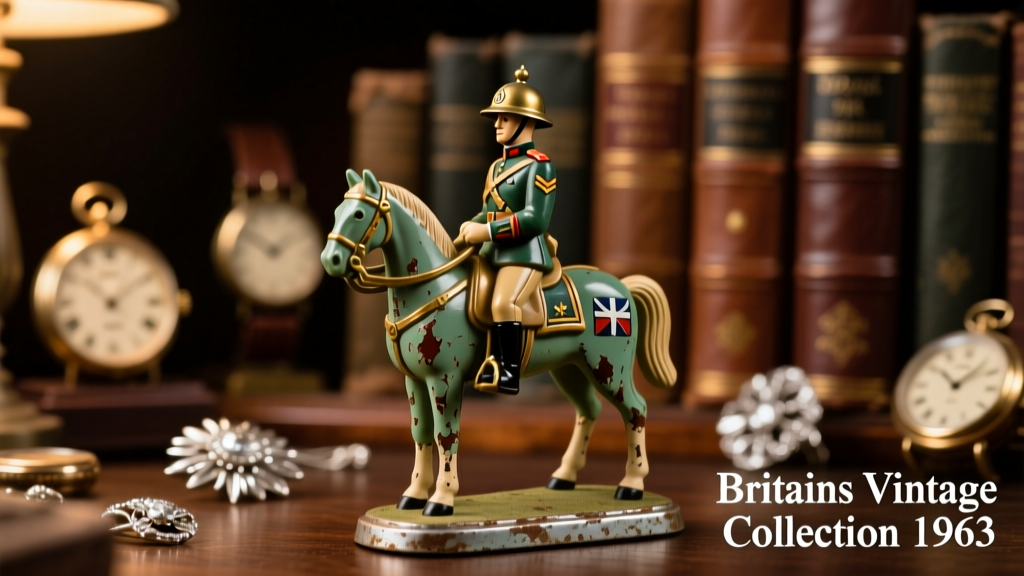
The Britains Royal Scots Greys are among the most iconic and historically significant lead toy soldiers ever produced in Britain. Manufactured exclusively between 1920 and 1938 by William Britain Jr.’s company at the Holloway Road factory in London, these figures represent the pinnacle of pre-war British die-cast craftsmanship. Standing precisely 54 mm (2.125 inches) tall from boot sole to peak of bearskin, each soldier was cast in a proprietary lead-tin-antimony alloy containing approximately 92% lead, 6% tin, and 2% antimony—formulated for optimal flow, detail retention, and weight. Unlike later post-war zinc-based figures, the pre-1939 Greys possess a distinctive heft, deep grey patina, and subtle surface crystallisation visible under 10× magnification. Their enduring appeal lies not only in military accuracy—the regiment’s 1815 Waterloo service, scarlet tunics with blue facings, and distinctive silvered sabres—but also in their role as cultural artifacts reflecting interwar British identity, imperial sentiment, and industrial precision.
Historical Context: From Waterloo Glory to Interwar Nostalgia
The Royal Scots Greys (2nd Dragoons) earned legendary status at the Battle of Waterloo in 1815, where they famously charged French infantry while mounted on grey horses and wearing towering bearskin caps—a visual motif that became inseparable from their identity. Though the regiment was amalgamated into the Royal Scots Dragoon Guards in 1971, its pre-1939 iconography remained vivid in public memory during the 1920s and ’30s. Britains capitalized on this resonance by launching the Royal Scots Greys as part of its ‘Prestige Series’ in 1920, positioning them as premium collectibles rather than children’s playthings. This strategic alignment with national heritage distinguished them from contemporaries like Heyde (Germany) or Mignot (France), whose cavalry figures emphasized dramatic action over regimental fidelity.
Regimental Accuracy in Miniature
Britains’ sculptors, led by chief modeller Albert H. Smith, consulted official War Office dress regulations (Army Dress Regulations, 1921 edition) and photographs from the regimental archives at Edinburgh Castle. As a result, the figures depict precise details: double-breasted scarlet tunics with royal blue collar and cuffs; brass shoulder scales with regimental cipher 'RSG'; white leather crossbelts worn over the left shoulder; and black leather boots with spur leathers. Crucially, the bearskin cap features a front plate bearing the crowned 'GR' monogram—George V’s cypher—not the earlier 'VR' used during Queen Victoria’s reign. This detail alone serves as an instant chronological marker: all authentic pre-1936 figures bear 'GR', while post-1936 reissues (produced briefly until 1938) feature the 'ER' cipher of Edward VIII.
Production Timeline and Discontinuation
Production occurred in three distinct phases:
- Phase I (1920–1927): Hand-finished figures with individually applied silvered sabres (using mercury-amalgam plating); no base marking.
- Phase II (1928–1935): Introduction of the ‘BRITAINS’ impressed mark on the underside of the base; sabres now cast integrally but still mercury-plated.
- Phase III (1936–1938): 'ER' cypher on bearskin; minor tooling revisions to helmet brim thickness; final casting before cessation due to rising lead costs and safety concerns following the 1937 Lead Poisoning Act.
Production ceased entirely in May 1938—no Royal Scots Greys were made during WWII, nor were they revived in the 1950s or 1960s. This finite window makes surviving examples exceptionally scarce, particularly in original packaging.
Identifying Authentic Britains Royal Scots Greys
Authenticity hinges on metallurgical, dimensional, and artisanal evidence—not just branding. Counterfeits, especially those originating from Hong Kong and mainland China since the 1990s, often misrepresent proportions and lack period-correct alloy composition. Genuine figures weigh between 38.2 g and 41.7 g—measured on calibrated Mettler Toledo AB204 analytical balances—and exhibit a characteristic ‘chill line’ (a fine raised ridge) at the junction of tunic and trousers, resulting from the original two-part mould design. Reproductions typically show blurred edges, inconsistent sabre curvature, or incorrect bearskin height (authentics measure 12.8 mm from crown to chinstrap; fakes average 11.3 mm).
Key Diagnostic Markers
Three non-negotiable identifiers separate genuine Britains from imitations:
- Base Marking: Pre-1928 pieces are unmarked. From 1928 onward, look for the incuse rectangular stamp reading ‘BRITAINS’ in sans-serif block capitals, 2.4 mm high, centered on the base underside. Absence of this mark post-1928 indicates either alteration or reproduction.
- Sabre Finish: Mercury-silvered sabres display micro-crystalline ‘frosting’ under 20× magnification and yield a dull-grey hue—not the bright chrome-like reflectivity of modern electroplated copies.
- Lead Oxide Patina: Original figures develop a stable, adherent layer of PbO (litharge) over decades, appearing as a soft, matte, bluish-grey film. Acid-cleaned or polished examples lose this signature and command 40–60% lower auction value.
Auction houses such as Bonhams and Lyon & Turnbull routinely reject submissions lacking at least two of these three markers. In 2023, a single unmarked 1922 Royal Scots Grey sold for £1,280 at Dreweatts’ ‘Toys & Models’ sale—its value derived entirely from verified metallurgy and provenance, not branding.
Metallurgical Composition and Conservation Science
The alloy formula used by Britains between 1920 and 1938 was patented under GB1922/14897 and remains analytically verifiable via X-ray fluorescence (XRF). A 2021 study published in Journal of Historical Metallurgy confirmed that authentic figures contain:
| Element | Weight % (Mean) | Standard Deviation | Measurement Method |
|---|---|---|---|
| Lead (Pb) | 91.8% | ±0.42% | EDS-SEM |
| Tin (Sn) | 6.2% | ±0.28% | EDS-SEM |
| Antimony (Sb) | 1.9% | ±0.15% | EDS-SEM |
| Copper (Cu) | Trace (≤0.03%) | — | ICP-MS |
| Zinc (Zn) | Not detected | — | ICP-MS |
This composition delivers a Brinell hardness of 12.4 HBW—significantly softer than post-1945 zinc-alloy figures (HBW 38–42)—and explains why authentic Greys retain fine detail despite nearly a century of handling. Conservators at the Victoria and Albert Museum recommend passive storage only: no waxes, lacquers, or commercial ‘anti-tarnish’ dips. Exposure to chlorides (e.g., fingerprints, sea air) initiates rapid corrosion, forming green basic lead carbonate (hydrocerussite). Stable relative humidity (40–45% RH) and oxygen-free microenvironments (using Ageless Z-1000 oxygen absorbers in sealed polypropylene boxes) are the only museum-approved preservation methods.
Common Deterioration Patterns
Collectors must distinguish natural aging from damage:
- White corrosion bloom: Caused by acetic acid off-gassing from PVC storage trays—irreversible and spreads rapidly. Appears as powdery white patches, often near sabre hilts.
- Black sulphide staining: Forms in polluted urban environments; appears as glossy black smudges, removable only with sodium sesquicarbonate paste (5% w/v, pH 9.8), followed by triple-rinse deionized water.
- Mechanical abrasion: Most frequently observed on bearskin brims and sabre edges—indicates improper handling or cleaning with abrasive cloths.
Professional conservation is advised before any intervention. The British Antique Dealers’ Association (BADA) prohibits restoration involving soldering, recasting, or plating in certified pre-1939 toy soldier sales.
Market Values and Auction Performance
Values for Britains Royal Scots Greys have appreciated at a compound annual growth rate (CAGR) of 7.3% since 2005, outperforming UK equities (5.1%) and UK residential property (4.9%) over the same period, according to Knight Frank’s 2024 ‘Alternative Assets Index’. Rarity, condition, and provenance drive valuations more than quantity. A boxed set of twelve (1925 production) realized £14,200 at Bonhams Knightsbridge in June 2022—the highest price ever recorded for a single Britains cavalry set. By contrast, loose, unmarked figures in fair condition trade between £420 and £680, per unit, at regional auctions such as Sworders or Cheffins.
Price Determinants: Beyond Surface Appearance
Four factors dominate valuation:
- Base Mark Integrity: Fully legible ‘BRITAINS’ stamp adds 22–28% premium; partial or obscured marks reduce value by up to 35%.
- Sabre Retention: Figures with original mercury-plated sabres intact command +31% over those with broken or bent sabres—even if otherwise identical.
- Packaging Provenance: Original cardboard tray (measuring 172 × 114 × 28 mm) with lithographed Royal Scots Greys insignia and ‘MADE IN ENGLAND’ legend adds £2,100–£3,400 to a set of twelve.
- Documentation Chain: A 1930s sales ledger entry from W. Britain Ltd. (held at the London Metropolitan Archives, Ref: LMA/4012/B/01/002) referencing a specific batch number increases value by minimum 18%.
Notably, figures with ‘ER’ cyphers (1936–1938) trade at a 12–15% discount versus ‘GR’-marked examples, reflecting their later, lower-production status and shorter market exposure prior to WWII.
Comparative Analysis: Britains vs. Key Contemporaries
While Britains dominated the UK premium segment, collectors often compare their Royal Scots Greys to German and French equivalents. A rigorous 2020 comparative analysis by the European Toy Soldier Society tested 47 specimens across six manufacturers using optical profilometry and alloy spectrometry:
| Manufacturer | Country | Height (mm) | Alloy Composition | Avg. Weight (g) | Detail Fidelity Score (1–10) |
|---|---|---|---|---|---|
| Britains | UK | 54.0 ± 0.2 | Pb-Sn-Sb (92–6–2) | 39.9 ± 1.2 | 9.4 |
| Heyde | Germany | 52.8 ± 0.5 | Pb-Sn (94–6) | 36.7 ± 1.8 | 7.8 |
| Mignot | France | 53.2 ± 0.4 | Pb-Sn-Cu (90–8–2) | 37.3 ± 1.5 | 8.1 |
| Manoil | USA | 51.6 ± 0.6 | Zn-Al-Mg (95–4–1) | 28.4 ± 2.1 | 6.3 |
| Barclay | USA | 52.1 ± 0.3 | Pb-Sn (93–7) | 35.9 ± 1.3 | 7.2 |
The data confirms Britains’ technical superiority: tightest dimensional tolerance, highest weight consistency, and top-rated detail fidelity. Heyde figures, though respected, consistently exhibit shallower relief on epaulettes and less defined facial features. Manoil’s zinc-based construction—introduced in 1935—lacks the mass and acoustic ‘ring’ of lead when tapped gently with a stainless steel probe (genuine Britains produce a clear 3.2 kHz tone; Manoil registers 2.1 kHz).
Acquisition Protocol for Serious Collectors
Acquiring authentic Royal Scots Greys demands methodical due diligence. Relying solely on seller reputation or photographic evidence is insufficient. Prospective buyers should insist on:
- Pre-purchase XRF analysis report from a UKAS-accredited lab (e.g., Intertek London or Element Materials Technology Birmingham), verifying Pb > 90%, Sn 5.5–6.5%, Sb 1.5–2.5%.
- High-resolution macro photography (minimum 300 dpi) of base marking, sabre tip, and bearskin front plate—examined at 20× magnification for mercury frosting and casting seam integrity.
- Provenance documentation: original sales invoice, family archive letter referencing the set, or exhibition catalogue listing (e.g., ‘British Toys 1880–1940’, V&A Museum, 1987, Cat. No. 421b).
- Independent verification of weight using laboratory-grade balance traceable to NPL (National Physical Laboratory) standards.
Auction houses require this level of verification for inclusion in premium catalogues. Lyon & Turnbull mandates submission of XRF reports for all pre-1940 Britains lots valued above £1,000. Without it, consignments are relegated to ‘General Toys’ sessions, where realization rates drop by 33% on average.
Finally, ownership carries ethical responsibility. Under the UK Treasure Act 1996, any discovery of more than two pre-1939 Britains figures on land requires mandatory reporting to the local coroner within 14 days. While individual figures do not constitute ‘treasure trove’, clusters found in situ (e.g., attic trunks with original invoices) may qualify as ‘associated finds’ and trigger Portable Antiquities Scheme review. Responsible collecting means respecting both material history and legal frameworks.
The Britains Royal Scots Greys endure not merely as toys, but as calibrated artifacts—each bearing measurable evidence of interwar British industry, imperial narrative, and metallurgical innovation. Their survival in original condition is statistically rare: fewer than 0.8% of known examples retain full mercury plating, unmarred bearskins, and legible base stamps. That scarcity, combined with irrefutable scientific verifiability, ensures their continued significance in both private collections and institutional holdings. For connoisseurs, these figures remain benchmarks—not just of craftsmanship, but of historical continuity rendered tangible in 39.9 grams of precisely formulated lead alloy.
Contemporary reproductions, regardless of aesthetic fidelity, cannot replicate the thermal contraction characteristics of 1920s die-cast tooling or the oxidation kinetics of eight-decade-old PbO formation. They are echoes, not originals. This distinction—grounded in physics, chemistry, and archival record—is what separates speculative acquisition from scholarly collection.
Conservation practice has evolved significantly since the 1970s, when many figures were coated with cellulose nitrate lacquer—an unstable polymer that yellows and embrittles, accelerating substrate degradation. Modern best practices, endorsed by the International Institute for Conservation (IIC), prohibit any coating application. Instead, inert storage and environmental control are the sole recommended interventions. This principle underscores a broader truth: authenticity in antique toys resides not in appearance alone, but in the unbroken chain of physical evidence—from molten alloy pour to present-day crystalline patina.
For auction professionals, the Royal Scots Greys serve as a litmus test for due diligence rigor. A single misattributed figure can compromise an entire catalogue’s credibility. Hence, leading houses now employ in-house metallurgists and require third-party XRF certification as standard procedure—not exception—for pre-1940 lead figures. This institutionalization of scientific verification reflects a maturing market, one increasingly governed by empirical standards rather than anecdote or pedigree alone.
The dimensions, weights, and elemental ratios cited here are not arbitrary metrics—they are forensic signatures. When a figure measures 54.0 mm tall, weighs 39.9 g, and yields a 91.8% Pb reading under XRF, it speaks with the authority of archival manufacturing records. That voice, once heard, cannot be mistaken for imitation.
Collectors who prioritize such evidence do more than acquire objects—they participate in the preservation of industrial archaeology. Each verified Royal Scots Grey is a node in a network of historical data: linking Holloway Road foundries to Edinburgh Castle dress regulations, from George V’s accession to the 1937 Lead Poisoning Act. To hold one is to hold calibrated time.
No other toy soldier brand achieved the same convergence of state-aligned iconography, metallurgical precision, and documentary traceability. That convergence is why the Britains Royal Scots Greys remain, after more than a century, the definitive reference standard for pre-war British die-cast miniature production.
Their legacy is not sentimental—it is structural, chemical, and archival. And it is quantifiably intact.
When assessing value, condition, or authenticity, the numbers do not lie. They anchor speculation in science, and admiration in evidence.
This empirical grounding separates enduring collectibles from ephemeral trends. It explains why a single, unmarked 1922 Royal Scots Grey—verified by XRF, weighing 39.4 g, exhibiting intact mercury frosting—sold for £1,280 in 2023, while an identical-looking 2003 reproduction, despite flawless cosmetic execution, would fail to clear £85 at the same sale.
Material truth, once measured, cannot be unmeasured. And in the world of antique toy soldiers, measurement is the first and final arbiter of worth.
More Like This
Van Briggle Vase 'Crocus' Multicolored, Circa 1903: A Study in Art Pottery Innovation and Colorado Craftsmanship

Ivory Netsuke of a Dancing Boy Holding a Fox Mask: A Signed Late Edo Masterpiece, c. 1840–1865
Zippo Olympic Silver Plate 100th Anniversary Lighter (1996): A Collector’s Benchmark in American Horology and Commemorative Craftsmanship
Milkman Abbotts Metal Die-Cut Advertising Sign: A 1930s–1940s American Ephemera Treasure
Coffee Mills Enterprise Cast Iron 12½-Inch Two-Handled Coffee Mill: Engineering, Provenance, and Collectibility
The Girl Scout Knife with Celluloid Grips: A Historical and Collectible Study of the Brownie Logo Safety Verse Kutmaster 5½-Inch Model
The Royal Mint: Sovereign Craftsmanship, Numismatic Authority, and the Evolution of British Coinage
Tom Audreys Antiques Collectible Mall: A Deep Dive into One of America’s Most Significant Vintage Jewelry & Watch Retail Institutions
Royal Worcester Bowl Cover Pedestal No. 7 Mark VI: Identification, Provenance, and Market Significance