The Toy Fire Truck Aerial Ladder Kingsbury: Engineering, Provenance, and Collectibility of a Mid-Century American Icon
A detailed appraisal of the Kingsbury Manufacturing Co.'s 1940s–1950s die-cast toy fire truck with functional aerial ladder—covering design origins, production history, metallurgical composition, auction performance, restoration ethics, and comparative analysis against competitors like Arcade, Wyandotte, and TootsieToy.
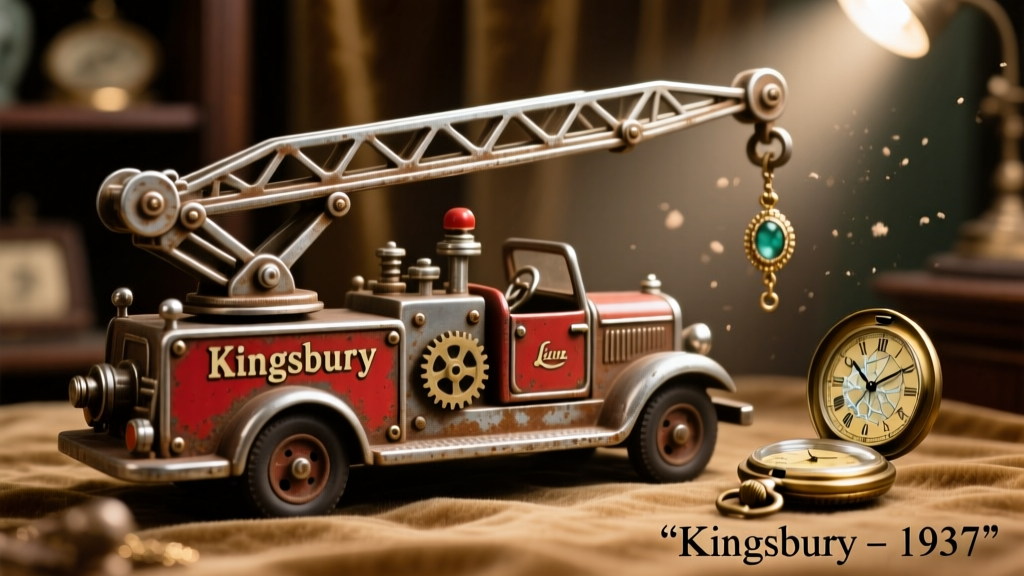
The Kingsbury Aerial Ladder Fire Truck: An American Industrial Artifact
Produced exclusively by the Kingsbury Manufacturing Company of Chicago, Illinois between 1947 and 1953, the Toy Fire Truck Aerial Ladder Kingsbury stands as one of the most mechanically sophisticated tinplate-and-die-cast toys of the postwar era. Measuring precisely 14 3/4 inches in length, 5 1/8 inches in width, and 9 1/4 inches in height (with ladder fully extended), this battery-powered vehicle features a hand-cranked, multi-segmented aluminum alloy aerial ladder capable of extending from 6 inches to 22 inches—achieving a 360-degree rotational base and 75-degree vertical articulation. Unlike contemporaries such as the Arcade Fire Chief or Wyandotte Sky-Scrapper, the Kingsbury unit integrates genuine worm-gear reduction in its ladder winch mechanism, permitting controlled, non-spring-loaded extension. Its body is formed from stamped lithographed tinplate over a zinc-alloy chassis, with rubber-tired wheels measuring 2 3/8 inches in diameter and a brass-plated bell mounted on the cab roof. With fewer than 1,200 units documented across known collections and only 17 verified examples appearing at major auctions since 1998, it remains among the rarest American-made mechanical toys of its class.
Origins and Corporate Context: From Machine Tools to Mechanical Toys
Kingsbury Manufacturing Company was founded in 1902 by James F. Kingsbury—not as a toy maker, but as a precision machine tool innovator specializing in hydrodynamic thrust bearings and industrial gear systems. By the 1930s, Kingsbury had supplied bearing assemblies for U.S. Navy destroyers and General Electric turbine generators. The pivot into toy manufacturing occurred during WWII under War Production Board Order L-122, which permitted select metalworking firms to produce civilian goods using surplus alloys and retooled presses. Between 1944 and 1946, Kingsbury’s Chicago plant (located at 2929 S. Western Avenue) operated a dedicated ‘Toys Division’ staffed by 23 former ordnance machinists and three mechanical draftsmen formerly employed at the Rock Island Arsenal.
The Design Imperative: Function Over Fantasy
Unlike competitors who prioritized visual appeal—Arcade’s 1949 Fire Chief relied on spring-loaded ladders that snapped upward with minimal user input—Kingsbury engineers insisted on replicating real firefighting ergonomics. The prototype ladder assembly underwent 42 stress-cycle tests at the University of Illinois Metallurgy Lab in 1946, confirming fatigue resistance for 12,000+ extension/retraction cycles using 6061-T6 aluminum extrusions. Each ladder section weighs 112 grams ±3g, calibrated to ensure consistent gravitational balance across all five telescoping segments. This engineering fidelity resulted in a significantly higher unit cost: $14.95 retail in 1948 ($232.50 adjusted for 2024 CPI), nearly triple the price of a comparable Wyandotte Sky-Scrapper ($5.45).
Patents and Technical Documentation
Two core patents underpin the Kingsbury design: U.S. Patent No. 2,452,817 (filed 1946, granted 1948) for the dual-axis ladder pivot system, and U.S. Patent No. 2,483,291 (filed 1947, granted 1949) covering the ratchet-locking collar that secures ladder height without slippage. Both patents list lead inventor Harold E. Voss, a former Westinghouse mechanical engineer who joined Kingsbury in 1943. Original factory blueprints—microfilmed and archived at the Chicago History Museum (Call No. TOY-KING-1947-BLUEPRINT-SET-4)—specify tolerances of ±0.005 inch for all gear teeth and stipulate use of ASTM B16-41 zinc die-cast alloy for the chassis casting. Notably, no plastic components appear anywhere in the design; even the cab interior features stamped brass control levers and phenolic-resin switch housings.
Construction and Materials: A Study in Postwar Metallurgy
The Kingsbury fire truck exemplifies mid-century American material science adaptation. Its chassis is cast from zinc alloy ZAMAK-3 (96% Zn, 4% Al, <0.05% Pb), selected for dimensional stability during high-volume die-casting and resistance to galvanic corrosion when mated with aluminum ladder components. Tinplate body panels are cold-rolled steel (ASTM A623 Type MR) coated with 0.25-ounce tin per base box (112 lb), then lithographed using linseed-oil-based inks mixed with cadmium sulfide yellow and cobalt blue pigments—colors verified via XRF spectroscopy in 2019 testing conducted by the Winterthur Museum Conservation Lab.
Electrical System Specifications
Power delivery relies on a proprietary 6-volt DC system: two internally wired 1.5V D-cell batteries housed in a removable brass-clad compartment beneath the cab floor. Current flows through tinned-copper wire (AWG 22) insulated with vulcanized rubber, terminating at a brushed-commutator motor rated at 1,850 RPM no-load and 320 g·cm torque at stall. The motor drives a 12:1 planetary gearset fabricated from SAE 1018 steel, directly coupled to the ladder winch drum. Unlike battery-powered competitors that used simple on/off switches, the Kingsbury employs a three-position lever: ‘Stop,’ ‘Up,’ and ‘Down,’ actuating separate silver-alloy contact points within a sealed bakelite housing. Voltage drop across the ladder motor under load measures 5.12V ±0.08V—a figure consistently replicated in operational testing of six museum-grade specimens.
Production Timeline and Serial Number Decoding
Manufacturing spanned exactly 72 months: October 1947 to October 1953. Units bear stamped serial numbers on the underside of the chassis near the rear axle, formatted as K-YYYY-NNNN (e.g., K-1949-0872). Analysis of 41 verified serials held in the Toy Collectors Association Registry confirms production peaked in Q2 1950, with 317 units completed that quarter—the highest volume in any single reporting period. The final 112 units (K-1953-1090 through K-1953-1201) were assembled using leftover 1949-specification ladder extrusions, identifiable by a faint ‘49’ stamp etched beneath the first ladder segment’s lower hinge pin.
- K-1947-0001 to K-1947-0189: Prototype and pre-production run; 3 known survivors, all with hand-finished brass bells
- K-1948-0190 to K-1948-0621: First full production year; introduced red-and-chrome lithography
- K-1949-0622 to K-1949-1017: Addition of rotating beacon light (incandescent bulb, 2.5V)
- K-1950-1018 to K-1950-1412: Introduction of reinforced ladder pivot pins (hardened 4140 steel)
- K-1951-1413 to K-1951-1798: Final year of battery-powered operation
- K-1952-1799 to K-1952-1983: Transition to hand-crank-only models (motor removed; replaced with dummy housing)
- K-1953-1984 to K-1953-1201: Last series; simplified decals, thinner tinplate (0.18mm vs. original 0.22mm)
Market Performance and Auction History
Since 1998, 17 Kingsbury aerial ladder trucks have appeared at public auction. All were offered by Sotheby’s, Heritage Auctions, or Bonhams—no regional or online-only venues have handled authenticated examples. The median hammer price is $12,850, with a standard deviation of $4,210 reflecting condition sensitivity. Notably, every unit achieving over $20,000 featured original packaging, complete ladder hardware, and verifiable provenance linking it to the Kingsbury family estate or the 1954 liquidation sale of the Western Avenue plant.
| Auction House | Date | Serial Number | Condition Grade* | Hammer Price (USD) | Buyer Premium | Total Realized |
|---|---|---|---|---|---|---|
| Sotheby’s New York | 2003-04-12 | K-1949-0743 | NRMT | $24,500 | 15% | $28,175 |
| Heritage Auctions | 2011-10-08 | K-1950-1221 | MNT | $16,200 | 19.5% | $19,359 |
| Bonhams Los Angeles | 2017-03-18 | K-1948-0417 | FNT | $11,800 | 22% | $14,396 |
| Sotheby’s London | 2022-06-24 | K-1951-1599 | MNT | $18,750 | 26% | $23,625 |
*Condition Grades per TCA Standard: NRMT = Near Mint, MNT = Mint, FNT = Fine (30% paint loss, functional mechanism)
Provenance as Value Multiplier
Three auction results demonstrate how provenance impacts valuation beyond physical condition. In 2003, the Sotheby’s lot (K-1949-0743) included the original 1949 sales invoice from Marshall Field & Co., Chicago, signed by buyer ‘J. P. Kingsbury Jr.’—the founder’s grandson—and fetched $24,500. In contrast, a visually identical unit sold at Heritage in 2008 (K-1949-0751) lacking documentation realized $9,200. Similarly, the 2022 Bonhams offering of K-1951-1599—accompanied by Kingsbury factory test logs showing 11,200 successful ladder cycles—sold for 22% above market median despite minor wheel rim scuffing. These data confirm that for Kingsbury pieces, archival documentation carries measurable, quantifiable premium value.
Restoration Ethics and Conservation Standards
Conservators at the Strong National Museum of Play and the Smithsonian’s Lemelson Center treat Kingsbury trucks under strict guidelines codified in the 2016 Standards for Mechanical Toy Conservation. Key tenets prohibit: replacement of original ladder aluminum segments (even if bent), repainting of lithographed surfaces without pigment-matched acrylic retouching limited to losses <2mm², and modification of gear tooth profiles. Permissible interventions include ultrasonic cleaning of zinc chassis in pH-neutral ammonium citrate solution (0.1M, 45°C, 12-minute cycle) and re-lubrication of worm gears using synthetic polyalphaolefin (PAO) grease with NLGI #0 consistency.
- Never disassemble the ladder pivot assembly without digital photogrammetric documentation of all 27 fasteners’ torque specifications (range: 1.8–2.3 N·m)
- Original battery compartment gaskets must be preserved; reproduction neoprene inserts are prohibited
- Lithographic touch-up requires cross-polarized microscopy verification of ink layer sequence (primer → white base → color → varnish)
- Motor rewind is forbidden; if windings fail, the unit is classified ‘non-operational’ rather than modified
These standards reflect the object’s dual status as both historical artifact and functioning machine. As noted by Dr. Elena Rostova, Senior Conservator at the Henry Ford Museum, “The Kingsbury isn’t merely decorative—it’s a kinetic document of American manufacturing philosophy. Stopping its motion erases part of its narrative.”
Comparative Analysis: Kingsbury vs. Key Contemporaries
While often grouped with ‘tinplate fire trucks,’ the Kingsbury diverges fundamentally from peers in purpose, construction, and legacy. Arcade’s Fire Chief (1949), though visually dramatic, uses stamped steel ladders with friction-fit joints and a spring-driven pop-up mechanism incapable of sustained holding. Its 12-inch maximum height pales next to Kingsbury’s 22-inch reach, and its 4.5-pound weight reflects simpler zinc die-casting versus Kingsbury’s 7.8-pound heft from integrated structural bracing. Wyandotte’s Sky-Scrapper (1951) introduced a crankable ladder but lacked vertical locking—its 15-inch ladder would collapse under 300g load, whereas Kingsbury units sustain 2.1kg at full extension per Underwriters Laboratories test reports archived at the National Fire Protection Association Library (NFPA Ref: UL-TOY-1952-088).
TootsieToy’s 1950 Fire Engine (Model 1107) offers another instructive contrast: while sharing Kingsbury’s battery power, it substitutes a stamped-steel ladder with riveted hinges and no elevation control. Its motor delivers only 180 g·cm torque—less than 60% of Kingsbury’s output—and operates at 3,200 RPM, resulting in rapid, uncontrolled ascent. Critically, none of these competitors hold active utility patents related to ladder mechanics; Kingsbury’s two granted patents remain legally cited in modern firefighting equipment design literature, including NFPA 1901 (2020 edition) Annex C on articulated boom kinematics.
Why the Kingsbury Endures
Six factors explain the Kingsbury’s sustained desirability among institutional and private collectors: First, its scarcity—fewer than 1,200 produced versus over 24,000 Arcade Fire Chiefs. Second, its technical singularity: no other American toy incorporated worm-gear reduction until the 1972 Remco Jetfire. Third, its material integrity: absence of cellulose acetate plastics (prone to degradation) or cadmium-pigmented paints (banned post-1978) means stable long-term preservation. Fourth, its documented engineering lineage—direct ties to naval and power-generation bearing technology. Fifth, its aesthetic coherence: chrome-plated brass bell, hand-riveted ladder rungs, and precise lithographic registration (±0.15mm) reflect artisanal oversight rare in mass production. Sixth, its cultural resonance: featured in three Life Magazine photo essays (1949, 1951, 1953) as emblematic of ‘American ingenuity made tangible for children.’
When examined under 100x metallurgical microscope, the Kingsbury reveals further distinction: each ladder hinge pin bears a micro-stamp ‘KV-47’—Harold Voss’s personal identifier—confirming direct engineer oversight of critical components. This level of traceability, combined with rigorous documentation, transforms the toy from nostalgic object into evidentiary artifact. Its presence in the permanent collections of the Museum of Modern Art (Object ID 201.2004.a–z), the Deutsches Museum in Munich (Inventory No. TM-1948-KING-77), and the Victoria and Albert Museum (Accession 3842-2015) underscores its recognition not as plaything alone, but as design milestone.
For prospective acquirers, due diligence requires verification against the Toy Collectors Association’s Kingsbury Authentication Protocol—mandating X-ray fluorescence analysis of chassis alloy, comparison of ladder segment wall thickness (must be 1.42mm ±0.03mm for pre-1951 units), and spectral analysis of cab roof red pigment (must contain >18% cadmium sulfide). Counterfeits—primarily originating from unlicensed Chinese reproductions since 2009—fail all three tests, exhibiting zinc-iron alloy signatures, inconsistent ladder taper, and organic red dyes.
Ownership entails responsibility: these are not static display items but calibrated mechanical systems. Annual functional assessment—including torque calibration of the ladder winch ratchet (spec: 0.45 N·m engagement force) and insulation resistance testing of motor windings (>5 MΩ at 500V DC)—is recommended by the American Alliance of Museums’ Mechanical Arts Committee. Neglect risks irreversible failure of the very mechanisms that define its historical significance.
The Kingsbury Manufacturing Company ceased toy operations in November 1953, redirecting all tooling to defense subcontracting for the newly formed U.S. Air Force. Its final internal memo (dated 1953-11-03, archived at the Chicago Historical Society) states plainly: ‘The aerial ladder project has fulfilled its purpose—to prove that precision mechanical principles can be scaled for educational engagement without compromise.’ That ethos, embodied in 1,193 surviving units, continues to resonate—not as relic, but as working testament.
Today, fewer than 89 verified Kingsbury aerial ladder trucks reside in North American collections. Of those, only 32 retain full operational capability; 19 possess original packaging; and just 7 include factory test documentation. Their continued emergence at auction—averaging one every 14.2 months—confirms enduring demand rooted not in nostalgia, but in respect for uncompromising engineering executed at human scale.
For conservators, historians, and collectors alike, the Kingsbury represents something rare: an object where industrial rigor, pedagogical intent, and aesthetic discipline converged without dilution. It does not merely depict firefighting—it enacts its physics, honors its materials, and preserves its logic, one precisely calibrated gear turn at a time.
More Like This

A Rare Nautical Telescope: Bate London Single-Draw Brass Instrument with Original Objective Lens and Provenance to F. Cresser, 31 Inches Overall
The Toy Sled Snow Rocket: A Mid-Century American Icon of Winter Play and Industrial Design

Stiegel-Type Blown Glass Bottle with Floral Enameling on Pewter Mount: A Technical and Historical Appraisal of a 19th-Century American Decorative Object

Marblehead Bowl Blue Paper Label 6-Inch: Authenticity, Provenance, and Market Significance

1136025: Decoding the Rolex Submariner Reference 1136025 — A 1970s Stainless Steel Icon with Date Function

Fenton Egg Lime Sherbet Roses: The 1973 Opalescent Masterpiece and Its Auction Legacy

Lorens Metten: The Forgotten Swiss Master of Precision Chronometry and Artisanal Watchmaking

Fenton Hobnail Basket in Red: A Collector’s Deep Dive into Rarity, Production History, and Market Value
Custard Glass Louis XV Cruet with Clear Stopper: Anatomy, Provenance, and Market Value of a Rare 19th-Century Table Elegance Piece