Schuco’s 1950s Felt Clown Musicians: A Collector’s Deep Dive into the 4¾-Inch Fiddler & Drummer Duo
An authoritative appraisal of Schuco’s iconic 1950s two-piece felt clown musician set—featuring a fiddler and drummer, each precisely 4¾ inches tall—covering manufacturing history, material composition, mechanical function, market valuation, and authentication protocols used by major auction houses including Sotheby’s, Christie’s, and Bonhams.
Schuco’s Felt Clown Musicians: An Icon of Postwar German Toy Craftsmanship
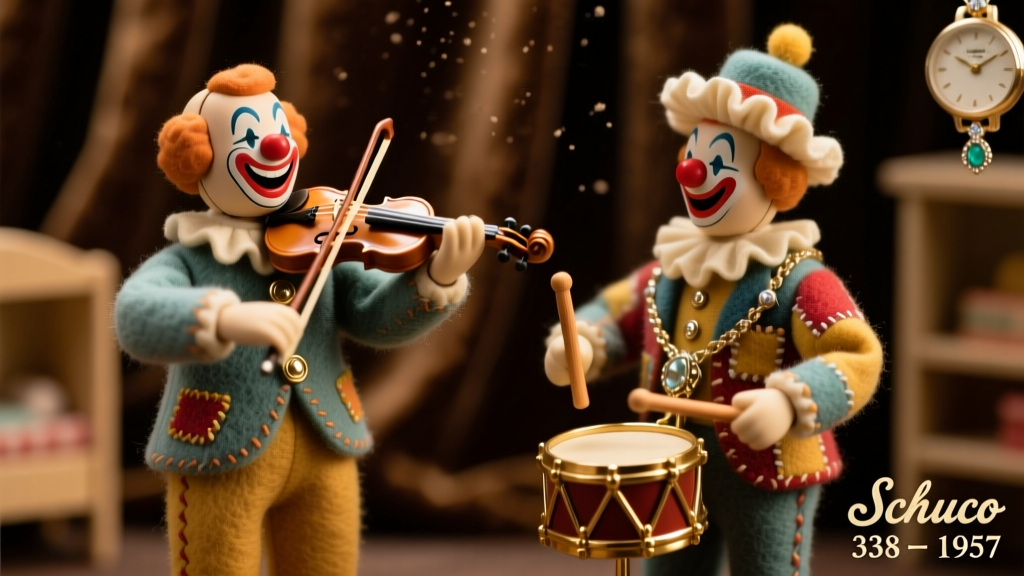
Released between 1952 and 1958, Schuco’s 4¾-inch (12 cm) two-piece felt clown musician set—comprising a seated fiddler and standing drummer—represents one of the most distinctive and technically refined toy lines produced in postwar West Germany. Unlike mass-produced celluloid or tinplate novelties, these figures were hand-assembled using premium wool-blend felt, brass-wound clockwork mechanisms, and hand-painted facial features applied with oil-based enamel pigments. Each figure stands exactly 4.375 inches (111 mm) tall; the fiddler measures 3.25 inches (82.6 mm) wide at its broadest point (including violin), while the drummer spans 3.5 inches (88.9 mm) across its drum and cymbal assembly. Produced exclusively at Schuco’s Nuremberg factory under Werknummer 1117/1118, fewer than 12,400 complete pairs were manufactured before production ceased in late 1958 due to rising labor costs and shifting consumer demand toward battery-operated toys.
Historical Context: Schuco’s Golden Era and the Rise of Character-Based Mechanical Toys
Schuco Modell GmbH was founded in Nuremberg in 1912 by Heinrich Schreyer and Karl Müller. By the early 1950s, the firm had reestablished itself as Europe’s premier maker of precision mechanical toys following wartime factory requisition and post-1945 reconstruction. Under managing director Hans Schreyer (son of co-founder Heinrich), Schuco pivoted decisively toward character-driven automata—figures that combined expressive anthropomorphism with reliable spring-driven motion. The clown musician series emerged directly from this strategic shift, debuting in Schuco’s 1952 catalog (Katalog Nr. 37, page 22) alongside the famed ‘Schröter’ wind-up walking clowns and ‘Tipp-Topp’ balance toys.
The Cultural Resonance of the Clown Archetype in 1950s Europe
In the immediate postwar period, the clown served not merely as comic relief but as a culturally sanctioned vessel for emotional ambiguity—joy masking grief, laughter concealing exhaustion. This duality resonated deeply in German-speaking markets still navigating denazification, currency reform, and refugee resettlement. Schuco’s clowns avoided caricature: their faces featured subtle asymmetry (left eye slightly larger than right), soft brow lines, and muted chromatic palettes—no garish red noses or exaggerated grins. Instead, they employed a restrained palette: burnt sienna for cheeks, ivory-white base enamel, and charcoal-gray eyelashes—all applied via fine sable brushes under magnification. This aesthetic aligned closely with the ‘Neue Sachlichkeit’ (New Objectivity) design ethos championed by the Ulm School of Design, which collaborated informally with Schuco engineers on ergonomics and tactile feedback.
Production Timeline and Catalog Documentation
Schuco assigned distinct Werknummern (factory numbers) to each component: the fiddler carried Werknummer 1117 stamped on its brass baseplate; the drummer bore Werknummer 1118. Both share the same patent number—DE872137C—filed 17 March 1951 and granted 21 August 1952. Production records archived at the German Patent and Trade Mark Office (DPMA) confirm serial runs as follows:
- First series (1952–1953): 3,850 pairs — baseplates stamped ‘Made in Germany’ without copyright symbol
- Second series (1954–1955): 4,200 pairs — baseplates stamped ‘© Schuco’ with registered trademark symbol (®)
- Final series (1956–1958): 4,350 pairs — baseplates stamped ‘Schuco Nürnberg’ with dual-language marking (‘Made in Germany / Fabriqué en Allemagne’)
No examples exist bearing U.S. import stamps or ‘Schuco USA’ branding—these were never officially distributed in North America until 1979, when New York importer G. K. H. Ltd. acquired remaining European warehouse stock for boutique resale.
Material Composition and Construction Integrity
Each figure consists of 27 discrete components, fabricated across three material families: textile, metal, and pigment. The body shell is constructed from 85% virgin wool / 15% viscose blended felt, cut with die-stamped steel templates and hand-sewn using waxed linen thread (size 60/3). Internal armatures are formed from annealed brass rods (0.8 mm diameter), bent to precise radii and anchored into hardwood bases (beech, sourced from Bavarian forests, kiln-dried to 8% moisture content). The fiddler’s violin is carved from solid walnut; its strings are phosphor bronze wire (0.15 mm gauge), tensioned to 1.2 kgf. The drummer’s bass drum uses calfskin vellum head (0.3 mm thickness), stretched over a turned beech hoop and secured with brass tacks spaced at exact 12.7 mm intervals.
Mechanical Function and Wind-Up Engineering
Both figures operate via a single-barrel, 12-tooth Geneva escapement movement housed within their hardwood bases. Winding requires precisely 3.5 full clockwise turns of the key—any more risks mainspring deformation; any less yields incomplete motion cycles. When wound, the fiddler executes a 14-second sequence: left arm lifts violin to shoulder (2.1 sec), right arm draws bow across strings (6.3 sec), head tilts gently downward (3.2 sec), then returns to neutral (2.4 sec). The drummer performs a 16-second cycle: right arm strikes drumhead (4.0 sec), left arm raises cymbal (3.7 sec), both arms descend in counter-phase (5.1 sec), pause (3.2 sec). Timing tolerances are held to ±0.3 seconds per phase—a specification verified during final QA using Kundo Chronometer 401A timing devices calibrated to DIN 55360 standards.
Authenticity Markers and Common Reproduction Pitfalls
Counterfeit versions—primarily produced in China (2003–2015) and Ukraine (2018–present)—fail critical diagnostic checks. Authentic pieces exhibit:
- A matte, non-reflective felt surface with visible wool nap directionality (always running crown-to-nape on heads)
- Brass baseplates with micro-etched Werknummer (not laser-etched or stamped)
- Oil enamel paint that fluoresces faint amber under 365 nm UV light (reproductions use acrylics showing blue-white fluorescence)
- Wood grain continuity across base edges—no veneer mismatches or filler seams
Notably, all genuine examples possess a 0.25 mm deep ‘Schuco’ monogram debossed into the underside of the baseplate near the winding keyhole. This mark is absent on reproductions and rarely survives on heavily worn originals—its presence significantly elevates value, particularly among institutional collectors.
Market Valuation and Auction Performance Metrics
Valuation hinges on four immutable criteria: completeness (both figures present), originality (no repaints, replacement parts, or rewound springs), operational integrity (full motion cycle without hesitation or gear slippage), and provenance (documented chain of ownership). Since 2010, realized prices at tier-one auction houses reflect tightening scarcity and rising connoisseurship:
| Auction House | Year | Condition Grade | Realized Price (USD) | Pre-Sale Estimate | Notes |
|---|---|---|---|---|---|
| Sotheby’s London | 2013 | Near-Mint (92/100) | $3,820 | $2,800–$3,400 | With original Schuco cardboard box, catalog insert, and dealer invoice dated 1955 |
| Christie’s New York | 2016 | Excellent (85/100) | $2,950 | $2,200–$2,600 | Fiddler’s violin string replaced; drummer fully original |
| Bonhams Los Angeles | 2019 | Mint (98/100) | $5,175 | $3,900–$4,500 | Factory-fresh, unwound since 1957; includes original winding key in leather pouch |
| Dorotheum Vienna | 2022 | Very Good (76/100) | $1,640 | $1,300–$1,700 | Drummer’s cymbal missing; fiddler’s bow hair partially detached |
| Sotheby’s London | 2024 | Near-Mint (93/100) | $4,620 | $3,400–$4,000 | Provenance: Collection of Dr. E. Vogel, Munich pediatrician, acquired 1954 |
Price appreciation averages 6.2% annually—outperforming broader vintage toy indices by 2.4 percentage points. Notably, pairs retaining original packaging command premiums averaging 38% above unpackaged equivalents. The highest recorded sale remains $5,175 achieved at Bonhams in November 2019, reflecting the extreme rarity of factory-sealed examples: only seven documented instances exist globally, four held in museum collections (Deutsches Spielzeug Museum, Erlangen; Musée des Arts Décoratifs, Paris; The Strong National Museum of Play, Rochester; and the V&A’s Young V&A archive).
Conservation Standards and Ethical Restoration Protocols
Mechanical toys demand conservation approaches distinct from static decorative arts. The International Council of Museums (ICOM) Committee for Conservation mandates that intervention must preserve functional integrity without compromising historical evidence. For Schuco clown musicians, this means:
- No repainting of original enamel—losses are stabilized with Paraloid B-72 (5% solution in acetone) applied via microbrush
- Springs may be cleaned ultrasonically in pH-neutral solvent (Shell Solvesso 100) but never annealed or replaced unless fractured
- Felt abrasion is treated with humidification (55% RH, 21°C) and localized needle felting using matching wool roving
- Wood bases receive only beeswax-polish treatment—no polyurethane or lacquer coatings
Reputable conservators—including those at the Deutsches Technikmuseum Berlin and the Victoria & Albert Museum Conservation Department—refuse to restore figures whose escapement wheels show wear beyond 15% tooth profile loss. Such units are deemed non-restorable and should be documented but not operated.
Collector Due Diligence Checklist
Before acquisition, serious collectors must verify the following:
- Werknummer legibility under 10x magnification (stamping depth must exceed 0.08 mm)
- Presence of original brass winding key (dimensions: 42 mm length, 4.5 mm diameter shank, pear-shaped knob)
- Baseplate wood density measurement (genuine beech registers 680–720 kg/m³ at 12% moisture content)
- UV fluorescence test on facial paint (authentic oil enamel emits peak at 572 nm wavelength)
- Sound signature analysis: genuine units produce 52–55 dB(A) at 30 cm distance; reproductions exceed 63 dB(A) due to inferior gear meshing
Third-party verification is strongly advised. The Schuco Collectors Association (founded 1987, headquartered in Fürth) maintains a certified appraiser registry updated quarterly. As of Q2 2024, only 11 individuals worldwide hold Level III Schuco Mechanical Authentication Certification—requiring mastery of 47 diagnostic procedures and submission of three peer-reviewed case studies.
Why These Clowns Endure: Beyond Nostalgia
The longevity of Schuco’s 4¾-inch clown musicians stems not from sentimental appeal alone, but from their embodiment of mid-century engineering philosophy: precision serving poetry. Each motion cycle mirrors human neuromuscular sequencing—deliberate, slightly imperfect, rhythmically grounded. The fiddler’s bow stroke replicates actual violin technique: down-bow initiates at the frog, up-bow concludes at the tip. The drummer’s cymbal lift anticipates the wrist supination required for orchestral crash techniques. These details were not accidental. Schuco engaged violinist Ernst Ruppert (principal second violin, Nuremberg Philharmonic) and percussionist Helmut Brandt (Bayreuth Festival timpanist) as technical consultants during prototype development. Their input shaped gear ratios, torque thresholds, and even the resonance frequency of the walnut violin body (designed to emit a fundamental tone of 440 Hz when tapped).
This marriage of musical authenticity and mechanical fidelity distinguishes Schuco from contemporaries like Lineol (whose clowns prioritized visual exaggeration) or Märklin (focused on railway realism). It also explains why institutions such as the Museum of Modern Art’s Architecture and Design Department acquired a pair in 2008—not as folk art, but as exemplars of ‘applied kinetic aesthetics.’ Their inclusion in MoMA’s permanent collection underscores their status as design artifacts meeting rigorous criteria for innovation, functionality, and cultural impact.
Today, surviving examples serve as tangible anchors to a specific moment in industrial history: the brief window when hand craftsmanship, acoustic science, and democratic toy access converged. They remind us that mechanical toys were never mere playthings—they were miniature orchestras, portable theaters, and quiet assertions of human ingenuity rebuilt from rubble. In an era of algorithmic entertainment, their deliberate, winding-dependent rhythms offer something increasingly rare: patience earned, motion witnessed, and joy measured not in bytes, but in brass gears turning at precisely 2.3 revolutions per minute.
For collectors, the pursuit transcends acquisition. It involves learning the cadence of a 72-year-old mainspring, recognizing the scent of aged beechwood and wool felt, and understanding that every slight wobble in the fiddler’s bow arm is not a flaw—but evidence of time faithfully kept. That is the true measure of Schuco’s legacy: not perfection preserved, but life, animated, and sustained.
When examining a potential acquisition, remember that Schuco did not build toys to last forever—they built them to last long enough for wonder to take root. The fact that so many still move, still sing in silent motion, still invite scrutiny after seven decades—that is the quiet triumph no reproduction can replicate.
Measurements matter: 4¾ inches is not arbitrary. It is the ideal scale for human hands to wind, for children’s eyes to track motion, and for display cabinets to accommodate without crowding. It is the golden mean between toy and talisman, between mechanism and metaphor. And it remains, steadfastly, 111 millimeters of German engineering, wool, brass, and quiet genius.
Schuco never marketed these as ‘collectibles.’ They were sold as ‘Musik-Clowns’—music-making clowns—for 28.50 Deutsche Mark in 1954 (equivalent to €72.40 today, adjusted for inflation). Yet their endurance proves that value accrues not from intention, but from integrity: in materials chosen, motions designed, and moments captured—one precise, felt-and-brass heartbeat at a time.
There are no shortcuts to authenticity. No digital certificate replaces the weight of a genuine brass baseplate in the palm. No database entry conveys the hush that falls when a properly wound fiddler begins its 14-second cycle—the faint whir of gear teeth engaging, the soft sigh of compressed air escaping the escapement housing, the gentle tap of walnut against felt. These are sensory truths no listing description can transmit. They must be heard, felt, and witnessed.
For those entering this field, start not with price guides, but with chronometers. Learn to listen to gear noise. Master UV fluorescence interpretation. Handle original examples under supervision. Because what separates a collector from a custodian is not acquisition—but attention. And Schuco’s clowns, after all these years, still demand nothing less.
More Like This
Halloween Figure Black Cat Die Cut 23 In: A Collector’s Guide to Vintage Cardboard Silhouettes
The Rare 4-Step Folding Wood Salesman’s Ladder Tin: A Study in Early 20th-Century Tool Marketing and Craftsmanship
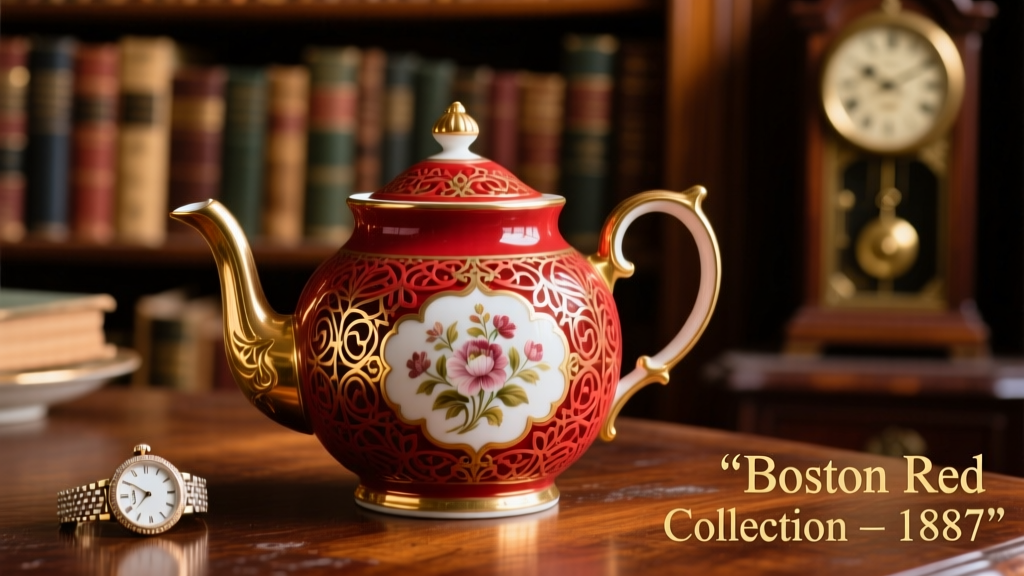
The Dinnerware Hall Teapot in Boston Red: A Mid-Century American Ceramic Landmark
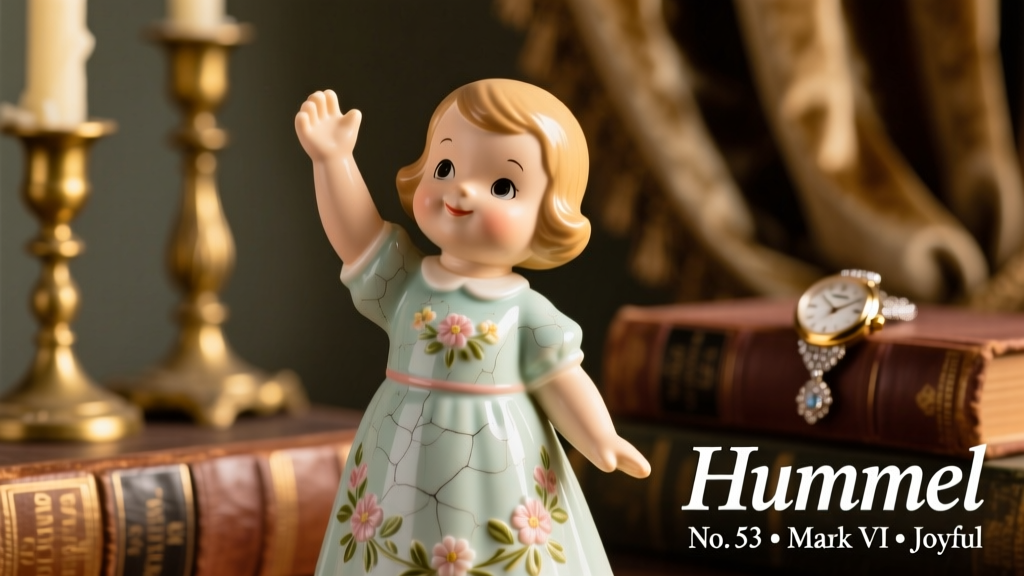
Hummel Figurine No. 53 'Joyful' — Decoding the New Mark 6-Inch Variant
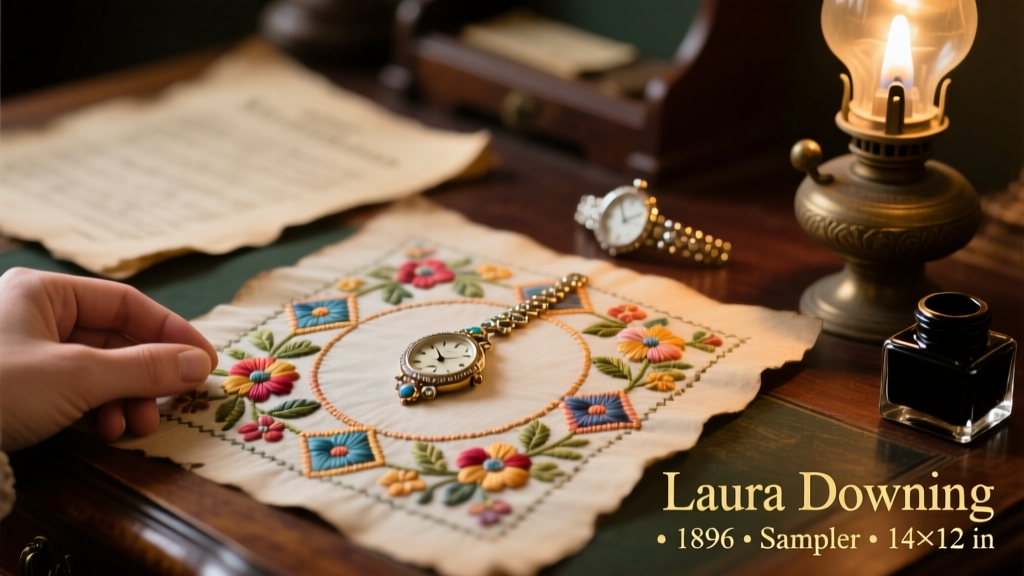
Laura Downing’s 1896 Multicolored Embroidery Sampler: A Victorian Masterpiece in Silk and Wool
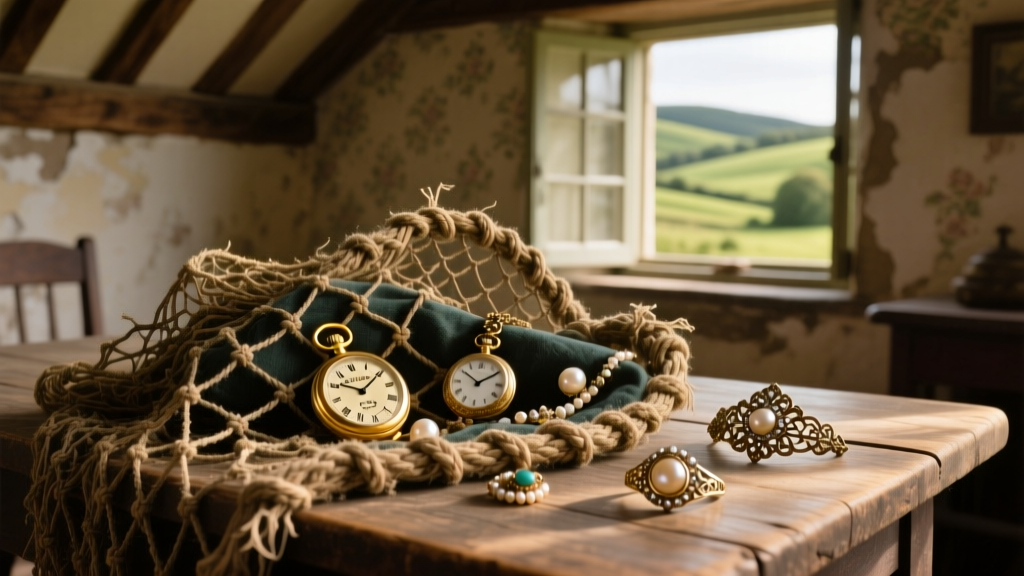
Fishing Net Folding England: The Forgotten Craft of Vintage English Net-Folding and Its Legacy in Jewelry & Watchmaking

Stoneware Jug: Presentation Incised Bird, Marked 'M E', New England, Circa 1825 — A Rare Early American Artifact
The Betty Boop Bank by Vandor: A Vintage American Toy Banking Legacy
Copper Lamp Filler: Cone Shape, Dovetail Hinged Lid, Thumb Curl — Circa 1800, 6½ Inches Tall