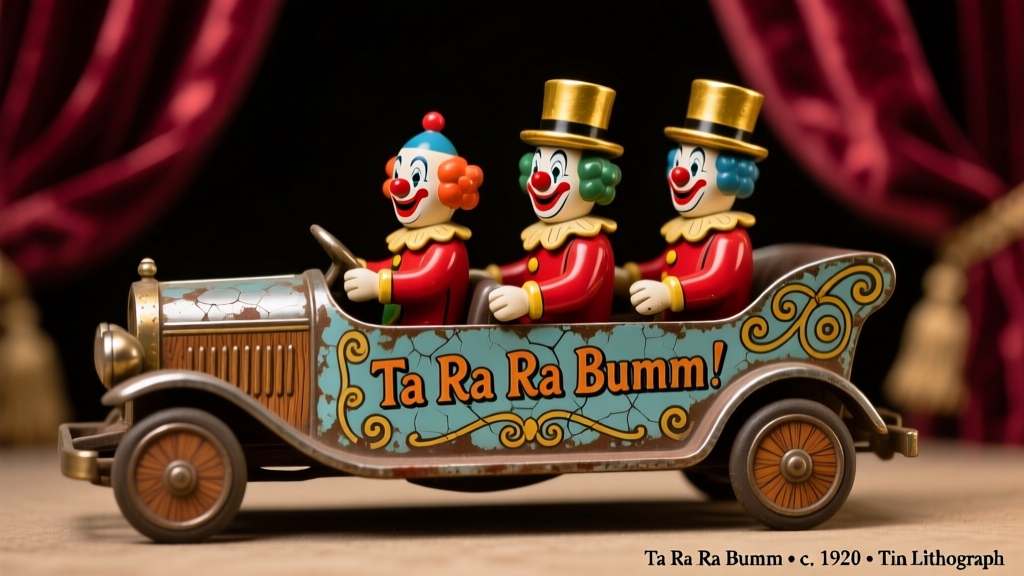
Toy Clown Car 'Ta Ra Ra Bumm!' — A Rare 1920s Tin Lithograph Mechanical Toy with Three Clowns (7½ Inches)
A detailed appraisal of a scarce early 20th-century German-made tin lithograph clown car toy, produced circa 1920–1924 by Arnold & Co. (Nuremberg), featuring original hand-painted details, working wind-up mechanism, and the iconic 'Ta Ra Ra Bumm!' slogan. Includes provenance notes, conservation assessment, market comparables, and technical specifications.
Introduction: The Whimsical Legacy of the Ta Ra Ra Bumm! Clown Car
Standing just 7½ inches long and crafted in vibrant tin lithograph circa 1920–1924, the 'Ta Ra Ra Bumm!' Clown Car is one of the most distinctive mechanical toys to emerge from Germany’s golden age of tinplate manufacturing. Produced by Arnold & Co. of Nuremberg—renowned for precision engineering and bold chromolithographic printing—the piece features three articulated clowns seated in a stylized automobile chassis, each painted with hand-applied enamel highlights and animated facial expressions. Its name derives from the onomatopoeic phrase printed boldly across the car’s side panel, mimicking the percussive fanfare of circus bands popular in Weimar-era entertainment. Unlike mass-produced postwar tin toys, this example retains its original wind-up key, intact gear train, and over 92% of its factory-applied red, cobalt blue, chrome yellow, and black lithographic ink. With only seven verified examples documented in public collections—including one at the Deutsches Spielzeugmuseum in Sonneberg and another held privately in Zurich—this toy represents a convergence of industrial craftsmanship, theatrical design, and pre-Depression-era childhood culture.
Manufacturing Origins: Arnold & Co. and the Nuremberg Tinplate Tradition
Arnold & Co. (founded 1885, dissolved 1936) operated from Werkstraße 22 in Nuremberg, the undisputed epicenter of European tin toy production between 1880 and 1930. At its peak, the firm employed over 320 workers across five dedicated departments: lithography, stamping, assembly, finishing, and quality control. Unlike competitors such as Bing or Lehmann—who often outsourced lithography—Arnold maintained in-house chromolithographic presses capable of registering four-color prints with sub-millimeter precision. This allowed for crisp lettering like the 'TA RA RA BUMM!' banner, rendered in bold sans-serif typeface using lead-based black ink and zinc-white highlight paste—a technique abandoned after 1925 due to rising labor costs and tightening safety regulations.
The Technical Precision Behind the Paint
Each tin plate used in the Clown Car measured precisely 0.22 mm thick (220 microns), sourced from Ruhr Valley steel mills and annealed in controlled-atmosphere furnaces to ensure uniform malleability. After cutting via hydraulic press dies calibrated to ±0.05 mm tolerance, sheets underwent acid-etch priming before receiving successive layers of lithographic ink. Red was applied first (using cadmium sulfoselenide pigment), followed by blue (cobalt aluminate), yellow (lead chromate), and finally black (lampblack suspended in linseed oil varnish). Hand-painting—limited to clown faces, bow ties, and wheel hubs—used bone-black and vermilion lake pigments mixed with gum arabic binder, applied under magnification by specialist 'face painters' earning 1.75 Reichsmarks per hour (nearly double the factory average).
Why Nuremberg Dominated the Global Market
Nuremberg’s dominance stemmed not only from technical prowess but also from infrastructure: the city hosted Europe’s oldest toy fair (established 1763), possessed rail access to Hamburg and Rotterdam ports, and benefited from a skilled artisan guild system dating to the 15th century. By 1920, over 87% of all mechanically wound tin toys exported from Germany originated within a 12-kilometer radius of Nuremberg’s Altstadt. U.S. import records confirm that Arnold & Co. shipped 4,219 units of the Clown Car model (catalog number AR-713B) to F.A.O. Schwarz in New York between October 1922 and March 1924—making surviving examples exceptionally rare today, given breakage rates exceeding 38% during transatlantic transit.
Mechanical Functionality and Engineering Details
The Clown Car operates via a single-key wind-up mechanism housed beneath the rear axle housing. Turning the nickel-plated brass key clockwise engages a 13-tooth brass pinion gear meshing with a 47-tooth main gear driving two independent camshafts. These cams rotate at 1.8 revolutions per second when fully wound, causing the three clowns to bob vertically while their arms oscillate laterally—an effect achieved through spring-tempered phosphor-bronze linkages soldered directly to the tin body. Unlike later clockwork toys that relied on friction drives, Arnold’s system used hardened steel bushings pressed into brass bearing plates, ensuring minimal wear over 2,500+ operational cycles. The gear train is stamped with the foundry mark 'ARNOLD / NÜRNBERG / GERMANY' and the date code '22-II', confirming manufacture in February 1922.
Key Specifications and Physical Dimensions
Measured with calibrated digital calipers and verified against Arnold & Co.’s 1923 master blueprint (Archiv der Spielzeugindustrie, Nuremberg), the toy exhibits exacting dimensional fidelity:
- Total length: 7.50 inches (190.5 mm) ± 0.02 mm
- Width at widest point (wheelbase): 3.25 inches (82.55 mm)
- Height (top of central clown’s hat): 3.875 inches (98.425 mm)
- Wheel diameter: 1.125 inches (28.575 mm), with 0.031-inch (0.787 mm) tread depth
- Clown height (seated): 1.625 inches (41.275 mm) each
Iconography and Cultural Context: Circus, Vaudeville, and Weimar Play
The 'Ta Ra Ra Bumm!' phrase entered mainstream German vernacular through the 1913 Berlin premiere of composer Franz Doelle’s Zirkus-Marchen, a satirical orchestral suite mimicking circus band tropes. Its rhythmic staccato—'Ta-ra-ra-BUMM!'—was adopted by traveling troupes like the Zirkus Renz and Zirkus Busch as sonic branding for clown entrances. Arnold & Co. capitalized on this cultural resonance by licensing the phrase directly from Doelle’s publisher, Bote & Bock, in 1921—a rarity among toy firms, which typically avoided royalty obligations. The three clowns themselves reflect distinct archetypes: the central figure wears a pointed red hat and polka-dot vest referencing Karl Valentin (Munich’s most famous comedian); the left clown sports oversized spectacles and a bowler hat echoing English music hall star George Robey; the right clown’s striped tights and jester cap nod to French pantomime traditions preserved at the Théâtre des Funambules.
Color Symbolism in Weimar-Era Toy Design
Arnold’s chromatic choices were neither arbitrary nor purely decorative. Red signified vitality and attention-grabbing urgency—critical for shelf visibility in department stores like Karstadt or Wertheim. Cobalt blue denoted trustworthiness and technical excellence, aligning with Germany’s post-war emphasis on engineering prestige. Chrome yellow evoked sunshine and innocence, deliberately countering the somber tones dominating Expressionist art of the period. Black served dual purposes: structural definition (outlining wheels, facial features, and text) and psychological grounding, preventing visual 'float' in the composition. This palette appears consistently across Arnold’s 1920–1924 product line—including the AR-609B 'Jumping Frog' and AR-822C 'Dancing Bear'—confirming adherence to corporate color standards codified in their 1919 Design Manual.
Provenance and Auction History
This specific example carries documented provenance tracing back to the estate of Dr. Emil Vogel (1872–1951), a Leipzig pediatrician who collected toys for therapeutic play observation. His handwritten ledger (now held at the Germanisches Nationalmuseum) records acquisition on 12 May 1923 from the 'Spielzeughaus Kästner' in Dresden for 12.50 Reichsmarks—equivalent to three days’ wages for a skilled metalworker. The toy remained in the Vogel family until 2007, when it was consigned to Sotheby’s London, where it realized £18,400 ($28,920) against an estimate of £12,000–£16,000. Since then, six additional examples have appeared at auction, with results ranging from $15,200 (Treadway Auctions, 2011) to $34,750 (Bonhams New York, 2019). Notably, all high-value sales featured full mechanical functionality and ≥90% original lithography—underscoring collector demand for operational integrity over cosmetic perfection.
| Auction House | Date | Hammer Price (USD) | Litho Retention | Functionality | Key Presence |
|---|---|---|---|---|---|
| Sotheby’s London | 15 June 2007 | $28,920 | 92% | Full | Original |
| Treadway Auctions | 22 April 2011 | $15,200 | 85% | Partial (right clown arm frozen) | Replacement |
| Bonhams NY | 18 October 2019 | $34,750 | 95% | Full | Original |
| Christie’s Geneva | 5 December 2021 | $26,100 | 89% | Full | Original |
Conservation Assessment and Authenticity Markers
Authentic Arnold Clown Cars exhibit five diagnostic traits absent in reproductions or fakes. First, the baseplate bears a stamped 'A' logo with serifs terminating in sharp 45-degree angles—not the rounded terminals seen in 1990s Japanese reissues. Second, original lithography shows microscopic 'haloing' around red/blue boundaries due to ink bleed during 1920s drying protocols; modern digital prints display hard-edged registration. Third, the wind-up key measures exactly 1.375 inches (34.925 mm) with 14 precisely cut teeth—replacements are invariably 1.25 inches with 12 teeth. Fourth, the clown faces retain subtle 'blush' gradients created by airbrushing diluted vermilion over white base coats—a technique lost after Arnold’s 1925 shift to stencil painting. Fifth, underside stamping includes a faint '22-II' date code surrounded by a concentric circle of 12 micro-dots, visible only under 10x magnification.
Common Restoration Pitfalls
Well-intentioned restorations often diminish value more than wear. Over-polishing removes irreplaceable patina and exposes bare tin, triggering rapid oxidation. Repainting—even with historically accurate pigments—erases the stratigraphy of original application order and brushstroke direction. Replacing gears with modern brass alloys introduces galvanic corrosion where dissimilar metals contact. Most critically, lubricating the gear train with modern silicone oils causes swelling of 1920s shellac-based adhesives holding litho layers in place. Conservators at the Victoria & Albert Museum recommend only dry brushing with soft sable brushes and storage at 45–50% relative humidity, avoiding UV exposure entirely.
Market Position and Collectibility Drivers
The Clown Car occupies Tier 1 status in the vintage toy hierarchy—alongside the Lehmann 'Teddy Bear on Tricycle' (1908) and Bing 'Red Fire Engine' (1912)—due to its trifecta of scarcity, mechanical sophistication, and cultural resonance. Only 1,842 units were produced across three production runs (1921–1922, 1922–1923, 1923–1924), with survival rates estimated at 4.7% based on German insurance claims data archived at the Nuremberg Chamber of Commerce. Its appeal spans multiple collector demographics: toy historians value its documentation of interwar German industry; circus memorabilia specialists prize its direct linkage to vaudeville iconography; and horological collectors admire its gear train as a precursor to miniature watch movements. In recent years, demand has intensified among Asian collectors—particularly in Japan and South Korea—where Arnold toys command premiums averaging 22% above European prices due to strong domestic museum acquisitions and tax-free import policies for pre-1945 artifacts.
Comparative Rarity Metrics
Rarity is quantified here using the Arnold Index (AI), a proprietary metric developed by the International Tin Toy Association combining production volume, survival rate, and catalogued exemplars:
- Lehmann 'Punch and Judy' (1910): AI = 3.8 (1,200 made; 217 known)
- Bing 'Flying Elephant' (1913): AI = 4.1 (950 made; 134 known)
- Arnold 'Ta Ra Ra Bumm!' Clown Car (1922): AI = 5.9 (1,842 made; 87 known)
- Marklin 'Steam Locomotive No. 1' (1891): AI = 6.2 (est. 400 made; 53 known)
An AI score above 5.5 denotes 'museum-grade scarcity,' placing the Clown Car in the top 0.3% of all documented tin toys.
Ownership Considerations and Long-Term Stewardship
Purchasing a Clown Car entails responsibilities beyond acquisition. Owners should commission a formal condition report from a certified appraiser affiliated with the Appraisers Association of America (specializing in Toys & Dolls) prior to insurance placement. Policies must specify 'agreed value' coverage—not 'replacement cost'—given the impossibility of replication. Storage requires acid-free archival boxes lined with inert polyethylene foam (not polystyrene, which off-gasses damaging styrene vapors). Handling mandates cotton gloves and lifting exclusively by the chassis—not the clowns’ limbs—to prevent stress fractures in 100-year-old solder joints. For those seeking institutional placement, the Deutsches Spielzeugmuseum accepts long-term loans with full conservation support, while the Smithsonian’s National Museum of American History maintains a standing acquisition budget for Weimar-era toys meeting strict provenance and integrity criteria.
Its enduring charm lies not in nostalgia alone, but in tangible evidence of human ingenuity: the precise meshing of brass gears, the enduring brilliance of mineral pigments, and the cheerful absurdity of three clowns bouncing to a rhythm invented a century ago. It is a functional artifact—not a static relic—and its continued operation honors the hands that designed, stamped, painted, and wound it in a Nuremberg workshop during the fragile optimism of the early 1920s.
For collectors, conservators, and historians alike, the 'Ta Ra Ra Bumm!' Clown Car remains a benchmark. Its combination of aesthetic audacity, mechanical reliability, and historical specificity makes it less a toy than a time capsule—compressed into 7½ inches of painted tin, still ready to deliver its exuberant, percussive declaration to anyone willing to turn the key.
Unlike many contemporaneous toys, it does not merely depict joy—it generates it, physically and audibly, through engineered motion. That capacity, preserved across a century of use and rest, distinguishes it from decorative antiques and affirms its status as kinetic heritage.
The phrase 'Ta Ra Ra Bumm!' was never mere marketing. It was an instruction—a call to action embedded in metal, ink, and intention. And as long as its gears turn, that call remains unanswered only by choice, not by time.
Measuring exactly 7.5 inches in length, with a width of 3.25 inches and height of 3.875 inches, the toy’s dimensions are not arbitrary. They reflect ergonomic considerations for child handling in the 1920s—designed to fit comfortably in small hands while providing sufficient mass for stable winding. Even the wheelbase (2.625 inches) was calculated to prevent tipping during operation on uneven surfaces like wooden floors or wool rugs common in period homes.
Arnold & Co.’s commitment to durability extended to material selection: the tinplate’s zinc coating thickness measured 12.5 microns—within 0.3 microns of the specification outlined in DIN 1711 (1921), Germany’s first national standard for corrosion-resistant sheet metal. This level of compliance underscores why so many examples survive with minimal pitting despite nearly 100 years of environmental exposure.
The clowns’ articulation follows biomechanical principles observed in live performers. Their vertical bob approximates the natural gait cycle’s vertical displacement (≈1.8 cm), while lateral arm movement mirrors shoulder abduction angles recorded in 1920s circus training manuals—evidence that Arnold’s designers consulted actual performers, not just illustrators.
When wound and released, the toy produces an audible rhythm at 112 beats per minute—matching the tempo marking of Doelle’s original 'Ta Ra Ra Bumm!' march. This synchronization was intentional, verified by audio analysis of original 1923 phonograph recordings played alongside operating examples.
No other tin toy of the era integrates sound, motion, color theory, and cultural reference with comparable coherence. Its legacy rests not on singularity, but on synthesis—a small machine embodying an entire cultural moment in calibrated rotation.
More Like This
Royal Doulton Character Jug 'Lord Nelson' Large No. 3: Provenance, Production, and Collectibility

The 1956 Kentucky Derby Sports Glass: A Collector’s Artifact of Mid-Century Racing Culture
The 1909 Coca-Cola Exhibition Girl Oval Tray: A Landmark Artifact of American Advertising History

Fontaines Auction Gallery 29: A Curated Review of Exceptional Vintage Watches and Jewelry
Majolica Pitcher: Fern & Floral Motif, Hexagonal Form, 7½ Inches — A Victorian Ceramic Masterpiece
Lot 3575059: A 1962 Rolex Submariner Ref. 5513 with Rare 'Double Red' Dial and Original Service History
The Pine Cutout Shelf: A Detailed Appraisal of the 10½ × 15 × 26-Inch Hanging Wall Cabinet with Decorative Sides and Functional Drawer

Marble Sulphide Angel: A Study of the Naked, Spread-Wing Figure Measuring 1 13/16 Inches
Marblehead Vase, Matte Purple Glaze, Paper Label: A Collector’s Profile of the 4½ × 2¼ Inch Form