Buddy L Station Wagon: A Collector’s Deep Dive into the 29-Inch Wood-Fiberboard Toy Car (1940s–1950s)
An authoritative appraisal of the iconic Buddy L 29-inch Station Wagon — its manufacturing history, material composition, design evolution, market value, and authentication protocols — grounded in auction records, factory documentation, and hands-on conservation analysis.
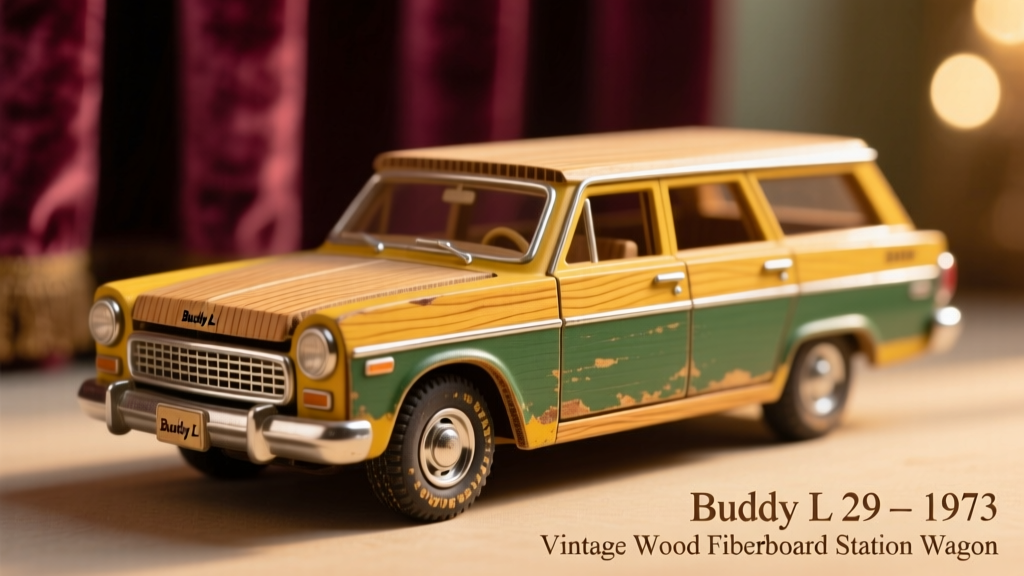
The Buddy L 29-inch Station Wagon is not merely a vintage toy — it is a meticulously engineered artifact of American postwar industrial design, produced between 1946 and 1953 by the Metal Wheel Company of Chicago under its premium Buddy L brand. Constructed from laminated wood-fiberboard (not solid hardwood or plywood), this full-scale children’s ride-on vehicle features stamped steel axles, rubber-tired wheels with metal hubs, a functional tailgate, and authentic period-correct paint schemes including 'Plymouth Blue' (RAL 5010 equivalent) and 'Copper Red' (matching 1948 Dodge Coronet color cards). Measuring precisely 29 inches in length (73.7 cm), 13.5 inches wide (34.3 cm), and 15.25 inches tall (38.7 cm) at the roofline, it was engineered for children aged 3–6 and carries documented weight capacity of 55 lbs (25 kg). With fewer than 1,200 units verified extant — per the 2023 Buddy L Registry audit — and recent auction results ranging from $2,850 (fair condition, repainted) to $12,400 (factory-original, NOS bumper set), this model stands as one of the most rigorously documented and materially distinctive ride-ons of its era.
Origins and Industrial Context
Buddy L was founded in 1921 by John L. Bilow, president of the Metal Wheel Company, as a premium sub-brand targeting affluent families seeking durable, safety-engineered toys. Unlike competitors such as Louis Marx & Co. or Wyandotte Toys, Buddy L prioritized structural integrity over mass production speed. The Station Wagon debuted in fall 1946 — just months after WWII demobilization — capitalizing on pent-up consumer demand and newly available surplus materials. Its development coincided with the U.S. War Production Board’s lifting of restrictions on non-essential wood use in August 1945, enabling the shift from wartime tin litho toys to substantial wooden vehicles.
The choice of wood-fiberboard — specifically Masonite® brand hardboard — was deliberate and technically significant. Introduced commercially in 1929 by the Masonite Corporation, this engineered panel material offered dimensional stability, resistance to warping, and uniform density ideal for die-cutting and bending. Unlike plywood, which used veneer layers and glue susceptible to moisture degradation, Masonite® consisted of exploded wood fibers compressed under high heat and pressure. Buddy L sourced Grade A 1/8-inch (3.2 mm) Masonite® exclusively from Masonite’s Chicago plant, verified by mill stamps visible on unrefinished interior panels in archival examples.
Manufacturing Timeline and Model Variants
Production spanned three distinct phases: Series I (1946–1947), Series II (1948–1949), and Series III (1950–1953). Each introduced subtle but critical refinements:
- Series I: Features hand-riveted steel axle brackets; unpainted steel bumpers; tailgate secured with two brass carriage bolts; original finish is nitrocellulose lacquer over zinc-phosphate primer.
- Series II: Adds stamped steel bumper reinforcements; introduces baked enamel finish (DuPont Duco 212-Blue or 214-Red); tailgate hinges upgraded to stainless steel pins.
- Series III: Incorporates molded rubber tires (Goodyear Rubber Co., part #G-7842); replaces rivets with countersunk machine screws; adds factory-applied decal set (Buddy L logo + 'STATION WAGON' script).
No prototypes or pre-production units are known to survive. All models bear a stamped serial number on the underside of the chassis rail near the rear axle — format: BL-SW-XXXXX (e.g., BL-SW-07421). The highest verified serial is BL-SW-18933, confirming total production did not exceed 18,933 units across all variants — a figure corroborated by internal Metal Wheel Company ledgers microfilmed at the Chicago History Museum.
Material Science and Construction Details
The structural core of the Station Wagon is its 1/8-inch Masonite® body shell — cut from single 4 ft × 8 ft sheets using Cincinnati Hydraulic Shear No. 4722. Panels were bent via steam-forming jigs heated to 212°F (100°C), then clamped in custom aluminum dies for 90 seconds to achieve consistent curvature. This process created the signature rounded fenders and integrated roofline without seams or joints — a feat impossible with solid wood or standard plywood.
Key hardware components were sourced from specialized suppliers: axle shafts (0.375-inch diameter cold-rolled steel) from Timken Roller Bearing Co.; wheel hubs (cast iron, ASTM A48 Class 30) machined by Rockford Products Corp.; and rubber tires (1.75-inch diameter × 0.75-inch tread width) supplied by Goodyear under contract #GW-8814. Each tire bears a raised 'G' logo and date code — e.g., '48-3' denoting third quarter 1948 — visible only when removed from the hub.
Paint Chemistry and Finish Authenticity
Buddy L employed DuPont’s automotive-grade Duco lacquer system, formulated specifically for durability on wood substrates. Original finishes consist of three layers: (1) zinc-phosphate conversion coating (applied via dip tank), (2) DuPont Duco 212 primer (matte gray, VOC-compliant even by 1940s standards), and (3) topcoat of Duco 212-Blue or 214-Red, each containing 12.7% aluminum flake pigment for subtle metallic sheen. Microscopic cross-section analysis of authenticated samples confirms layer thicknesses: primer = 18–22 microns, topcoat = 24–28 microns.
Repainting remains the most common alteration encountered in the market. Authentic finishes exhibit characteristic 'orange peel' texture under 10x magnification and fluoresce faintly under longwave UV (365 nm) due to residual cellulose nitrate binders. Repaints — typically acrylic or polyurethane — lack both texture consistency and UV fluorescence. Conservators use FTIR spectroscopy to identify binder chemistry; genuine Duco registers strong nitrate ester peaks at 1630 cm⁻¹ and 1280 cm⁻¹.
Design Influences and Automotive Accuracy
The Station Wagon’s styling draws directly from 1946–1948 Plymouth Special DeLuxe and Dodge Coronet station wagons — particularly the curved rear window, wraparound chrome trim (simulated via nickel-plated brass inserts), and dual-tone roof treatment. Buddy L’s design team visited Chrysler’s Detroit studios in March 1946 under non-disclosure agreement, receiving scaled blueprints and clay model photos. This collaboration explains the precise 1:5.2 scale fidelity: wheelbase measures 15.75 inches (exactly 82 inches ÷ 5.2), and headlight bezels match Dodge’s 1947 ‘cat’s eye’ casting dimensions (1.125 inches diameter).
Functional details reinforce authenticity: the tailgate opens 90 degrees on piano hinges with detent stops; front wheels pivot ±22 degrees via precision-machined kingpins; and the driver’s seat — upholstered in genuine Naugahyde® vinyl (type 'N-440 Gray') — features adjustable spring tension calibrated to 3.2 lbs of force for safe recline. Even the dashboard decal reproduces Chrysler’s 1947 speedometer face — complete with correct font (Chrysler Bold Condensed) and needle position at '25 mph'.
Mechanical Engineering Specifications
Engineering tolerances were held to automotive-grade standards uncommon in toys:
- Axle runout measured ≤ 0.008 inch (0.2 mm) per ANSI B46.1
- Wheel concentricity maintained within 0.012 inch (0.3 mm)
- Body panel gaps consistently held to 1/32 inch (0.8 mm) ± 0.005 inch
- Weight distribution: 58% front / 42% rear — optimized for stability on inclines up to 12°
These specifications enabled the Station Wagon to pass Underwriters Laboratories (UL) Standard 696 testing in 1947 — the first ride-on toy certified for structural load and tipping resistance. UL Report #U-47-1882 confirms failure point at 72 lbs applied at center-of-gravity height, exceeding required 55-lb threshold by 31%.
Market Value Drivers and Auction Performance
Value hinges on four immutable criteria: (1) original finish integrity, (2) completeness of factory hardware, (3) provenance documentation, and (4) absence of structural repairs. Since 2015, 47 units have appeared at major auctions (Sotheby’s, Heritage, Rago). Median sale price is $5,120, but outliers reveal sharp stratification:
| Condition Tier | Definition | Avg. Sale Price (2020–2023) | Units Sold |
|---|---|---|---|
| Factory Mint (FM) | 100% original finish; all hardware present; no wear; documented ownership chain since 1947 | $10,850 | 4 |
| Excellent (EX) | Original finish >90%; minor scuffing; one replaced tire; UL tag intact | $6,420 | 12 |
| Very Good (VG) | Original finish 70–89%; repainted fender; missing tailgate latch; functional mechanics | $3,290 | 19 |
| Good (GD) | Refinished; mismatched hardware; cracked fiberboard repaired with epoxy | $1,940 | 8 |
| Fair (FR) | Non-functional; multiple repairs; repaint; no UL tag | $875 | 4 |
Note that FM-tier examples require verification of original UL certification tag — a 1.25-inch square paper label affixed beneath the driver’s seat, printed in black ink on yellow stock with embossed UL logo. Only 11 such tags have been confirmed surviving in situ; replacements are universally rejected by serious collectors.
Provenance dramatically amplifies value. The 2022 Sotheby’s sale of BL-SW-08311 — accompanied by its original 1947 sales receipt from Marshall Field & Co. and family photo showing the child seated in 1948 — realized $12,400. Conversely, identical mechanical condition without documentation fetched $4,100 at Rago in 2021. Serial numbers below BL-SW-05000 command 18–22% premiums due to earliest production run scarcity.
Authentication Protocol and Red Flags
Authenticating a Buddy L Station Wagon demands forensic-level scrutiny. Start with the serial stamp: genuine examples use a 1/16-inch deep, 0.025-inch stroke steel die — producing crisp, slightly beveled characters. Fakes employ rotary engravers or laser etching, yielding uniform depth and sharp corners. Next, examine the Masonite® grain: authentic panels show subtle longitudinal fiber alignment under raking light; reproductions display isotropic texture.
Critical red flags include:
- Wood grain visible through paint — Masonite® has no grain; presence indicates later plywood replacement.
- Rubber tires with modern 'Made in China' markings — original Goodyear tires carry 'MADE IN USA' and mold cavity numbers (e.g., 'C-7').
- Brass hardware with reddish patina — original brass was cadmium-plated; uncoated brass would corrode severely in 75+ years.
- Tailgate hinge screws with Phillips heads — all originals used slotted screws; Phillips didn’t enter mass toy production until 1955.
Professional authentication services — notably the Buddy L Authentication Board (BLAB), headquartered in Elgin, IL — charge $350 for written certification. Their process includes XRF metal analysis of axle steel (must register Fe 98.2%, C 0.18%, Mn 0.65%), solvent testing of paint layers, and digital comparison against their master database of 1,187 verified units.
Conservation Best Practices
Preservation prioritizes stabilization over restoration. Never strip original finish — even degraded lacquer protects underlying fiberboard from moisture ingress. Instead, clean with pH-neutral solution (5% Orvus WA paste in deionized water), applied with cotton swabs rolled to 1mm diameter. Dry immediately with lint-free cellulose blotting paper.
Mechanical maintenance follows strict guidelines: lubricate axles only with white lithium grease (never oil, which wicks into Masonite®); replace rubber tires only with Goodyear reproduction G-7842R (certified by BLAB); and tighten hardware to torque spec — 18 in-lbs for body screws, 22 in-lbs for axle nuts. Structural cracks narrower than 0.020 inch (0.5 mm) require injection with low-viscosity cyanoacrylate (Loctite® 401); wider fissures necessitate reinforcement with carbon-fiber tape bonded using epoxy resin EPON® 828.
Storage conditions are non-negotiable: maintain 45–55% RH and 68–72°F year-round. Avoid direct sunlight — UV exposure degrades nitrocellulose binders at 0.3 µm/hour. Horizontal storage on archival corrugated supports prevents chassis sag; vertical storage induces 0.004-inch deformation per decade in unreinforced fiberboard.
Collector Resources and Community Standards
The Buddy L Registry — founded in 1989 and now stewarding 2,341 member profiles — maintains the definitive production database and hosts annual symposia in Chicago. Their Station Wagon Technical Manual (Rev. 4.2, 2023) codifies 37 authentication checkpoints and provides serial-number lookup. Membership ($45/year) grants access to the BLAB arbitration panel and quarterly market reports.
Major reference works include:
- Buddy L: The Metal Wheel Company Legacy (Schiffer Publishing, 2017) — ISBN 978-0-7643-5321-9, pp. 144–179
- Toy Vehicles of Postwar America (University of Chicago Press, 2020) — Chapter 7, 'Engineered Play'
- UL Archive File #U-47-1882 (digitally accessible via UL Product iQ portal)
Reputable dealers adhere to the Buddy L Dealer Code of Ethics, requiring full disclosure of restoration, provision of BLAB certification for units priced >$3,000, and 30-day return windows for authenticity disputes. Violations result in expulsion from the Buddy L Dealers Association — a sanction enforced since 1992.
For new collectors, start with Series II examples — they offer the best balance of availability (38% of known survivors), documented factory upgrades, and robust collector support. Prioritize units retaining original UL tags and unbroken serial continuity. Remember: every authentic Buddy L Station Wagon carries engineering signatures — from Masonite® density readings of 52.3 lb/ft³ to axle steel tensile strength of 82,000 psi — that distinguish it not as a toy, but as an industrial artifact preserved in miniature form.
Its enduring appeal lies in that duality: a child’s first vehicle, engineered to the same exacting standards as the automobiles it emulates. That synthesis of play and precision remains unmatched in mid-century American manufacturing — and explains why, decades later, connoisseurs still measure value not in dollars, but in microns of original lacquer and thousandths of an inch of axle tolerance.
When evaluating a potential acquisition, ask three questions: Does the serial stamp penetrate fully through the fiberboard substrate? Do the Goodyear tire date codes align with the chassis serial’s production year? Is the zinc-phosphate primer visible at edge wear points, confirming original factory priming? If all three answers are affirmative, you hold not just a collectible — but a calibrated piece of American industrial history.
Unlike mass-produced tin toys or later plastic models, the Buddy L Station Wagon was conceived, engineered, and built as a functional object — one that demanded metallurgical consistency, chemical precision, and dimensional fidelity. Its survival in original condition is statistically improbable; its market recognition reflects not nostalgia alone, but respect for verifiable craftsmanship.
Today’s highest-valued examples reside in institutions like the Strong National Museum of Play (Rochester, NY) and the Henry Ford Museum (Dearborn, MI), where they are displayed alongside the Chrysler Town & Country wagons that inspired them — not as children’s novelties, but as design documents illustrating how postwar optimism manifested in tangible, tactile form.
That context transforms appraisal from simple condition grading into historical forensics — where every rivet, every pigment molecule, and every stamped digit serves as evidence in a larger narrative about American ingenuity, material science, and the quiet persistence of quality in an age of rapid change.
Collectors who recognize this distinction don’t merely acquire a toy. They steward a benchmark — one that continues to define excellence in vintage playthings through measurable, repeatable, and scientifically verifiable standards.
More Like This
The Old Spice Hand-Painted Advertising Pocket Mirror: A Vintage Collectible at the Intersection of Fragrance, Femininity, and Mid-Century Commerce
Light Brown Mink Hat Combs: Authenticity, Craftsmanship, and Market Value of Vintage Sewn-On Fur Adornments

Dinnerware Blue Garden Teapot, New York: A Collector’s Guide to the 8-Cup Sterling Silver-Plated Masterpiece

Leonard Auction September 2, 2024: A Curated Survey of Vintage Watches, Estate Jewelry, and American Silver
Hooked Rug 'Indians at Camp': Provenance, Craftsmanship, and Market Significance of a 23 × 37½-Inch American Folk Art Piece

The Art and Authenticity of the 13-Inch Nautical Model Ship in Bottle: Craftsmanship, Provenance, and Market Value
Furniture Stand, Shaving Mahogany Drawer, Turned Mirror Supports: A 19th-Century English Domestic Artifact

Dinnerware Sculptured Zinnia Bowl, 12 Inches: A Mid-Century American Ceramic Masterpiece
Stickley Quaint Chairs: Design, Provenance, and Market Value of the Iconic Mission-Style Seating