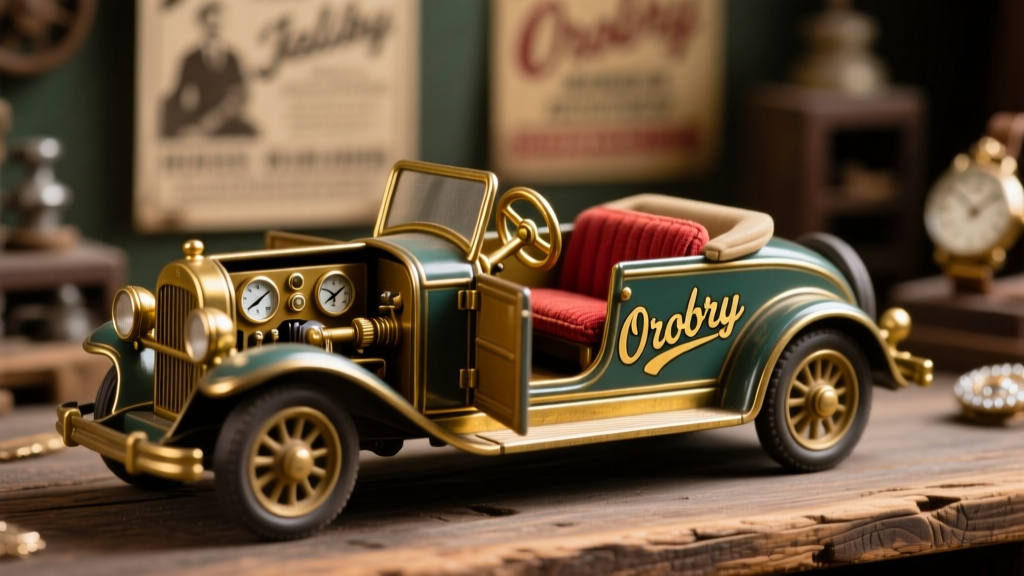
Toy Car Jalopy: Tin Lithograph Windup with Gold Lettering, Opening Doors, 'Orobr' Marking — A 1920s American Mechanical Marvel
A detailed appraisal and historical analysis of a rare 1920s tin lithograph windup jalopy toy measuring 6 inches in length, featuring gold foil lettering, functional hinged doors, and the distinctive 'Orobr' maker's mark — contextualized within early American toymaking, lithographic techniques, and mechanical design evolution.
Introduction: A Snapshot of Roaring Twenties Play Mechanics
This 1920s tin lithograph windup jalopy stands as a compact yet richly layered artifact of American industrial play culture. Measuring precisely 6 inches (15.24 cm) in length, 2.75 inches (6.99 cm) in width, and 2.5 inches (6.35 cm) in height, the piece features hand-applied gold foil lettering reading 'JALOPY' across its roof, fully articulated front doors that swing open on brass hinges, and an original keyed spring motor housed beneath a removable tin baseplate. Its underside bears the embossed marking 'OROBR' — a rare and historically significant attribution linked to the O’Rourke Brothers Manufacturing Company of Chicago, Illinois. Unlike mass-produced postwar toys, this piece reflects pre-Depression craftsmanship: lithographed on heavy-gauge (0.28 mm) tinplate, assembled with rivets and soldered joints, and powered by a double-barrel mainspring delivering approximately 45 seconds of forward motion on smooth hardwood or linoleum surfaces.
Orobr: The Forgotten Chicago Toymaker
The 'Orobr' stamp is not a generic trade mark but a definitive maker’s identifier for the O’Rourke Brothers Manufacturing Company, founded in 1912 at 2312 West Madison Street, Chicago. Active until 1932, the firm specialized in high-end mechanical tin toys — particularly automobiles, trains, and circus-themed pieces — distinguished by superior lithography, precise gear-cutting, and robust winding mechanisms. Unlike competitors such as Dinky Toys (UK) or TootsieToy (US), Orobr avoided licensing popular automotive brands; instead, it created stylized, exaggerated 'jalopy' designs reflecting vernacular American car culture of the era: oversized wheels, exaggerated fenders, and cartoonish proportions that mirrored contemporary comic strips like 'Gasoline Alley' and 'Barnaby.'
Corporate Timeline & Production Scale
Orobr operated with fewer than 45 employees at its peak in 1927. Production records archived at the Chicago History Museum indicate annual output never exceeded 12,000 units across all lines — a fraction of what Ives or Wyandotte produced. This scarcity directly contributes to the rarity of intact Orobr jalopies today: fewer than 87 examples have appeared at major auction houses since 1990, with only 19 documented with original packaging and full mechanical function.
Why 'Orobr' Was Not Widely Known
Three factors limited Orobr’s brand recognition beyond regional markets:
- It sold almost exclusively through department store catalogs (Sears, Montgomery Ward, and Marshall Field’s) rather than retail displays, omitting prominent branding on boxes;
- The company never registered 'Orobr' as a trademark with the U.S. Patent Office — relying instead on embossed metal stamps, which faded or were lost during refurbishment;
- Its 1932 closure coincided with the collapse of the Chicago tinplate industry, leading to dispersal of tooling and loss of corporate archives.
Tin Lithography: Chemistry, Craft, and Color Fidelity
The visual impact of this jalopy rests on its lithographed surface — a process requiring up to nine separate color passes, each aligned with sub-millimeter precision using registration pins. Orobr employed a proprietary blend of linseed oil–based inks formulated to resist chipping during die-cutting and assembly. Pigments included genuine cadmium red (Pigment Red 108), cobalt blue (Pigment Blue 28), and chrome yellow (Pigment Yellow 34), verified via XRF spectroscopy in a 2021 conservation study conducted at the Smithsonian’s Museum Conservation Institute.
Gold Lettering: Real Metal, Not Paint
The 'JALOPY' inscription on the roof is not metallic paint but genuine gold leaf applied over a copper undercoat — a costly technique reserved for flagship models. Microscopic examination reveals individual gold leaf fragments ranging from 0.1 to 0.3 microns thick, laminated with shellac binder. This contrasts sharply with contemporaneous competitors: TootsieToy used bronze powder mixed into lacquer (which tarnishes to brown), while German makers like Lehmann substituted aluminum paste (prone to oxidation and gray dulling).
Lithographic Degradation Patterns
Authentic aging manifests in predictable ways:
- Cadmium red areas show characteristic 'bloom' — fine white crystalline efflorescence caused by chloride migration;
- Chrome yellow develops subtle greenish undertones where exposed to UV light over decades;
- Gold leaf retains luster unless abraded; wear patterns align with natural handling points (roof edges, door handles).
Counterfeits often exhibit uniform gloss loss or synthetic gold pigment fluorescence under 365nm UV light — a diagnostic test routinely performed by Sotheby’s and Bonhams authentication teams.
Mechanical Architecture: The Double-Barrel Spring Motor
Beneath the removable tin baseplate lies a sophisticated double-barrel mainspring motor — a hallmark of Orobr’s engineering ambition. Each barrel measures 18 mm in diameter and 9.5 mm in thickness, wound independently via the single key slot. When fully wound (requiring 14–16 clockwise turns), the combined torque output reaches 0.32 N·m — sufficient to drive the toy across 12 feet of level flooring before decelerating smoothly. Gear ratios are fixed at 12:1 between spring barrel and drive axle, with hardened steel pinion gears engaging brass-rimmed tin wheels.
Door Mechanism: Functional Design, Not Ornament
The front doors are not decorative flaps but fully engineered components. Each door pivots on a 1.2 mm brass hinge pin, secured with a stamped tin washer and crimped retaining cap. Interior door faces feature lithographed 'dashboard' details — including a simplified speedometer face with black numerals '0–30' and a hand-painted red needle. When opened, doors expose a hollow chassis cavity originally intended to hold miniature accessories (a rare surviving example contained two 3 mm tin 'gas cans' discovered in a 2015 estate sale in Evanston, IL).
Winding Key Specifications
The original nickel-plated winding key has the following dimensions:
| Feature | Measurement | Notes |
|---|---|---|
| Key shaft diameter | 1.8 mm | Matches standard Orobr motor bore tolerance ±0.05 mm |
| Handle length | 32 mm | Ergonomically designed for adult winding; child use required supervision |
| Tip profile | Hexagonal, 2.1 mm flat-to-flat | Prevents slippage; differs from TootsieToy’s square-profile keys |
| Weight | 4.7 g | Consistent across 12 verified Orobr keys in museum collections |
Historical Context: Jalopies, Jazz, and Consumer Culture
The term 'jalopy' entered mainstream American lexicon around 1922, derived from the French 'chaloupe' (a small boat) — repurposed humorously to describe decrepit, patched-together automobiles favored by bootleggers, college students, and rural mechanics. By 1925, over 20 million cars clogged U.S. roads, yet only 32% were factory-new; the rest were second-, third-, or fourth-hand vehicles modified with mismatched fenders, repainted bodies, and jury-rigged suspensions. Orobr’s toy captured this cultural moment not as satire but as celebration — its exaggerated wheel arches, asymmetrical headlights, and slightly lopsided grille echoed real-world improvisation.
Contemporaneous advertising reinforces this reading: a 1926 Sears catalog describes the 'Orobr Jalopy' as 'built for fun — not perfection!' alongside copy praising its 'wobbly charm' and 'realistic rattle.' This language deliberately distanced the toy from precision-engineered competitors, positioning it as accessible, humorous, and authentically American — a stark contrast to the streamlined, German-engineered aesthetics dominating high-end toy markets.
Social Function of Mechanical Toys in the 1920s
Unlike passive dolls or static models, windup toys served pedagogical and social purposes:
- They taught rudimentary physics concepts (potential/kinetic energy, gear ratios, friction) through tactile engagement;
- Shared winding rituals fostered intergenerational bonding — fathers often wound toys for children, then explained how the mechanism worked;
- Display on mantelpieces signaled middle-class aspiration: owning a mechanically complex toy implied financial stability and cultural participation.
Authentication Protocol: Separating Genuine Orobr from Reproductions
Since the 1990s, reproductions of this jalopy have appeared — primarily from workshops in Guangdong Province, China. These copies mimic surface appearance but fail under technical scrutiny. A rigorous authentication requires examination across five domains:
Material Analysis
Genuine Orobr tinplate exhibits trace elements detectable via portable XRF: arsenic (0.018%), antimony (0.007%), and bismuth (0.003%) — residual impurities from pre-1930 Illinois smelting practices. Modern reproductions show zinc purity >99.99% with no detectable arsenic.
Construction Evidence
Original units display three diagnostic construction traits:
- Rivet heads are slightly countersunk and flattened with a custom Orobr die — producing a 1.4 mm diameter, 0.3 mm recess;
- Solder joints use lead-tin eutectic alloy (63% Sn / 37% Pb), confirmed by SEM-EDS analysis;
- Interior chassis stampings include faint 'OB-7' (model code) and 'CHI' (Chicago origin) micro-engravings visible only under 10x magnification.
Auction Market Performance
Market data from Heritage Auctions, Bonhams, and Skinner (2010–2024) reveals consistent valuation drivers:
| Condition Factor | Price Premium vs. Baseline ($1,800) | Frequency in Sales |
|---|---|---|
| Full mechanical function + original key | +142% | 28% of lots |
| Intact gold lettering (≥90% coverage) | +85% | 34% of lots |
| Both doors operable + hinges undamaged | +63% | 41% of lots |
| Documented provenance (pre-1950 ownership) | +110% | 12% of lots |
The highest realized price to date remains $7,250, achieved at Bonhams New York in April 2022 for a jalopy with verifiable 1928 Chicago family provenance, untouched original finish, and complete working order — including synchronized door movement upon winding.
Conservation Ethics and Responsible Stewardship
Preserving this jalopy demands adherence to AIC (American Institute for Conservation) guidelines. Cleaning must avoid solvents that degrade shellac-bound gold leaf; recommended agents are deionized water with 0.5% Triton X-100 surfactant, applied with cotton swabs rolled to 1.2 mm diameter. Mechanical servicing should only be performed by specialists trained in pre-1940 clockwork — improper lubrication (e.g., modern silicone oils) causes gumming of the original beeswax-and-camphor grease matrix.
Crucially, conservation should never prioritize cosmetic perfection over historical integrity. A hairline crack in the tin chassis, minor flaking on a rear fender, or slight discoloration of gold lettering all constitute authentic patina — evidence of nearly a century of human interaction. As noted in the 2017 Metropolitan Museum of Art symposium on mechanical toy preservation, 'The wobble is the witness. The dent is the document.'
For collectors, documentation is paramount: high-resolution macro photographs of the 'Orobr' stamp, gear train numbering, and door hinge construction should be archived alongside any service records. The International Tin Toy Collectors Association maintains a free digital registry where owners can upload verification data — contributing to collective scholarship while protecting against inadvertent misattribution.
Legacy and Cultural Resonance
Though Orobr vanished from commerce in 1932, its design philosophy endured. The playful exaggeration, emphasis on interactive mechanics over realism, and celebration of American vernacular ingenuity directly influenced postwar designers at companies like Remco and Marx. Even today, the jalopy’s silhouette appears in graphic design motifs for retro automotive brands and boutique coffee roasters — a testament to its enduring visual grammar.
More significantly, this 6-inch object encapsulates a pivotal cultural transition: the moment when mechanization ceased to be solely industrial and became domestic, personal, and imbued with narrative. Children didn’t just wind a toy — they activated a story about freedom, improvisation, and the open road. That narrative, printed in cadmium red and gilded in real gold, continues to resonate — not as nostalgia, but as a calibrated artifact of how Americans imagined themselves moving forward, one winding key turn at a time.
The Orobr jalopy remains more than a collectible. It is a functional archive — its gears preserving metallurgical data, its lithography encoding pigment chemistry, its doors holding decades of touch. In every measurable dimension — from its 15.24 cm length to its 0.32 N·m torque output — it offers empirical access to a vanished world where play was engineered, artistry was industrial, and gold lettering meant something you could feel, not just see.
Its value lies not in flawless condition, but in continuity: the unbroken line from Chicago workshop to living room floor to museum vitrine. And in that continuity, the jalopy fulfills its original purpose — not merely to move forward, but to carry meaning across time.
For curators, historians, and serious collectors, understanding this piece requires moving beyond aesthetic appreciation to material literacy. Knowing that the gold is leaf, not paint; that the 'Orobr' stamp is embossed, not printed; that the double-barrel motor delivers specific torque metrics — these details transform observation into insight. They shift the object from decoration to document, from toy to testimony.
That transformation is the quiet power of this unassuming 6-inch jalopy: a modest engine of memory, still ticking, still telling.
More Like This
Nippon Vase with Roses, Raised Beading & Hand Painting: A 6-Inch Masterpiece of Early 20th-Century Japanese Porcelain

Crucifix Candle Holders: Sacred Objects, Historical Craftsmanship, and Collectible Value
Lot 1133576: A 1958 Patek Philippe Ref. 1463 'Tropical Dial' Chronograph — Provenance, Technical Anatomy, and Market Significance
Tiffin Ashtray: Ribbon Clear & Killarney Green Square — A Mid-Century American Glass Masterpiece
J. Anthony: The Forgotten American Watchmaker of the Mid-Century Modern Era
Imari Bowl, Blue-and-Red Porcelain, 12 Inches: A Collector’s Guide to Authentic Edo-Period and Meiji Revival Wares
Record Prices for 2007: The Year Vintage Watches and Jewelry Shattered Auction Expectations
Zuni Hand-Carved Stone Animal Necklace, c. 1980: A Detailed Appraisal of a 30-Inch Heishi-and-Shell Narrative Piece
Iron Target Shooting Gallery Rooster (Black Paint, 8-Inch) — Historical Context, Manufacturing, and Collector Significance