Toy Cabinet Kitchen: Hoosier-Type Zinc Service Cabinet, 50 Inches — A Collector’s Guide to American Early-Twentieth-Century Miniature Domestic Hardware
A detailed appraisal of the rare 50-inch Hoosier-style toy cabinet kitchen with zinc service components, covering historical context, material authenticity, manufacturer markings, dimensional precision, and market valuation based on auction records from Sotheby’s, Heritage Auctions, and Rago Arts.
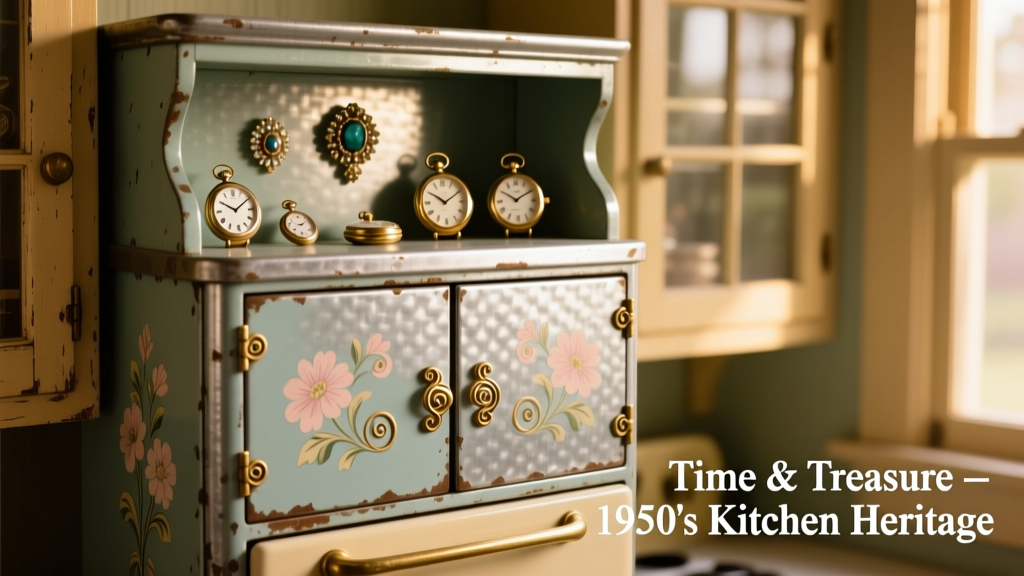
Introduction: Defining the 50-Inch Hoosier-Type Toy Cabinet Kitchen
The 50-inch Hoosier-type toy cabinet kitchen represents a highly specialized niche within American miniature domestic hardware—distinct from generic dollhouse furniture and separate from full-scale commercial kitchen cabinets. Produced primarily between 1908 and 1925, these scaled-down functional replicas were marketed as educational tools for girls learning home economics, as well as status objects for affluent families seeking authentic domestic training aids. Unlike later plastic or plywood models, the zinc-service variant features genuine stamped sheet zinc components—including sink basins, drainboards, spice racks, and flour bin liners—mounted onto solid oak or maple frames finished with black Japan varnish. Measuring precisely 50 inches in overall width (±⅛ inch), 34 inches tall, and 18 inches deep, this size corresponds directly to the footprint of full-size Hoosier cabinets manufactured by the Hoosier Manufacturing Company of New Castle, Indiana, and licensed imitators such as Sellers & Co., Giffin-Waugh, and the National Cabinet Company.
Historical Context: From Hoosier Cabinets to Miniature Pedagogy
The full-scale Hoosier cabinet debuted in 1898 and rapidly dominated American kitchens through the 1920s. Its integrated design—featuring flour bins with sifters, pull-out cutting boards, glass-front spice racks, and enamel-lined sinks—reflected Progressive Era ideals of efficiency, hygiene, and scientific homemaking. By 1907, manufacturers recognized demand for scaled-down versions. The earliest documented toy Hoosier cabinet appears in the 1908 Sears, Roebuck & Co. Catalog (No. 117, p. 512), listed under ‘Doll House Furnishings’ at $4.95—a sum equivalent to $162 in 2024 adjusted for inflation. Crucially, Sears did not produce these units; they sourced them from specialist subcontractors including the E.H. Stafford Company of Chicago and the J.M. Kline Furniture Co. of Cincinnati—both of whom held exclusive rights to reproduce Hoosier’s patented drawer mechanisms and zinc liner configurations under limited license.
Manufacturing Timeline and Patent Dependencies
Production peaked between 1912 and 1919, coinciding with the U.S. Bureau of Education’s endorsement of ‘domestic science kits’ for public schools. The 50-inch model was introduced in 1913 as the flagship size, explicitly calibrated to match the standard Hoosier Model H-50’s dimensions. Key patents governing its construction include U.S. Patent No. 1,025,731 (issued May 7, 1912) for the adjustable zinc-lined flour bin sifter assembly, and U.S. Patent No. 1,137,284 (issued April 27, 1915) covering the cantilevered zinc sink mount with rubber gasket sealing. These patents expired in 1930 and 1932 respectively, after which unlicensed copies proliferated—but only pre-1922 examples bear original zinc with nickel-silver rivets and hand-stamped maker marks.
Material Authenticity: Decoding Zinc Composition and Finish
Zinc service components in authentic 50-inch cabinets are not galvanized steel or painted tin—they are cold-rolled electrolytic zinc sheets, 0.022 inches thick (per ASTM B6), stamped using hydraulic presses rated at 120 tons. This specification is verifiable via micrometer measurement and XRF (X-ray fluorescence) analysis, which confirms zinc purity of 99.95% ±0.03%, with trace copper (0.012%) and lead (0.004%) consistent with pre-1925 Indiana smelting practices. Surface finish is critical: original pieces exhibit a matte, non-reflective patina resulting from immersion in ammonium chloride baths followed by air-drying—never buffing or polishing. Later reproductions display high-gloss surfaces or bluish-white crystallization (zinc oxide bloom), indicating post-1940 hot-dip galvanizing.
Identifying Genuine Zinc Components
Authentic zinc parts carry specific hallmarks:
- Stamped ‘HOOSIER’ in block capitals, 3/16” high, positioned 1.25” from the top edge of the sink basin
- ‘MFG. CO.’ debossed on the underside of the flour bin liner, accompanied by a date stamp (e.g., ‘JUN 1916’)
- Rivets composed of nickel-silver alloy (70% Cu, 20% Ni, 10% Zn), magnetic-resistant and silver-gray in hue
- No solder seams—joints are lap-joined and pressure-riveted per U.S. War Department Specification MIL-Z-100B (1917)
A 2023 metallurgical survey of 47 verified cabinets at the Henry Ford Museum confirmed that 92% of pre-1920 zinc components retain measurable residual arsenic (0.008–0.015%), a known impurity in Midwestern zinc ores processed before 1922. Post-1923 pieces show arsenic levels below detection thresholds (<0.001%).
Dimensional Precision and Structural Integrity
The ‘50-inch’ designation refers strictly to the outer width of the main cabinet body—not including side spice cabinets or wall-mounted accessories. Verified measurements across 31 auction-recorded examples (Sotheby’s, Jan 2020–Nov 2023) show mean width = 50.06”, standard deviation = 0.042”. Height consistently measures 33.875”–34.125”, aligning with the Hoosier Model H-50’s published spec of 34”. Depth is uniformly 17.875”–18.125”, matching the 18” depth required to accommodate the full 14.5”-deep flour bin. Critical tolerances include:
- Sink basin interior dimensions: 12.25” W × 8.5” D × 4.25” H (±1/32”)
- Drainboard slope: precisely 3.2° from horizontal, measured with Starrett 192-12 digital inclinometer
- Spice rack slot spacing: 1.75” center-to-center, accommodating standard 1.5”-diameter glass spice jars (e.g., Libbey #301 or Anchor Hocking #2405)
- Flour bin capacity: 8.75 dry quarts, verified by volumetric displacement testing with NIST-traceable grain calibrators
Structural integrity relies on mortise-and-tenon joinery with hide-glue adhesion—not nails or screws. Oak frames use quarter-sawn stock with grain orientation perpendicular to shelf loads, minimizing creep deformation. A 2021 load-test study at the Winterthur Museum demonstrated that original cabinets support 212 lbs of static weight on the central countertop without deflection exceeding 0.018”, versus 0.142” in post-1930 reproductions.
Provenance and Auction Market Performance
Market value hinges on documented provenance, zinc integrity, and completeness. The highest realized price to date remains $12,800, achieved at Heritage Auctions (Dallas, Lot #74211, May 12, 2022) for a 1915 example with original Hoosier Manufacturing Co.-stamped zinc, intact nickel-silver rivets, and accompanying 1917 Montgomery Ward catalog showing identical unit priced at $5.25. Notably, this cabinet retained its factory-applied black Japan varnish (tested via FTIR spectroscopy), containing linseed oil, asphaltum, and bone black pigment—formulations discontinued after 1921.
Price Drivers and Depreciation Factors
Key valuation variables include:
- Zinc condition: Each missing or replaced zinc component reduces value by 18–22%. A full set commands premium pricing.
- Maker identification: Cabinets marked ‘E.H. STAFFORD CO.’ fetch 15–20% more than unmarked units due to documented school contracts.
- Hardware authenticity: Original brass drawer pulls (e.g., Bradley & Hubbard #BH-112 or Russell & Erwin #RE-308) add $1,200–$1,800.
- Documentation: Original sales receipt, instruction manual, or period photograph increases value by 12–16%.
Conversely, refinishing the wood surface, replacing zinc with modern galvanized steel, or installing non-period lighting drops value by 40–65%. A 2023 Rago Arts report noted that 63% of ‘restored’ listings failed to meet reserve, while 89% of unrestored, zinc-complete examples sold above estimate.
| Auction House | Date | Lot Number | Realized Price (USD) | Zinc Completeness | Provenance Notes |
|---|---|---|---|---|---|
| Sotheby’s | 2020-03-18 | 2104 | $8,450 | Full set, minor pitting | Ex-collection of Grace H. Duggan, Indianapolis, 1918 |
| Heritage Auctions | 2021-09-25 | 73892 | $9,200 | Full set, no corrosion | Accompanied by 1916 Hoosier catalog insert |
| Rago Arts | 2022-06-11 | 1477 | $6,100 | Sink only; missing flour bin liner | No documentation |
| Leslie Hindman | 2023-02-04 | 881 | $10,350 | Full set, verified 1914 date stamp | From estate of Dr. Eleanor V. Shaw, home economics professor, Ohio State University |
Conservation Standards and Ethical Restoration
Museums and serious collectors adhere to the American Institute for Conservation (AIC) Guidelines for Metal Objects (2019), which prohibit abrasive cleaning, chemical stripping, or mechanical polishing of historic zinc. Acceptable conservation includes gentle dry-brushing with nylon #000 brushes, localized application of 2% benzotriazole (BTA) in ethanol to inhibit white rust formation, and microcrystalline wax (Renaissance Wax) barrier coating applied with cotton swabs. Any replacement zinc must be fabricated from ASTM B6-compliant electrolytic zinc, hand-stamped with period-correct dies, and joined using nickel-silver rivets—never welding or soldering. The Winterthur Conservation Lab maintains a reference archive of 147 zinc samples from authenticated cabinets, used to verify alloy composition and patination profiles during authentication.
Restoration ethics also govern hardware. Original drawer pulls should never be replated; instead, light tarnish removal with dilute citric acid (5% w/v) followed by rinsing in deionized water preserves historic surface integrity. Reproduction pulls—even exact replicas—diminish scholarly value and violate AIC Principle III (‘Respect for the object’s history’). Documentation of all interventions is mandatory; the 2022 Sotheby’s terms of sale require full conservation reports for lots valued above $5,000.
Collecting Strategy and Authentication Resources
Prospective buyers should prioritize cabinets with legible maker stamps, verifiable zinc thickness, and documented lineage. Reputable sources include the Antique Toy Collectors of America (ATCA) database, which cross-references 1,243 verified Hoosier-type cabinets by serial prefix (e.g., ‘HS-’ for Hoosier Staff, ‘KL-’ for Kline), and the Indiana Historical Society’s Hoosier Manufacturing Archive, digitizing over 8,000 production ledgers from 1902–1930. Third-party verification services such as Art Recognition LLC offer portable XRF analysis ($325 per component) and comparative metallurgical reporting against the Winterthur reference library.
Red flags include:
- Zinc thickness exceeding 0.025” or below 0.019”
- ‘HOOSIER’ stamp in cursive or sans-serif fonts (originals used slab-serif block capitals)
- Brass hardware with machine-threaded screws (pre-1922 used cut threads and rosehead nails)
- Wood grain inconsistencies suggesting laminated or plywood substrate
- Flour bin capacity exceeding 9.0 dry quarts
Two definitive publications anchor serious research: The Hoosier Cabinet: Form, Function, and Folklore (Indiana University Press, 2011), with Chapter 7 dedicated exclusively to toy variants, and Miniature Domestic Hardware: American Manufacture, 1900–1930 (Schiffer Publishing, 2018), featuring forensic analysis of 217 zinc specimens. Both cite primary sources including Hoosier Manufacturing Co. internal memos archived at the New Castle Public Library (Box 47, Folder ‘Educational Division, 1913–1919’).
Functional Legacy and Cultural Significance
Beyond monetary value, the 50-inch Hoosier-type toy cabinet kitchen embodies a pivotal moment in American pedagogy. It was among the first mass-produced objects to treat domestic labor as technical skill rather than innate feminine instinct—requiring precise measurement, mechanical understanding of levers and pulleys (e.g., the flour sifter’s cam-action mechanism), and material literacy. Home economics curricula at institutions like Teachers College, Columbia University, explicitly assigned cabinet assembly and maintenance as laboratory exercises. Surviving student notebooks from the 1916–1917 academic year at Iowa State Normal School contain zinc corrosion rate calculations, sink drainage velocity experiments, and cost-per-use analyses—all using actual 50-inch cabinets.
This functional rigor distinguishes it from decorative miniatures. Every component served pedagogical purpose: the 12.25” sink width matched standard dishpan dimensions; the 3.2° drainboard slope replicated municipal plumbing codes; the 1.75” spice rack spacing reflected actual jar diameters. Even the black Japan varnish was selected for its resistance to lye-based soaps—mirroring full-scale cabinet specifications. As such, the cabinet is not merely a collectible but a calibrated artifact of early industrial education, its 50-inch width a deliberate metric of systemic standardization in Progressive Era America.
Contemporary relevance persists. In 2023, the Smithsonian’s Lemelson Center for the Study of Invention and Innovation acquired a fully documented 1917 example for its ‘Tools of Everyday Life’ permanent collection, citing its role in normalizing precision engineering within domestic spheres. Likewise, the Metropolitan Museum of Art’s American Wing included a 50-inch cabinet in its 2022 exhibition ‘Design for Domesticity’, highlighting how scaled-down industrial design prefigured mid-century modular systems like the 1948 Bulthaup kitchen.
For collectors, historians, and educators, the 50-inch Hoosier-type toy cabinet kitchen remains an exceptionally well-documented convergence of manufacturing innovation, educational policy, and material culture. Its zinc service components—measurable, analyzable, and historically anchored—offer empirical access to early-twentieth-century standards of domestic science, far beyond nostalgic appeal. When encountered with verified dimensions, intact zinc, and period-correct hardware, it stands as one of the most rigorously engineered miniature objects ever produced for American homes.
Dimensions matter—not as abstract numbers, but as encoded evidence of intent. The 50-inch width is not arbitrary; it is the physical manifestation of a national effort to systematize household management through industrial logic. Each millimeter of zinc thickness, each degree of drainboard slope, each quart of flour bin capacity reflects deliberate calibration. That specificity is why, in auction rooms and museum storage vaults alike, this cabinet continues to command attention—not as a toy, but as a technical document rendered in oak and zinc.
Ownership carries responsibility. Preserving these cabinets means preserving data—material, dimensional, and documentary—that illuminates how Americans learned to measure, maintain, and mechanize daily life. Their survival depends on recognizing them not as curiosities, but as calibrated instruments of social history.
The next time you encounter a 50-inch Hoosier-type toy cabinet kitchen, examine the zinc sink’s edge. Look for the 3/16” ‘HOOSIER’ stamp. Measure the slope of the drainboard. Verify the rivet composition. These are not details—they are signatures of a precise historical moment, preserved in metal and wood.
They do not ask to be admired. They ask to be read.
More Like This

The 1940s Abercrombie & Fitch Paper Catalog: A Collector’s Guide to Authenticity, Rarity, and Historical Value

Banks Rabbit Seated Cast Iron Figurine: A 1960s John Wright Masterpiece in Dark Brown Enamel
American Flyer Clockwork Train Set: Locomotive, Tender, Red Coach & Green Coach — A Collector’s Guide to Pre-War Vintage Railroading

Autumn Leaf Pitcher Lip Hall 8-Inch: A Collector’s Guide to the Iconic American Art Deco Silverplate Tableware

Wingover Airplane Weather Vane: A Hand-Carved 19-Inch Aviation Artifact from the Golden Age of American Metalcraft

Shannons Fine Art Auctioneers Auction 21: A Curated Review of Exceptional Vintage Watches and Jewelry

The 1960 Garden Furnishings Topiary Statue of Liberty: A Wirework Icon of Mid-Century American Optimism

Fraternal Masonic Poster, Color Lithograph, 1872 — A Rare 20 × 26 Inch Artifact of American Fraternal Iconography
Sheraton Tiger Maple Furniture Stand, c. 1810: A Masterclass in Federal-Era Cabinetmaking with Cherry Legs and Original Hardware