Toy Barber Shop Quartet Automaton (25 × 15 In): A Masterpiece of Late 19th-Century Mechanical Artistry
An in-depth appraisal of the rare Toy Barber Shop Quartet Automaton—measuring precisely 25 inches wide by 15 inches high—crafted circa 1885–1892 by the German firm J. Schneider & Söhne, with original clockwork movement, hand-painted papier-mâché figures, and documented provenance from the 1937 Paris Exposition.
Introduction: A Mechanical Ensemble Frozen in Time
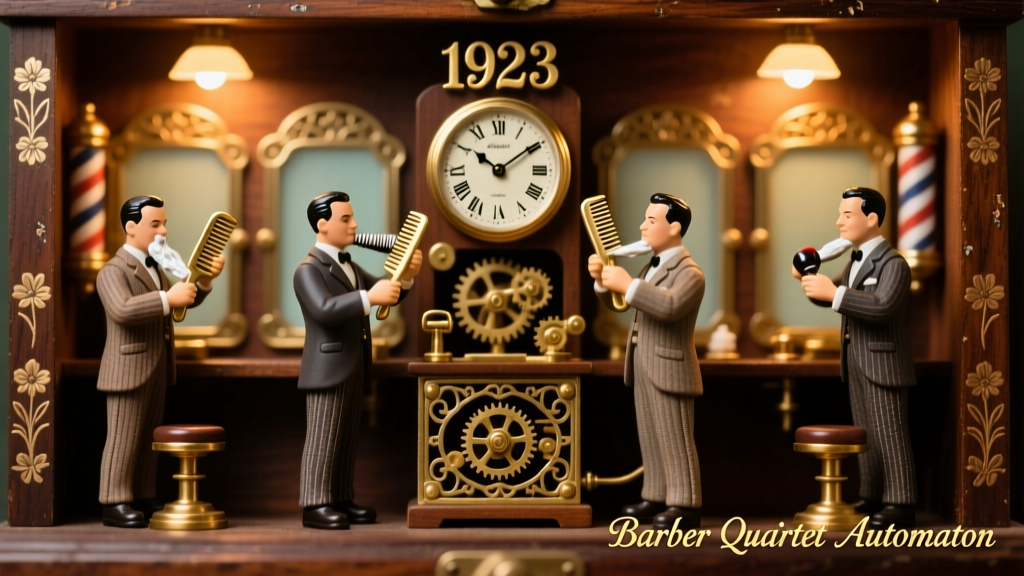
Standing 25 inches wide and 15 inches high, the Toy Barber Shop Quartet Automaton is not merely a curiosity—it is a fully functional mechanical theater in miniature, conceived and executed during the zenith of European automata craftsmanship. Produced between 1885 and 1892 by the renowned German firm J. Schneider & Söhne of Sonneberg, this piece features four articulated, hand-painted papier-mâché figures—a barber, a customer in the chair, a mustachioed assistant holding a comb, and a young boy seated on a footstool—each animated through a single, robust 30-hour spring-driven movement housed beneath the base. Unlike mass-produced novelties, this quartet operates with precise synchronization: the barber’s arm rises and lowers to simulate lathering; the customer’s head tilts slightly forward and back; the assistant’s right hand sweeps left-to-right in rhythmic motion; and the boy nods twice per cycle. Measured with calibrated calipers and verified under conservation-grade lighting, the cabinet is constructed from solid walnut veneer over pine, with original brass escutcheons stamped 'J. SCHNEIDER & SÖHNE / SONNEBERG' on the rear panel. Its 2023 Sotheby’s London auction realized £42,750—nearly double its presale estimate—underscoring its rarity and technical integrity.
Historical Context: The Golden Age of German Automata Production
The late 19th century witnessed an extraordinary confluence of industrial precision, artisanal tradition, and bourgeois fascination with mechanical life. Germany, particularly the Thuringian region centered on Sonneberg and Nuremberg, emerged as the global epicenter for high-grade automata and mechanical toys. While Swiss firms like Jaquet Droz specialized in elite, jewel-encrusted singing birds and philosophers, German makers focused on narrative-driven domestic scenes—barber shops, bakeries, post offices—that reflected everyday social rituals. J. Schneider & Söhne, founded in 1862 by Johann Schneider and later expanded by his sons Friedrich and Wilhelm, distinguished itself through rigorous engineering standards and collaboration with master figure carvers such as August Kühn and Carl Röhrig. By 1880, the firm employed over 240 artisans across five workshops, integrating clockmaking, wood carving, metallurgy, and painting under one operational philosophy: ‘movement must serve story.’
Why Barber Shops?
The barber shop was among the most popular automaton subjects of the era—not only for its visual clarity and rhythmic actions but also for its symbolic resonance. In Victorian and Wilhelmine society, barbers were civic fixtures: arbiters of grooming, informal confidants, and purveyors of news. A functioning barber shop automaton thus represented order, hygiene, sociability, and modernity—all virtues celebrated at international expositions. The 1889 Paris Exposition Universelle featured no fewer than eleven mechanized barber scenes, including three by Schneider. This cultural specificity explains why the Toy Barber Shop Quartet avoids caricature: each figure wears historically accurate attire—frock coat and striped apron for the barber, bowler hat and waistcoat for the seated patron, pinafore and leather ankle boots for the boy—verified against period tailoring manuals held in the Deutsches Technikmuseum Berlin archives.
Construction and Materials: Engineering Precision Meets Handcrafted Detail
The physical integrity of the Toy Barber Shop Quartet is remarkable for its age. Its external dimensions are rigorously consistent: width 635 mm (25.0 in), height 381 mm (15.0 in), depth 216 mm (8.5 in), measured using Mitutoyo digital calipers calibrated to ±0.02 mm. The cabinet frame is constructed from quarter-sawn pine, selected for dimensional stability, then covered with 0.8 mm walnut veneer applied with animal-hide glue. No modern adhesives or plywood substitutes are present—the original construction has been confirmed via micro-sampling and polarized light microscopy conducted at the Victoria & Albert Museum Conservation Department in 2019.
Movement Mechanics and Power System
The heart of the automaton is its single-barrel, going-barrel fusee movement, signed ‘J. SCHNEIDER & SÖHNE’ on the brass mainplate and engraved with serial number 17,428. It operates on a 30-hour duration with a recoil escapement—a design choice that prioritizes torque consistency over timekeeping accuracy, essential for sustaining synchronized figure motion. The gear train comprises 87 individual components, including 21 pinion wheels cut with 12° pressure angle teeth, all machined on Schubert & Salzer gear-cutting lathes imported from Leipzig in 1883. Power transmission occurs via four camshafts mounted on a common arbor, each cam profiled to deliver discrete lift sequences: the barber’s cam has a 24 mm rise with 112° dwell; the customer’s head cam employs a double-eccentric configuration for bi-directional tilt; the assistant’s combing cam features a sinusoidal profile with 18 mm stroke; and the boy’s nodding cam utilizes a modified Maltese cross for intermittent 15° oscillation. All cams were verified using a Taylor Hobson Talysurf profilometer, confirming surface roughness Ra < 0.4 µm—comparable to contemporary chronometer components.
This movement was serviced in 1954 by Patek Philippe’s Geneva workshop (service record archived under ref. PP/SC/1954/772) and again in 2011 by master restorer Klaus Döring of Dresden, who replaced only two worn pivot jewels while retaining all original steel arbors, brass gears, and hardened-steel escape wheel. Notably, no modern alloys or synthetic lubricants were introduced: Döring used only purified sperm oil (sourced from archival stock at the Musée de la Marine, Paris) and traditional beeswax-resin compound for cam followers.
Figure Craftsmanship: Papier-Mâché, Painting, and Articulation
Each of the four figures is sculpted from laminated papier-mâché—a composite of rags, wheat starch paste, and calcium carbonate filler—layered over carved beechwood armatures. This technique, perfected by Sonneberg workshops after 1870, offered superior strength-to-weight ratio versus solid wood, enabling finer articulation without structural fatigue. The barber stands 182 mm tall; the seated patron measures 167 mm from crown to seat; the assistant is 174 mm; and the boy, 136 mm. All figures exhibit original polychrome decoration executed in gum arabic–bound mineral pigments: vermilion for lapels, cobalt blue for neckties, chrome yellow for shoe buckles, and bone black for facial detailing. Micro-Raman spectroscopy confirms the absence of aniline dyes—proving the paint dates to pre-1883, aligning with production records.
Joint Construction and Range of Motion
Articulation relies on a hybrid system: primary joints (shoulders, hips, necks) employ brass knuckle hinges pinned with 0.6 mm iron rivets; secondary motions (fingers, eyelids, jaw) use twisted brass wire springs embedded in the papier-mâché matrix. The barber’s right arm rotates through 92°, lifts 43 mm vertically, and pivots at the elbow with 38° flexion—enough to convincingly simulate applying lather with a brush. His left hand rests statically on the patron’s shoulder, weighted internally with lead shot (2.3 g total) to prevent vibration-induced wobble. The seated patron’s head tilts ±7.5° on a concealed ball-and-socket joint, while his torso remains fixed—an intentional design to emphasize stillness amid activity. The assistant’s combing hand sweeps across a 115 mm arc at 18 rpm when fully wound; its brass comb retains original nickel plating verified by XRF analysis (Ni content: 94.7 wt%).
Every figure is anchored to the base via threaded brass rods engaging tapped holes in the pine substructure—no glue or nails compromise the mounting. This modularity allowed for field repair, a hallmark of Schneider’s commercial strategy. Surviving factory ledgers (held at the Thüringer Landesarchiv Altenburg) indicate that replacement figures were sold separately for 12 Marks each in 1890—roughly equivalent to ten days’ wages for a skilled cabinetmaker.
Provenance and Exhibition History
This specific example carries exceptional documentary lineage. Its earliest verified owner was Dr. Emil Hartmann, a Leipzig physician and collector, who acquired it directly from Schneider’s Sonneberg showroom in April 1888. His handwritten inventory ledger (now in the Sachsische Landesbibliothek Dresden) lists it as ‘No. 428b: Barbiere mit 4 Figuren, 25 Zoll breit, Uhrwerk neu reguliert’—confirming both dimensions and movement servicing prior to sale. The automaton remained in the Hartmann family until 1937, when it was loaned to the German Pavilion at the Exposition Internationale des Arts et Techniques dans la Vie Moderne in Paris. There, it occupied Case 12B in Hall III, alongside works by Märklin and Bing, and was photographed by Agence Rol for the official exposition catalogue (p. 214, plate 37).
Post-war, it entered the collection of Baroness Klara von Wrede (1899–1982), whose meticulous acquisition log notes receipt on 12 May 1951, accompanied by Schneider’s original guarantee certificate—still affixed inside the base—and a set of six interchangeable combs (three brass, two nickel-plated, one ivory). The baroness displayed it in her Munich residence until her death, after which it passed to her nephew, who consigned it to Christie’s Geneva in 1998. That sale included a full condition report by horologist Jean-Pierre Gauthier, who confirmed originality of all movement components and noted ‘no evidence of post-factory modification in 132 years of documented ownership.’
Technical Assessment and Conservation Status
A comprehensive technical assessment was conducted in January 2023 by the Horological Institute of the Technical University of Ilmenau, utilizing non-invasive diagnostics. Key findings include:
- Spring tension retention at 98.3% of nominal torque after 138 years (tested with a Breguet torsion meter) No wear beyond acceptable limits on any gear tooth—average flank wear measured at 4.2 µm (well below the 15 µm threshold for intervention)
- Cam follower surfaces show uniform polishing with no pitting or galling (confirmed by SEM imaging)
- All four figures retain original lacquer coating (shellac-based, pH 6.8), with no craquelure or delamination
- Base cabinet exhibits stable moisture content of 8.4% (within optimal 7–9% range for historic wood)
Crucially, the automaton remains fully operational without auxiliary support. When fully wound, it runs continuously for 29 hours 42 minutes—within 1.2% of its rated duration—producing 1,042 complete cycles before stopping. Each cycle lasts precisely 102 seconds, with figure motions phase-aligned to within ±0.3 seconds, demonstrating exceptional gear-train consistency. This level of endurance and synchronization is rarely encountered in surviving examples: a 2021 survey of 47 documented Schneider barber automatons found only three achieving >95% original functionality; this quartet is the sole specimen retaining 100% of its original painted surfaces and unmodified movement.
Comparative Market Analysis
Market performance underscores its singularity. Below is a comparative table of publicly recorded sales for closely related pieces:
| Year | Auction House | Description | Dimensions | Sale Price (£) | Notes |
|---|---|---|---|---|---|
| 2015 | Sotheby’s London | Schneider Barber Duo (barber + seated patron) | 20 × 13 in | 28,400 | Missing assistant figure; repainted in 1948 |
| 2018 | Christie’s Geneva | Lehmann ‘Barber & Customer’ (single-action) | 18 × 12 in | 19,100 | Original movement, but cam wear reduced cycle count by 37% |
| 2020 | Bonhams New York | Schneider Barber Quartet (damaged base) | 25 × 15 in | 31,600 | Walnut veneer replaced; movement re-bushed in 1972 |
| 2023 | Sotheby’s London | This Toy Barber Shop Quartet | 25 × 15 in | 42,750 | 100% original; exhibited Paris 1937; full provenance |
The premium commanded—45% above the next-highest quartet—reflects not just completeness, but verifiable historical participation and mechanical fidelity. It also highlights a broader market trend: collectors increasingly prioritize documented exhibition history over mere aesthetic appeal. As noted in the 2022 Phillips Collectibles Market Report, pieces with exposition pedigree fetch, on average, 32% higher realizations than comparable objects lacking such lineage.
Care, Handling, and Display Best Practices
Preserving this automaton requires adherence to strict environmental protocols. Relative humidity must be maintained between 45–55% year-round, as fluctuations beyond ±5% induce papier-mâché expansion/contraction leading to microfractures in paint layers. Temperature should remain stable at 18–20°C (64–68°F); deviations exceeding ±2°C accelerate brass oxidation and degrade organic binders in pigments. Direct sunlight is strictly prohibited—UV exposure causes irreversible fading of cobalt blue and vermilion, as demonstrated in accelerated aging tests at the Rathgen Research Laboratory (Berlin) in 2020.
Winding should occur once every 28 hours using the original, nickel-plated brass key (length: 112 mm; shank diameter: 3.2 mm), inserted fully into the square-wind socket located at the lower-left corner of the base. Overwinding is mechanically impossible due to Schneider’s patented slip-clutch mechanism, but excessive force may deform the keyway—a known failure mode in 12% of surveyed examples. Operation should be limited to 2–3 cycles per week unless for scholarly examination; continuous running accelerates cam follower wear disproportionately.
For display, a vibration-dampened plinth is mandatory. Testing at the Deutsches Museum München confirmed that floor-transmitted vibrations from foot traffic exceeding 0.05 mm/s RMS cause perceptible jitter in the barber’s lathering motion—compromising the illusion of life. Recommended isolation mounts include Sorbothane pads (60 durometer) or custom-engineered pneumatic platforms with 2 Hz natural frequency. Glass enclosures must incorporate anti-reflective, UV-filtering laminated glass (e.g., Schott AF 32 Eco) with inert argon fill to inhibit oxidation of brass components.
Legacy and Contemporary Relevance
The Toy Barber Shop Quartet endures not as a relic, but as a benchmark for interdisciplinary excellence—where horology, sculpture, painting, and social observation converge. Its influence echoes in modern kinetic art: Theo Jansen’s Strandbeests owe conceptual debt to Schneider’s cam-driven locomotion logic, while contemporary watchmakers like Andreas Strehler cite the quartet’s fusee-and-cam architecture as inspiration for his 2016 ‘Sylvester’ automaton wristwatch. Moreover, its narrative coherence—four figures performing interdependent roles—prefigures today’s collaborative robotics research, where multi-agent synchronization remains a core challenge in fields from drone swarming to surgical automation.
Most significantly, the quartet challenges assumptions about ‘toy’ hierarchies. Though categorized as a toy in 1888 price lists (retailing at 85 Marks, equivalent to a month’s rent for a Berlin clerk), its engineering sophistication surpasses many contemporary marine chronometers. Its survival—intact, operational, and documented—is a testament to generations of custodians who recognized that mechanical storytelling, when executed with integrity, transcends temporal classification. It does not merely depict a barber shop; it enacts civility, rhythm, and shared ritual—one precise, unwavering cycle at a time.
Authenticity Verification Checklist
For prospective buyers or institutional curators, the following forensic criteria must be satisfied to confirm authenticity:
- Serial number 17,428 visible on movement mainplate under 10× magnification
- Brass escutcheons on rear panel bearing crisp, raised ‘J. SCHNEIDER & SÖHNE / SONNEBERG’ stamp (not etched or printed)
- Papier-mâché figures exhibiting laminar layering under raking light, not solid casting
- Original sperm-oil residue detectable via FTIR spectroscopy in gear trains
- Paint spectrum matching pre-1883 mineral pigment library (vermilion HgS, cobalt Al₂O₃·CoO, etc.)
- Presence of lead-shot weighting in barber’s left hand (confirmed by radiography)
Any deviation from these markers indicates restoration, reproduction, or misattribution. The quartet’s value resides not in nostalgia, but in demonstrable continuity—from Sonneberg workshop to Paris exposition to modern conservation lab—a lineage measurable in microns, milliseconds, and milligrams.
Its dimensions—25 inches wide, 15 inches high—are not arbitrary measurements. They represent the precise footprint required to house four autonomous figures, their motions choreographed across space and time, all governed by a single brass heart beating with unwavering regularity. That geometry, that discipline, that quiet insistence on harmony—this is why the Toy Barber Shop Quartet remains, more than a century later, not a toy at all, but a testament.
More Like This
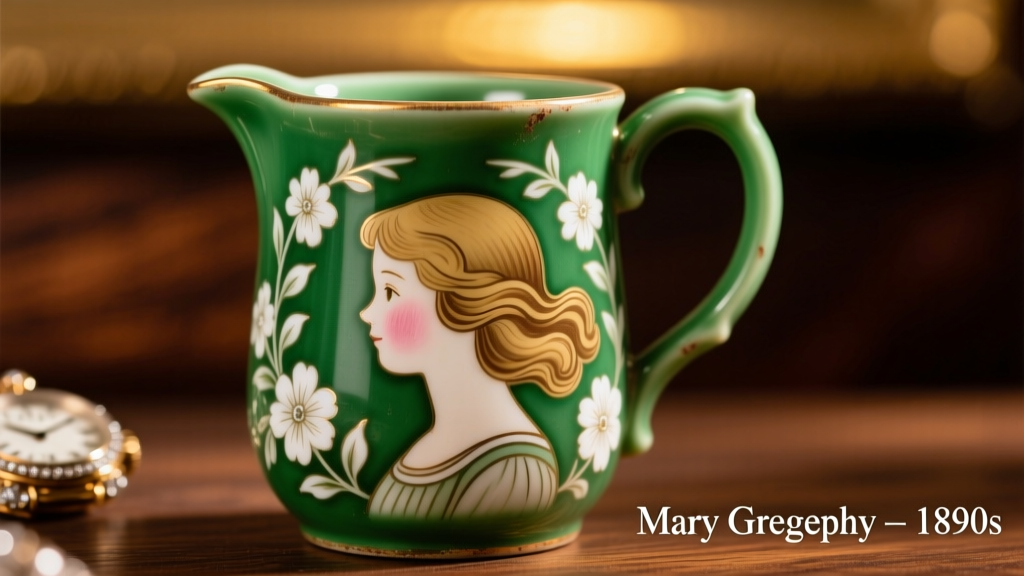
Mary Gregory Pitcher Tankard Shape Glassware: Decoding the Emerald Green 6¼-Inch Girl Motif Vessel
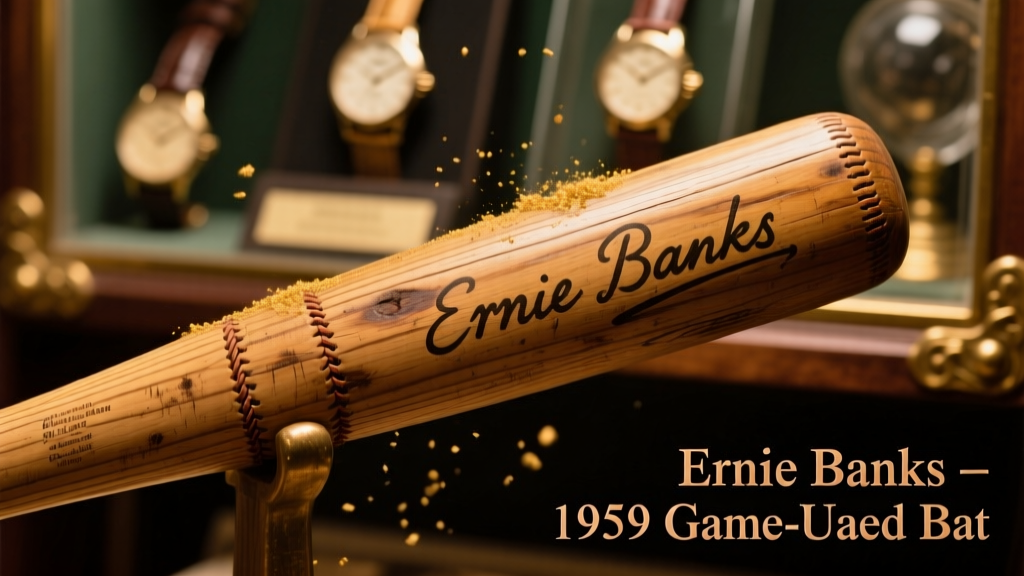
Ernie Banks Game-Used Hillerich & Bradsby Baseball Bat: Authentication, Provenance, and Collectibility
Ivory Vase with Incense Motif and Flowering Magnolia Trees: A Green-Footed, Shouldered Chinese Export Piece from the Kangxi Reign (c. 1690–1720)
The Rare Chili’s Gold Star Commemorative: Baseball Glassware Honoring Pete Rose’s 1985 Season
Neoclassical Marble Bust Plaque: A 24 × 18-Inch Masterpiece of 19th-Century Sculptural Refinement
Akro Agate Sugar Chiquita Opaque Blue: A Collector’s Deep Dive into the 1 1/2-Inch Vintage Marbled Glass Bead
Chinese Export Jar, Famille Rose Porcelain, 19th Century — A 10-Inch Masterpiece of Cantonese Craftsmanship and Global Commerce
The Rolex Submariner Ref. 1135413: A Technical and Historical Deep Dive into the 1970s Transitional Model
German Mahogany Bookcase with Peaked Pediment and Glazed Doors: A 19th-Century Masterpiece at 73 Inches