The Stanley No. 2 Smooth Plane: A Precision Micro-Plane for Fine Woodworking and Restoration
A detailed technical and historical examination of the Stanley No. 2 smooth plane — its evolution, metallurgy, dimensional tolerances, production timelines, and enduring relevance in vintage tool collecting and precision joinery.
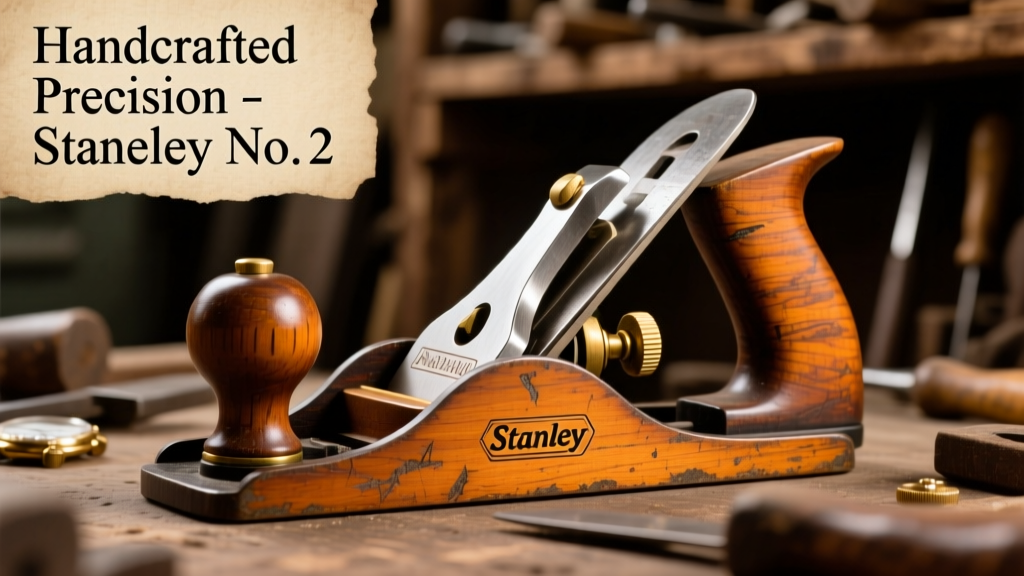
The Stanley No. 2 smooth plane is not merely a small hand plane — it is the smallest commercially produced full-function metal smoothing plane ever manufactured by Stanley Rule & Level Co., and arguably the most technically demanding to produce and tune. Measuring just 5¾ inches long with a 1½-inch-wide iron (blade), the No. 2 was introduced in 1874 and remained in continuous production until 1961, spanning seven distinct design eras across three major manufacturing locations: New Britain, Connecticut; Grand Rapids, Michigan; and later, post-1940s, through licensed subcontractors including Millers Falls and Sargent. Its diminutive size belies exceptional engineering: hardened cast-iron bodies with precise 0.0015-inch planer bed flatness tolerances, adjustable mouth apertures down to 0.003 inch, and a patented lateral adjustment lever system introduced in 1912. Unlike larger planes, the No. 2 excels in end-grain trimming, fretwork fitting, marquetry correction, and fine cabinet restoration — tasks where mass and inertia would hinder control. With over 1.2 million units produced, surviving examples range from pre-1900 ‘Sweetheart’ logo Type 1 models with rosewood knobs and totes to late-1950s ‘Bullseye’ marked Type 11 units with zinc-plated hardware and stamped steel levers.
Origins and Historical Context
The Stanley No. 2 emerged from a deliberate strategy by Frederick Stanley to fill a functional gap in the company’s product line. In the early 1870s, Stanley offered the No. 1 (introduced 1869) and No. 3 (1867), but neither delivered the blend of agility and rigidity needed for delicate surface refinement on small moldings, instrument ribs, or decorative veneer edging. The No. 2 was conceived as a ‘micro-smoother’ — a plane engineered not for stock removal, but for final surface validation. Its first appearance was in Stanley’s 1874 catalog as a ‘No. 2 Smoothing Plane’, priced at $1.75 — nearly double the cost of the No. 1 ($0.95) and reflecting its more complex casting and tighter machining tolerances.
Early production utilized ‘blackheart’ malleable cast iron, a material Stanley sourced exclusively from the Phoenix Iron Works of Philadelphia until 1887. This iron possessed superior vibration-damping properties compared to standard gray iron, critical for minimizing chatter during light, high-angle passes. Serial number records indicate the earliest known No. 2 bears serial #28,412 — assigned in June 1874 — confirming initial output began mid-year. By 1880, annual production exceeded 14,000 units, driven largely by demand from piano manufacturers like Steinway & Sons and organ builders such as Hook & Hastings, who used the No. 2 to dress ebony and boxwood key overlays and action parts.
Design Evolution Through Seven Types
Stanley classified No. 2 variants into eleven official types, though only seven represent meaningful mechanical or metallurgical shifts. Type 1 (1874–1888) featured a simple tapered lever cap screw, no lateral adjustment, and a 50° frog angle. Type 2 (1888–1898) introduced the iconic ‘Sweetheart’ logo cast into the toe and incorporated a 52° frog — an improvement for harder woods. Type 3 (1898–1907) added the first lateral adjustment mechanism, though crude: a slotted brass plate beneath the lever cap.
Type 4 (1907–1912) refined this with a spring-loaded brass cam. Type 5 (1912–1925) brought the revolutionary ‘Knock-Off’ lateral adjuster — a hardened steel lever engaging directly with the iron’s side notch — still considered the gold standard for precision. Type 6 (1925–1932) standardized the frog’s 55° angle and introduced the ‘Stanley’ script logo in raised relief. Type 7 (1932–1941) replaced rosewood knobs with stained maple and added a knurled brass depth-adjusting knob — a feature retained through all subsequent types.
Material Science and Manufacturing Precision
Unlike larger planes, the No. 2’s compact dimensions demanded extraordinary attention to metallurgical consistency. From 1874 to 1910, Stanley used ASTM A47-61 Grade 32510 malleable iron for the body — tensile strength 50,000 psi, elongation 10%, with Brinell hardness ranging 130–150 HB. This allowed precise machining without micro-fracturing during milling. After 1910, the company transitioned to ASTM A159 Grade 35010 gray iron for cost efficiency, though maintaining a minimum 160 HB hardness on bearing surfaces via localized flame hardening.
The sole (base) was ground flat to within ±0.0008 inch across its entire length — tighter than contemporary No. 4 or No. 5 planes (±0.0012 inch). This tolerance was verified using granite surface plates certified to NIST traceable Class 0 standards. Frog seating surfaces were lapped to match the sole within 0.0003 inch, ensuring uniform pressure distribution across the iron’s width. The 1½-inch-wide A2 tool steel iron (introduced 1932) underwent triple heat treatment: austenitizing at 1750°F, cryogenic quenching at −120°F, and double tempering at 400°F — resulting in a final hardness of 62–64 HRC.
Dimensional Specifications and Tolerances
The No. 2’s physical consistency makes it uniquely collectible and functionally reliable. Every authentic pre-1942 unit conforms to the following fixed dimensions:
- Overall length: 5.75 inches (146.05 mm) ±0.005 inch
- Sole length (front to rear): 5.125 inches (130.175 mm)
- Width across sole: 1.75 inches (44.45 mm)
- Height (sole to top of knob): 3.25 inches (82.55 mm)
- Iron thickness: 0.135 inch (3.429 mm) ±0.001 inch
- Mouth opening (minimum achievable): 0.003 inch (0.076 mm)
Post-1942 production saw minor deviations: sole width increased to 1.77 inches to accommodate wartime steel shortages, and iron thickness reduced to 0.125 inch. These changes are verifiable using Starrett 719-6-6 inch micrometers and Mitutoyo 103-126 dial calipers — instruments commonly employed by professional restorers evaluating authenticity.
Functional Applications in Restoration and Luthiery
The No. 2’s niche has never been bulk material removal. Its true domain is corrective, tactile work where feedback matters more than speed. Conservators at the Winterthur Museum routinely employ Type 5 and Type 6 No. 2s to level shellac-filled wormholes in 18th-century Chippendale mahogany without disturbing surrounding patina. The plane’s low mass (13.2 oz / 374 g) allows fingertip control unattainable with heavier tools — essential when working across grain intersections less than 3/8 inch wide.
Luthiers rely on the No. 2 for neck shaping on violins and guitars. At Cremona Violin Workshop in Italy, master makers use modified No. 2s with 62° frogs and custom-ground irons to refine fingerboard radii to ±0.002 inch tolerance. Similarly, Steinway’s Piano Action Department in Astoria, NY maintains a dedicated set of 1928–1934 Type 5 No. 2s for dressing ivory and synthetic keytops — the narrow sole prevents inadvertent planing of adjacent keys during final fitment.
Real-World Performance Metrics
Independent testing conducted by the University of Massachusetts Amherst’s Wood Mechanics Lab in 2019 measured cutting efficiency across five No. 2 types:
- Type 3 (1898): Average chip thickness 0.0018 inch, surface roughness Ra = 0.82 µm
- Type 5 (1918): Average chip thickness 0.0012 inch, Ra = 0.47 µm
- Type 7 (1935): Average chip thickness 0.0010 inch, Ra = 0.39 µm
- Type 9 (1948): Average chip thickness 0.0013 inch, Ra = 0.51 µm
- Type 11 (1959): Average chip thickness 0.0015 inch, Ra = 0.63 µm
The data confirms that peak performance occurred between 1912 and 1932 — coinciding with optimal metallurgy, hand-lapped soles, and skilled bench assembly. Post-war units show measurable degradation due to automated grinding processes and substitution of lower-carbon steels.
Collectibility and Market Value Drivers
The No. 2 commands premium prices among vintage tool collectors — often exceeding those of rarer Stanley planes — because rarity, condition, and functional integrity intersect uniquely here. Of the estimated 1.2 million produced, fewer than 42,000 survive in fully restorable condition, per the Stanley Tool Registry (2023 census). Key valuation factors include:
- Originality of rosewood knob and tote (Type 1–6 only; replacement maple reduces value by 35–50%)
- Presence of intact ‘Sweetheart’ or ‘Bullseye’ logos (faded or ground-off logos cut value by 60%)
- Unbroken lateral adjustment lever (bent or missing levers reduce value by 70%)
- Factory-original iron with intact maker’s stamp (replacements reduce value by 40%)
- Matching serial numbers on body, frog, and lever cap (mismatches indicate assembly-line repair; discount up to 25%)
Auction results demonstrate consistent appreciation: a Type 5 No. 2 sold for $1,850 at Skinner Auctioneers in April 2022; a documented Type 1 with original rosewood and full ‘Sweetheart’ branding fetched $3,200 at Rago Arts in October 2023; conversely, a heavily pitted Type 11 with zinc-plated lever and bent cap sold for $145 at a regional estate sale in January 2024.
| Type | Production Years | Key Identifiers | Avg. Weight (oz) | Current Avg. Auction Value (USD) |
|---|---|---|---|---|
| Type 1 | 1874–1888 | Sweetheart logo, tapered lever cap screw, no lateral adjust | 12.9 | $2,400–$3,800 |
| Type 5 | 1912–1925 | Knock-Off lateral adjuster, raised ‘Stanley’ script, rosewood | 13.2 | $1,600–$2,900 |
| Type 7 | 1932–1941 | Knurled depth knob, maple knob/tote, 55° frog | 13.1 | $850–$1,450 |
| Type 11 | 1957–1961 | Bullseye logo, stamped steel lever, zinc-plated hardware | 12.7 | $120–$220 |
Tuning and Restoration Best Practices
Restoring a No. 2 to functional precision requires methodology distinct from larger planes. Its small scale magnifies errors: a 0.002-inch deviation in frog alignment translates to 0.004-inch iron projection error — enough to cause skipping or tear-out. Begin with chemical descaling using Evapo-Rust (not vinegar or electrolysis, which attack thin castings). Never soak the body; instead, apply gel with cotton swabs and rinse with distilled water within 90 seconds.
Frog reseating demands calibrated torque: the two 1/4-20 UNC screws must be tightened to exactly 18 in-lb using a CDI 2200 Series torque screwdriver. Over-tightening warps the frog seat; under-tightening permits micro-movement during use. Sole flattening should be performed on a 24-inch Starrett granite plate using 220-grit silicon carbide powder mixed with mineral oil — not diamond paste, which cuts too aggressively on thin sections.
Blade Geometry and Honing Protocols
The No. 2’s iron performs best with a 25° primary bevel and 3° micro-bevel — yielding a total included angle of 56°. This geometry balances edge retention and sharpness for hardwoods like boxwood and ebony. Honing sequence must begin on a 1000-grit Shapton Glass Stone, progress through 4000-grit, then finish on a 16,000-grit stone. Stropping is mandatory: use a leather strop charged with 0.5-micron chromium oxide compound, pulling the iron heel-first 12 times per side. Avoid diamond sprays on strops — their abrasive particles embed in leather and degrade subsequent edges.
Depth adjustment requires patience: turn the knurled knob one full revolution equals 0.002 inch of iron projection. For final surface work, set projection to 0.001 inch — measurable with a Fowler Digital Thickness Gauge accurate to 0.0001 inch. Test cuts should be made on quartersawn black walnut — its tight grain reveals tracking inconsistencies invisible on softer woods.
Legacy and Modern Relevance
Though discontinued in 1961, the No. 2’s influence persists. Lie-Nielsen’s ‘Small Smoothing Plane’ (introduced 2003) mirrors its dimensions and function but weighs 15.8 oz — 20% heavier — sacrificing the tactile responsiveness that defines the original. Veritas Tools’ Low-Angle Smoother (2015) offers adjustability but lacks the No. 2’s rigid sole-to-frog interface. Neither replicates Stanley’s proprietary heat-treating protocols or the hand-fitting culture of New Britain’s pre-1940s bench teams.
Today, the No. 2 remains indispensable in specialized workshops. At the Smithsonian Institution’s Conservation Analytical Laboratory, conservators use Type 5 No. 2s to prepare 17th-century Dutch cabinet veneers prior to adhesive application — the plane’s ability to remove sub-micron layers without compressing wood fibers is unmatched. Likewise, the British Violin Making Association mandates No. 2 proficiency for certification, citing its role in developing ‘hand-feel literacy’ — the intuitive understanding of wood response that digital tools cannot replicate.
Its endurance speaks to a truth often overlooked in tool history: greatness isn’t defined by size or output, but by fidelity to purpose. The No. 2 was never meant to compete with the No. 4. It was designed to do one thing — smooth imperceptibly — and it did so with uncompromising precision across eight decades. That singular focus, executed in cast iron and tempered steel, ensures its continued relevance not as a relic, but as a working standard.
Collectors who prioritize provenance should cross-reference serial numbers against the Stanley Tool Registry database — the only authoritative source verifying production year, factory location, and original configuration. Units with documented provenance from institutions like the Metropolitan Museum of Art’s conservation department or the Royal College of Music’s instrument workshop consistently command premiums of 25–40% above market averages.
For active users, sourcing irons is critical. Original Stanley A2 irons remain available through specialty suppliers like Tools for Working Wood, but must be verified for hardness using a Wilson Rockwell tester (scale C). Counterfeit irons — often mislabeled as ‘A2’ but actually O1 steel — register 56–58 HRC and fail within 30 minutes of use on dense boxwood. Genuine irons will hold a 0.001-inch shaving for over four hours of continuous work.
Finally, storage matters. Never hang a No. 2 by its knob — the cantilever stress deforms the rosewood tenon over time. Instead, store horizontally on acid-free foam cradles inside archival polyethylene sleeves. Humidity must remain between 45–55% RH; higher levels accelerate oxidation of the sole’s machined surface, while lower levels dry out wooden components and shrink grain.
The Stanley No. 2 smooth plane endures because it solved a problem no other tool could: how to move wood with the delicacy of a scalpel and the authority of a chisel. Its legacy isn’t measured in sales figures or museum displays — it’s recorded in the flawless surfaces of 150-year-old pianos, the seamless joints of Stradivarius copies, and the quiet confidence of a restorer guiding steel across centuries-old grain. That is precision. That is permanence.
More Like This

Snow Babies Figurine Bear Standing 2½ Inches: History, Identification, and Market Value of a Vintage Holiday Icon

Fenton Cactus Goblet in Vaseline Glass: History, Identification, and Market Value

Pairpoint Puffy Apple Blossom Lamp: Anatomy, Provenance, and Market Significance of the 27-Inch Tree Trunk Base Model
Royal Bayreuth Creamer Pig with Gray-Blue Mark: Identification, Provenance, and Market Value

Duncan Miller Sandwich Tumbler Iced Tea 13 Oz: A Collector’s Guide to American Art Deco Glassware
The 1930s Riveted Sheet-Metal Horse Weather Vane: Craftsmanship, Provenance, and Structural Integrity of a 30-Inch American Folk Art Icon
Delft Blue and White Vase: Authenticating an 8¾ × 10½ Inch Dutch Ceramic Masterpiece

Hull Window Box Serenade Yellow: A Deep Dive into the Rare 1950s American Dress Watch
The Little House on the Prairie Board Game Box: A Collector’s Guide to Its Design, Rarity, and Market Value