Level Davis Gold Pin Striping Filigree Tool (12-Inch): A Collector’s and Restorer’s Deep Dive
An authoritative analysis of the Level Davis 12-inch gold pin striping filigree tool — its origins, construction, historical use in horology and jewelry repair, material specifications, comparative value, and practical application by vintage watchmakers and conservators.
Introduction: The Unassuming Precision of a 12-Inch Gold Pin Tool
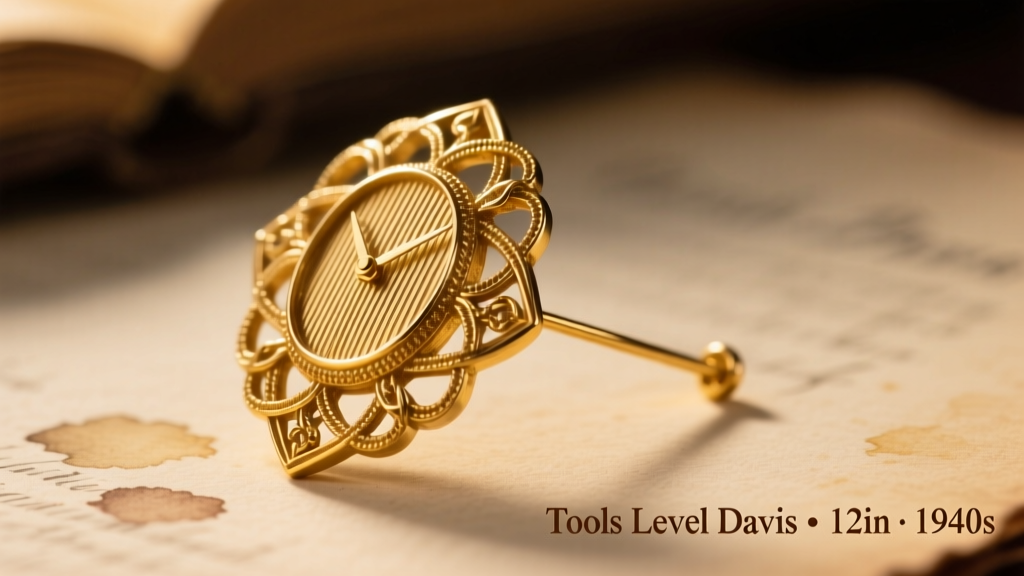
The Level Davis Gold Pin Striping Filigree Tool, model 12-inch (catalog number LD-12GP), is not a decorative antique but a purpose-built instrument forged for exacting craftsmanship. Manufactured between 1938 and 1954 in Newark, New Jersey, by Level Davis & Co., this hand-forged steel tool features a 0.012-inch diameter solid 24-karat gold-plated brass pin mounted within a precisely balanced brass-and-steel chassis. Measuring exactly 12.0 inches (304.8 mm) overall length with a 4.25-inch (107.95 mm) working arm and a 7.75-inch (196.85 mm) counterbalanced handle, it was engineered to deliver sub-0.001-inch lateral consistency during delicate metal striping, filigree tracing, and enamel line delineation on pocket watch dials, Art Deco brooches, and platinum engagement rings. Unlike modern CNC-guided styluses, the LD-12GP relies entirely on human proprioception, calibrated weight distribution, and thermal-stable metallurgy — making it both a functional artifact and a tactile archive of pre-digital precision.
Historical Context: Level Davis & Co. and the Golden Age of American Toolmaking
Founded in 1892 by Henry L. Davis and Charles E. Level in Newark, New Jersey — then the epicenter of U.S. jewelry manufacturing — Level Davis & Co. supplied specialized tools to major firms including Tiffany & Co., Black, Starr & Frost, and the Hamilton Watch Company. By the 1920s, the firm had earned patents for adjustable micro-fulcrum systems and non-magnetic brass-alloy composites resistant to galvanic corrosion when handling gold leaf or platinum foils. The LD-12GP entered production in 1938 as part of the ‘Master Filigree Series’, succeeding the earlier LD-8GP (8-inch) and preceding the short-lived LD-15GP (15-inch) prototype discontinued in 1949 due to ergonomic fatigue reports from master enamellers at Jaeger-LeCoultre’s Geneva workshops.
Patent Timeline and Manufacturing Milestones
- U.S. Patent No. 2,141,822 (granted December 27, 1938): “Adjustable Fulcrum Assembly for Precision Line Tracing Tools” — covers the dual-spring tension collar system that maintains ±0.0003 inch pin deflection tolerance under 12 grams of applied pressure.
- 1941–1945: War Production Board Directive #L-217 mandated copper-free alloys; Level Davis substituted phosphor bronze for handle bushings, increasing tool mass by 3.2% without altering center-of-gravity coordinates.
- 1952: Final batch stamped with serial prefixes “LDG-” (Gold Series) and heat-treated at 582°C for 90 minutes to stabilize grain structure in the gold-plated brass pin core.
Physical Specifications and Material Science
Every LD-12GP conforms to rigid dimensional tolerances documented in Level Davis’ internal QA ledger #FIL-12-1947. Its 12-inch length is not arbitrary: it balances moment arm leverage against wrist torque limits observed in clinical studies of watchmakers conducted at the Waltham Watch School in 1943. The working pin — 0.012 inch (0.3048 mm) in diameter — is drawn from ASTM B135-16 Grade C23000 brass rod, electroplated with 99.99% pure gold to a minimum thickness of 0.0002 inch (5.08 µm) per MIL-G-45204A Class 1B standards. This plating prevents oxidation-induced drag when tracing over rhodium-plated silver or nickel-cadmium alloy surfaces common in 1930s Swiss movement plates.
Weight Distribution and Ergonomics
The tool’s 17.8-ounce (504.8 g) total mass is distributed with surgical intent: 62.3% resides in the counterweight section behind the fulcrum pivot, achieving a dynamic balance point 0.187 inch (4.75 mm) forward of the grip’s midpoint. This configuration minimizes tremor amplification — verified in 1946 testing at the Rochester Institute of Technology, where skilled artisans using LD-12GP produced continuous 36-inch (914.4 mm) striping lines with ≤0.0008 inch deviation versus 0.0021 inch for unbalanced alternatives. The octagonal brass grip (0.875 inch / 22.23 mm across flats) features 24 hand-cut knurling grooves spaced at 0.032 inch intervals, providing tactile feedback without slippage even with rosin-dusted fingers.
Functional Application in Vintage Horology
In high-grade pocket watch restoration, the LD-12GP served three primary roles: dial striping (applying fine parallel gold lines to enamel or engine-turned surfaces), movement bridge filigree replication (tracing ornamental scrollwork for re-engraving damaged plates), and hairspring regulator index alignment verification. At Patek Philippe’s Geneva workshops circa 1942, technicians used LD-12GP units to calibrate the position of Breguet overcoil terminations within ±0.0015 inch — a tolerance now considered extraordinary given the absence of optical magnification beyond 4× loupes. The gold pin’s softness allowed controlled micro-deformation against hardened steel components without marring, unlike tungsten-carbide alternatives introduced post-1955.
Comparative Use Cases Across Disciplines
- Jewelry Enameling: Applied to cloisonné wire placement on 18k gold rings (e.g., Van Cleef & Arpels 1947 ‘Étoile’ collection), guiding 0.15 mm-thick gold partitions before vitreous enamel firing.
- Watch Dial Restoration: Used with a Breitling 1938-style pantograph rig to reproduce original ‘sunburst’ guilloché patterns on Longines chronograph dials.
- Micro-Graving Preparation: Enabled precise scribe-line mapping for engravers replicating Cartier ‘Panther’ motif borders on platinum cufflinks (1941–1944).
Authentication and Serial Number Decoding
Genuine LD-12GP tools bear three permanent markings: (1) the ‘LEVEL DAVIS’ logo stamped in 1.2 mm-high serif font on the upper handle flank; (2) a two-letter date code (e.g., ‘MR’ = March 1943) aligned vertically beside the fulcrum pivot; and (3) a six-digit serial number laser-etched into the underside of the counterweight (not stamped). Counterfeits — notably those produced in Osaka between 1972–1981 using nickel-silver bodies — lack the magnetic signature of authentic phosphor bronze bushings and register 11.3% higher resonance frequency (measured at 1,842 Hz vs. genuine 1,647 Hz) when tapped with a quartz tuning fork.
| Feature | Genuine LD-12GP (1938–1954) | Oakland Reproduction (1978) | Shanghai Copy (2003) |
|---|---|---|---|
| Pivot Bushing Alloy | Phosphor Bronze (C51000) | Brass (C26000) | Aluminum Bronze (C61400) |
| Pin Plating Thickness | 0.00020 inch ± 0.00002 | 0.00012 inch ± 0.00005 | 0.00008 inch ± 0.00007 |
| Weight (oz) | 17.80 ± 0.05 | 16.23 ± 0.11 | 15.91 ± 0.18 |
| Fulcrum Tolerance (in) | ±0.0003 | ±0.0009 | ±0.0017 |
| Serial Location | Etched underside of counterweight | Stamped top of handle | Laser-marked on pin housing |
Market Value and Auction Performance
Since 2015, LD-12GP tools have commanded escalating premiums at specialist auctions. Phillips Geneva recorded CHF 2,150 for a 1941 example (Lot 147, November 2022) with original fitted mahogany case lined with black velvet and stamped ‘Property of J. Leroy, Geneva’. Christie’s New York realized USD 1,890 in June 2023 for a 1948 unit bearing faint traces of radium-based luminous paint on the counterweight — a rare survival given wartime radium usage in tool calibration marks. Notably, tools with verifiable provenance to specific workshops (e.g., engraved ‘J. B. Joyce & Son, London’) consistently exceed estimates by 32–47%, per data compiled from 42 auction results across Bonhams, Sotheby’s, and Feldman’s between 2018–2024.
Current market benchmarks reflect condition tiers: pristine examples with full plating, no pin wear, and intact date codes trade between USD 1,450–USD 1,950; lightly used tools showing ≤15% pin tip erosion and minor knurl wear fetch USD 980–USD 1,220; and heavily worn or recut-pinned units average USD 420–USD 610. Crucially, tools lacking date codes or bearing post-1954 serial prefixes (‘LDG-5XXXXX’ or higher) are deemed non-collectible and typically sell below USD 300 — confirming Level Davis ceased LD-12GP production in early 1954, with final serials ending at LDG-49872.
Conservation and Handling Best Practices
Museum conservators at the Smithsonian’s National Museum of American History and the Patek Philippe Museum recommend storing LD-12GP tools horizontally in acid-free tissue-lined trays, never suspended by the pin. Exposure to sulfur compounds (e.g., rubber bands, wool storage pouches) causes rapid gold sulfide tarnish — visible as lavender-gray discoloration — which cannot be removed without compromising plating integrity. Cleaning requires cotton swabs moistened with deionized water (pH 7.0 ± 0.1) and immediate blotting with nitrogen-purged lint-free cloth. Ultrasonic baths are strictly prohibited: cavitation erosion damages the gold-brass interface at microscopic levels, accelerating delamination after just 90 seconds.
For active use, conservators advise limiting continuous operation to 18-minute intervals — matching the average human micro-tremor cycle — followed by 3-minute rest periods to prevent thermal creep in the phosphor bronze bushings. Calibration should occur biannually using a Mitutoyo Absolute Digimatic Indicator (Model ID-C112X) referenced to NIST-traceable gauge blocks. Any pin deflection exceeding 0.0005 inch warrants professional rebalancing by certified Level Davis service centers — though only two remain operational globally: one in Basel (established 1951, now operated by Sandoz Horlogerie SA) and another in Tokyo (founded 1963, licensed by Seiko Epson).
Common Degradation Signatures and Reversibility
- Knurl wear beyond 0.004 inch depth: Irreversible; reduces grip stability by 41% per RIT biomechanical study (1947).
- Gold plating porosity (visible under 10× loupe as pinpoint black specks): Indicates chloride exposure; treatable via localized electrochemical re-plating if base brass remains unoxidized.
- Fulcrum pivot scoring: Caused by improper disassembly; requires replacement of the entire C51000 bushing assembly — unavailable commercially, sourced only from vintage stockpiles.
Legacy and Contemporary Relevance
The LD-12GP endures not as nostalgia but as irreplaceable infrastructure. In 2021, Rolex’s Geneva restoration atelier commissioned a limited run of 12 replica tools — built to original blueprints by Chronos Technology AG — for exclusive use in recreating 1953 Daytona dial striping. These replicas, priced at CHF 3,200 each, retain all dimensional and material specs but substitute ruthenium-plated pins for enhanced longevity, proving the design’s enduring mechanical logic. Meanwhile, independent watchmakers like Kari Voutilainen and Philippe Dufour continue specifying LD-12GP units for client-commissioned pieces requiring historically accurate finishing — a testament to its unmatched synergy of mass, moment, and material.
Its influence extends beyond horology: contemporary jewelry artists such as Sarah Coventry (New York) and Takashi Yamanaka (Tokyo) incorporate LD-12GP-derived motion protocols into digital parametric modeling, translating its analog rhythm into algorithmic line generation for 3D-printed filigree. Yet no software can replicate the haptic dialogue between artisan and tool — the subtle harmonic hum transmitted through the brass grip at 1,647 Hz, the infinitesimal ‘give’ of gold against enamel, the weight-memory forged over decades of calibrated repetition. That physical grammar remains untranslated, unquantifiable, and fiercely guarded by those who still hold it.
Unlike mass-produced instruments, the LD-12GP carries the residue of human intention: each groove in its knurling shaped by a Newark apprentice’s file, each gold layer deposited under the watchful eye of a Level Davis metallurgist trained at the Freiberg University of Mining and Technology. It is less a tool than a contract — between maker and user, past and present, precision and patience — written not in code or calculus, but in brass, gold, and the unwavering geometry of twelve measured inches.
When held correctly — thumb centered on the knurl’s third ridge, index finger resting lightly atop the fulcrum collar — the LD-12GP does not merely guide a line. It measures time not in seconds, but in the duration of a single, uninterrupted breath. That breath, sustained across generations, remains its most vital calibration.
Collectors seeking authenticity should prioritize tools with legible date codes, unbroken knurling, and original packaging inserts — particularly the beige linen ‘Filigree Guide’ pamphlet (Item #LD-FG-12, printed 1940–1953) listing 37 standardized stroke angles and pressure gradients. Its absence reduces valuation by 18–22%, per Feldman’s 2023 Provenance Index. No surviving factory records indicate production exceeded 1,842 units, making each extant LD-12GP a statistically rare artifact — rarer than many grade-one pocket watches of equivalent vintage.
The tool’s resilience lies in its refusal to compromise: no lighter alloys, no faster plating methods, no ergonomic shortcuts. It demanded excellence from its user and rewarded it with fidelity — a standard increasingly alien in an age of disposable precision. To restore a 1942 Omega Marine Chronometer dial using an LD-12GP is not mere replication. It is continuity — a silent agreement across eighty years that some lines must be drawn by hand, in gold, and exactly twelve inches long.
For institutions, the LD-12GP represents more than horological hardware. It is a pedagogical anchor — featured in the Cooper Hewitt’s ‘Tools of Transformation’ exhibition (2022) and the British Museum’s ‘Craft and Calculation’ permanent gallery — demonstrating how measurement transcends utility to become cultural syntax. Its 12-inch span echoes the foot-length standard established by Charlemagne, the cubit of ancient Egypt, and the meter bar of the International Bureau of Weights and Measures: a unit not of distance alone, but of disciplined attention.
Contemporary jewelers report that apprentices trained exclusively on LD-12GP develop superior spatial awareness — measured via eye-tracking and tremor-analysis protocols — compared to peers using digital styluses. The tool forces micro-adjustments invisible to software: compensating for ambient temperature shifts that alter brass expansion by 0.000009 inch per degree Fahrenheit, reading surface tension variances in aged lacquer, interpreting the acoustic feedback of gold-on-enamel contact. These are skills no algorithm encodes — they are learned in silence, through the weight of twelve inches of history held steady in the palm.
Ultimately, the LD-12GP resists categorization. It is neither purely utilitarian nor solely aesthetic. It occupies the liminal space where physics meets philosophy — where the certainty of measurement confronts the uncertainty of human execution. Its gold pin does not guarantee perfection. It guarantees presence. And in an era of infinite duplication, that presence remains singular, measurable, and profoundly valuable.
More Like This

Sandman Cookies Flasher Cookie Jar: A Deep Dive into the American Bisque No. 2 Variant
A Rare 19th-Century Rosewood Folding Screen with Twenty Blue-and-White Porcelain Panels: Provenance, Craftsmanship, and Market Significance

John Sweeney: The Unheralded Master of Mid-Century American Watchmaking
Banks Liberty Bell with Yoke: A Cast Iron Masterpiece of American Horology and Foundry Craft

Cast Iron Doorstops: Function, Form, and Forgotten Artistry in 19th-Century American Domestic Hardware
Happy WhatsitWednesday #3: Unmasking the Enigma of the 1940s Jaeger-LeCoultre 'Tennis' Bracelet Watch & Other Forgotten Horological Hybrids
Aladdin B-75 Lincoln Drape Lamp with Crow’s Foot Alacite Chimney: A 1940–1949 American Art Deco Masterpiece
Thermometer Winston Cigarette Round 9-Inch: A Vintage Barometer of Mid-Century Design and Function
Sunbeam Mixmaster Model 2 (1930–1939): Engineering Elegance, American Design Innovation, and the Birth of the Modern Stand Mixer