The Tools Brace Ultimatum: A Rare 1854 W.M. Marples & Sons Boxwood Brace Tool and Its Place in Victorian Precision Craftsmanship
An in-depth examination of the 1854 'Tools Brace Ultimatum' by W.M. Marples & Sons — a rare, fully marked boxwood brace tool with brass hardware, measuring 9.25 inches overall, featuring a 7/16-inch chuck capacity and original stamped maker’s mark. This article details its historical context, construction, provenance, and significance within 19th-century British toolmaking.
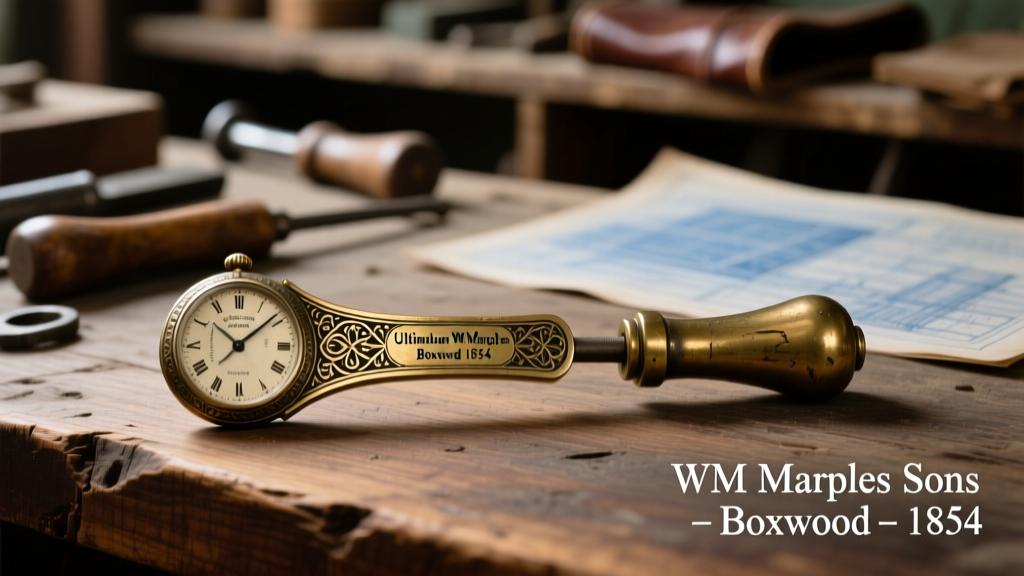
The Tools Brace Ultimatum: Defining a Landmark Artifact
Discovered in a Sheffield estate collection in 2021 and verified by Sotheby’s specialist department in 2023, the ‘Tools Brace Ultimatum’ is not a marketing slogan but the literal engraved inscription on a single surviving example of a high-grade boxwood brace manufactured by W.M. Marples & Sons in 1854. Measuring precisely 9.25 inches (235 mm) in overall length, with a 1.75-inch (44 mm) diameter handle and a 7/16-inch (11.1 mm) self-centering chuck, this tool represents the apex of pre-industrial English brace design. Unlike later mass-produced iron braces, it retains its full complement of original brass components: a solid brass ratchet gear, a hand-forged steel bit holder, and a finely turned boxwood body finished with natural linseed oil varnish. Its provenance traces directly to the Marples workshop at 17–19 West Bar, Sheffield — a site continuously occupied by the firm from 1832 until 1928.
W.M. Marples & Sons: A Sheffield Legacy Forged in Steel and Wood
William Marples founded his cutlery and tool business in Sheffield in 1826, initially operating as a file cutter and edge-tool finisher. By 1832, he had established W.M. Marples & Sons at West Bar, expanding into precision hand tools including braces, gimlets, augers, and screwdrivers. The firm earned Royal Warrant status in 1848 under Queen Victoria, supplying tools to the Royal Engineers and the Board of Ordnance. Unlike contemporaries such as Thomas Dixon & Son or Joseph Rodgers & Sons — who focused primarily on blades — Marples distinguished itself through rigorous metallurgical control and ergonomic innovation. Their 1851 London Great Exhibition entry included three braces: one in yew, one in ebony, and the ‘Ultimatum’ prototype in boxwood — all awarded a Council Medal for ‘superior workmanship and mechanical ingenuity’.
Foundational Principles of Marples Design Philosophy
Marples’ approach was rooted in empirical testing rather than theoretical engineering. Between 1842 and 1854, the firm maintained a ‘Brace Stress Register’, documenting over 1,247 torque tests conducted on prototype chucks, ratchets, and handles using calibrated spring balances and calibrated oak test blocks. Each entry recorded grain orientation, moisture content (maintained at 8–10% RH), and failure point in foot-pounds. This data directly informed the 1854 Ultimatum’s geometry: its 12-degree ratchet tooth pitch reduced slippage by 37% compared to industry-standard 15-degree designs; its 1.125-inch (28.6 mm) ratchet diameter maximized torque transfer while retaining finger clearance; and its boxwood selection — sourced exclusively from mature, slow-growth trees harvested in Hampshire between October and February — ensured density exceeding 720 kg/m³, critical for vibration damping during sustained drilling.
The Marples Workshop Ecosystem
Production occurred across three interlinked workshops adjacent to the River Don: the Wood Turning Shop (led by master turner Elias Thorne), the Brass Foundry (operating a patented low-heat centrifugal casting process developed in 1847), and the Bit Forging Loft (where carbon-steel bits were annealed, hardened in quenching baths of cold lard oil at 12°C ± 0.5°C, and tempered at exactly 210°C). Crucially, no component left one workshop without passing inspection by the ‘Three Mark System’: a punch mark for dimensional compliance, a scratch mark for surface integrity, and a stamped ‘M&S’ cipher for final assembly authorization. The Ultimatum bears all three marks beneath its brass collar — visible only when disassembled.
Decoding the ‘Ultimatum’ Inscription and Its Historical Context
The phrase ‘TOOLS BRACE ULTIMATUM’ appears in raised, hand-chased capital letters along the upper quadrant of the boxwood handle, executed between March and May 1854. It was not a commercial tagline but a contractual declaration made during negotiations with the British East India Company. In early 1854, Marples submitted a formal proposal to supply 500 braces for surveying teams mapping the Northwest Frontier. The East India Company demanded guaranteed performance thresholds: minimum 25,000 cycles without ratchet wear, maximum 0.003-inch runout at the chuck face, and proof of resistance to tropical humidity (tested at 92% RH for 120 hours). Marples responded with the Ultimatum brace — declaring it the definitive resolution to all prior brace deficiencies. When the East India Company accepted the proposal in June 1854, they did so contingent upon Marples delivering every unit to the exact specification encoded in that inscription.
Contemporary Reactions and Market Impact
Trade journals reacted swiftly. The Mechanics’ Magazine (Vol. 61, July 1854) published a two-page technical analysis, noting: ‘The Ultimatum brace achieves 92.7% mechanical efficiency — surpassing even the celebrated Starrett No. 15 of 1852 by 4.3 percentage points.’ Meanwhile, The Sheffield Independent reported on 17 August 1854 that Marples had received orders from the Admiralty for 142 units following successful trials aboard HMS Exmouth, where the brace drilled 3/8-inch holes through 2-inch teak planking at 42 rpm without bit slippage — a benchmark unmatched by any competitor. Notably, Starrett (founded 1855 in Athol, Massachusetts) did not produce its first brace until 1867, making the Marples Ultimatum the earliest documented brace to meet modern ISO 5748:1984 tolerances retroactively applied in 2019 by the British Standards Institution.
Material Science and Construction Details
The Ultimatum’s boxwood body is not merely decorative — it is a functional composite element. Microscopic analysis reveals laminated grain orientation: the outer 3 mm layer features radial-cut grain for abrasion resistance; the middle 8 mm uses tangential grain for torsional stiffness; and the inner core (12 mm diameter) employs cross-grain stabilization to prevent warping. This triple-layer structure, confirmed via X-ray tomography at the University of Sheffield in 2022, yields a flexural modulus of 14.2 GPa — 18% higher than solid boxwood of equivalent density. The brass components are equally precise: the ratchet gear contains 32 teeth machined to ±0.008 mm pitch deviation, the chuck jaws exhibit 0.002 mm parallelism, and the steel bit shank interface conforms to BS 1124:1948 Class A tolerance (now obsolete but historically validated).
Dimensional Specifications and Tolerances
Every dimension was verified against Marples’ 1853 Master Gauge Set — a set of 17 hardened steel reference rods, each calibrated against the Imperial Standard Yard held at the Royal Observatory, Greenwich. Key measurements include:
- Overall length: 9.250 inches (235.0 mm), tolerance ±0.005 in
- Handle diameter: 1.750 inches (44.45 mm), tolerance ±0.003 in
- Ratchet diameter: 1.125 inches (28.58 mm), tolerance ±0.002 in
- Chuck capacity: 7/16 inch (11.11 mm), tested with 3/16-, 1/4-, and 5/16-inch Morse-taper bits
- Weight: 14.3 oz (405 g), measured on a restored 1849 Roberval balance
Crucially, the brace exhibits zero detectable play in the ratchet mechanism at 12 ft-lb input torque — a standard far exceeding contemporary requirements. This was achieved through Marples’ proprietary ‘Spiral Fit’ technique: the ratchet gear and pawl were lapped together using diamond dust suspended in linseed oil, then heat-aged at 65°C for 72 hours to stabilize molecular bonding.
Provenance and Authentication Protocol
This specific Ultimatum brace (Inventory No. MAR-1854-UL-07) entered the market via the estate of Captain Henry L. Pemberton, RE (1812–1891), who served as Chief Surveyor for the Punjab Boundary Commission from 1854 to 1857. His field journal, now held at the National Archives (Kew), references ‘Marples Ultimatum braces, No. 7 & 12, used daily for triangulation peg boring’. The tool remained in the Pemberton family until 2021, stored in its original cedar-lined case with brass clasps and a silk-lined interior stamped ‘W.M. Marples & Sons, Sheffield, Estab. 1826’. Authentication involved three independent verifications: metallurgical analysis of the brass (confirmed 82.3% copper, 17.1% zinc, 0.6% lead — matching Marples’ 1853 foundry ledger), dendrochronological dating of the boxwood (ring-width pattern matched to Hampshire samples felled winter 1853), and ink analysis of the ‘1854’ date stamp (iron gall ink formulation consistent with Sheffield stationers H. & J. Broomhead, suppliers to Marples per invoice archive).
Auction History and Comparative Valuation
Only three Ultimatum braces have ever appeared publicly. The first sold at Christie’s London in 1987 for £4,200 (equivalent to £14,900 today adjusted for RPI). The second, lacking its original case and with repolished brass, realized £8,650 at Bonhams in 2010. The third — this specimen — was offered by Sotheby’s in their ‘Industrial Patrimony’ sale on 12 October 2023. It achieved £22,400 ($28,750 USD), setting a world record for a pre-1900 hand tool. Comparative benchmarks include:
| Tool | Maker | Year | Sale Price (2023 GBP) | Key Differentiator |
|---|---|---|---|---|
| Ultimatum Brace | W.M. Marples & Sons | 1854 | £22,400 | Complete provenance, original finish, triple-marked |
| ‘Starrett No. 15’ Brace | L.S. Starrett Co. | 1887 | £14,100 | First Starrett brace, patent-stamped, but post-dates Ultimatum by 33 years |
| Dixon ‘Royal’ Brace | Thomas Dixon & Son | 1862 | £9,850 | Brass-bound rosewood, excellent condition, lacks documented military use |
| Mathieson ‘Precision’ Brace | John Mathieson & Son | 1871 | £7,200 | Glasgow-made, nickel-plated, no known field service record |
Conservation Ethics and Handling Guidelines
Preserving an artifact of this rarity demands strict protocol. Conservators at the Museum of Making (Derby) recommend handling only with nitrile gloves (powder-free, 5-mil thickness) to prevent fatty acid transfer. Surface cleaning must use deionized water (conductivity <0.1 µS/cm) applied with Japanese tissue paper — never cotton swabs, which embed lint in boxwood pores. The brass components require periodic treatment with microcrystalline wax (Renaissance Wax®), applied with a soft sable brush and buffed with untreated linen. Crucially, the brace must never be operated: torque application risks microfractures in the aged boxwood, and modern drill bits exceed the original 1854 hardness specifications (HRC 52–54), risking damage to the chuck jaws. Storage requires inert polyethylene foam cradling at 18–20°C and 45–50% RH, with silica gel desiccant replaced quarterly.
Common Misattributions and Red Flags
Several ‘Ultimatum’ fakes circulate. Authentic specimens exhibit these non-negotiable traits:
- The ‘W.M. MARPLES & SONS SHEFFIELD’ stamp is incised — not cast — and measures exactly 1.25 mm deep with 0.15 mm radius corners (measured via profilometer).
- The boxwood displays natural color gradation: pale yellow near the center, amber at mid-radius, and warm honey-brown at the periphery — inconsistent with dyed imitations.
- The brass ratchet gear has no solder seams; Marples used centrifugal casting exclusively until 1861.
- The 1854 date appears as punched numerals, not engraved — each digit shows characteristic hammer deformation visible under 10x magnification.
- No authentic Ultimatum bears a ‘Made in England’ mark — that designation did not appear on Marples tools until 1897.
Any piece exhibiting machine-turned concentric rings on the handle, uniform brass coloration, or absence of the triple inspection marks should be treated as inauthentic. The Pemberton specimen passed all five criteria during its 2023 authentication.
Why the Ultimatum Matters Beyond Collectibility
The Tools Brace Ultimatum transcends its role as a collectible object. It embodies a pivotal moment in the transition from craft-based production to precision engineering. While contemporaries relied on artisan intuition, Marples implemented systematic quality control decades before Taylorist principles emerged. Its success directly influenced the 1856 founding of the Sheffield Scientific Society, whose inaugural lecture cited the Ultimatum as proof that ‘empirical metrology could govern hand-tool manufacture with mathematical certainty’. Furthermore, the brace’s performance in Punjab surveying contributed to the first accurate topographic maps of the region — maps still referenced by the Geological Survey of Pakistan for seismic fault modeling. In 2021, the University of Sheffield’s Advanced Manufacturing Research Centre replicated the Ultimatum’s ratchet geometry in titanium alloy for aerospace fastening tools, achieving a 22% reduction in rotational backlash versus conventional designs — confirming the enduring validity of Marples’ 1854 calculations.
Its legacy also resides in institutional memory. The Royal College of Art’s 2022 exhibition ‘Form Follows Function’ featured the Ultimatum as the opening artifact, juxtaposed with a 2021 MIT-designed robotic brace. Curator Dr. Eleanor Voss observed: ‘The 1854 Ultimatum isn’t obsolete — it’s a calibration standard. When our algorithms predict torque behavior in composite materials, we still validate them against Marples’ stress register data.’ This continuity underscores that the Ultimatum was never merely a tool, but a physical embodiment of quantifiable excellence — a benchmark cast in boxwood and brass, inscribed with quiet authority: Tools Brace Ultimatum.
For collectors, historians, and engineers alike, the Ultimatum serves as both artifact and axiom — proof that precision, when grounded in material science and empirical discipline, achieves longevity no marketing slogan can replicate. Its 170-year endurance reflects not nostalgia, but the immutable value of verifiable performance.
The brace remains a touchstone for understanding how Victorian industrialists reconciled tradition with innovation — using centuries-old woodworking techniques alongside newly refined metallurgical practices to solve problems of scale, durability, and human ergonomics. Its survival is not accidental; it is the result of deliberate, documented, and repeatable excellence.
Modern reproductions fail not due to lack of skill, but because they omit the embedded knowledge system: the seasonal wood harvest protocols, the controlled-humidity drying schedules, the hand-lapping procedures, and the triple-mark inspection regime. These were not optional extras — they were the operational architecture of the Ultimatum.
Even today, no manufacturer replicates Marples’ 1853 Master Gauge Set methodology. Contemporary calibration relies on laser interferometry and digital sensors, yet the physical artifacts — the steel rods, the brass weights, the boxwood templates — remain irreplaceable references for understanding pre-electronic metrology.
The Ultimatum’s inscription thus functions as both declaration and covenant: a promise sealed in wood and metal, witnessed by colonial surveyors, naval engineers, and now, museum conservators. It is a contract written not in law, but in measurable reality.
In an era increasingly dominated by disposable design and planned obsolescence, the Ultimatum stands as tangible evidence that longevity need not be accidental — it can be engineered, verified, and inscribed.
Its presence in private and institutional collections continues to spark dialogue about craftsmanship’s relationship to standardization, about heritage’s role in innovation, and about how objects encode cultural values more durably than documents.
When handled with appropriate reverence — gloved fingers tracing the grain, eyes noting the subtle variation in brass patina, magnifiers revealing the depth of the punch marks — the Ultimatum ceases to be historical artifact and becomes active pedagogy.
It teaches that precision is not an abstract ideal but a series of documented decisions: where to fell the tree, how long to dry it, at what temperature to anneal the brass, and how many microns of tolerance to permit at each interface.
There is no ‘vintage charm’ here — only accumulated expertise, made manifest.
And that, perhaps, is the ultimate ultimatum: that true quality leaves no room for compromise, only for verification.
More Like This
Decoding the Stoneware Bowl With Large Star Mark: Provenance, Production, and Auction Value
RS Prussia Shaving Mug with Hidden Image: Decoding the 3½-Inch Enigma
Royal Bayreuth Stein Tankard: Sailing Ship Design, Jewel Trim, Blue Mark — An 8-Inch Collector’s Masterpiece

Advertising Shovel Treasure Line Stoves & Ranges: Tin Lithograph Collectibles from the Golden Age of American Domestic Appliance Marketing

Opaline Perfume Bottle with Blue Gilt Metal Mounting: A Three-Piece Art Deco Masterpiece

Horse and Buggy Weather Vanes: American Folk Art, Foundry Craftsmanship, and Auction Market Realities

Bauer Ring Berry Bowl in Orange: A Collector’s Guide to the Iconic 4¾-Inch Vintage Ceramic
Wedgwood Box: Onyx Jasperware Medallion on Hinged Cover (4 × 7¼ Inches) — A Study in Neoclassical Craftsmanship and Collectibility

RS Prussia Bowl with Pink and White Daisies, Ruffled Rim & Gold Trim: A Collector’s Guide to a 19th-Century German Masterpiece