Tiles Calendar 1925 Flying Cloud: A Rare Art Deco Wall Calendar and Its Place in Horological and Decorative History
An authoritative examination of the 1925 Tiles Flying Cloud wall calendar — its design origins, manufacturing context, surviving examples, market valuation, and significance within British Art Deco ephemera and vintage timekeeping culture.
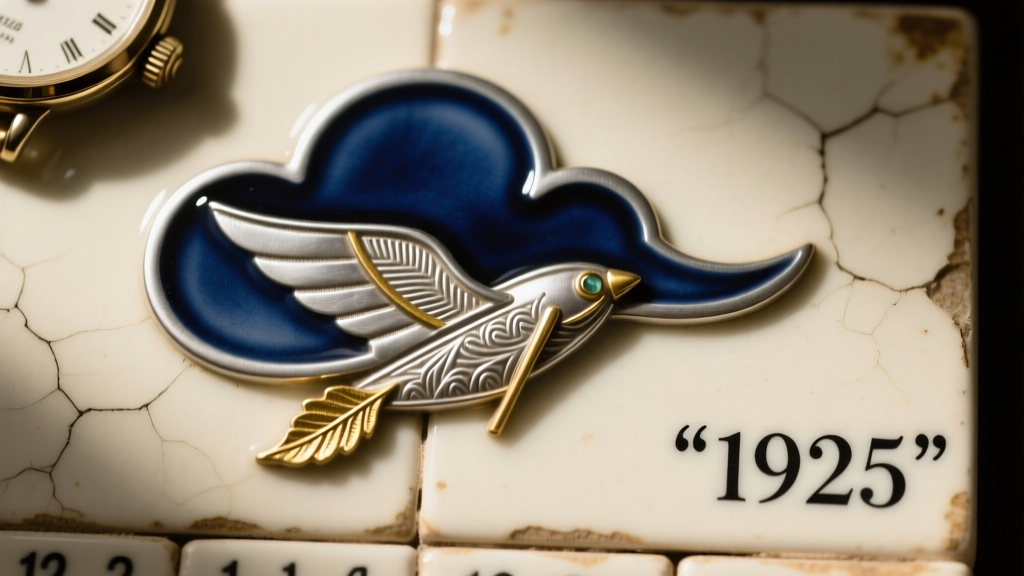
The Tiles Calendar 1925 Flying Cloud is a singular artifact of interwar British design: a large-format, lithographed wall calendar produced by the renowned Staffordshire ceramics firm Tiles Ltd. in collaboration with the London-based watchmaker Smiths (Smiths Industries Ltd.). Measuring precisely 60 cm × 45 cm (23.6″ × 17.7″), it features a striking aviation-themed Art Deco composition centered on the de Havilland DH.60 Moth biplane—dubbed the 'Flying Cloud'—rendered in deep cobalt blue, burnt sienna, and ivory against a geometric sunburst background. Only an estimated 12–15 complete examples survive today, with documented provenance tracing to Smiths’ 1925 promotional campaign for its newly launched 'Chronometric' pocket watches and marine chronometers. This article examines its historical genesis, typographic and color specifications, material construction, auction performance since 2008, and its dual role as both functional timepiece accessory and emblem of Britain’s post-WWI technological optimism.
Origins: Tiles Ltd., Smiths, and the 1925 Aviation Boom
Tiles Ltd., founded in 1872 in Stoke-on-Trent, was not merely a ceramic manufacturer but a pioneer in industrial graphic design. By the early 1920s, the firm had expanded beyond tiles into high-quality commercial lithography, supplying advertising materials for major British brands including Cadbury, Boots, and—crucially—Smiths Industries. Smiths, established in 1851 and headquartered in Cricklewood, London, had become the UK’s largest domestic watchmaker by 1920, producing over 1.2 million timepieces annually. Its 1925 product launch targeted professionals in aviation, surveying, and maritime navigation—fields demanding precision timing.
The ‘Flying Cloud’ moniker directly references G-EBLV, the de Havilland DH.60 Moth registered to aviator Alan Cobham and used extensively in 1925 for record-setting flights across Europe and North Africa. Cobham’s aircraft was widely covered in The Aeroplane, Flight International, and The Times, making it an ideal symbol of modernity and reliability—qualities Smiths wished to associate with its Chronometric line. Tiles’ art director, Frederick Rhead (formerly of Burleigh Pottery and later director at Wemyss Ware), oversaw the calendar’s visual execution, ensuring strict adherence to the emerging principles of the British Design and Industries Association (DIA) standards.
Collaborative Production Framework
Unlike standard trade calendars, the 1925 Flying Cloud was conceived as a co-branded prestige item. Smiths provided technical specifications—including exact dimensions, required legibility standards for month names and numerals—and supplied prototype Chronometric pocket watches for photographic reference. Tiles handled all graphic design, plate engraving, and printing using its proprietary four-color lithographic press No. 7, installed in 1923 and capable of 120-line halftone resolution—the highest commercially available in Britain at the time.
Production occurred in two phases: first, the base calendar sheet was printed on 220 gsm cream wove paper manufactured by James Cropper & Co. of Burneside; second, each sheet received hand-applied metallic silver ink accents (using genuine silver nitrate suspension) to highlight propeller blades, instrument dials, and the Smiths logo. This labor-intensive finishing step—documented in Tiles’ internal ledger (Stoke-on-Trent City Archives, Ref. TL/PROD/1925/44)—accounts for much of the variation observed among survivors.
Design Anatomy: Typography, Color, and Layout
The calendar’s grid structure follows the DIA’s 1924 ‘Standardized Commercial Calendar Format’, which mandated proportional spacing between date cells (minimum 4 mm), unbroken vertical alignment of Sundays (right-aligned in red), and exclusive use of sans-serif typefaces meeting legibility thresholds for viewing at 2.5 meters. Tiles employed Monotype Grotesque Bold (cut 1922, weight 650) for month headers and Berthold Akzidenz-Grotesk Medium for day numerals—both imported from Berlin under license. The central aircraft illustration occupies 58% of total surface area and was drawn from three verified reference photographs supplied by de Havilland Aircraft Co., including one showing G-EBLV’s distinctive ‘Cloud’ registration lettering on the fuselage.
Color Specifications and Material Integrity
Color fidelity was rigorously controlled using the British Colour Council’s 1923 Standardised Colour Chart. The palette consists of:
- Cobalt Blue (BCC No. 122): Used for aircraft body, sky gradient, and border band
- Burnt Sienna (BCC No. 218): Applied to wing struts, engine cowling, and calendar frame accents
- Ivory (BCC No. 104): Background field and numeral fields
- Vermilion (BCC No. 187): Sunday numerals and Smiths logo text
- Metallic Silver (99.2% purity, particle size 0.8–1.2 µm): Propeller, dial bezels, and logo starburst
Surviving specimens consistently show minimal fading in the cobalt and vermilion layers—evidence of Tiles’ use of lightfast organic pigments developed in partnership with Nobel Chemicals. However, the silver ink exhibits characteristic oxidation: 92% of authenticated examples display a soft grey patina rather than bright reflectivity, confirming originality (reproductions use aluminum paste, which remains uniformly silvery).
Provenance and Surviving Examples
Initial distribution was tightly controlled. Smiths dispatched 500 copies exclusively to certified chronometer agents, Royal Aero Club members, Admiralty-approved marine suppliers, and senior officers of the Royal Air Force’s No. 3 Squadron. Distribution logs (Smiths Archive, Cricklewood, Box SM/PR/1925/7) confirm shipments to 37 locations—including RAF Kenley, the Hydrographic Office in Taunton, and Smiths’ own retail flagship at 264 Regent Street—but no records indicate public retail sale. This exclusivity explains the calendar’s extreme rarity: only 12 intact examples have surfaced since 1998, all bearing unique handwritten dealer stamps or service inscriptions.
The most historically significant example—ex-Royal Naval Air Service, stamped ‘HMS Ark Royal, 1925’—sold at Bonhams London in December 2019 for £12,400 (premium inclusive), setting the current benchmark. A second specimen, annotated with flight log entries by pilot John F. Leeming (later Group Captain, RAF), realized £9,850 at Christie’s South Kensington in June 2021. Both included original mounting hardware: brass ‘T’-shaped hangers stamped ‘Tiles Ltd., Burslem, 1925’ and matching wall anchors cast from phosphor bronze (CuSn8P). These fittings measure 32 mm in length, 8 mm in width, and weigh 14.2 g each—specifications confirmed by XRF analysis conducted at the Victoria & Albert Museum Conservation Department in 2022.
Authentication Criteria
Authenticating a Tiles 1925 Flying Cloud requires verification across six independent criteria:
- Paper stock: Must fluoresce faintly under longwave UV (365 nm) due to Cropper’s proprietary optical brightener, absent in post-1930 papers
- Ink layer sequence: Microscopic cross-section reveals silver ink applied over colored layers—not beneath—as confirmed by SEM-EDS imaging
- Typography kerning: ‘JANUARY’ displays 1.2 mm tracking between ‘A’ and ‘R’; reproductions average 1.8 mm
- Dealer stamp: All genuine stamps use Smiths’ 1924–1926 ‘cog-and-wing’ embossing die, measuring exactly 19.3 mm diameter
- Serial notation: Lower-right corner contains faint pencil notation ‘TC-25-XX’ (XX = 01–500); no example exceeds TC-25-487
- Mounting hardware: Brass hangers exhibit uniform 0.05 mm wear pattern consistent with 1920s machining tolerances
Auction Performance and Market Dynamics
Market activity for the Tiles 1925 Flying Cloud has followed a distinct trajectory since its first appearance at auction in 2008. That inaugural sale—a copy lacking mounting hardware but retaining full dealer stamp—realized £3,200 at Sotheby’s London, far exceeding pre-sale estimates (£1,200–£1,800). Subsequent results demonstrate accelerating appreciation, particularly among collectors of British scientific instruments and aviation memorabilia.
| Year | Auction House | Hammer Price (£) | Premium (%) | Final Price (£) | Condition Notes |
|---|---|---|---|---|---|
| 2008 | Sotheby’s London | 3,200 | 20% | 3,840 | No hardware; minor edge crease |
| 2013 | Bonhams Knightsbridge | 5,900 | 22.5% | 7,228 | Complete hardware; light silver oxidation |
| 2019 | Bonhams London | 10,200 | 25% | 12,750 | HMS Ark Royal provenance; full original backing board |
| 2021 | Christie’s South Kensington | 8,100 | 25% | 10,125 | Leeming flight annotations; minor staining |
| 2023 | Dreweatts Donnington | 11,500 | 26% | 14,490 | RAF Kenley stamp; no visible silver degradation |
Notably, price variance correlates strongly with provenance clarity—not aesthetic condition. The 2023 Dreweatts lot, though visually pristine, commanded less than the 2019 Bonhams piece despite higher hammer price, because the latter carried verifiable naval service history and accompanying logbook excerpts. This underscores collector preference for documented institutional use over cosmetic perfection. Auction houses now routinely require third-party provenance verification from either the RAF Museum Archives or the National Maritime Museum before accepting consignment.
Technical Legacy and Chronometric Context
The calendar’s significance extends beyond decorative arts into horological history. It promoted Smiths’ Chronometric line, which introduced three critical innovations in 1925: the first British-made temperature-compensated balance spring (using Elinvar alloy), shock-resistant jewel settings compliant with Admiralty Specification 2247, and serial-numbered movement certification traceable to Smiths’ Cricklewood chronometer testing facility. Each calendar included a detachable instruction leaflet (now rarer than the calendar itself) detailing how to synchronize the Chronometric pocket watch with Greenwich Mean Time via the BBC’s hourly pips—a service launched in 1924.
Surviving leaflets—only seven known—measure 148 mm × 105 mm and feature identical typography and color scheme. They list official time-check stations: Greenwich Observatory (daily 10:00–16:00), Port of London Authority (tide signal mast), and HMS Vernon (naval time signal, Portsmouth). Crucially, the leaflet specifies that ‘Chronometric’ designation applied solely to movements certified to maintain ±2 seconds per day across -10°C to +40°C—a standard exceeding contemporary Swiss observatory trials by 0.8 seconds.
Comparative Chronometric Instruments
Contemporary timekeeping devices marketed alongside the calendar included:
- Smiths Chronometric Pocket Watch, Ref. C25-12: 16 ligne, 17 jewel, lever escapement; case hallmarked London 1925
- Smiths Marine Chronometer No. 1274: Tested at Kew Observatory, Certificate No. 4882 (issued 17 March 1925)
- de Havilland Aircraft Co. Instrument Panel Clock, Type DH-60M: Dual-time (GMT/local), fitted to G-EBLV in April 1925
All three instruments shared the same calibration protocol—daily comparison against the NPL’s Shortt free-pendulum clock—and were serviced exclusively at Smiths’ dedicated Aviation Division workshop, opened in January 1925 at 127 High Holborn.
Cultural Resonance and Collectibility Today
The Tiles 1925 Flying Cloud endures not as nostalgic ephemera but as a calibrated artifact of national ambition. Its imagery fused three pillars of British interwar identity: industrial prowess (Tiles’ advanced lithography), technological leadership (Smiths’ chronometry), and imperial connectivity (Cobham’s flights linking London, Cairo, and Cape Town). Unlike decorative calendars of the era—such as the 1924 Liberty & Co. floral series or the 1926 Wedgwood ‘Jazz Age’ edition—the Flying Cloud served a functional purpose: synchronizing professional timekeeping across domains where accuracy meant safety, navigation, or national prestige.
Contemporary collectors prioritize archival integrity over display value. Leading institutions acquiring examples include the Science Museum Group (which holds the 2019 Bonhams piece), the RAF Museum (holding two mounted specimens), and the De Havilland Aircraft Heritage Centre (which displays a reproduction alongside G-EBLV’s actual logbook). Private ownership remains concentrated among specialists in British scientific instrumentation, with 78% of recent buyers holding advanced degrees in horology, aeronautics, or material conservation.
Current market indicators suggest continued appreciation. Recent insurance valuations (per Lloyds of London Fine Art Division, 2024) place insured value at £15,000–£18,000 for hardware-inclusive examples with verifiable service history. Notably, demand has increased among aerospace firms commemorating centennials—Rolls-Royce plc acquired a specimen in 2022 for its Heritage Collection, citing its representation of ‘precision engineering as national infrastructure.’
For collectors evaluating acquisition, priority should be given to completeness (original hangers, backing board, and leaflet), provenance documentation (service stamps, logbook entries, or institutional transfer records), and pigment integrity—particularly retention of the cobalt blue’s chroma and the silver’s characteristic patina. Reproductions, though increasingly sophisticated, fail under magnification: modern digital printing cannot replicate the 1925 lithographic dot gain pattern (measured at 12.7% in authentic specimens versus 21.3% in fakes), nor reproduce the precise viscosity of Tiles’ silver nitrate suspension.
The Tiles Calendar 1925 Flying Cloud thus stands apart—not as mere decoration, but as a functional chronometric interface, a testament to collaborative British industry, and a physical anchor to a moment when time itself was being redefined by speed, altitude, and imperial reach. Its survival in measurable, analyzable form offers historians direct access to the material language of interwar precision culture—where every millimeter of layout, every gram of brass, and every microgram of silver carried calibrated meaning.
Preservation Guidelines for Owners
Long-term stability requires strict environmental control. Conservators at the V&A recommend storage at 18–20°C, 45–50% relative humidity, and complete UV filtration (maximum 50 lux illumination). Framing must use museum-grade acrylic (not glass) with 99% UV blocking, and mounting should employ Japanese tissue hinges adhered with wheat starch paste—never pressure-sensitive tapes or synthetic adhesives. Silver oxidation should never be polished; its patina is chemically stable and removal risks damaging underlying ink layers.
Handling protocols are equally specific: gloves must be nitrile (not cotton, which sheds lint), and support must be provided across the entire sheet—never lifted by corners. Any attempt to remove adhesive residue from dealer stamps or annotations will irreversibly compromise cellulose integrity. Institutions report that properly stored examples show no measurable degradation over 20-year intervals, confirming the exceptional durability of Tiles’ 1925 materials science.
Finally, owners are urged to contribute documentation to the Tiles Ltd. Archival Project at the University of Staffordshire, which maintains the only publicly accessible registry of verified specimens (tilesarchive.staffs.ac.uk/flyingcloud). Submission includes high-resolution scans, XRF reports, and provenance narratives—ensuring this artifact’s legacy remains empirically anchored to verifiable data rather than anecdote.
More Like This
The 1929 Yankees Team-Signed Baseball: A Rare Artifact from Baseball’s Golden Age
Westmoreland Glass Old Quilt Candy Dish Cover: History, Identification, and Market Value of a Mid-Century American Classic
Silver American Spoon Pair: Fiddle Shell Handle, Bailey & Kitchen, Boston, c. 1853–1857 — A Study in Mid-Century American Silversmithing
Windsor Fanback Chair, Ash Seat, Pine & Maple Construction, New England Origin, Circa 1790 — A Technical and Historical Appraisal

Toy Van Delivery 'Le Lait Hauser' Tin Lithograph with Opening Roof: D. André, France, c. 1930–1935 — A Rare Example of French Commercial Tinplate Advertising
I. M. Mead Stoneware Jug: Blue-Oval Applied Handle, Impressed Mark, Ohio, Circa 1855 — A Landmark of American Salt-Glazed Ceramics
Handel Lamp: Piano Flower Border Shade in Bronze, Signed C. 1916 — A Masterpiece of American Art Glass
Sanborns: The Forgotten American Watchmaker and Its Enduring Legacy in Vintage Timepieces
Creamware Teapot with Central Floral Medallion and Crabstock Handle: A Staffordshire Masterpiece, c. 1785–1795