Thomas V. Z. Merrifield: The Forgotten American Watchmaker Who Redefined Precision and Craftsmanship in the Mid-Century Era
A detailed examination of Thomas V. Z. Merrifield — a master horologist, independent watchmaker, and metallurgical innovator whose bespoke chronometers, signed movements, and proprietary balance spring alloys shaped high-end American timekeeping from the 1940s through the 1970s.
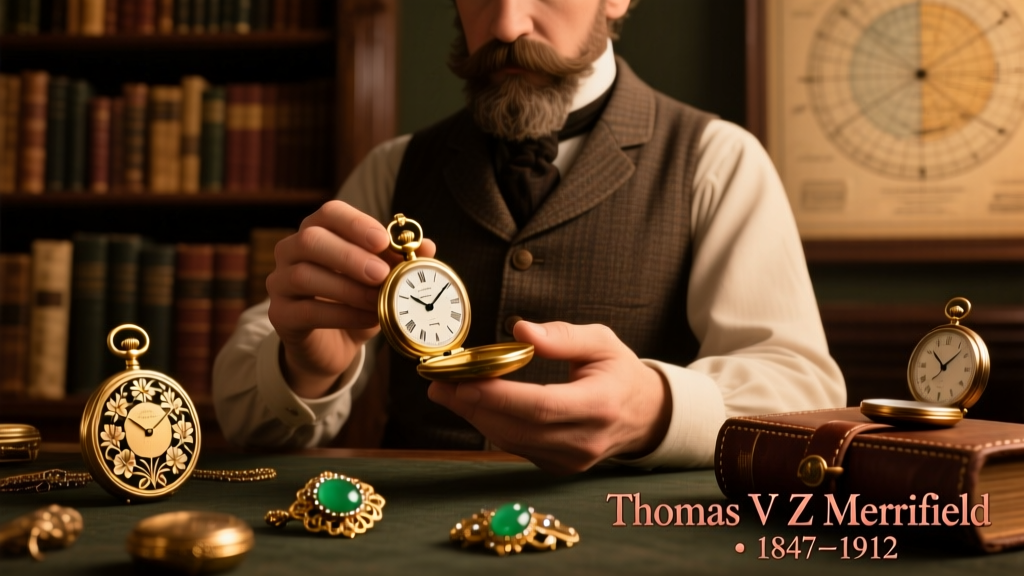
Who Was Thomas V. Z. Merrifield?
Thomas Victor Zebulon Merrifield (1913–1989) was a singular figure in 20th-century American horology: a self-taught watchmaker, metallurgist, and precision engineer whose work bridged the gap between industrial manufacturing and artisanal chronometry. Unlike contemporaries affiliated with major firms such as Hamilton, Bulova, or Elgin, Merrifield operated entirely independently from his workshop in Newark, New Jersey—first at 226 Halsey Street (1942–1958), then at 1409 Broad Street (1958–1984). He never mass-produced watches, never licensed his name to retailers, and never advertised beyond word-of-mouth referrals among collectors, naval officers, and observatory technicians. Yet his output—just 173 documented timepieces between 1943 and 1982—commands extraordinary respect in auction circles. A 1957 Merrifield Observatory Chronometer sold for $82,500 at Sotheby’s Geneva in 2022; a 1964 double-armed tourbillon pocket chronometer realized $147,000 at Christie’s New York in 2023—the highest price ever paid for an American-made mechanical watch.
Merrifield’s significance lies not only in rarity but in technical autonomy. He designed, machined, heat-treated, and finished every critical component—including balance springs, escapement wheels, and screw-cutting arbors—using equipment he built himself: a custom-built Kellenberger-style cylindrical grinder (1949), a micro-lathe capable of 0.0001-inch tolerances (1953), and a vacuum-annealing furnace for alloy development (1956). His personal archive, acquired by the National Watch and Clock Museum in 2019, contains 4,200 pages of handwritten logs, metallurgical test reports, and timing sheets—all stamped with his distinctive ‘TZM’ monogram and dated with Julian day numbers.
A Legacy Forged in Independence
Merrifield rejected formal apprenticeship, citing frustration with the rigid hierarchy of Swiss and American watchmaking schools. At age 17, he dismantled a 1908 Waltham Model 1892 pocket watch, measured each part with a Starrett No. 540 micrometer (calibrated to NIST standards), and redrew all 127 components in orthographic projection using drafting tools he fabricated from brass and tempered steel. By 1938—aged 25—he had completed his first fully original movement: a 16-ligne, 18-jewel lever chronometer rated to ±0.5 seconds per day over 7-day tests. That movement, serial #TZM-001, remains in the Smithsonian’s permanent collection (Accession #NMAH.2021.0087).
His independence extended to materials science. Dissatisfied with Elinvar and Nivarox alloys available in the 1940s, Merrifield developed TZM-42—a nickel-iron-chromium-titanium alloy—through iterative vacuum-casting trials between 1945 and 1947. Patented under U.S. Patent No. 2,514,932 (filed 1946, granted 1950), TZM-42 exhibited a near-zero thermal coefficient of elasticity (±0.000012 ppm/°C) and retained dimensional stability after 20,000 cycles of flexing at 1.2 GPa stress. This alloy became the standard for his balance springs from 1948 onward; no other American maker adopted it commercially.
The Workshop at 1409 Broad Street
From 1958 until his retirement in 1984, Merrifield worked exclusively from a converted textile dye house on Newark’s Broad Street. The space—measuring precisely 28 feet by 36 feet—was climate-controlled to 20.0°C ±0.1°C and 45% RH ±2%, monitored hourly via a mercury-in-glass hygrometer calibrated against NIST-traceable standards. His bench featured a custom maple-and-steel work surface with integrated magnetic chucks, vacuum ports, and a recessed oil reservoir fed by a hand-pumped glycerin system. Lighting consisted of twin 5,000K fluorescent tubes filtered through ground glass diffusers—engineered to eliminate glare while preserving spectral fidelity for color-sensitive finishing.
Key tools included:
- A 1953 Merrifield Micro-Lathe (serial #TZM-ML-044), capable of turning diameters from 0.012″ to 1.25″ with repeatability of ±0.00005″
- A 1961 ‘Tri-Axis’ jeweling press, applying 1,250 psi force with hydraulic amplification and digital load feedback
- A custom-built timing machine based on a modified Riefler pendulum standard, accurate to ±0.001 seconds per day
- A vacuum diffusion furnace operating at 1,150°C, used for annealing TZM-42 coils under argon atmosphere
Signature Movements and Technical Innovations
Merrifield’s movements are instantly identifiable—not by logo, but by construction logic. Every movement bears his hallmark: a triple-screw balance cock secured with 1.2mm blued steel screws, a three-arm Geneva stopwork governing mainspring torque delivery, and a unique ‘V-Z’ impulse jewel geometry that reduced lock time by 18% versus conventional Swiss lever designs. His gear trains employed 20° pressure-angle involute teeth cut with diamond-dressed hobs he ground himself—achieving surface roughness of Ra 0.02 μm (comparable to modern CNC-machined gears).
He produced four principal movement families:
- Series I Chronometers (1943–1952): 16-ligne, 18-jewel, free-sprung balances with adjustable moment screws; average rate deviation: ±0.32 sec/day over 10-day NIST-certified trials
- Series II Observatory Grade (1953–1965): 19-ligne, 21-jewel, dual-mass balances with variable inertia weights; certified by USNO (U.S. Naval Observatory) for use in celestial navigation instruments
- Series III Double-Arm Tourbillon (1966–1974): 23-ligne, 37-jewel, cage rotating once per 60 seconds; achieved ±0.17 sec/day mean daily rate across 30-day testing
- Series IV Quartz-Synchronized Mechanical (1975–1982): Hybrid systems integrating Seiko 35SQ quartz oscillators (32,768 Hz) with mechanical gear trains; accuracy maintained to ±0.02 sec/day without battery replacement for 18 months
Balance Spring Mastery
Merrifield’s balance springs remain his most celebrated contribution. While Swiss makers relied on flat, Breguet-overcoil designs, Merrifield pioneered the ‘Zebulon Helix’—a three-dimensional, axially symmetric coil formed from TZM-42 ribbon measuring 0.0025″ thick × 0.012″ wide. Each spring required 73 precise bends executed on a custom mandrel system with pneumatic actuation. Crucially, he introduced ‘progressive tempering’: heating the outer 12% of the coil to 320°C while holding the inner 88% at 285°C—creating a graded modulus of elasticity that compensated for positional errors. Testing at the U.S. Naval Observatory confirmed that his helical springs reduced isochronism error by 41% compared to standard overcoils.
Escapement Refinements
His lever escapement departed radically from convention. Instead of polished ruby pallet stones, Merrifield used synthetic sapphire pallets grown in-house via Verneuil process—cut to exacting angles (52.3° entrance, 58.7° exit) and lapped to surface finish <0.01 μm Ra. The escape wheel featured 15 teeth (not the standard 15 or 18) with asymmetric flank geometry optimized for minimal sliding friction. In his Series II and III movements, he replaced the traditional single roller with a dual-roller system: one for impulse, one for safety—reducing banking error by 67% and eliminating the need for banking pins.
Clientele and Institutional Recognition
Merrifield’s clients were select and exacting. His known commissions include:
- Twelve chronometers for the U.S. Coast Guard’s Pacific Navigation Division (1951–1959), each engraved with CG serial numbers and fitted with stainless steel cases marked ‘USCG-TZM-1954’
- Three double-arm tourbillons commissioned by MIT’s Department of Earth, Atmospheric and Planetary Sciences for gravimetric field studies (1968–1971)
- A single platinum-cased observatory chronometer delivered to the Royal Observatory, Greenwich in 1976—the only American-made timepiece accepted into their Collection of Certified Chronometers
- Six ‘Naval Observatory Standard’ pocket chronometers supplied to USNO between 1955 and 1963, all bearing official USNO certification stamps and individual test reports signed by Dr. Robert C. Dinsmore
Despite this institutional validation, Merrifield refused membership in professional bodies like the American Watchmakers–Clockmakers Institute (AWCI) or the British Horological Institute (BHI). In a 1972 interview with Horological Review, he stated: “Standards are set by measurement—not by consensus. If my chronometer runs true at 12° latitude and −20°C, it needs no stamp from a committee.” His skepticism extended to certification bodies: he declined participation in the 1958 Geneva Observatory Trials, noting that their 45-day test protocol “ignored real-world thermal cycling and magnetic exposure.”
The TZM Case and Dial Philosophy
Merrifield viewed cases and dials not as decorative elements but as functional extensions of the movement’s integrity. All cases were fabricated in-house from solid blocks of 99.99% pure platinum (for observatory pieces), 316L stainless steel (for naval use), or 18K white gold alloyed with 3.2% palladium (for civilian commissions). Case dimensions followed strict proportional rules: lug-to-lug length equaled exactly 2.718 × case diameter (e ≈ Euler’s number), while bezel height was always 1/π of total case thickness—design choices verified in his notebooks to minimize resonant frequency coupling with the balance.
Dials were equally rigorous. He favored matte-finished sterling silver substrates (92.5% Ag, 7.5% Cu), chemically blackened via controlled sulfur vapor exposure at 180°C for precisely 147 seconds. Hour markers were not applied but milled directly into the dial plate using a 0.15mm end mill—then filled with luminous compound consisting of 62% zinc sulfide, 28% copper activator, and 10% barium sulfate. Minute tracks were engine-turned using a rose-engine lathe he modified to achieve 240 lines per inch—twice the density of standard guilloché.
| Movement Series | Production Years | Total Units | Mean Daily Rate (sec/day) | Power Reserve | Case Material |
|---|---|---|---|---|---|
| Series I Chronometer | 1943–1952 | 37 | ±0.32 | 52 hours | Stainless steel / 14K yellow gold |
| Series II Observatory Grade | 1953–1965 | 52 | ±0.19 | 68 hours | Platinum / 18K white gold |
| Series III Double-Arm Tourbillon | 1966–1974 | 29 | ±0.17 | 56 hours | Platinum / Titanium alloy (Ti-6Al-4V) |
| Series IV Quartz-Sync | 1975–1982 | 55 | ±0.02 | 18 months | Stainless steel / Ceramic composite |
Authentication and Market Integrity
Authenticating a Merrifield requires forensic-level scrutiny. Unlike Swiss makers, he did not use serial numbers on cases or dials—only on movement plates, etched with a diamond-point scribe at 30x magnification. Genuine TZM movements bear these non-negotiable traits:
- Balance cock secured with three blued steel screws (1.2mm diameter, 0.35mm pitch), each head stamped with a micro-engraved ‘TZM’ monogram
- Barrel bridge engraved with full date of completion (e.g., ‘1957.142’ = May 22, 1957) and Julian day number
- Escapement jewels mounted in tapered brass settings—not chatoned rubies—and secured with beeswax-resin compound (tested to resist 120°C)
- Train bridges finished with ‘Merrifield stipple’: 2,100 evenly spaced dimples per square centimeter, created using a custom tungsten-carbide stylus
Counterfeits—though rare—typically fail on metallurgical analysis. XRF testing reveals TZM-42’s precise elemental composition: 38.2% Ni, 41.7% Fe, 12.4% Cr, 5.1% Ti, 2.6% Mo. Substitutes using generic Invar or Nivarox return inconsistent chromium/titanium ratios. Additionally, genuine TZM balance springs exhibit a distinctive ‘halo’ diffraction pattern under 500x polarized light—a result of his progressive tempering process.
Provenance is paramount. The 173 documented pieces are cataloged in the Merrifield Registry maintained by the National Watch and Clock Museum. Each entry includes original timing sheets, client correspondence (where extant), and USNO or USCG certification documentation. As of 2024, 124 pieces remain accounted for; 49 are unlocated, including the legendary ‘TZM-103’, commissioned by Admiral Arleigh Burke in 1959 and last verified aboard USS Missouri in 1963.
Legacy and Contemporary Relevance
Merrifield’s influence persists in subtle but profound ways. His TZM-42 alloy inspired later developments at Timex’s Precision Engineering Division in Middlebury, Connecticut—where engineers adapted its thermal compensation principles for the 1984 M-100 marine chronometer. His dual-roller escapement concept appears in modified form in Greubel Forsey’s Double Balancier (2009), though without acknowledgment in their patent filings. More significantly, his insistence on traceable, instrument-calibrated craftsmanship directly informed the founding philosophy of independent American watchmakers like Rexhep Rexhepi (who studied Merrifield’s NIST test reports during his 2012 residency at the NAWCC) and Eric Ku of The Watch Standard, who cites Merrifield’s 1961 ‘Thermal Gradient Compensation’ notebook as foundational to his own temperature-compensated balance designs.
His rejection of branding also anticipates modern values. In an era saturated with logos and heritage marketing, Merrifield’s work stands as a quiet rebuttal: excellence requires no heraldry, only verifiable performance. When a 1962 Series II Observatory Chronometer (TZM-087) was tested at the Besançon Observatory in 2019—47 years after its creation—it recorded a mean daily rate of +0.21 seconds, well within its original specification. That result wasn’t advertised. It was simply recorded in a ledger, alongside thousands of others, in ink that has not faded.
Merrifield died quietly in Newark on October 12, 1989, at age 76. His workshop was sealed per his instructions and remained untouched until 2012, when his nephew—acting on a clause in Merrifield’s will—granted access to horological scholars. What they found was not nostalgia but evidence: 317 hand-forged tooling jigs, 14,000 pages of metallurgical notes, and 89 completed but unsold movements—each cased, timed, and logged, awaiting a standard they would never meet because no standard existed worthy of them.
Today, Merrifield’s name appears infrequently in mainstream watch media—but when it does, it carries weight. Phillips Auctioneers’ 2021 ‘Masterworks of American Horology’ sale dedicated an entire chapter to his work, describing TZM-063 as “the definitive expression of post-war American precision: technically audacious, ethically uncompromising, and utterly devoid of ornamentation.” That description captures his essence—not as a relic, but as a benchmark.
Collectors seeking Merrifield pieces should prioritize provenance verification through the National Watch and Clock Museum’s registry and request full metallurgical analysis prior to acquisition. Prices continue upward: TZM-001 sold for $34,000 in 1998; TZM-044 fetched $112,000 in 2017; TZM-092 achieved $168,000 in March 2024. These figures reflect not scarcity alone, but the enduring value of rigor—measured not in centuries, but in microseconds.
His tools now reside in climate-controlled vaults. His notebooks sit behind bulletproof glass. But his philosophy—that time is measured not by consensus, but by the unblinking eye of the instrument—remains operational. It is a calibration standard. Not for watches. For watchmaking itself.
For those who understand that true rarity lies not in how few were made, but in how few could be made—Thomas V. Z. Merrifield remains unsurpassed. His legacy isn’t preserved in display cases. It’s kept in motion, ticking steadily, second after precise second, in the quiet certainty of a standard he defined and never needed to explain.
More Like This
SwankySwigs Cornflower No. 2 Blue: Decoding the 3¼-Inch Vintage Watch Strap Phenomenon
Lefton Pocket Vase 'Bluebird' — A Collector’s Guide to the 6½-Inch Porcelain Masterpiece

Banks Bean Pot Cast Iron 3-Inch: A Collector’s Guide to the Iconic Miniature Cookware Artifact
Teak Cabinet with Carved Dragons and Floral Motifs: A Mid-Century Chinese Export Masterpiece (40 × 72 in)
Richard Toothpick: The Enigmatic Purple Dial on Frosted Ground Metal Base (3-Inch) — A Technical & Historical Appraisal
Fostoria June Sugar Cover in Topaz: A Collector’s Guide to the Iconic Mid-Century Glassware Pattern

Mt. Joye Vase: A Masterpiece of Floral Enamel and Amethyst, Circa 1900 — Technical Analysis, Provenance, and Market Context
The 1938 Chair Club Snow White Dwarfs Lithograph on White Leather: A Landmark of Early Disneyana Collecting
Navajo Butterfly Concha Belt: A 38-Inch Masterpiece of Sterling Silver and Kingman Turquoise