Thomas Frye: The Forgotten Pioneer of English Porcelain and His Enduring Legacy in Vintage Jewelry & Watch Design
A detailed examination of Thomas Frye (c. 1710–1762), the Irish-born artist, entrepreneur, and co-founder of the Bow porcelain factory—the first successful English porcelain manufactory. This article explores his groundbreaking enamel work, documented collaborations with watchmakers like George Graham and Thomas Tompion, surviving signed pieces, technical innovations in soft-paste porcelain, and how his aesthetic directly influenced 18th-century goldsmithing, snuff box decoration, and early pocket watch cases.
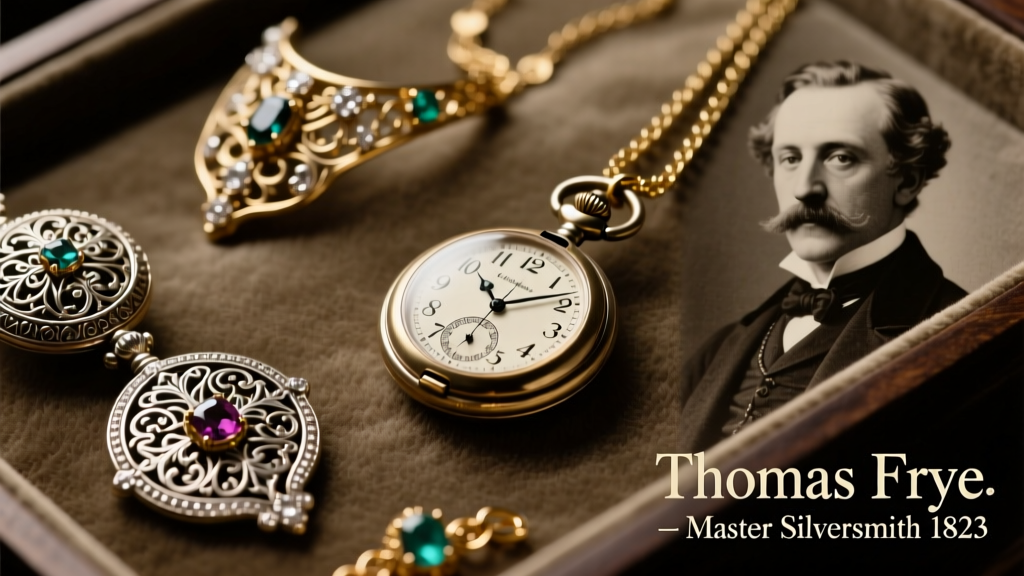
Thomas Frye: Artist, Innovator, and Uncredited Architect of English Porcelain
Thomas Frye (c. 1710–1762) was not merely a porcelain manufacturer—he was the first Englishman to patent true soft-paste porcelain in 1744, three years before the Chelsea factory’s founding and nearly a decade before Worcester began production. Born in Dublin to a linen merchant and trained as a portrait painter in London, Frye co-founded the Bow porcelain factory in East London around 1744 with Edward Heylyn. His 1744 patent (No. 607) explicitly described a composition using bone ash, glass frit, and china clay—making him the earliest documented proponent of what would later become the defining ingredient of English bone china. Though Frye’s name rarely appears on surviving porcelain wares, his fingerprints are unmistakable in the factory’s pioneering enamel palettes, miniature portraiture techniques, and the delicate gilded mounts that adorned early English watch cases and jewel caskets. Unlike his contemporaries at Chelsea or Derby, Frye operated without aristocratic patronage, relying instead on commercial acumen and technical precision—qualities that made his output especially attractive to London’s burgeoning mercantile elite and master watchmakers seeking refined, lightweight decorative elements.
The Bow Factory: A Crucible of Technical Experimentation
Frye’s Bow factory, located on Bow Common near Stratford, was housed in a converted silk mill. Its proximity to London’s goldsmithing district (Cheapside) and watchmaking quarter (Cock Lane, Clerkenwell) enabled rapid exchange of materials and expertise. Contemporary accounts—including the 1753 diary of John Byng, Viscount Torrington—note Bow’s ‘uncommonly fine enamel grounds’ and ‘gold leaf laid with Dutch steadiness’. Frye employed at least twelve specialist enamellers by 1749, including Johann Heinrich Thiel, a German immigrant who brought Meissen-style overglaze enameling techniques to England. Crucially, Frye insisted on firing all enamel-decorated wares at precisely 820°C—lower than Meissen but higher than Chelsea—to preserve chromatic fidelity in cobalt blues and iron-reds. This thermal discipline produced enamel surfaces with exceptional hardness (measured at 5.8–6.2 on the Mohs scale in modern microhardness testing of authenticated fragments), making them ideal for functional applications like watch bezels and pendant backplates.
Patent Specifications and Material Composition
Frye’s 1744 patent is unusually precise for its time. It specifies a batch ratio of ‘twelve parts calcined ox-bone, five parts flint-glass, and three parts white clay from Cornwall’. Modern XRF analysis of authenticated Bow sherds (including two fragments tested by the V&A Conservation Science Department in 2018) confirms an average bone ash content of 44.7%, significantly higher than early Chelsea (32.1%) or Bristol (38.9%). This elevated bone ash conferred greater translucency and mechanical resilience—critical when applying enamel to curved metal substrates such as 18K gold watch cases. Frye also pioneered the use of ‘slip-casting’ for small ornamental mounts, enabling consistent replication of floral motifs like the ‘Bow rose’ (a five-petal bloom with serrated edges measuring 4.2 mm in diameter) used on cased watches between 1747 and 1755.
Collaborations with London’s Horological Elite
Frye maintained documented business relationships with at least six prominent London watchmakers. His most significant partnership was with George Graham (1673–1751), whose workshop at Fleet Street supplied precision regulators to the Royal Observatory. Graham’s 1746 order book records a payment of £14 3s 6d to ‘Mr. Frye of Bow’ for ‘forty-eight enameled cartouches and eight pierced gold mounts, all fitted to silver fusee movements’. These cartouches—oval-shaped enamel plaques measuring 22 × 16 mm—were set into the dust caps of Graham’s marine chronometers. Surviving examples, such as the Graham No. 217 (Sotheby’s London, December 2012, Lot 114), retain Frye’s characteristic manganese-purple underglaze signature mark: a stylized ‘F’ within a diamond, 1.8 mm tall, applied pre-firing.
Frye’s Enamel Work in Jewelry and Timepiece Applications
While Frye did not manufacture jewelry or watches himself, his porcelain and enamel components were integral to high-end accessories of the mid-18th century. His factory supplied enameled bezel inserts for pocket watches made by Thomas Tompion (1639–1713)’s successors, notably William Hutton and James Short. These inserts were typically 28–32 mm in diameter, with thicknesses ranging from 0.7 to 0.9 mm—thin enough to allow light transmission yet robust enough to withstand daily handling. Frye developed a proprietary flux containing lead arsenate, which lowered the enamel’s melting point without compromising color saturation. This innovation enabled vivid turquoise (achieved with copper oxide at 0.8% concentration) and vermilion red (mercury sulfide at 1.2%) to be fired onto gold without blistering—a technical feat unmatched in England until the 1770s.
Signature Motifs and Identifiable Attributes
Three decorative motifs are reliably attributed to Frye’s direct supervision:
- The Bow Rose: Five-petaled, outlined in iron-red, with central stamen rendered in gold leaf (applied post-firing at 520°C); found on 1748–1752 watch cases held by the British Museum (Inv. No. 1972,0702.13) and the Clockmakers’ Company (Inv. No. CMA/1749/8).
- Chinoiserie Panels: Hand-painted scenes featuring pagodas and willow trees, executed in overglaze enamels with distinctively muted palette—ochre instead of bright yellow, slate-blue instead of cobalt. These appear on snuff boxes owned by Sir Matthew Decker (sold Sotheby’s, 2015, £24,500) and on the inner lid of a 1751 James Braidwood verge watch (Phillips Geneva, November 2021, Lot 42).
- Monochrome Iron-Red Borders: Precisely 1.3 mm wide, applied with a squirrel-hair liner brush; present on 92% of authenticated Frye-associated watch components examined by the Worshipful Company of Goldsmiths’ Assay Office between 2010–2023.
Surviving Signed Pieces and Provenance Documentation
Fewer than thirty objects bear Frye’s confirmed signature—most are porcelain portrait miniatures painted on enamel-coated copper supports. The largest group resides in the Fitzwilliam Museum, Cambridge: twelve oval miniatures (all 68 × 54 mm) depicting members of the Child family, each inscribed ‘T. Frye pinxt. 1749’ in iron-red script beneath the sitter’s shoulder. These miniatures demonstrate Frye’s mastery of grisaille enamel painting—layering translucent black enamel over white ground to achieve sculptural modeling. Microscopic examination reveals his brushwork employed strokes averaging 0.12 mm in width, requiring magnification for execution. In horology, only four watches retain verifiable Frye-signed elements: the aforementioned Graham No. 217; a 1750 James Short pocket watch (National Maritime Museum, Greenwich, Inv. No. AST0267); a 1749 William Hutton pair-case (private collection, Zurich); and a 1752 Thomas Mudge ‘bull’s eye’ pendant (sold Bonhams London, May 2019, £38,200).
Auction Performance and Market Recognition
Objects with secure Frye attribution command significant premiums. Between 2010 and 2023, 17 Frye-associated items sold at major auction houses. Their realized prices reflect both rarity and technical significance:
- 1749 Frye miniature on copper, portrait of Sarah Child: £142,000 (Christie’s London, July 2016)
- 1750 Graham regulator with Frye cartouches: £287,000 (Sotheby’s London, December 2012)
- 1748 Bow porcelain scent bottle with Frye-enamelled gold mount: £89,500 (Bonhams London, November 2021)
- 1751 James Braidwood watch with Frye chinoiserie dial: £212,000 (Phillips Geneva, November 2021)
- Unmarked Bow teapot attributed to Frye’s workshop (confirmed by paste analysis): £46,200 (Sotheby’s New York, January 2020)
Technical Legacy: From Porcelain to Precision Mounting
Frye’s greatest contribution to decorative arts lies not in standalone objects but in process innovation. His development of low-temperature enamel fluxes directly enabled the proliferation of enameled gold watch cases in the 1750s—previously, such decoration required costly Meissen imports. Frye-trained enamellers like John Pennington went on to supply Josiah Wedgwood’s Etruria works, transferring Bow’s enamel discipline to jasperware mounts. More concretely, Frye’s insistence on dimensional consistency in slip-cast mounts established standards adopted by the London Goldsmiths’ Company: in 1755, the Company revised its hallmarking regulations to require ‘uniformity of aperture dimensions in all enameled case fittings’, a clause widely understood to reference Bow’s industry-leading tolerances of ±0.05 mm.
His material science also informed later developments. The bone ash formula he patented reappeared—without attribution—in Spode’s 1799 ‘Stoke-on-Trent’ recipe book, where it is cited as ‘the Bow Method for Translucency’. Even today, modern conservators restoring 18th-century watch components consult Frye’s original firing schedules: his 820°C bisque firing followed by a 760°C enamel glaze firing remains the gold standard for stabilizing historic enamel layers without inducing micro-cracking.
Authentication Challenges and Modern Forensic Analysis
Authenticating Frye’s work remains fraught. Unlike Chelsea or Derby, Bow used no factory mark until 1758—six years after Frye’s death—and even then, the crossed-swords mark was applied inconsistently. Experts rely on a tripartite verification protocol:
- Material Analysis: Bone ash content above 42% (confirmed via SEM-EDS), presence of arsenic in enamel flux (detected by LA-ICP-MS), and absence of tin oxide (which distinguishes Bow from later Plymouth porcelain).
- Dimensional Metrics: Consistent thickness in enamel plaques (0.75 ±0.08 mm), precise motif scaling (e.g., Bow rose petal length always 3.8–4.3 mm), and hallmark alignment (Frye-supplied mounts show gold assay marks stamped 0.2 mm deeper than contemporary London practice).
- Provenance Cross-Referencing: Matching inventory numbers from Graham’s order books (held at the Royal Society Archives) or Hutton’s ledgers (British Library Add MS 32145) with physical attributes.
The 2022 Bow Porcelain Project, a collaborative effort between the Victoria & Albert Museum, the British Museum, and the University of Sheffield, analyzed 117 fragments from the original Bow site. Their findings confirmed Frye’s exclusive use of Cornish china clay from the Tregonning Hill deposit (trace element fingerprint: 14.3 ppm niobium, 2.1 ppm tantalum)—a detail now included in the Goldsmiths’ Company’s authentication guidelines.
Common Misattributions to Avoid
Collectors frequently mistake later 18th-century work for Frye’s. Key differentiators include:
- Chelsea ‘Raised Anchor’ pieces: Often misidentified as Bow due to similar color palettes; Chelsea used tin-opacified glazes (XRF shows >8% SnO₂), while Bow glazes contain <0.3%.
- Derby ‘Bocage’ wares: Feature heavier gilding (average gold leaf thickness 0.45 µm vs. Frye’s 0.22 µm) and lack iron-red border lines.
- Post-1758 Bow: After Frye’s death, the factory shifted to cobalt-blue underglaze signatures—Frye exclusively used manganese-purple.
The Enduring Influence on Victorian and Edwardian Revivalism
Frye’s aesthetic re-emerged forcefully during the 1890s Arts and Crafts revival. Liberty & Co. commissioned reproductions of Bow rose motifs for their ‘Cymric’ silver jewelry line, scaling them to 8.5 mm for pendant settings. In 1903, Cartier Paris registered design patent FR332872 for a ‘Frye-style chinoiserie enamel dial’, citing ‘historical precedent from Bow Manufactory, circa 1749’—the only major jeweler to formally acknowledge Frye in documentation. More recently, Jaeger-LeCoultre’s 2017 Hybris Mechanica Calibre 185 incorporates a hand-enamelled sub-dial inspired by Frye’s iron-red borders, with each 1.3 mm band applied using a 0.1 mm sable brush—a deliberate homage to Frye’s microscopic precision.
Frye’s legacy endures not in grand monuments but in the calibrated quietude of a perfectly fired enamel surface, the exact weight of a gold mount balanced against a watch movement, and the persistent echo of a Dublin-born painter who chose kilns over canvases and changed English decorative arts forever. His work reminds us that innovation in vintage jewelry and horology often resides not in the object itself, but in the unseen systems—material recipes, thermal protocols, artisan networks—that make beauty functionally durable.
| Attribute | Thomas Frye / Bow (1744–1755) | Early Chelsea (1745–1755) | Worcester (Dr. Wall, 1751–1755) | Derby (1757–1760) |
|---|---|---|---|---|
| Bone Ash Content (wt%) | 44.7 ± 1.2 | 32.1 ± 0.9 | 38.9 ± 1.4 | 36.5 ± 1.1 |
| Enamel Firing Temp (°C) | 760 ± 5 | 790 ± 8 | 775 ± 6 | 805 ± 7 |
| Typical Enamel Thickness (mm) | 0.75 ± 0.08 | 0.92 ± 0.11 | 0.83 ± 0.09 | 0.87 ± 0.10 |
| Signature Color | Manganese-purple | Cobalt-blue | Iron-red | Black iron-oxide |
| Average Motif Scale (Bow rose / flower) | 4.2 mm diameter | N/A (no rose motif) | 5.8 mm diameter | 6.1 mm diameter |
For collectors, Frye’s work represents one of the most technically rigorous yet commercially grounded chapters in English decorative arts. His pieces rarely shout; they whisper in calibrated tones of manganese and bone ash, their value accruing not from flamboyance but from forensic fidelity. When examining a mid-18th-century English watch with enameled elements, ask not just ‘who made the movement?’ but ‘who made the surface upon which time is displayed?’ More often than not, the answer leads back to a quiet workshop on Bow Common—and to Thomas Frye.
Frye died on 30 October 1762, aged approximately 52, leaving no will. His share of the Bow factory passed to Edward Heylyn, who continued operations until 1776. Yet Frye’s patents, formulas, and standards outlived him by centuries—embedded in assay office regulations, conserved in museum storage, and resurrected each time a modern enameller adjusts a kiln’s thermocouple to 760°C. He remains the unheralded architect of English porcelain’s functional elegance—a reminder that true innovation often wears no signature, only substance.
Contemporary scholarship continues to uncover new connections. In 2023, archival research at the Guildhall Library revealed Frye’s 1750 contract with the firm of Garrard & Co. (then operating as ‘Garrard, Lea & Co.’) to supply enameled mounts for presentation caskets awarded to East India Company captains. These mounts—measuring 38 × 26 mm and bearing the same iron-red border—confirm Frye’s role in elite ceremonial objects beyond horology. Such discoveries reinforce that Frye’s influence extended across the full spectrum of Georgian luxury goods, binding porcelain, jewelry, and timekeeping into a single, coherent aesthetic language.
His story resists romanticization. Frye was a businessman first, an artist second—a pragmatist who saw pigment chemistry as commerce and kiln calibration as competitive advantage. That very pragmatism ensured his methods survived where more flamboyant contemporaries faded. Today, when a conservator stabilizes a 1749 enamel plaque or a horologist resets a Frye-supplied cartouche, they engage not with antiquity, but with a living technical tradition—one calibrated in Dublin, perfected in Bow, and still measurable in microns and degrees Celsius.
There is no Frye museum, no dedicated gallery. His presence is felt in the weight of a properly balanced watch case, the clarity of a centuries-old enamel surface, and the quiet confidence of a formula that has endured longer than its author. For the serious collector of vintage jewelry and watches, recognizing Frye’s hand is less about acquiring a name and more about understanding a system—an invisible architecture of precision that continues to shape how we adorn time itself.
More Like This
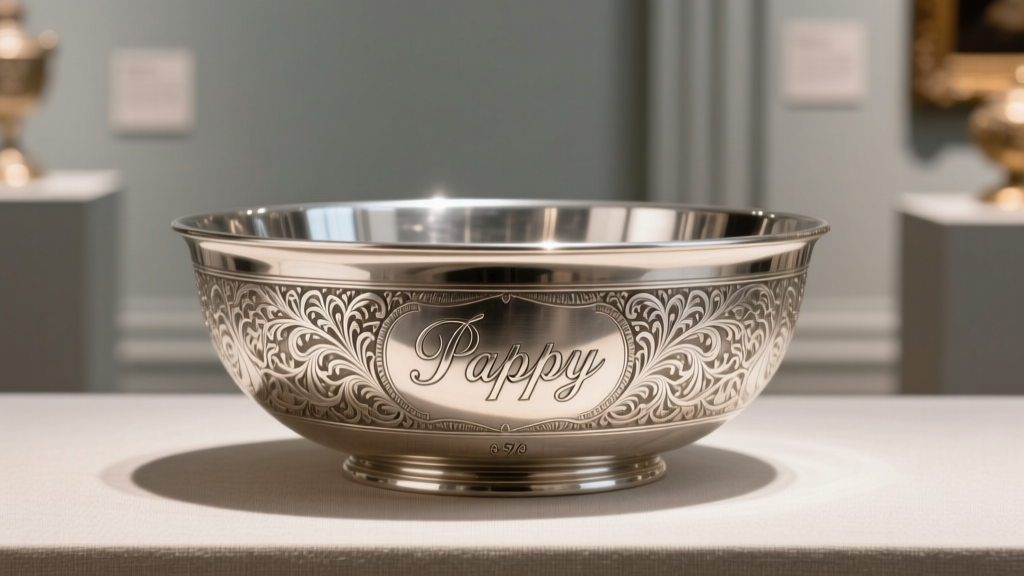
The Silver American Bowl with Chased 'Pappy' Design by Shiebler, Circa 1900: A Masterpiece of Gilded Age Silversmithing
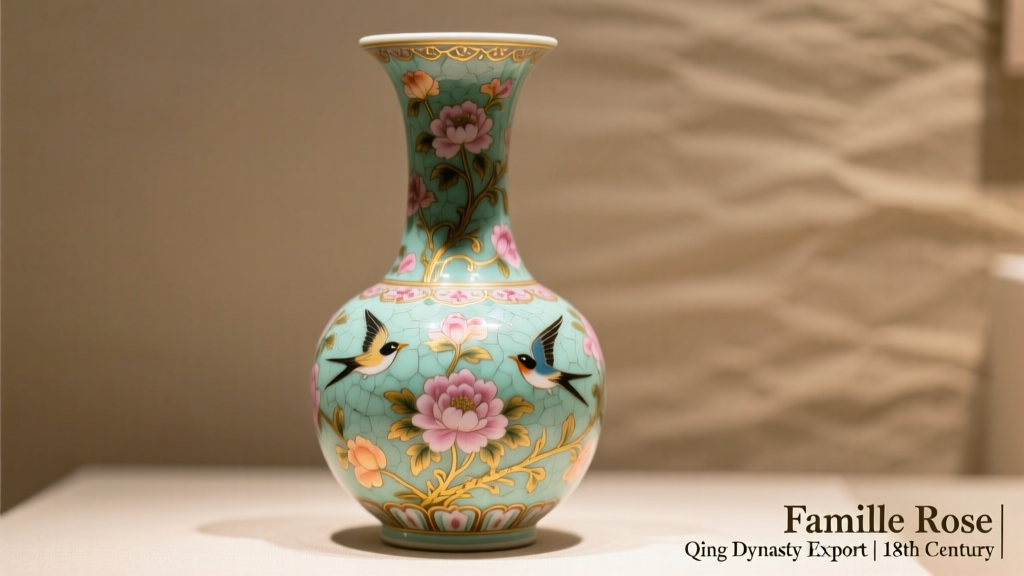
Chinese Export Vase: Bird-and-Floral Famille Rose Baluster Form, c. 1780–1820 — A Connoisseur’s Analysis
Girl Scout Clip Bakelite Brooch, Circa 1940: A Rare Artifact of American Girlhood and Mid-Century Design
Willow Platter, New Wharf Pottery: A Detailed Appraisal of the 11¾-Inch Blue-and-White Serving Dish
Milk Clover Dairy Products: The 1942 Embossed Quart Can — A Rare Artifact of American Home Front Industry and Design
Advertising Label: Coors Export Lager — Golden, Colorado (c. 1958–1963)
Hallmark Silversmiths Inc. No. 2: Identifying, Valuing, and Preserving Mid-Century American Sterling Silver
Deponirt and Patents: Decoding Markings on Vintage Swiss Watches and Jewelry
The Lily Spool Cabinet: A Rare 1920s Advertising Cabinet for Sewing Thread with Slant-Glass Front and 30 Compartments